
Puck, 1878-10-09 · page 3 of 16
Puck — October 9, 1878 — page 3: what you’re looking at
What you’re looking at
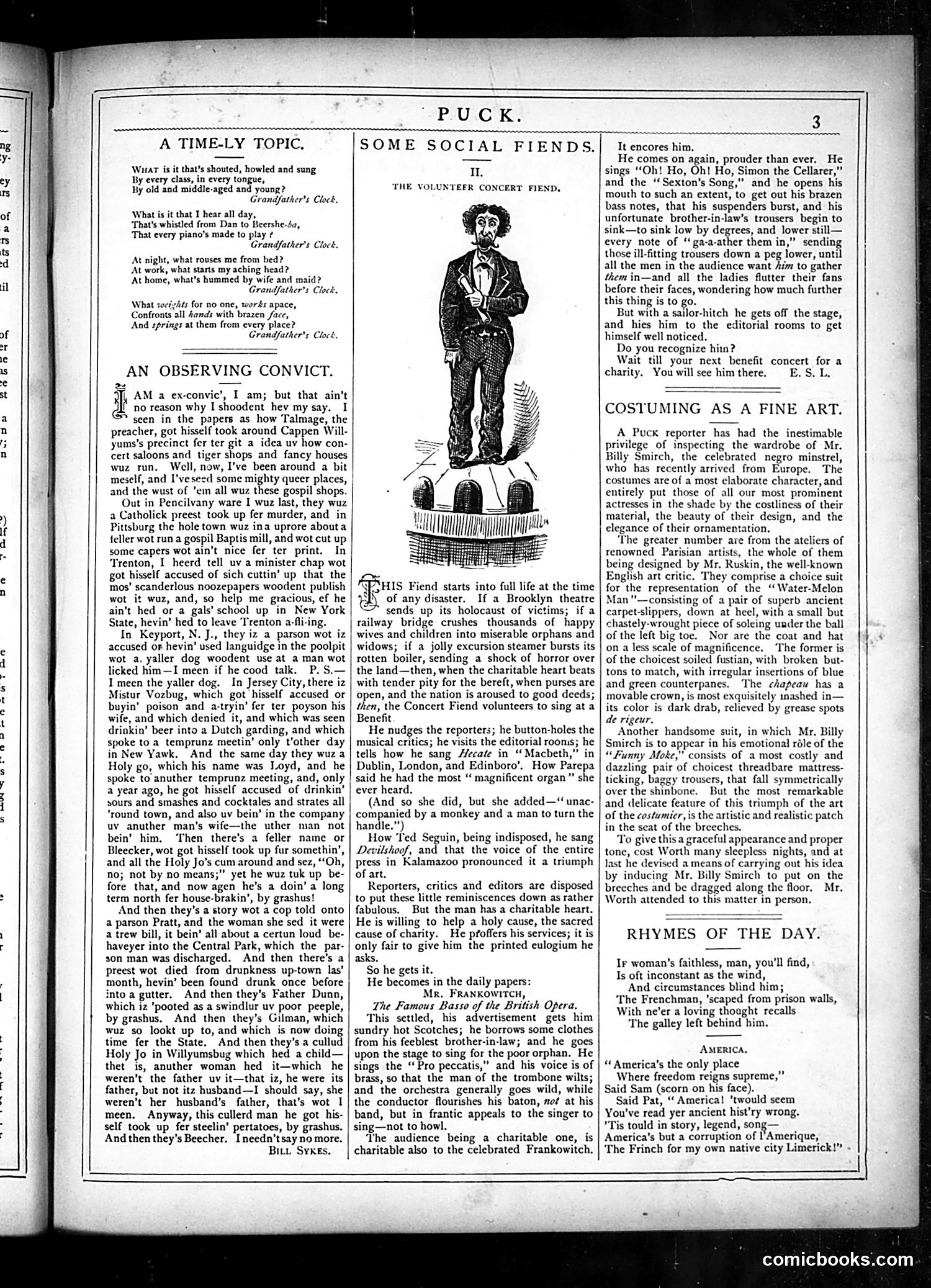
This page contains three distinct pieces of social satire: 1. **"A Time-ly Topic"** (verse): Mocking Grandfather's Clock, a popular song, through parody questions about domestic life's mundane sounds. 2. **"An Observing Convict"** (main article by Bill Sykes): A satirical monologue from an ex-convict's perspective, critiquing American hypocrisy. The speaker observes that criminals are punished harshly while respectable citizens (preachers, judges, politicians) commit sins with impunity—murder, theft, corruption—without consequence. The satire targets moral double standards in society. 3. **The central illustration** shows a man in formal dress standing on a pedestal, likely depicting "The Volunteer Concert Fiend" discussed in the accompanying article about elaborate theatrical costumes and performances. The page's overarching theme: exposing pretense and hypocrisy in American society.
📄 Transcribed text from this page (OCR, searchable)
Machine-transcribed from the original scan — historical spelling and the odd misread are preserved.
pus A TIME-LY TOPIC, Wuar is it that’s shouted, howled and sung By every class, in every tongue, By old and middle-aged and young? Grandfather's Clock. What is it that I hear all day, ‘That's whistled from Dan to Beershe-Ja, That every piano’s made to play ¢ Grandfather's Clock. At night, what rouses me from bed? ‘At work, what starts my aching head? ‘At home, what's hummed by wife and maid? Grandfather's Clock, What wweiyits for no one, works apace, Confronts all hands with brazen face, And springs at them from every place? Grandfather's Clock. AN OBSERVING CONVICT. Bi no reason why I shoodent hey my say. I seen in the papers as how Talmage, the preacher, got hisself took around Cappen Will- yums’s precinct fer ter git a idea uv how con- cert saloons and tiger shops and fancy houses wuz tun. Well, now, I've been around a bit meself, and I'veseed some mighty queer places, Sad the wust of "em all wus these gospil shops. Out in Pencilvany ware I wuz last, they wuz a Catholick preest took up fer murder, and in Pittsburg the hole town wuz ina uprore abouta {eller wot run a gospil Baptis mill, and wot cut up some capers wot ain’t nice fer ter print. In Trenton, I heerd tell uv a minister chap wot got hisself accused of sich cuttin’ up that the mos’ scanderlous noozepapers woodent publish wot it wuz, and, so help me gracious, ef he ain’t hed or a gals’ school up in New York State, hevin’ hed to leave ‘Trenton a-fli-ing. In Keyport, N. J., they iz a parson wot iz accused or hevin’ used languidge in the poolpit wot a. yaller dog woodent use at a man wot licked him—I meen if he cood talk. P. S.. I meen the yaller dog. In Jersey City, there iz Mistur Vozbug, which got hisself accused or buyin’ poison and a-tryin’ fer ter poyson his wife, and which denied it, and which was seen drinkin’ beer into a Dutch garding, and which spoke to a temprunz meetin’ only t’other day in New Yawk. And the same day they wuz a Holy go, which his name was Loyd, and he spoke to anuther temprunz meeting, and, only a year ago, he got hisself accused of drinkin’ sours and smashes and cocktales and strates all "round town, and also uv bein’ in the company uv anuther man’s wife—the uther man not bein’ him, ‘Then there’s a feller name or Bleecker, wot got hisself took up fur somethin’, and all the Holy Jo’s cum around and sez, “Oh, no; not by no means;” yet he wuz tuk up be- fore that, and now agen he’s a doin’ a long term north fer house-brakin’, by grashus! And then they’s a story wot a cop told onto a parson Pratt, and the woman she sed it were a trew bill, it bein’ all about a certun loud be- haveyer into the Central Park, which the par- son man was discharged. And then there’s a preest wot died from drunkness up-town las’ month, hevin’ been found drunk once before into a gutter, And then they’s Father Dunn, which iz 'pooted as a swindlur uv poor peeple, by grashus. And then they’s Gilman, which wuz so lookt up to, and which is now doin; time fer the State, And then they’s a cullu Holy Jo in Willyumsbug which hed a child— thet is, anuther woman hed it—which he weren’t the father uv it—that iz, he were its father, but not itz husband—I should say, she weren’t her husband’s father, that’s wot | meen, Anyway, this cullerd man he got his- self took up fer steelin’ pertatoes, by grashus. And then they’s Beecher. Ineedn’tsay no more. Bite Sykes. AM a ex-convic’, I am; but that ain’t SOME SOCIAL FIENDS. Il. ‘THE VOLUNTEER CONCERT FIEND. \EGHIS Fiend starts into full life at the time h. of any disaster. If a Brooklyn theatre sends up its holocaust of victims; if a railway bridge crushes thousands of happy wives and children into miserable orphans and widows; if a jolly excursion steamer bursts its rotten boiler, sending a shock of horror over the land—then, when the charitable heart beats with tender pity for the bereft, when purses are open, and the nation is aroused to good deeds; then, the Concert Fiend volunteers to sing at a Benefit He nudges the reporters; he button-holes the musical critics; he visits the editorial rooms; he tells how he sang /ecafe in ‘ Macbeth,” in Dublin, London, and Edinboro’. How Parepa said he had the most “ magnificent organ” she ever heard, (And so she did, but she added—“ unac- companied by a monkey and a man to turn the handle.”) How ‘Ted Seguin, being indisposed, he sang Devilshoof, and that the voice of the entire press in Kalamazoo pronounced it a triumph of art. Reporters, critics and editors are disposed to put these little reminiscences down as rather fabulous. But the man has a charitable heart. He is willing to help a holy cause, the sacred cause of charity. He pfoffers his services; it is only fair to give him the printed eulogium he asks. So he gets it. He becomes in the daily papers: Mr. FrankowiTcu, The Famous Basso of the British Opera. This settled, his advertisement gets him sundry hot Scotches; he borrows some clothes from his feeblest brother-in-law; and he goes upon the stage to sing for the poor orphan. He sings the ‘“ Pro peccatis,” and his voice is of brass, so that the man of the trombone wilts; and the orchestra generally goes wild, while the conductor flourishes his baton, nof at his band, but in frantic appeals to the singer to sing—not to howl. The audience being a charitable one, is It encores him. He comes on again, prouder than ever. He sings “Oh! Ho, Oh! Ho, Simon the Cellarer,” and the ‘“Sexton’s Song,” and he opens his mouth to such an extent, to get out his brazen bass notes, that his suspenders burst, and his unfortunate brother-in-law’s trousers begin to sink—to sink low by degrees, and lower still— every note of ‘ga-a-ather them in,” sending those ill-fitting trousers down a peg lower, until all the men in the audience want Aim to gather them in—and all the ladies flutter their fans before their faces, wondering how much further this thing is to go. But with a sailor-hitch he gets off the stage, and hies him to the editorial rooms to get himself well noticed. Do you recognize hit? Wait till your next benefit concert for a charity. You will see him there. E.S. L. COSTUMING AS A FINE ART. A Puck reporter has had the inestimable privilege of inspecting the wardrobe of Mr. Billy Smirch, the celebrated negro minstrel, who has recently arrived from Europe. The costumes are of a most elaborate character, and entirely put those of all our most prominent actresses in the shade by the costliness of their material, the beauty of their design, and the elegance of their ornamentation, The greater number are from the ateliers of renowned Parisian artists, the whole of them being designed by Mr. Ruskin, the well-known English art critic. They comprise a choice suit for the representation of the ‘Water-Melon Man "—consisting of a pair of superb ancient carpet-slippers, down at heel, with a small but chastely-wrought piece of soleing under the ball of the left big toe. Nor are the coat and hat on a less scale of magnificence. ‘The former is of the choicest soiled fustian, with broken but- tons to match, with irregular insertions of blue and green counterpanes. The chapeau has a movable crown, is most exquisitely inashed in— its color is dark drab, relieved by grease spots de rigeur. Another handsome suit, in which Mr. Billy Smirch is to appear in his emotional réle of the “Funny Moke,” consists of a most costly and dazzling pair of choicest threadbare mattress- ticking, baggy trousers, that fall symmetrically over the shinbone. But the most remarkable and delicate feature of this triumph of the art of the costumier, is the artistic and realistic patch in the seat of the breeches, To give this a graceful appearance and proper tone, cost Worth many sleepless nights, and at last he devised a means of carrying out his idea by inducing Mr. Billy Smirch to put on the breeches and be dragged along the floor. Mr. Worth attended to this matter in person. RHYMES OF THE DAY. Ir woman’s faithless, man, you'll find, Is oft inconstant as the wind, And circumstances blind him; ‘The Frenchman, 'scaped from prison walls, With ne’er a loving thoaght recalls The galley left behind him. AMERICA. “ America’s the only place Where freedom reigns supreme,” Said Sam (scorn on his face). Said Pat, ‘‘ America! 'twould seem You've read yer ancient hist'ry wrong. 'Tis tould in story, legend, song— America’s but a corruption of l’Amerique, charitable also to the celebrated Frankowitch, The Frinch for my own native city Limerick!” - comicbooks.com