
A complete issue · 16 pages · 1878
Puck — September 18, 1878
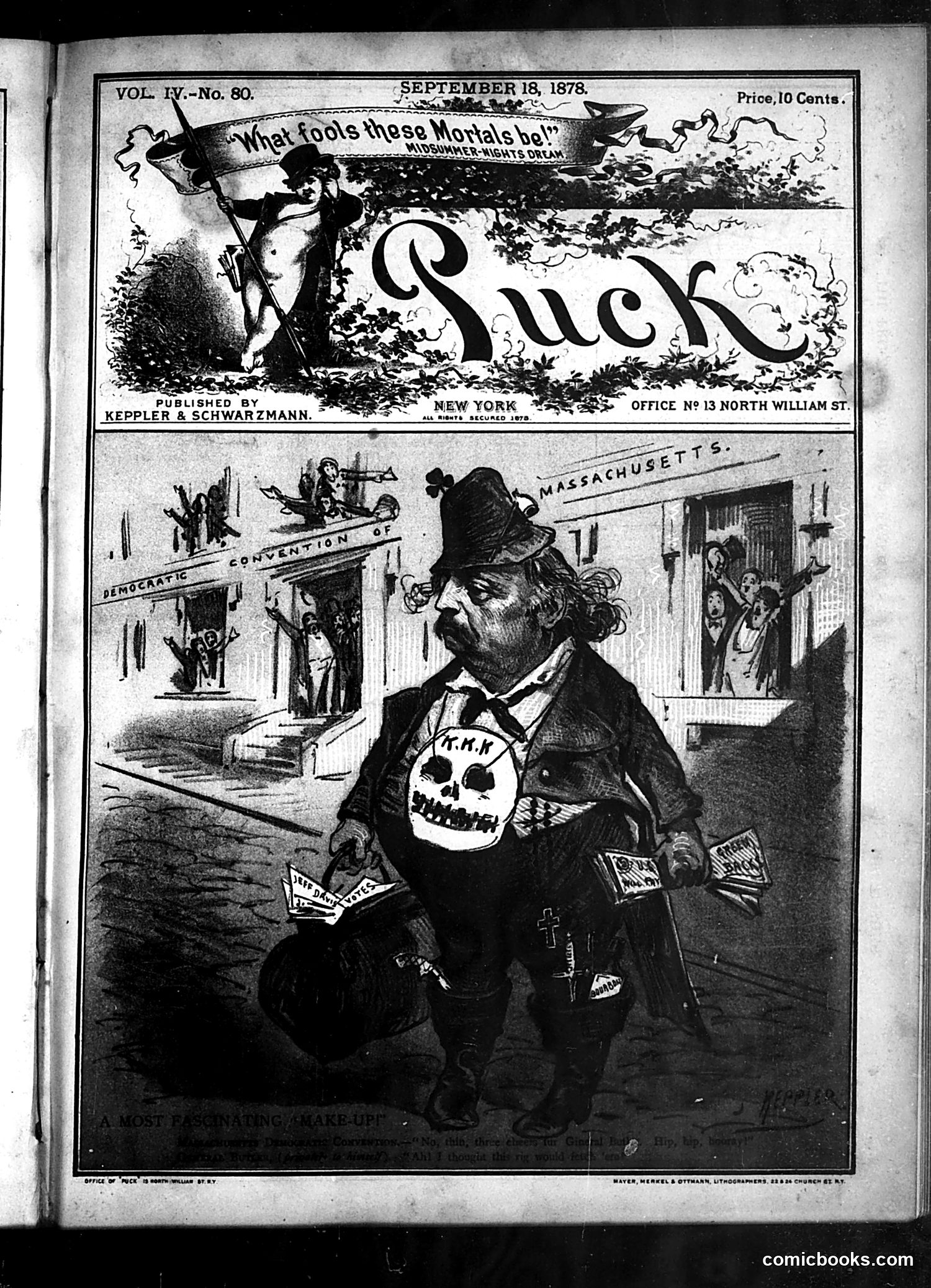
This Puck cover satirizes the 1878 Democratic National Convention in Massachusetts. The central figure appears to be a grotesque caricature wearing a skull-marked chest piece labeled "K.K.K." (Ku Klux Klan), representing Democratic association with white supremacist violence. The figure holds inflammatory materials and stands amid convention imagery showing partisan conflict. The satire criticizes Democrats for their historical ties to racial violence and opposition to Republican Reconstruction policies protecting Black rights. The "make-up" caption suggests the Democrats are masking their true nature. This reflects Republican campaign messaging during the 1878 midterm elections, portraying Democrats as the party of violent racism and sectional division. The crude caricature style and exaggeration were standard for period political attack journalism.
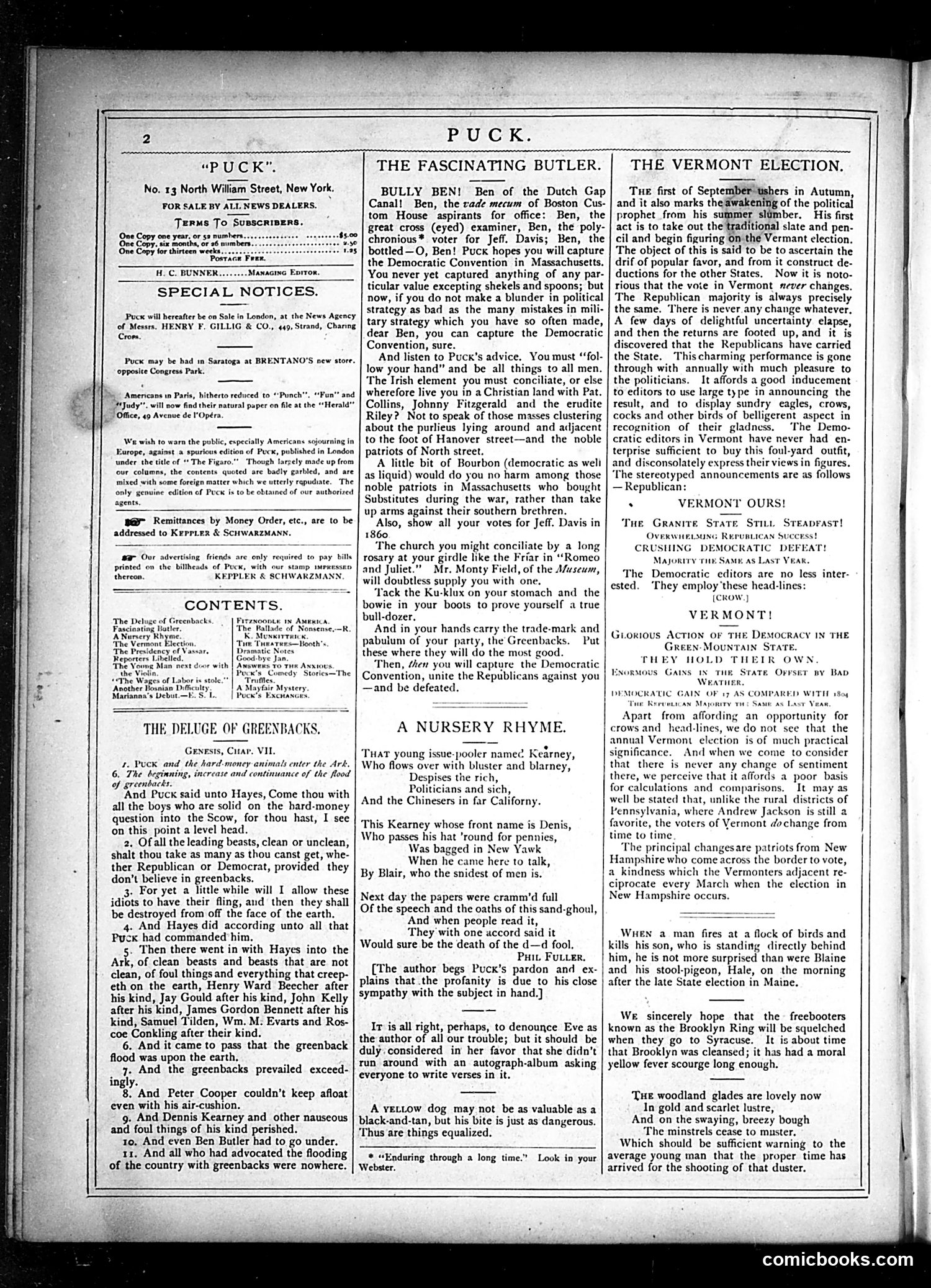
This page contains **three distinct political commentaries** on the 1866 U.S. elections, particularly Vermont's race. **"The Fascinating Butler"** mocks Ben Butler—a Union general and political figure—for his contradictory positions and failed attempt to win the Democratic nomination. The satire suggests his "strategy" is as muddled as his military record. **"The Vermont Election"** celebrates Republican success, portraying the election as a referendum on Reconstruction policy. Republicans won decisively, which Puck frames as voter endorsement of their approach versus Democratic opposition. **"A Nursery Rhyme"** uses satirical verse to ridicule Denis Kearney and California politics, while also lampooning Phil Fuller—appearing to be a minor political figure—with crude humor about his competence. The page reflects Puck's Republican leanings during Reconstruction era debates.
This page contains **no political cartoon**—it's primarily text-based editorial content from Puck magazine. The main article, "The Presidency of Vassar," discusses Samuel L. Caldwell's election as President of Vassar College. The piece critiques the trustees' choice, arguing Caldwell is unqualified and that the college should prioritize women's education over appointing male leadership. It satirizes the decision by questioning whether Caldwell actually understands women's issues or education. Below, "Reporters Libelled" addresses disputes between rival newspapers (the *Sun*, *Herald*, *World*, and *Tribune*) regarding journalistic ethics and accuracy. The section mocks reporters' defensive responses to criticism about fabricated stories and unprofessional conduct. The satire targets institutional mismanagement and journalistic dishonesty rather than specific political figures.
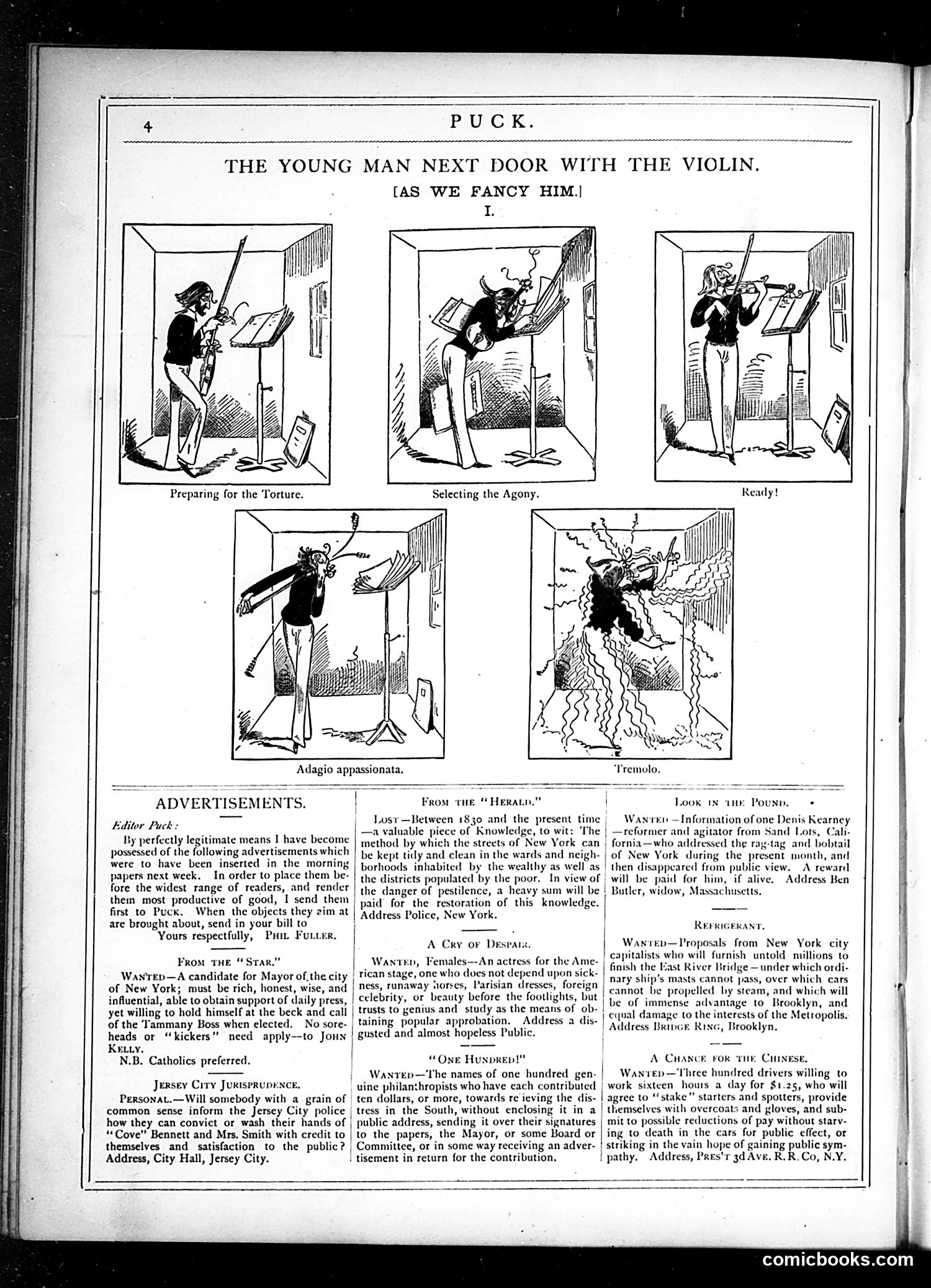
This cartoon satirizes a common urban annoyance: an amateur violinist practicing in close quarters. The five-panel sequence humorously depicts the progression of the musician's torture—both his own and his neighbors'. The panels show him: "Preparing for the Torture," "Selecting the Agony" (choosing which piece to inflict), "Ready!," then "Adagio appassionata" and finally "Tremolo"—the last panel showing the violent effects of his playing with lightning-bolt imagery suggesting the noise's explosive impact. The satire targets the common frustration of apartment dwelling and amateur musicians' obliviousness to their effect on others. The musical terms used mockingly suggest self-important pretension. It's relatable domestic humor playing on shared urban experiences.
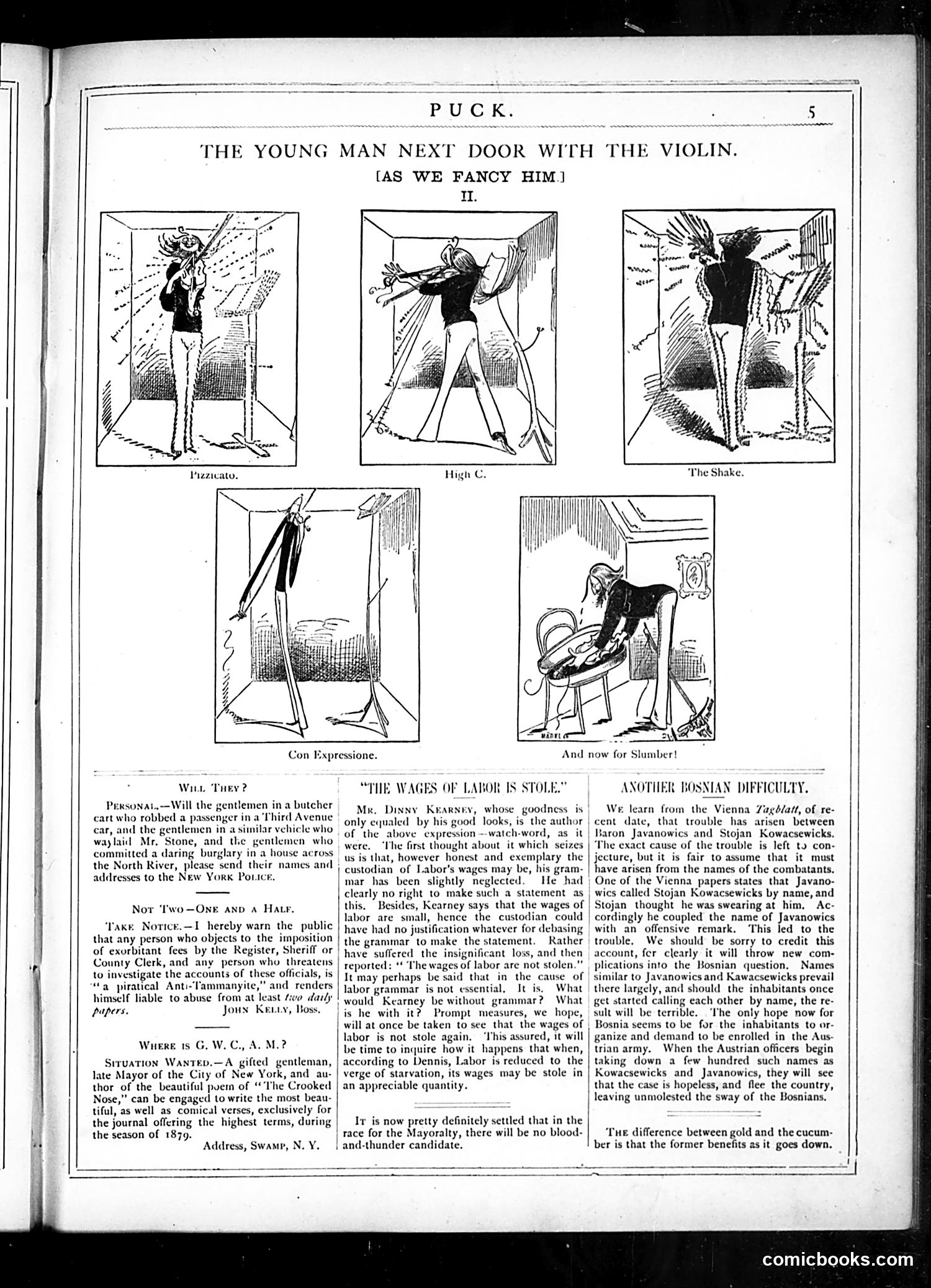
This satirical cartoon series mocks an amateur violinist neighbor through five vignettes labeled "Pizzicato," "High C," "The Shake," "Con Espressione," and "And now for Slumber!" Each depicts increasingly frantic, contorted poses suggesting the young man produces awful sounds while playing. The joke targets the stereotype of enthusiastic but talentless amateur musicians—a common complaint in urban apartment living. The final panel shows him exhausted, humorously implying his neighbors are similarly exhausted by the noise. The accompanying text columns discuss unrelated political/labor issues ("The Wages of Labor is Stole," "Another Bosnian Difficulty"), standard for Puck's mixed-content format.
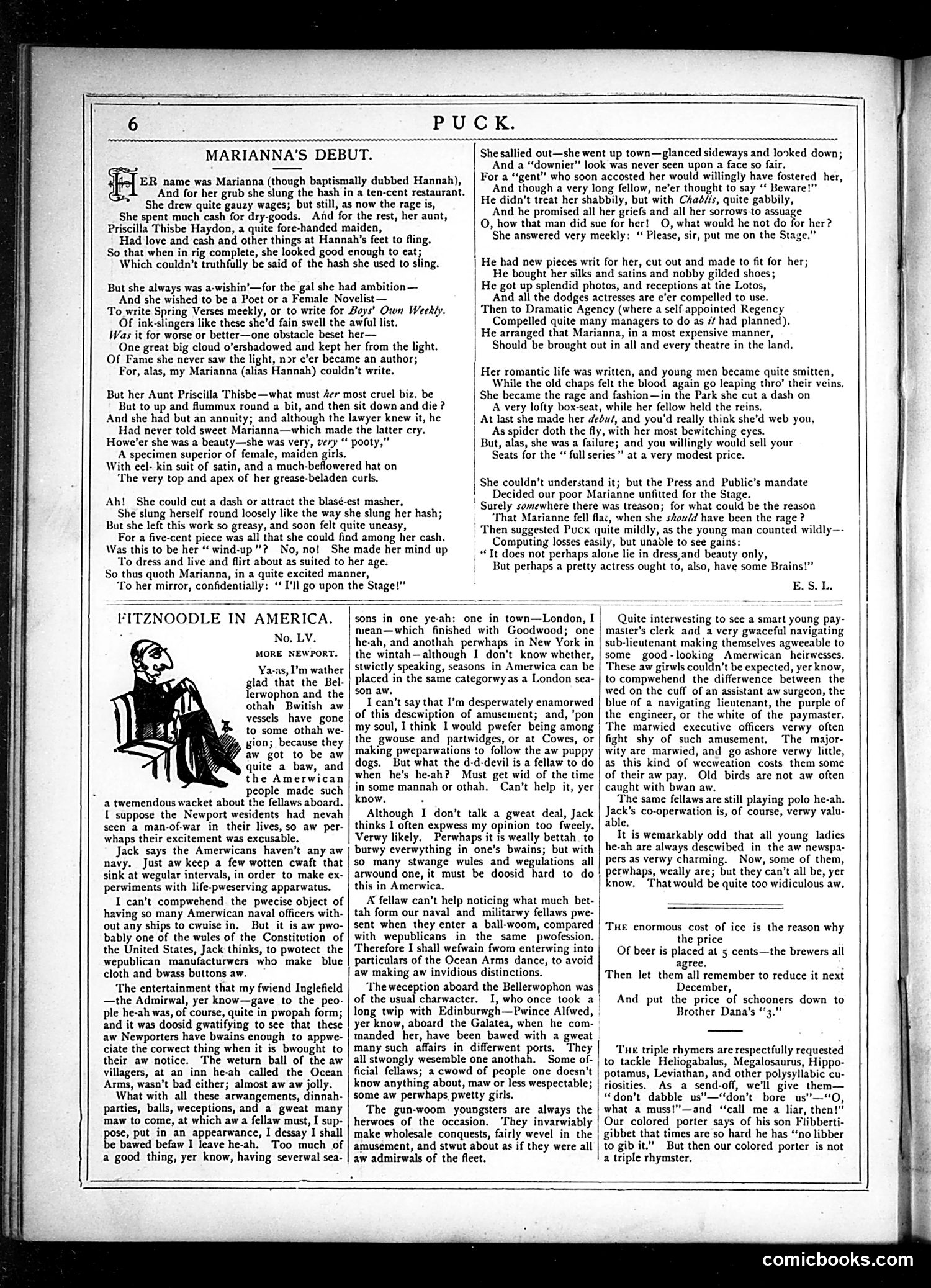
This page contains two distinct pieces: **"Marianna's Debut"** (top): A satirical poem about a young woman named Marianna (baptismally Hannah) who aspires to theatrical success. The piece mocks her ambitions and her aunt Priscilla Thibbe's manipulation of her career. It satirizes the theatrical world's exploitation of young women and the era's gossip press. **"Fitznoodle in America"** (bottom): A humorous essay comparing American and British social customs. The author (identified as "J.O.") contrasts American informality—exemplified by "Jack Fitznoodle"—with British formality, poking fun at both cultures' pretensions and the complications of cross-cultural social interaction. The piece is lighthearted social commentary rather than political satire. Both pieces represent Puck's typical blend of theatrical and social criticism.
This page contains theatrical criticism and society commentary rather than political cartoons. The main content includes: **"The Ballade of Nonsense"** — a poem critiquing romantic theatrical conventions, mocking sentimental love scenes and melodramatic staging popular in contemporary theater. **Dramatic Notes** — brief reviews of current theatrical productions, discussing performances by actresses like Miss Genevieve Ward and Miss Mary Anderson. The critics assess acting quality and plot merit. **"Answers for the Anxious"** — advice column responding to reader questions about practical matters. The page reflects Puck's role as a satirical magazine covering theater, society, and everyday concerns. Rather than political satire, it targets the theatrical establishment's sentimentality and conventional tastes of the era. The tone is sophisticated, urbane commentary aimed at educated readers interested in theater criticism.
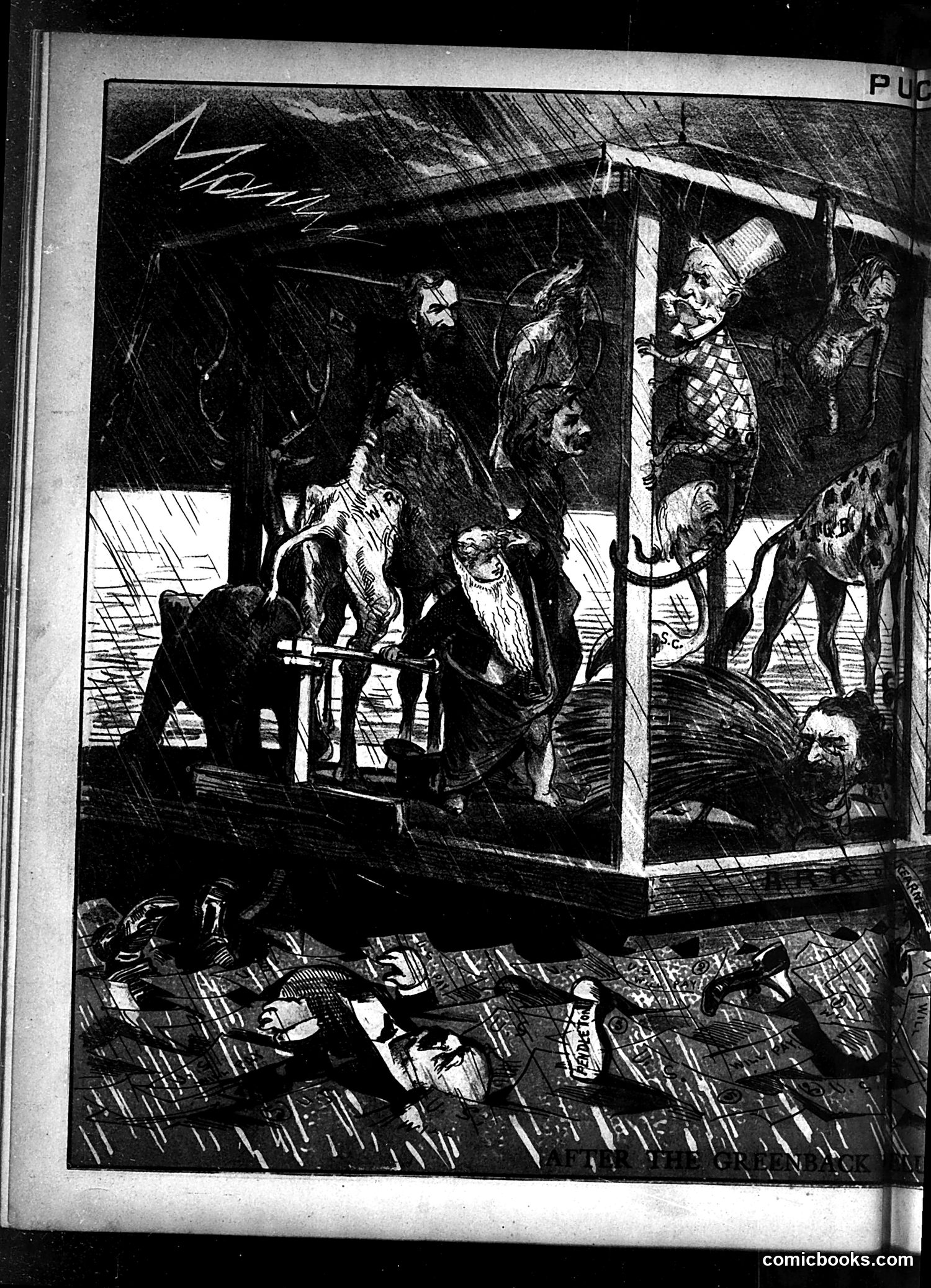
This appears to be a dramatic woodcut or engraving depicting a scene of social upheaval or labor unrest. The image shows multiple figures in what looks like a tent or temporary shelter, with exaggerated, caricatured faces suggesting satirical intent. Some figures appear agitated or confrontational, while others display expressions of distress or anger. The heavy cross-hatching and theatrical composition suggest this is political satire, likely commentary on labor disputes, poverty, or civil unrest common to the Gilded Age when *Puck* was published. However, without visible text identifying specific figures or events, I cannot definitively state which historical incident or political figures are being lampooned. The scene's intensity suggests it addresses a significant contemporary controversy, but the specific reference remains unclear from the image alone.
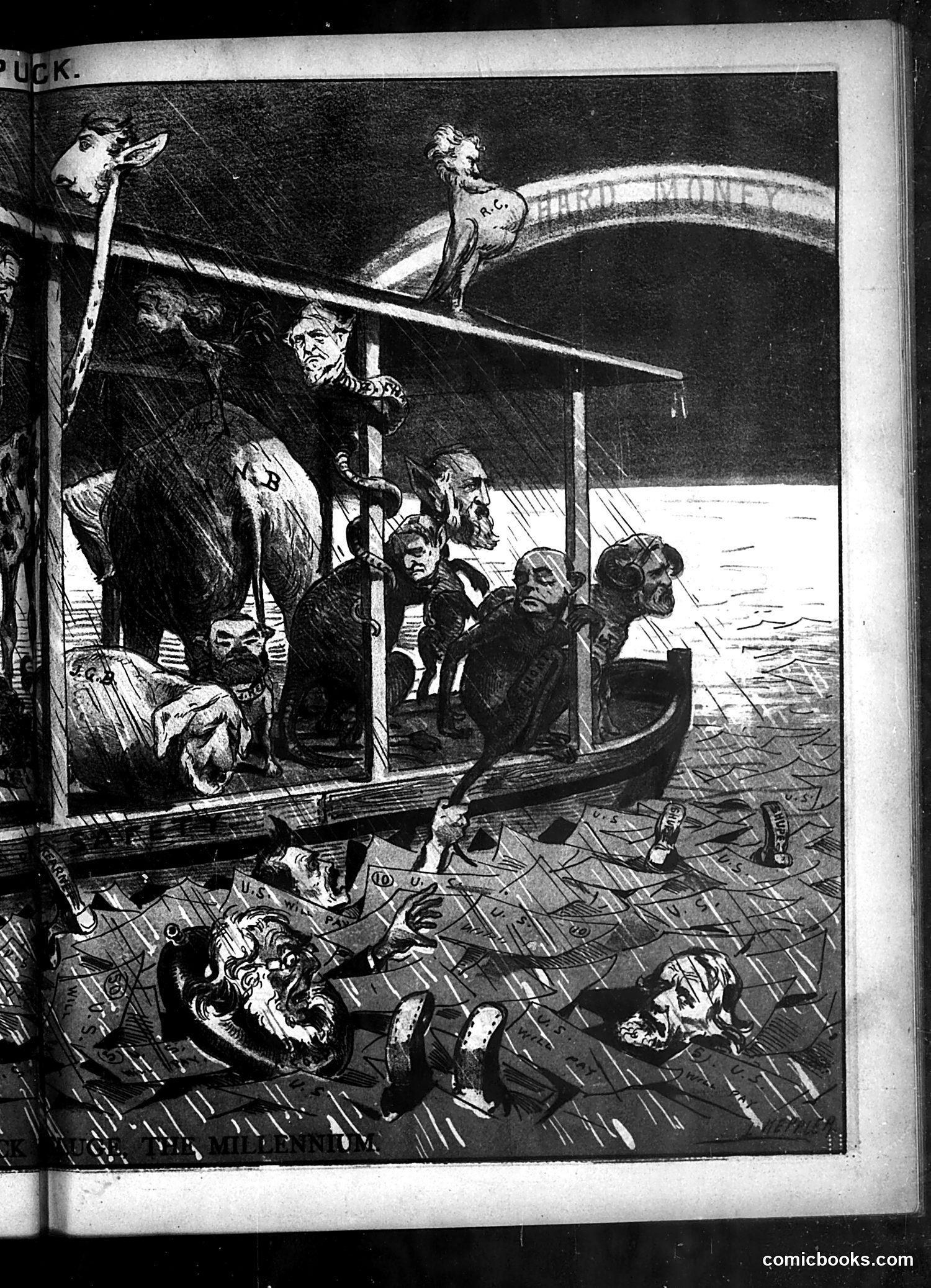
I can see this is a Puck magazine illustration depicting what appears to be a satirical scene on a ship or boat. The image shows multiple figures in period dress (appearing to be 19th century), with animals including what looks like a bear and goats on deck. There's a banner or sign visible that reads "HARD MONEY" (or similar). However, **I cannot reliably identify the specific political figures or read the OCR text clearly enough to confidently explain the cartoon's meaning**. The visual elements suggest commentary on financial policy (the "hard money" reference) and possibly political parties or economic systems being compared to animals or cargo, but without clearer text or identifying features, I cannot definitively explain which historical event, politicians, or debates this satirizes. A clearer image or more legible text would be needed for accurate interpretation.
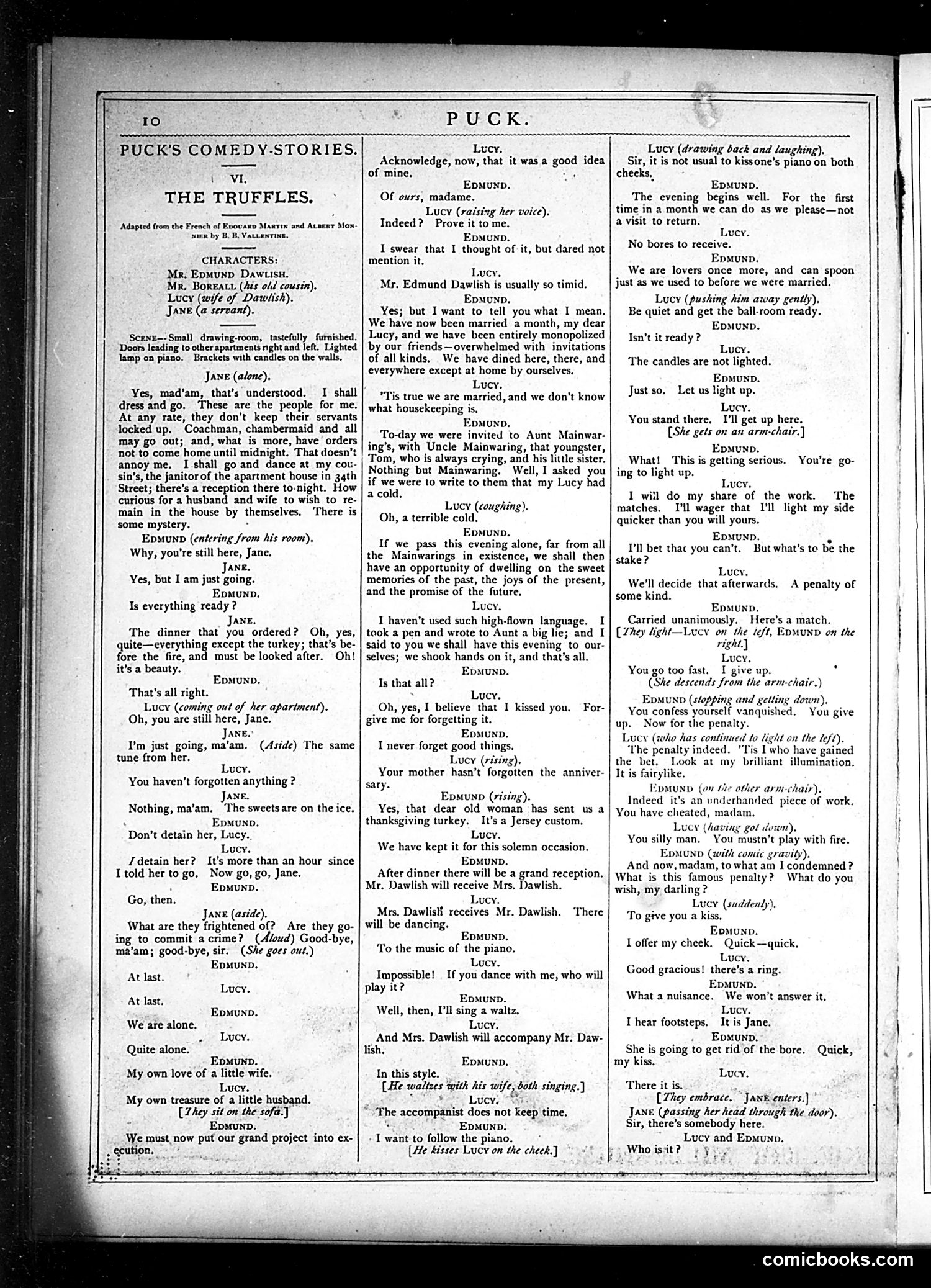
This page from *Puck* magazine contains **"The Truffles," a comedy sketch** rather than a political cartoon. It's a domestic farce adapted from French sources, featuring characters Mr. Edmund Davilish, Mrs. Boreal, and Jane (a servant). The plot concerns a newly married couple overwhelmed by social obligations—constant dinner invitations and entertainments have prevented them from being alone together. The humor derives from **typical Victorian domestic comedy**: the wife's frustration, the husband's timidity, the servant's comic commentary, and the couple's attempts to create private time (notably by lighting the candles and preparing the ballroom for dancing). This represents *Puck's* entertainment content rather than political satire—theatrical humor designed to amuse middle-class readers through relatable marital situations.
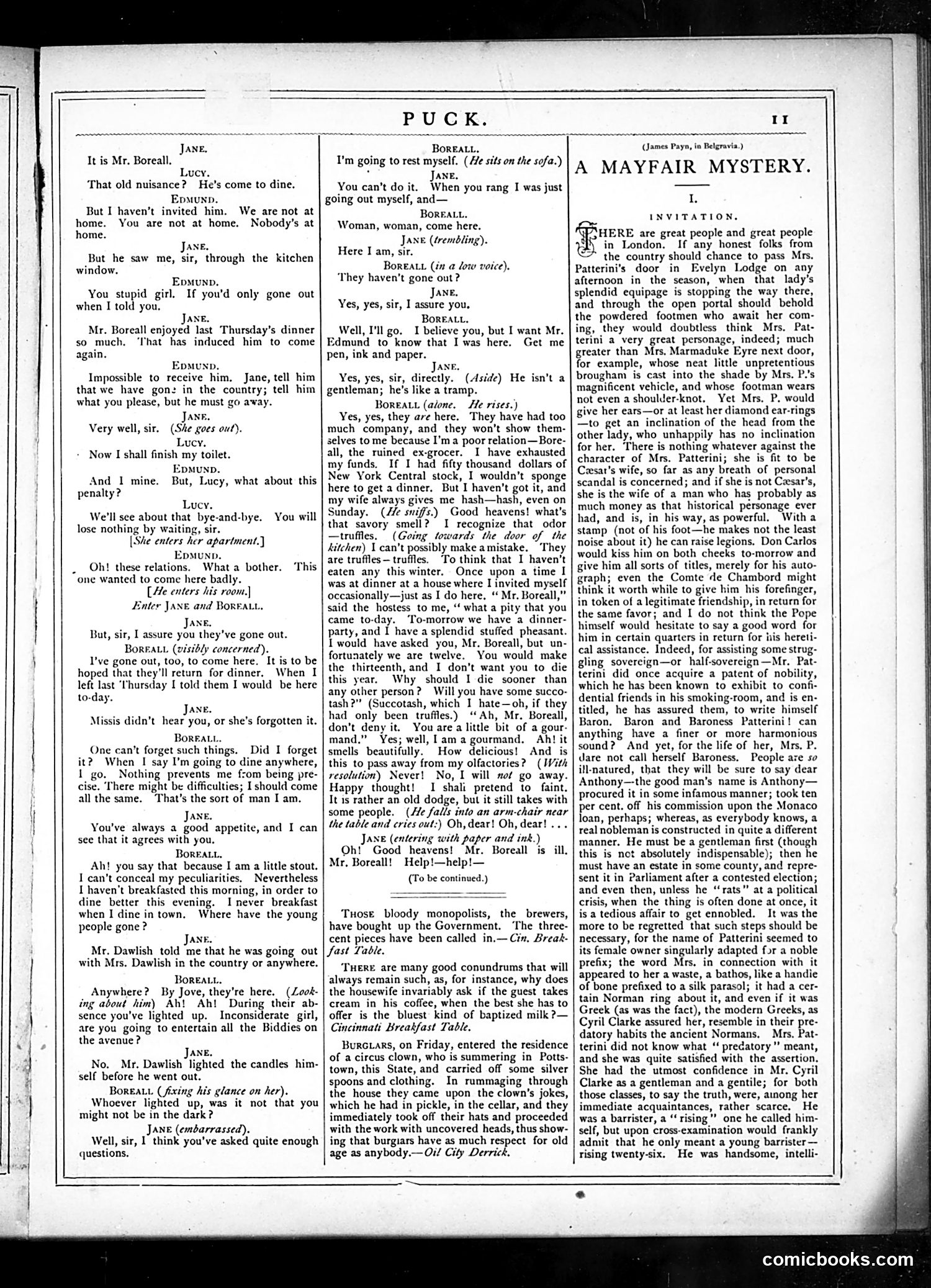
This page contains the opening of a serialized fiction story rather than a political cartoon. The narrative appears to be a drawing-room comedy involving the British upper class (the "Mayfair" setting references London's wealthy neighborhood). The plot involves characters including Mr. Boreall, Jane, Lucy, and Edmund discussing dinner plans and social obligations. References to "powdered footmen," servants, and elaborate domestic arrangements indicate satire of aristocratic pretension and idle society life. The right-hand column includes an editorial section titled "Those Bloody Monopolists," criticizing government monopolies and breweries buying up businesses—a topical economic complaint of the era. The page functions primarily as serialized entertainment fiction with incidental social commentary rather than explicit political satire.
This page is entirely text—a satirical article from Puck magazine with no illustrations or cartoons visible. The piece discusses London high society, focusing on three social classes: aristocracy, wealthy Bohemians, and millionaires. The satire targets the superficiality and materialism of these groups, particularly mocking their pretensions and the role of money in determining social status. The article references a character named Cyril Clarke and his romantic entanglements with someone named Myra, using this narrative to critique how wealth and social climbing override genuine human values in Victorian-era London society. The tone is distinctly satirical, exposing hypocrisy among the upper classes through gossipy, anecdotal storytelling typical of Puck's social commentary.
This page contains satirical humor pieces and small illustrations typical of Puck's miscellaneous commentary section titled "Puck's Persiflage." The main illustrated item, "The Cream of the Bucket," shows a figure in a boat or tub surrounded by water, though the specific satirical target is unclear from the image alone. The text pieces mock various contemporary subjects: incompetent politicians and bureaucrats, wealthy businessmen, social pretensions, and absurd human behavior. References include the Shah of Persia (known for polygamy), grasshoppers destroying crops, and urban scandals. The humor relies on brief, punchy observations about American life, regional stereotypes (Texas, New Orleans), and social hypocrisy—typical of Puck's style attacking establishment figures and foolish behavior without targeting specific named individuals in most entries.
This page is primarily **advertising and satirical commentary**, not a political cartoon. The main content includes: **Satirical pieces** (left column): Short humorous anecdotes mocking Vassar College expenses, pretzel manufacturing, and a Boston girl's request to read "European news" — likely satirizing American ignorance of foreign affairs. **Advertisements** dominate: Apollinaris mineral water ("Queen of Table Waters"), compressed yeast, a photographer, dress goods, dental services, and other products typical of 1890s-era publications. **The Hunyadi János ad** (top right) promotes a Hungarian laxative as a "natural aperient." The page reflects **Gilded Age consumer culture** and light social satire rather than serious political commentary. The humor targets everyday American life — college finances, manufacturing processes, and cultural pretension — typical of Puck's satirical approach.
This appears to be primarily an **advertising page from Puck magazine** rather than a satirical cartoon page. The layout contains numerous commercial advertisements for products and services available in late 19th-century New York City, including: - Vienna Coffee Pots and umbrellas - Champagne and wine importers - Furniture dealers - A tailor's shop - The Louisiana State Lottery The only editorial content visible is **"Puck's Almanac for 1878"** (a small box advertising the publication itself) and a notice about **patent covers for filing Puck**. The page serves as a back-cover advertising section, with Puck's publisher contact information at the bottom. It documents commercial life in 1870s New York but contains no political satire or recognizable caricatures of public figures.
This political cartoon from Puck magazine depicts a chaotic scene titled "Grand Democratic Bribe for 1896." The image shows numerous figures engaged in frenzied activity around a large wheel or mechanism, suggesting corruption and bribery within Democratic Party operations. The cartoon satirizes the 1896 election by portraying Democratic politicians and operatives as scrambling for bribes and patronage rewards. Various figures appear to be competing for attention or advantage, with papers and money scattered throughout the composition. The "wheel" likely represents the party machine itself, grinding away while politicians jostle for position. The satire suggests the Democratic Party during this election cycle was rife with corruption and self-interested dealings rather than principled governance. Without clearer labels identifying specific individuals, the cartoon functions as general criticism of Democratic electoral practices during the 1896 campaign.