
Puck, 1878-09-18 · page 7 of 16
Puck — September 18, 1878 — page 7: what you’re looking at
What you’re looking at
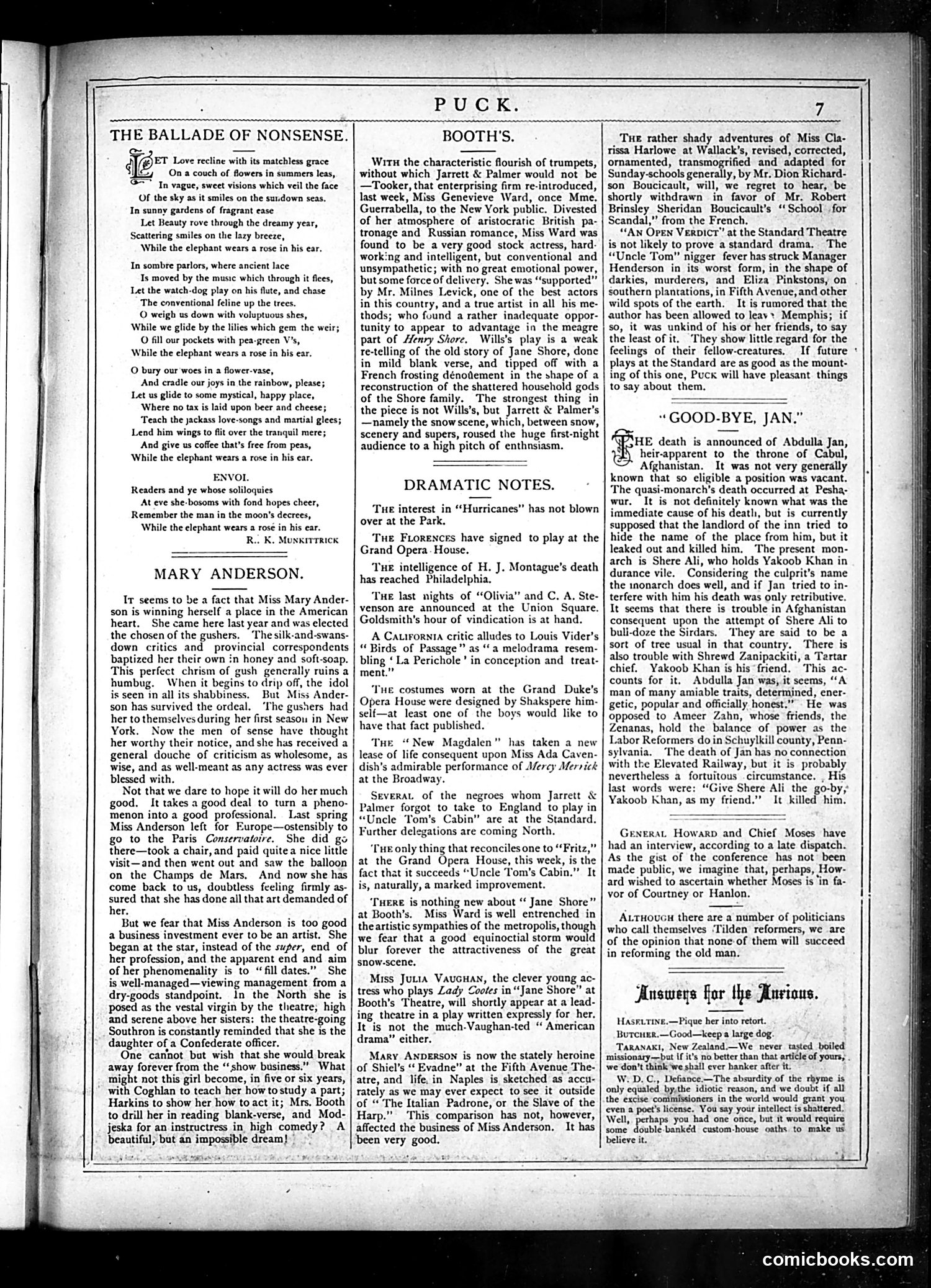
This page contains theatrical criticism and society commentary rather than political cartoons. The main content includes: **"The Ballade of Nonsense"** — a poem critiquing romantic theatrical conventions, mocking sentimental love scenes and melodramatic staging popular in contemporary theater. **Dramatic Notes** — brief reviews of current theatrical productions, discussing performances by actresses like Miss Genevieve Ward and Miss Mary Anderson. The critics assess acting quality and plot merit. **"Answers for the Anxious"** — advice column responding to reader questions about practical matters. The page reflects Puck's role as a satirical magazine covering theater, society, and everyday concerns. Rather than political satire, it targets the theatrical establishment's sentimentality and conventional tastes of the era. The tone is sophisticated, urbane commentary aimed at educated readers interested in theater criticism.
📄 Transcribed text from this page (OCR, searchable)
Machine-transcribed from the original scan — historical spelling and the odd misread are preserved.
PUCK. 7 THE BALLADE OF NONSENSE. q) (ert Love recline with its matchless grace K On a couch of flowers in summers leas, In vague, sweet visions which veil the face Of the sky as it smiles on the sundown seas. In sunny gardens of fragrant ease Let Beauty rove through the dreamy year, Scattering smiles on the lazy breeze, While the elephant wears a rose in his ear. = In sombre parlors, where ancient lace Is moved by the music which through it flees, Let the watch-dog play on his flute, and chase The conventional feline up the trees. © weigh us down with voluptuous shes, While we glide by the lilies which gem the weir; fill our pockets with pea-green V's, While the elephant wears a rose in his ear. bury our woes in a flower-vase, And cradle our joys in the rainbow, please; Let us glide to some mystical, happy place, ‘Where no tax is laid upon beer and cheese; ‘Teach the jackass love-songs and martial glees; Lend him wings to flit over the tranquil mere; And give us coffee that’s free from peas, While the elephant wears a rose in his ear. ENVOIL. Readers and ye whose soliloquies At eve she-bosoms with fond hopes cheer, Remember the man in the moon's decrees, While the elephant wears a rosé in his ear. MARY ANDERSON. Ir seems to be a fact that Miss Mary Ander- son is winning herself a place in the American heart. She came here last year and was elected the chosen of the gushers. ‘The silk-and-swans- down critics and provincial correspondents baptized her their own in honey and soft-soap. This perfect chrism of gush gencrally ruins a humbug. When it begins to drip off, the idol is seen in all its shabbiness. But Miss Ander- son has survived the ordeal. ‘The gushers had her to themselves during her first season in New York. Now the men of sense have thought her worthy their notice, and she has received a general douche of criticism as wholesome, as wise, and as well-meant as any actress was ever blessed with, Not that we dare to hope it will do her much good. It takes a good deal to turn a pheno- menon into a good professional. Last spring Miss Anderson left for Europe—ostensibly to go to the Paris Conservatoire. She did go there—took a chair, and paid quitea nice little visit—and then went out and saw the balloon on the Champs de Mars, And now she has come back to us, doubtless feeling firmly as- sured that she has done all that art demanded of her. But we fear that Miss Anderson is too good a business investment ever to be an artist. She began at the star, instead of the super, end of her profession, and the apparent end and aim of her phenomenality is to “fill dates.” She is well-managed—viewing management from a dry-goods standpoint. In the North she is posed as the vestal virgin by the theatre, high and serene above her sisters: the theatre-going Southron is constantly reminded that she is the daughter of a Confederate officer. One cannot but wish that she would break away forever from the “show busin What might not this girl become, in five or six years, with Coghlan to teach her how to study a part; Harkins to show her how to act it; Mrs. Booth to drill her in reading blank-verse, and Mod- jeska for an instructress in high comedy? A beautiful, but an impossible dream} ° BOOTH'S. Wrru the characteristic flourish of trumpets, without which Jarrett & Palmer would not be —Tooker, that enterprising firm re-introduced, last week, Miss Genevieve Ward, once Mme, Guerrabella, to the New York public. Divested of her atmosphere of aristocratic British pa- tronage and Russian romance, Miss Ward was found to be a very good stock actress, hard- working and intelligent, but conventional and unsympathetic; with no great emotional power, but some force of delivery. She was “supported” by Mr. Milnes Levick, one of the best actors in this country, and a true artist in all his me- thods; who found a rather inadequate oppor- tunity to appear to advantage in the meagre part of Henry Shore. Wills's play is a weak re-telling of the old story of Jane Shore, done in mild blank verse, and tipped off with a French frosting dénofement in the shape of a reconstruction of the shattered household gods of the Shore family. The strongest thing in the piece is not Wills’s, but Jarrett & Palmer’s —namely the snow scene, which, between snow, scenery and supers, roused the huge first-night audience to a high pitch of enthnsiasm. DRAMATIC NOTES. Tue interest in “Hurricanes” has not blown over at the Park, ‘Tue Frorences have signed to play at the Grand Opera. House. ‘Tue intelligence of H. J. Montague’s death has reached Philadelphia. ‘Tue last nights of “Olivia” and C. A. Ste- venson are announced at the Union Square. Goldsmith’s hour of vindication is at hand. A Cauirornta critic alludes to Louis Vider’s “ Birds of Passage” as “a melodrama resem- bling ‘La Perichole’ in conception and treat- ment.” ‘THe costumes worn at the Grand Duke's Opera House were designed by Shakspere him- self—at least one of the boys would like to have that fact published. THe “New Magdalen” has taken a new lease of life consequent upon Miss Ada Caven- dish’s admirable performance of Mercy Merrick at the Broadway. Severat of the negroes whom Jarrett & Palmer forgot to take to England to play in “Uncle Tom's Cabin” are at the Standard. Further delegations are coming North. ‘Tue only thing that reconciles one to “Fritz,” at the Grand Opera House, this week, is the fact that it succeeds “Uncle Tom's Cabin.” It is, naturally, a marked improvement. ‘Tere is nothing new about “ Jane Shore” at Booth’s. Miss Ward is well entrenched in the artistic sympathies of the metropolis, though we fear that a good equinoctial storm would blur forever the attractiveness of the great snow-scene, Miss Jutta Vaucuan, the clever young ac- tress who plays Lady Cootes in“Jane Shore” at Booth's Theatre, will shortly appear at a lead- ing theatre in a play written expressly for her. It is not the much-Vaughan-ted “ American drama” either. Mary ANpERSON is now the stately heroine of Shiel’s ‘ Evadne” at the Fifth Avenue The- atre, and life, in Naples is sketched as accu- rately as we may ever expect to see it outside of “ The Italian Padrone, or the Slave of the Harp.” This comparison has not, however, affected the business of Miss Anderson. It has been very good. ‘Tue rather shady adventures of Miss Cla- rissa Harlowe at Wallack’s, revised, corrected, ornamented, transmogrified and adapted for Sunday-schools generally, by Mr. Dion Richard- son Boucicault, will, we regret to hear, be shortly withdrawn in favor of Mr. Robert Brinsley Sheridan Boucicault’s ‘“ School for Scandal,” from the French, “(An Open Verpicr” at the Standard Theatre is not likely to prove a standard drama, The “Uncle Tom" nigger fever has struck Manager Henderson in its worst form, in the shape of darkies, murderers, and Eliza Pinkstons, on southern plantations, in Fifth Avenue, and other wild spots of the earth, It is rumored that the author has been allowed to leav: Memphis; if so, it was unkind of his or her friends, to say the least of it. They show little regard for the feelings of their fellow-creatures. If future * plays at the Standard are as good as the mount- ing of this one, Puck will have pleasant things to say about them. “GOOD-BYE, JAN.” HE death is announced of Abdulla Jan, heir-apparent to the throne of Cabul, Afghanistan. It was not very generally known that so eligible a position was vacant. The quasi-monarch’s death occurred at Pesha- wur. It is not definitely known what was the immediate cause of his death, but is currently supposed that the landlord of the inn tried to hide the name of the place from him, but it leaked out and killed him, The present mon- arch is Shere Ali, who holds Yakoob Khan in durance vile. Considering the culprit’s name the inonarch does well, and if Jan tried to in- terfere with him his death was only retributive. It seems that there is trouble in Afghanistan consequent upon the attempt of Shere Ali to buli-doze the Sirdars. ‘hey are said to be a sort of tree usual in that country, There is also trouble with Shrewd Zanipackiti, a Tartar chief. Yakoob Khan is his friend. This ac- counts for it, Abdulla Jan was, it seems, ‘A man of many amiable traits, determined, ener- getic, popular and officially honest.” He was opposed to Ameer Zahn, whose friends, the Zenanas, hold the balance of power as the Labor Reformers do in Schuylkill county, Penn- sylvania. The death of Jan bas no connection with the Elevated Railway, but it is probably nevertheless a fortuitous .circumstance. , His last words were: “Give Shere Ali the go-by, Yakoob Khan, as my friend.”’ It killed him. Generat. Howarp and Chief Moses have had an interview, according to a late dispatch. As the gist of the conference has not been made public, we imagine that, perhaps, How- ard wished to ascertain whether Moses is ‘in fa- vor of Courtney or Hanlon. ALTHOUGH there are a number of politicians who call themselves ‘Tilden reformers, we are of the opinion that none-of them will succeed in reforming the old man. Ausweys for the Anvious. Pique her into retort. d—keep a large dog. Taranaki, New Zealand.—We never tasted boiled missionary—but if it’s no better than that article of yours, we don’t think ‘we shall ever hanker after it. W. D.C., Defiance —The absurdity of the rhyme is only equaled by,the idiotic reason, and we doubt if all the excise conimissioners in the world would grant you even a poet's license. You say your intellect is shattered, Well, perhaps you had one once, but it would require some double-bankéd custom-house oaths to make us believe it. comicbooks.com