
Puck, 1878-09-18 · page 11 of 16
Puck — September 18, 1878 — page 11: what you’re looking at
What you’re looking at
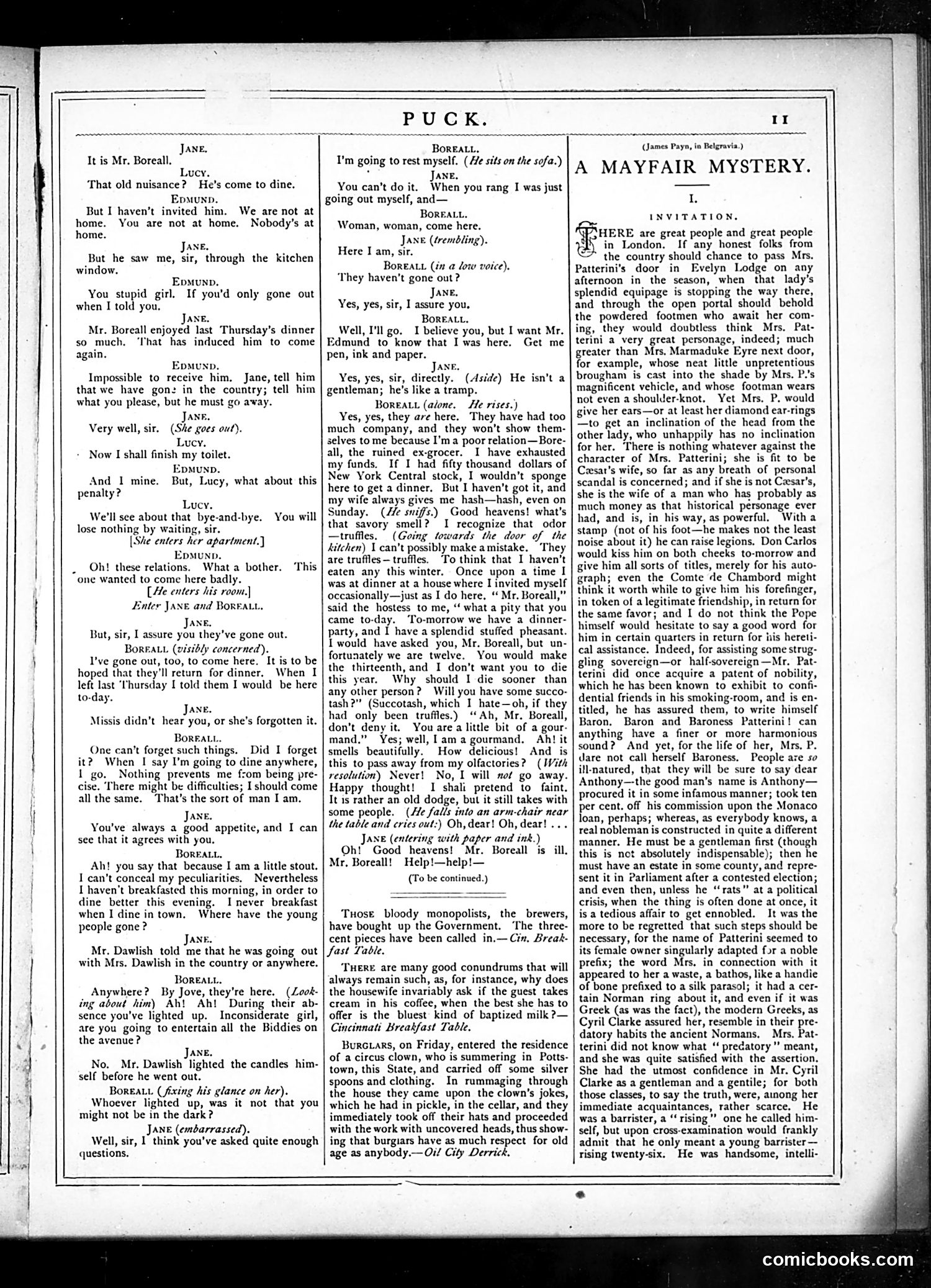
This page contains the opening of a serialized fiction story rather than a political cartoon. The narrative appears to be a drawing-room comedy involving the British upper class (the "Mayfair" setting references London's wealthy neighborhood). The plot involves characters including Mr. Boreall, Jane, Lucy, and Edmund discussing dinner plans and social obligations. References to "powdered footmen," servants, and elaborate domestic arrangements indicate satire of aristocratic pretension and idle society life. The right-hand column includes an editorial section titled "Those Bloody Monopolists," criticizing government monopolies and breweries buying up businesses—a topical economic complaint of the era. The page functions primarily as serialized entertainment fiction with incidental social commentary rather than explicit political satire.
📄 Transcribed text from this page (OCR, searchable)
Machine-transcribed from the original scan — historical spelling and the odd misread are preserved.
Jane. It is Mr. Boreall. Lucy. That old nuisance? He’s come to dine. Epwunp. But I haven’t invited him. We are not at home. You are not at home. Nobody’s at home. Jane. But he saw me, sir, through the kitchen window. Epmunp. You stupid girl. If you'd only gone out when I told you. Jane. Mr. Boreal enjoyed last Thursday's dinner so much, ‘That has induced him to come again. Eps Impossible to receive him. Jane, tell him that we have gonz in the country; tell him what you please, but he must go away. Be Very well, sir. (She goes out). Lucy. Now I shall finish my toilet. Epmunp. And 1 mine. But, Lucy, what about this penalty? Lucy. We'll sce about that bye-and-bye. lose nothing by waiting, sir. [She enters her apartment.) EDMUND. Oh! these relations. What a bother. one wanted to come here badly. [He enters his room. Enter Janet. and BORFALL, You will This Jane. But, sir, I assure you they’ve gone out. Borratt (visibly concerned). I’ve gone out, too, to come here. It is to be hoped that they'll return for dinner, When I left last ‘Mhursday I told them I would be here to-day. Jane. Missis didn’t hear you, or she’s forgotten it. BorFatt. One can’t forget such things. Did I forget it? When I say I’m going to dine anywhere, 1 go. Nothing prevents me f:om being pre- cise. There might be difficulties; I should come all the same. That’s the sort of man I am. JANE. You've always a good appetite, and I can see that it agrees with you, Boreat., Ah! you say that because I am a little stout. I can't conceal my peculiarities. Nevertheless IL haven't breakfasted this morning, in order to dine better this evening. I never breakfast when I dine in town, Where have the young people gone ? JANE. Mr. Dawlish told me that he was going out with Mrs. Dawlish in the country or anywhere. Boreaut.. Anywhere? By Jove, they’re here. (Look- ing about him) Ah! Ah! During their ab- sence you've lighted up. Inconsiderate girl, are you going to entertain all the Biddies on the avenue ? Jane. No. Mr. Dawlish lighted the candles him- self before he went out. Boreauu (fixing his glance on her). Whoever lighted up, was it not that you might not be in the dark? Jane (embarrassed). Well, sir, I think you've asked quite enough questions. — II BorEALL. I'm going to rest myself. (He sits on the sofa.) : JANE. You can’t do it. When you rang I was just going out myself, and— BorFALL. Woman, woman, come here. Jane (drembling). Here I am, sir. Boreaut (in a low voice). ‘They haven't gone out? Jane. Yes, yes, sir, ] assure you, BorEALL. Well, I'll go. I believe you, but I want Mr. Edmund to know that I was here. Get me pen, ink and paper. ANE, Yes, yes, sir, directly. (Aside) He isn't a gentleman; he’s like a tramp. Boreatt (alone. He rises.) Yes, yes, they are here. They have had too much company, and they won't show them- selves to me because I'm a poor relation—Bore- all, the ruined ex-grocer. I have exhausted my funds. If I had fifty thousand dollars of New York Central stock, I wouldn't sponge here to get a dinner. But I haven't got it, and my wife always gives me hash—hash, even on Sunday. (/7e sniffs.) Good heavens! what's that savory smell? I recognize that odor —truffles. (Going towards the door of the kitchen) 1 can’t possibly make a mistake. ‘They are truffles—truffles. To think that I haven't eaten any this winter. Once upon a time I was at dinner at a house where I invited myself occasionally—just as I do here. “ Mr. Boreall,” said the hostess to me, ‘ what a pity that you came to-day. ‘To-morrow we have ‘a dinner- party, and I have a splendid stuffed pheasant. I would have asked you, Mr. Boreall, but un- fortunately we are twelve. You would make the thirteenth, and I don’t want you to die this year. Why should I die sooner than any other person? Will you have some succo- tash?"” (Succotash, which I hate—oh, if they had only been truffles.) “Ah, Mr. Boreall, don’t deny it. You area little bit of a gour- mand.” Yes; well, Lama gourmand, Ah! it smells beautifully. How delicious! And is this to pass away from my olfactories? (With resolution) Never! No, I will not go away. Happy thought! I shali pretend to faint. Itis rather an old dodge, but it still takes with some people. the table and cries out:) Oh, dear! Oh, dear! ... Jane (entering with paper and ink.) Oh! Good heavens! Mr. Boreall is ill. Mr, Boreall! Help!—help!— (To be continued.) Tuose bloody monopolists, the brewers, have bought up the Government. ‘The three- cent pieces have been called in.— Cin, Break- fast Table. ‘Tere are many good conundrums that will always remain such, as, for instance, why does the housewife invariably ask if the guest takes cream in his coffee, when the best she has to offer is the bluest kind of baptized milk ?— Cincinnati Breakfast Table. Burccars, on Friday, entered the residence of a circus clown, who is summering in Potts- town, this State, and carried off some silver spoons and clothing. In rummaging through the house they came upon the clown’s jokes, which he had in pickle, in the cellar, and they immediately took off their hats and proceeded with the work with uncovered heads, thus show- ing that burgiars have as much respect for old age as anybody.— Oi? City Derrick. (He falls into an arm-chair near (James Payn, in Belgravia.) A MAYFAIR MYSTERY. Ll INVITATION, HERE are great people and great people Sf) in London. If any honest folks from 7 the country should chance to pass Mrs. Patterini’s door in Evelyn Lodge on any afternoon in the season, when that lady’s splendid equipage is stopping the way there, and through the open portal should behold the powdered footmen who await her com- ing, they would doubtless think Mrs. Pat- terini a very great personage, indeed; much greater than Mrs. Marmaduke Eyre next door, for example, whose neat little unpretentious brougham is cast into the shade by Mrs. P.’s magnificent vehicle, and whose footman wears not even a shoulder-knot, Yet Mrs. P. would give her ears—or at least her diamond ear-rings —to get an inclination of the head from the other lady, who unhappily has no inclination for her. There is nothing whatever against the character of Mrs. Patterini; she is fit to be Crsat's wife, so far as any breath of personal scandal is concerned; and if she is not Czsar’s, she is the wife of a man who has probably as much money as that historical personage ever had, and is, in his way, as powerful. With a stamp (not of his foot—he makes not the least noise about it) he can raise legions. Don Carlos would kiss him on both cheeks to-morrow and give him all sorts of titles, merely for his auto- graph; even the Comte de Chambord might think it worth while to give him his forefinger, in token of a legitimate friendship, in return for the same favor; and I do not think the Pope himself would hesitate to say a good word for him in certain quarters in return for his hereti- cal assistance. Indeed, for assisting some strug- gling sovercign—or half-sovereign—Mr. Pat- terini did once acquire a patent of nobility, which he has been known to exhibit to confi- dential friends in his smoking-room, and is en- titled, he has assured them, to write himself Baron. Baron and Baroness Patterini! can anything have a finer or more harmonious sound? And yet, for the life of her, Mrs. P. dare not call herself Baroness. People aze so ill-natured, that they will be sure to say dear Anthony—the good man’s name is Anthony— procured it in some infamous manner; took ten per cent. off his commission upon the Monaco loan, perhaps; whereas, as everybody knows, a real nobleman is constructed in quite a different manner. He must be a gentleman first (though this is not absolutely indispensable); then he must have an estate in some county, and repre- sent it in Parliament after a contested election; and even then, unless he ‘‘rats” at a political crisis, when the thing is often done at once, it is a tedious affair to get ennobled. It was the more to be regretted that such steps should be necessary, for the name of Patterini seemed to its female owner singularly adapted for a noble prefix; the word Mrs. in connection with it appeared to her a waste, a bathos, like a handie of bone prefixed to a silk parasol; it had a cer- tain Norman ring about it, and even if it was Greek (as was the fact), the modern Greeks, as, Cyril Clarke assured her, resemble in their pre- datory habits the ancient Normans. Mrs. Pat- terini did not know what “ predatory’ meant, and she was quite satisfied with the assertion, She had the utmost confidence in Mr. Cyril Clarke as a gentleman and a gentile; for both those classes, to say the truth, were, ainong her immediate acquaintances, rather scarce. He was a barrister, a ‘rising’ one he called him- self, but upon cross-examination would frankly admit that he only meant a young barrister— rising twenty-six. He was handsome, intelli- comicbooks.com