
Puck, 1878-09-18 · page 6 of 16
Puck — September 18, 1878 — page 6: what you’re looking at
What you’re looking at
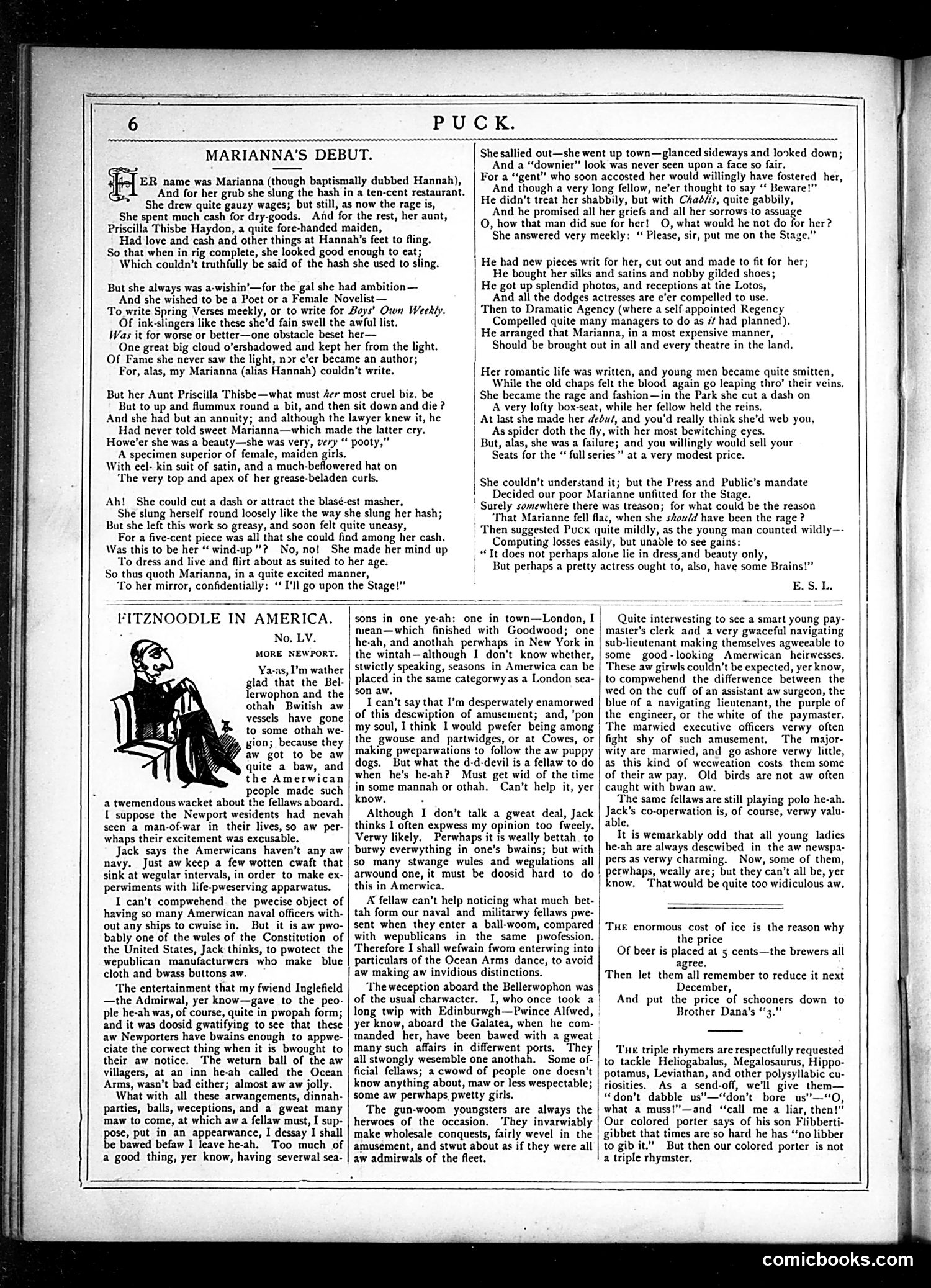
This page contains two distinct pieces: **"Marianna's Debut"** (top): A satirical poem about a young woman named Marianna (baptismally Hannah) who aspires to theatrical success. The piece mocks her ambitions and her aunt Priscilla Thibbe's manipulation of her career. It satirizes the theatrical world's exploitation of young women and the era's gossip press. **"Fitznoodle in America"** (bottom): A humorous essay comparing American and British social customs. The author (identified as "J.O.") contrasts American informality—exemplified by "Jack Fitznoodle"—with British formality, poking fun at both cultures' pretensions and the complications of cross-cultural social interaction. The piece is lighthearted social commentary rather than political satire. Both pieces represent Puck's typical blend of theatrical and social criticism.
📄 Transcribed text from this page (OCR, searchable)
Machine-transcribed from the original scan — historical spelling and the odd misread are preserved.
MARIANNA’S DEBUT. ER name was Marianna (though baptismally dubbed Hannah), And for her grub she slung the h: She drew quite gauzy wages; but still, as now the rage is, She spent much cash for dry-goods. And for the rest, her aunt, Priscilla Thisbe Haydon, a quite fore-handed maiden, Had love and cash and other things at Hannah's feet to fling. So that when in rig complete, she looked good enough to eat; Which couldn’t truthfully be said of the hash she used to sling. But she always was a-wishin’—for the gal she had ambition— And she wished to be a Poet or a Female Novelist— To write Spring Verses meekly, or to write for Boys’ Own Weekly. Of ink-slingers like these she'd fain swell the awful list. Was it for worse or better—one obstacle beset her— One great big cloud o'ershadowed and kept her from the light. Of Fame she never saw the light, nor e’er became an author; For, alas, my Marianna (alias Hannah) couldn’t write. But her Aunt Priscilla Thisbe—what must Aer most cruel biz. be But to up and flummux round a bit, and then sit down and die ? And she had but an annuity; and although the lawyer knew it, he Had never told sweet Marianna—which made the latter cry. Howe’er she was a beauty—she was very, very “ pooty,” A specimen superior of female, maiden girls. With eel- kin suit of satin, and a much-beflowered hat on ‘The very top and apex of her grease-beladen curls. Ah! She could cut a dash or attract the blasé-est masher, She slung herself round loosely like the way she slung her hash; But she left this work so greasy, and soon felt quite uneasy, For a five-cent piece was all that she could find among her cash. Was this to be her “ wind-up"? No, no! She made her mind up ‘To dress and live and flirt about as suited to her age. So thus quoth Marianna, in a quite excited manner, in a ten-cent restaurant. She sallied out—she went up town—glanced sideways and looked down; And a “downier” look was never seen upon a face so fair. For a “gent” who soon accosted her would willingly have fostered her, And though a very long fellow, ne’er thought to say ‘ Beware!" He didn’t treat her shabbily, but with Chaé/is, quite gabbily, And he promised all her griefs and all her sorrows to assuage O, how that man did sue for her! O, what would he not do for her? ‘She answered very meekly: ‘Please, sir, put me on the Stage.” | He had new pieces writ for her, cut out and made to fit for her; He bought her silks and satins and nobby gilded shoes; He got up splendid photos, and receptions at tne Lotos, And all the dodges actresses are e'er compelled to use. Then to Dramatic Agency (where a self-appointed Regency Compelled quite many managers to do as i had planned). He arranged that Marianna, in a most expensive manner, Should be brought out in all and every theatre in the land. Her romantic life was written, and young men became quite smitten, While the old chaps felt the blood again go leaping thro’ their veins. She became the rage and fashion—in the Park she cut a dash on A very lofty box-seat, while her fellow held the reins. At last she made her dedu/, and you'd really think she'd web you, As spider doth the fly, with her most bewitching eyes. But, alas, she was a failure; and you willingly would sell your Seats for the “ full series” at a very modest price. She couldn’t understand it; but the Press and Public’s mandate Decided our poor Marianne unfitted for the Stage. Surely somewhere there was treason; for what could be the reason ‘That Marianne fell flac, when she shou/d have been the rage ? Then suggested Puck quite mildly, as the young man counted wildly—- Computing losses easily, but unable to see gains: “It does not perhaps alone lie in dress,and beauty only, But perhaps a pretty actress ought to, also, have some Brains!” ‘To her mirror, confidentially: “ I'll go upon the Stag FITZNOODLE IN AMERICA. : No, LV. MORE NEWPORT. Ya-as, I’m wather glad that the Bel- lerwophon and the othah Bwitish aw vessels have gone to some othah we- gion; because they aw got to be aw quite a baw, and the Amerwican . people made such a twemendous wacket about the fellaws aboard. I suppose the Newport wesidents had nevah seen a man-of-war in their lives, so aw per- whaps their excitement was excusable. Jack says the Amerwicans haven’t any aw navy. Just aw keep a few wotten cwaft that sink at wegular intervals, in order to make ex- perwiments with life-pweserving apparwatus, I can’t compwehend the pwecise object of having so many Amerwican naval officers with- out any ships to cwuise in. But it is aw pwo- bably one of the wules of the Constitution of the United States, Jack thinks, to pwotect the wepublican manufacturwers who make blue cloth and bwass buttons aw. The entertainment that my fwiend Inglefield —the Admirwal, yer know—gave to the peo- ple he-ah was, of course, quite in pwopah form; and it was doosid gwatifying to see that these aw Newporters have bwains enough to appwe- ciate the corwect thing when it is bwought to their aw notice. The weturn ball of the aw villagers, at an inn he-ah called the Ocean Arms, wasn’t bad either; almost aw aw jolly. What with all these arwangements, dinnah- parties, balls, weceptions, and a gweat many maw to come, at which aw a fellaw must, I sup- , put in an appearwance, I dessay I shall be bawed befaw I leave he-ah. Too much of a good thing, yer know, having severwal sea- | dogs. sons in one ye-ah: one in town—London, I mean—which finished with Goodwood; one he-ah, and anothah perwhaps in New York in the wintah—although I don't know whether, stwictly speaking, seasons in Amerwica can be placed in the same categorwy as a London sea- son aw. I can't say that I’m desperwately enamorwed of this descwiption of amusement; and, 'pon my soul, I think 1 would pwefer being among the gwouse and partwidges, or at Cowes, or making pweparwations to follow the aw puppy But what the d-d-devil is a fellaw to do when he’s he-ah? Must get wid of the time in some mannah or othah. Can't help it, yer know. Although I don’t talk a gweat deal, Jack thinks I often expwess my opinion too fweely. Verwy likely. Perwhaps it is weally bettah to burwy everwything in one’s bwains; but with so many stwange wules and wegulations all arwound one, it must be doosid hard to do this in Amerwica. A fellaw can’t help noticing what much bet- | tah form our naval and militarwy fellaws pwe- sent when they enter a ball-woom, compared with wepublicans in the same pwofession. Therefore I shall wefwain fwom enterwing into particulars of the Ocean Arms dance, to avoid aw making aw invidious distinctions. ‘The weception aboard the Bellerwophon was of the usual charwacter. long twip with Edinburwgh—Pwince Alfwed, yer know, aboard the Galatea, when he com- manded her, have been bawed with a gweat many such affairs in differwent ports. They all stwongly wesemble one anothah. know anything about, maw or less wespectable; some aw perwhaps pwetty girls. The gun-woom youngsters are always the herwoes of the occasion. ‘They invarwiably make wholesale conquests, fairly wevel in the amusement, and stwut about as if they were all aw admirwals of the fleet. I, who once took a/ Some of- | ficial fellaws; a cwowd of people one doesn't | E.S.L. Quite interwesting to see a smart young pay- master’s clerk aad a very gwaceful navigating sub-lieutenant making themselves agweeable to some good-looking Amerwican heirwesses. ‘These aw girwls couldn’t be expected, yer know, to compwehend the differwence between the wed on the cuff of an assistant aw surgeon, the blue of a navigating lieutenant, the purple of the engineer, or the white of the paymaster. The marwied executive officers verwy often fight shy of such amusement. The major- wity are marwied, and go ashore verwy little, as this kind of wecweation costs them some of their aw pay. Old birds are not aw often caught with bwan aw. ‘The same fellaws are still playing polo he-ah. Jack's co-operwation is, of course, verwy valu- able. It is wemarkably odd that all young ladies he-ah are always descwibed in the aw newspa- pers as verwy charming. Now, some of them, perwhaps, weally are; but they can’t all be, yer know. That would be quite too widiculous aw. ‘THE enormous cost of ice is the reason why the price Of beer is placed at 5 cents—the brewers all agree. a Then let them all remember to reduce it next December, And put the price of schooners down to Brother Dana's ‘‘3.” ‘Tue triple rhymers are respectfully requested to tackle Heliogabalus, Megalosaurus, Hippo- potamus, Leviathan, and other polysyllabic cu- riosities. As a send-off, we'll give them— ‘don’t dabble us”—‘‘don’t bore us”—“O, what a muss!"—and “call me a liar, then!” Our colored porter says of his son Flibberti- gibbet that times are so hard he has “no libber to gib it.” But then our colored porter is not a triple rhymster. comicbooks.com