
A complete issue · 16 pages · 1878
Puck — August 21, 1878
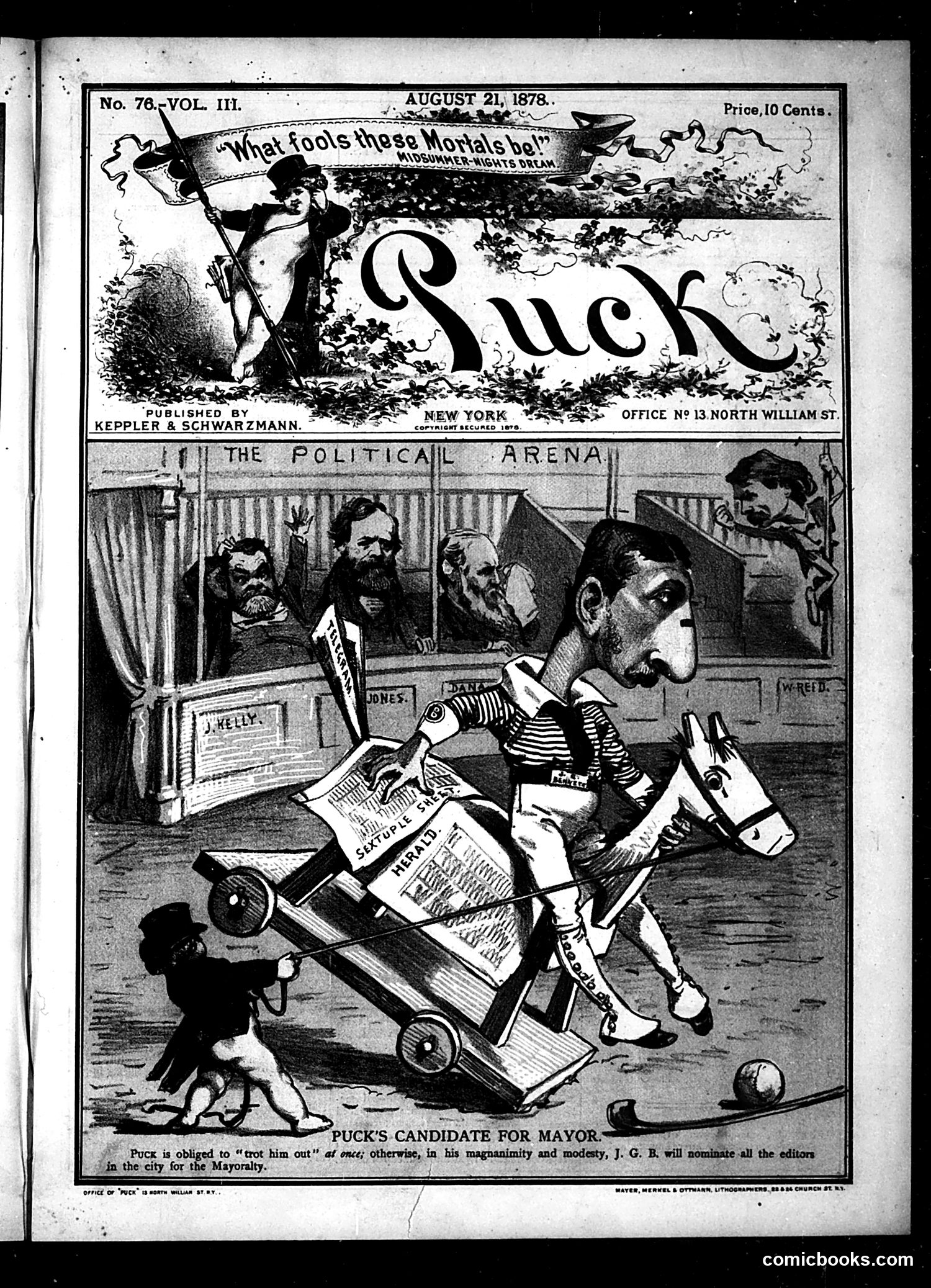
This cartoon satirizes a political figure (likely a New York mayoral candidate) by depicting him as a ridiculous, self-aggrandizing fool. The main caricature rides in an elaborate carriage labeled with grandiose titles like "Sagacity" and "Hermitage," while a small dog pulls at his pants leg—suggesting his pretensions are literally being undermined by insignificant forces. In the background, "The Political Arena" shows observers (including figures labeled "Kelly" and "Jones") watching skeptically. The caption notes Puck is "obliged to trot him out," suggesting editorial obligation rather than endorsement. The satire mocks the candidate's inflated self-importance and suggests he's an unfit, laughable choice for mayor—someone whose grandiosity masks incompetence or corruption typical of Gilded Age urban politics.
This page contains primarily **text content rather than cartoons**: satirical short pieces and social commentary typical of Puck magazine's editorial section. The visible content includes: - "The Canada Combatants" - discussing violent faction fights in Montreal between Irish groups (Orangemen and Ribbonmen), describing street battles where gangs attacked homes and people - "Puckerings" - brief humorous observations on social absurdities (Mormon discounts, underground railways, spring water safety, etc.) - Social satire targeting hypocrisy: Christians valuing gold over charity, English newspaper readers, landlords The magazine's approach is **satirical commentary on contemporary social issues** — documenting actual violence in Canada while mocking American social pretensions and contradictions. No specific identified political figures appear prominent on this particular page.
This page is primarily **text-based editorial content** rather than political cartoons. The main article, "The Season," discusses the opening of New York's theatrical season, mentioning specific venues like the Union Square Theatre and Fifth Avenue Theatre. The piece satirizes theatrical management and performers of the era, referencing specific figures like **Mr. Coghlain** (likely actor Charles Coghlan) and **Miss Davenport**. The satire targets: - Pretentious theatrical productions - Managers' grandiose ambitions - The quality of contemporary American drama compared to European standards - Specific performers' abilities and reputations The secondary article, "The Irish to Have a Tongue of Their Own," satirizes a school teaching Irish language and culture, mocking Irish-American identity politics and linguistic nationalism—reflecting period attitudes toward Irish immigrants.
This satirical piece mocks a British gentleman ("Fitznoodle") who arrives in America with grandiose expectations. The cartoon depicts him as an aristocratic dandy, labeled with class pretensions. The text humorously chronicles his disappointment: he expected refined society but encounters rowdy drinking culture, particularly gin-drinking ("gin fizz"), crude behavior, and egalitarian irreverence toward British nobility. The humor targets: 1. **British snobbery** - his assumption of American inferiority 2. **American vulgarity** - the contrast with his refined expectations 3. **Class anxiety** - his distress at being treated as an equal rather than a superior The piece satirizes both British condescension toward America and American disregard for Old World pretension, reflecting late-19th-century transatlantic cultural tensions.
This page contains two satirical pieces from Puck magazine: 1. **"A Matin Misery, After Swinburne"** (top): A poem mocking overly sentimental Victorian poetry, likely parodying Algernon Charles Swinburne's ornate romantic style. It humorously catalogs domestic annoyances (hangover, noise, etc.) in grandiose language to ridicule the era's affected literary conventions. 2. **"A Visit to a Phrenologist"** (bottom): A humorous sketch about Samuel Flubbs visiting Dr. Sokhed, a phrenologist (someone claiming to read character through skull bumps). The doctor insults Flubbs extensively while examining his head, telling him he's a coward, fool, and miser. The satire targets both phrenology—a now-discredited pseudoscience popular in the 19th century—and the pretentiousness of practitioners who used it to disparage clients while charging fees.
This page contains two distinct articles: "SMOKE" (a poem) and "POLO" (prose narrative). The "POLO" section is a satirical first-person account of a character attempting to join an exclusive polo club in New York. The narrator describes his struggle to acquire an appropriate horse, his uncertainty about polo's rules, and ultimately his initiation into the club through answering fifty examination questions about membership eligibility. The satire targets **exclusive social clubs and their gatekeeping pretensions**—the rigorous, almost absurd screening process mirrors how elite institutions maintained class barriers in Gilded Age America. The emphasis on horse-ownership and arcane sporting knowledge reflects how wealth and leisure pursuits determined social standing. The "SMOKE" poem appears unrelated, offering romantic verse about nature and idealization. Both pieces appear to be satirizing **upper-class affectation and exclusionary social practices** characteristic of late 19th-century American society.
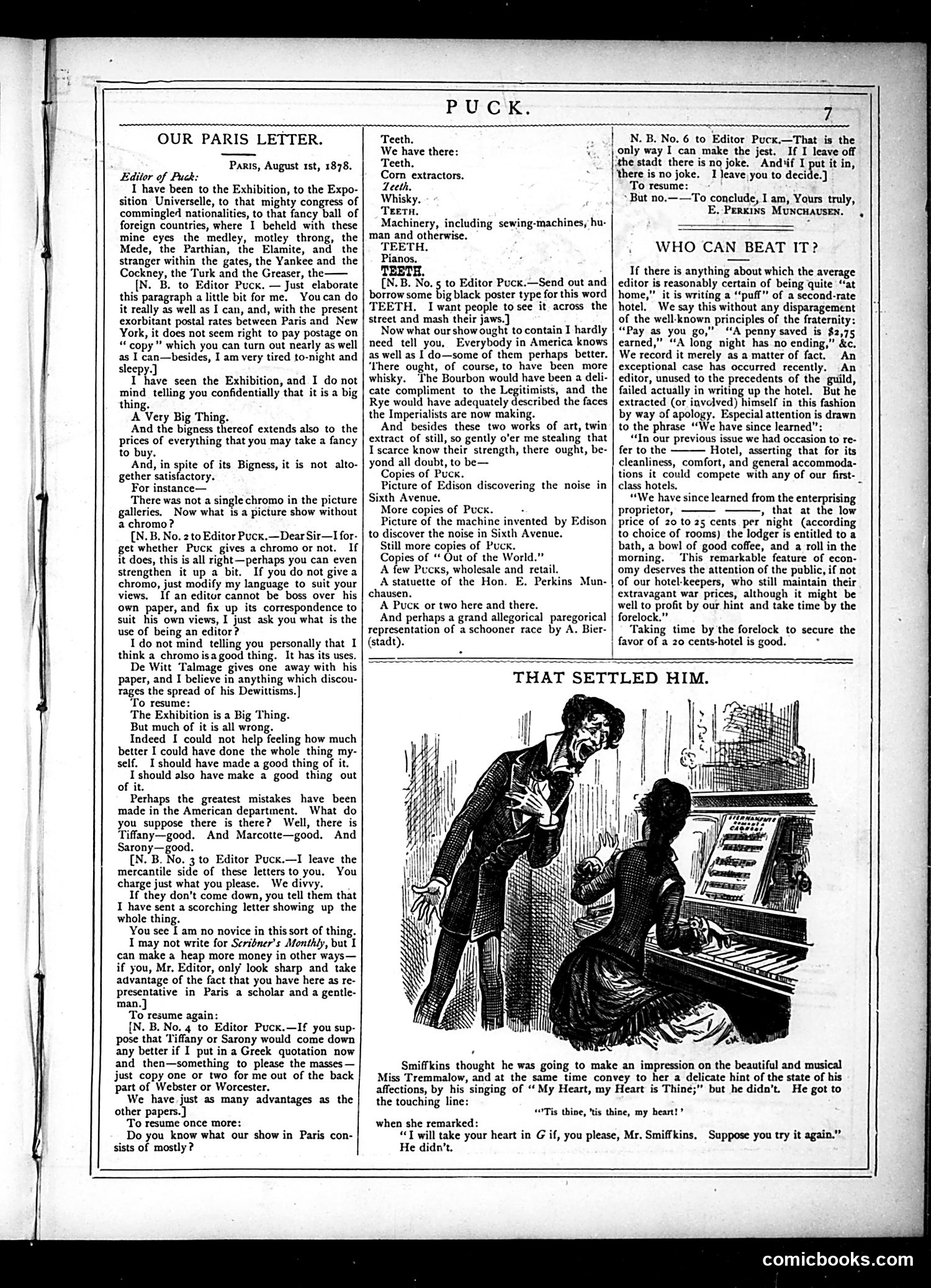
This cartoon depicts a man (Mr. Sniffkins, identified in the caption) attempting to impress a woman (Miss Tremmalow) by singing "My Heart, my Heart is Thine." However, his performance fails spectacularly when he hits a wrong note—specifically singing in G instead of the intended key. The woman's reaction ("That settled him") indicates his musical blunder has destroyed any romantic impression he hoped to make. The satire targets amateur musicians and romantic pretension: a man's attempt at cultural sophistication backfires when his actual incompetence becomes obvious. It's a gentle mockery of Victorian-era courtship rituals where musical performance served as a social accomplishment, exposing the gap between aspiration and ability.
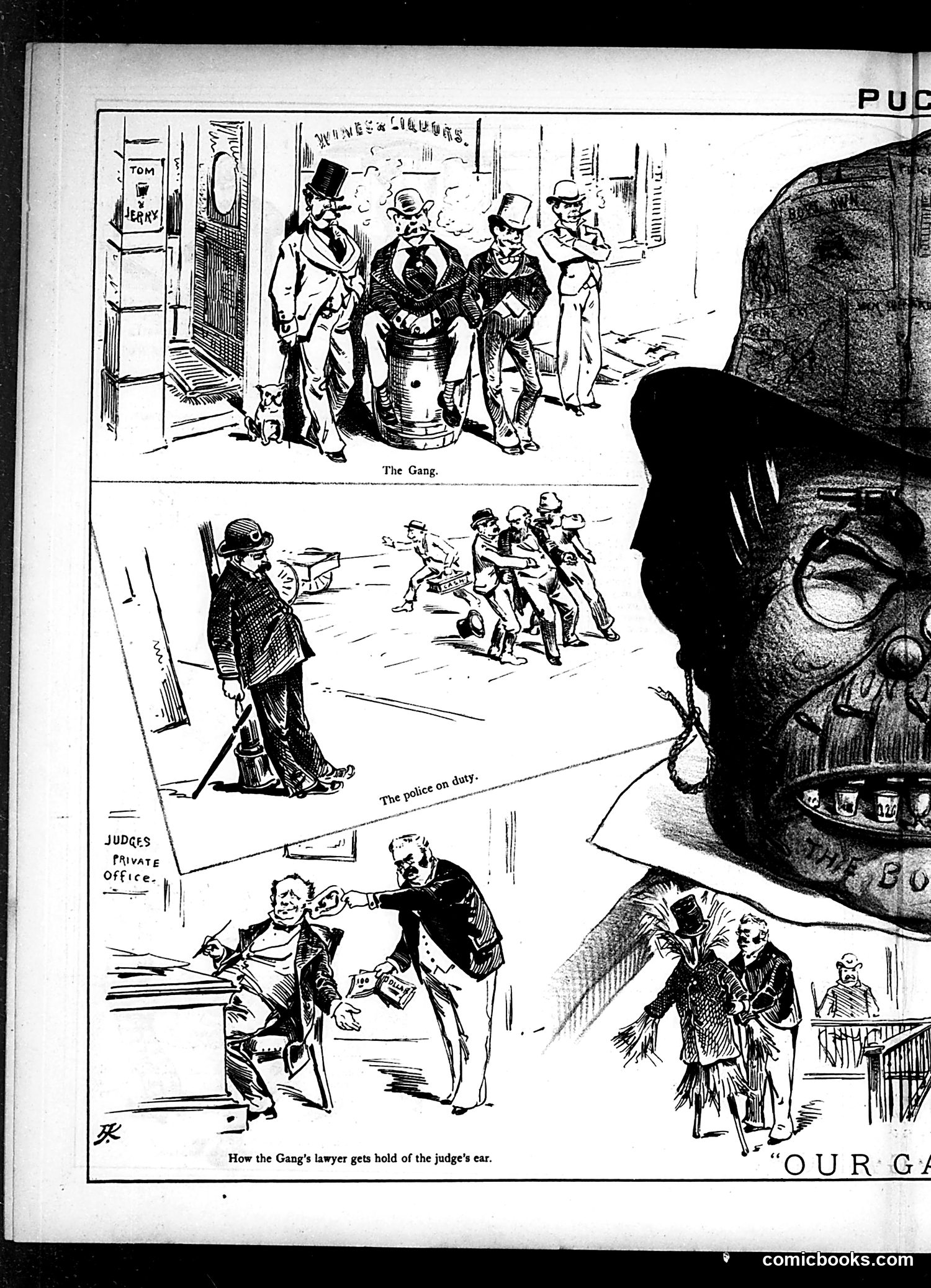
This page contains three sequential comic panels satirizing urban crime and the justice system. **"The Gang"** (top): Depicts a group of well-dressed men with a large barrel, likely representing organized criminals or a criminal organization. **"The police on duty"** (middle): Shows a police officer confronting street children or young gang members. **"How the Gang's lawyer gets hold of the judge's ear"** (bottom): Illustrates a lawyer whispering to a judge outside the courthouse, satirizing judicial corruption—suggesting that criminal gangs employed lawyers to bribe or influence judges. The satire targets urban organized crime and the corrupt relationships between criminal enterprises, their legal representatives, and the judiciary. It reflects turn-of-century concerns about criminal gangs exploiting legal systems through corrupt judges.
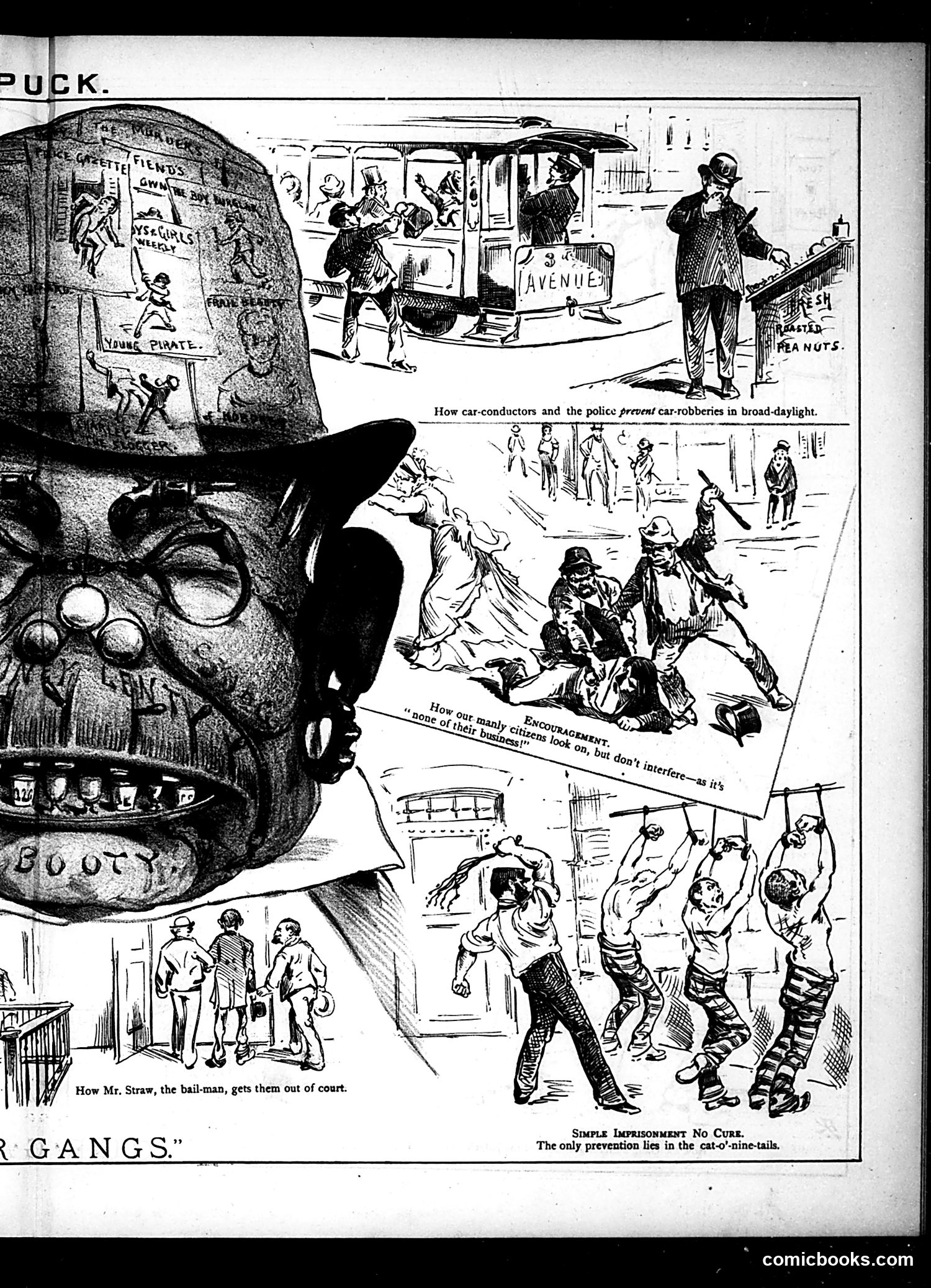
This Puck page satirizes urban crime and law enforcement in early 20th-century America. The central image shows a large, menacing figure labeled "BOOT" (likely representing organized crime or gang violence) looming over various scenes of street crime—car robberies, mugging, and youth violence. The captions critique the inadequacy of responses: police and car-conductors attempt to prevent robberies "in broad daylight"; a bail-man named "Mr. Straw" gets criminals "out of court"; and magistrates offer only "simple imprisonment" as a cure, while the cartoon suggests "the only prevention lies in the cat-o'-nine-tails" (corporal punishment). The satire attacks both lenient judicial responses and systemic ineffectiveness against gang violence plaguing American cities.
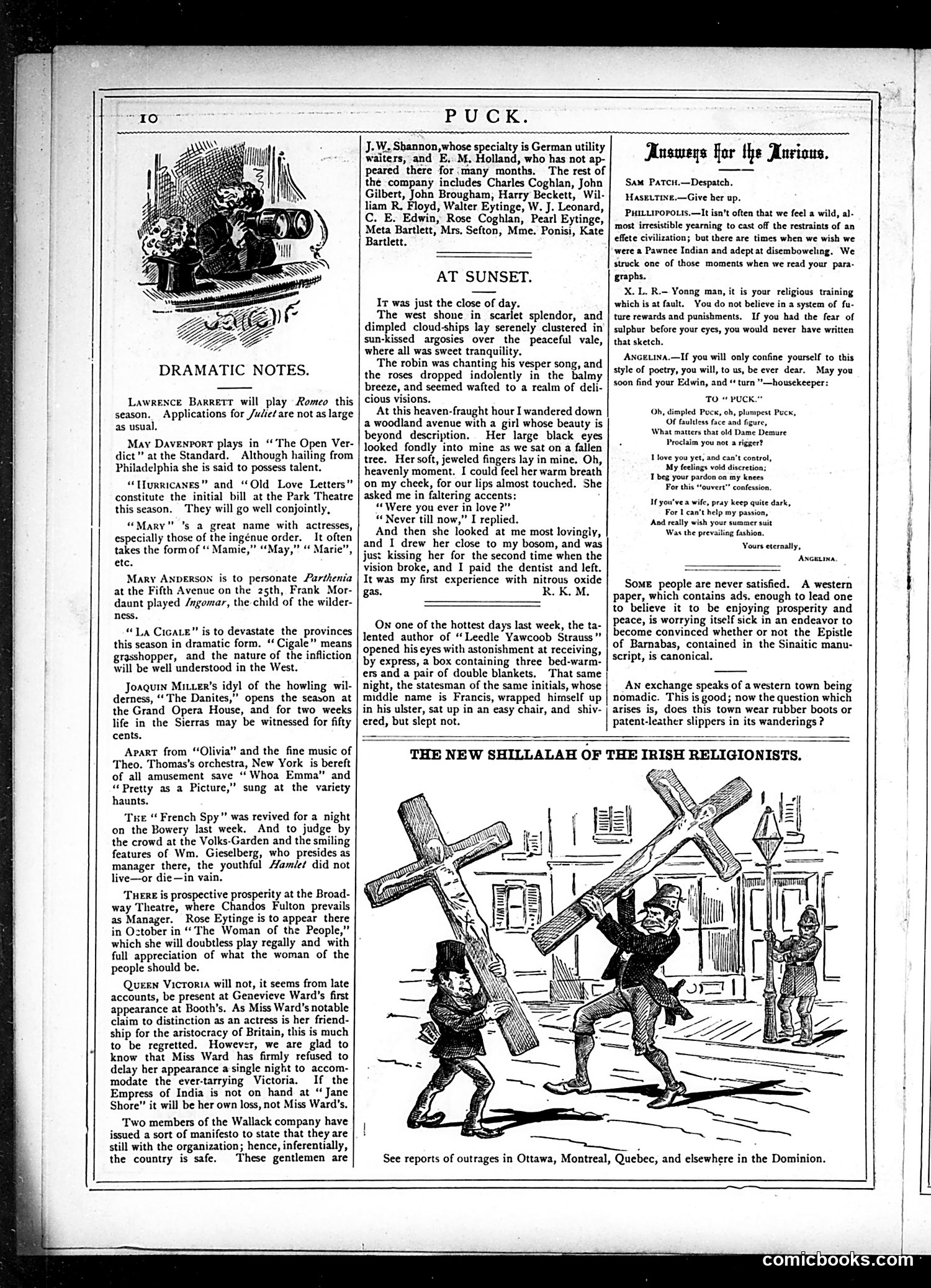
This cartoon satirizes religious violence in Ireland. The image depicts figures wielding crosses as weapons—literally using Christian symbols as "shillelaghs" (Irish clubs). The caption references "reports of outrages in Ottawa, Montreal, Quebec, and elsewhere in the Dominion," suggesting Irish religious groups were engaging in violent confrontations in Canada. The satire criticizes how Irish religious factions (Protestant and Catholic) were using their faith as justification for brutality rather than practicing Christian principles. By transforming sacred crosses into weapons, the cartoonist mocks the hypocrisy and absurdity of religiously-motivated violence. This reflects late 19th-century tensions between Irish immigrant communities in North America, where sectarian conflicts sometimes erupted into physical confrontations.
This page contains no political cartoon. It is **Part IV of a serialized fiction story titled "For Better, for Worse,"** credited to Lyons Wood in Tinsley's Magazine. The text is a romantic narrative focusing on characters named Florence, Edgar, and Mrs. Alden. The passage describes domestic drama—Florence's emotional turmoil after Edgar's departure, her internal struggle between duty and longing, and their eventual reunion at a train station. This is straightforward literary fiction rather than satire or political commentary. The page demonstrates that Puck magazine, while famous for satirical cartoons, also published serialized stories to fill its pages.
This page contains satirical commentary and short humorous pieces typical of Puck magazine, rather than a single political cartoon. The visible illustration titled "Puck's Beginnings" depicts a cherub or cupid figure in classical style. The text includes various brief satirical items mocking contemporary figures and situations. References include mentions of Edgar (apparently a deceased romantic figure), Mrs. Aldon, and various social situations. The pieces employ Puck's characteristic approach: witty, sometimes caustic commentary on everyday life and society. Without clearer identification of specific individuals or dated events in the visible text, the precise political targets remain unclear. The humor appears focused on social manners, relationships, and human foibles rather than major political events.
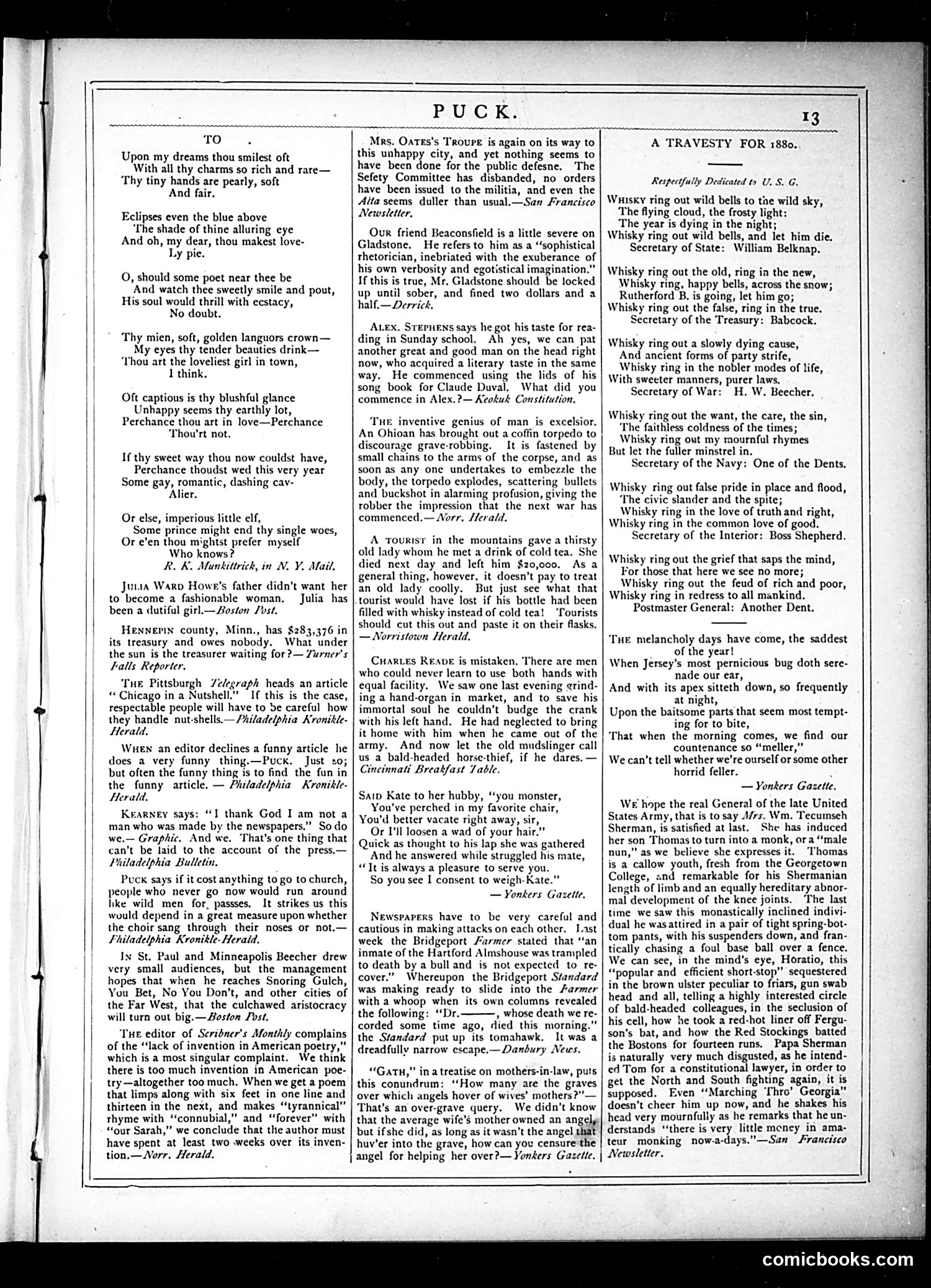
This page consists primarily of **text commentary and jokes** rather than illustrated cartoons. The content includes: 1. **Poetry and verse** addressing romantic themes and social observations 2. **Short satirical commentary** on contemporary issues, including: - Mrs. Oakes's "Trouble" affecting an unnamed city - References to a "Safety Committee" disbanding - Commentary on Mr. Gladstone (likely William Ewart Gladstone, the British politician) - Criticism of Chicago conditions - Various social critiques about newspapers, editors, and public figures 3. **"A Travesty for 1880"** — a verse dedicated to U.S. General Tecumseh Sherman, parodying patriotic language The page reflects **Puck's satirical approach**: mocking politicians, social institutions, and contemporary events through written humor rather than visual caricature. Without identifying specific illustrations, the textual content targets 1880s American political and social targets.
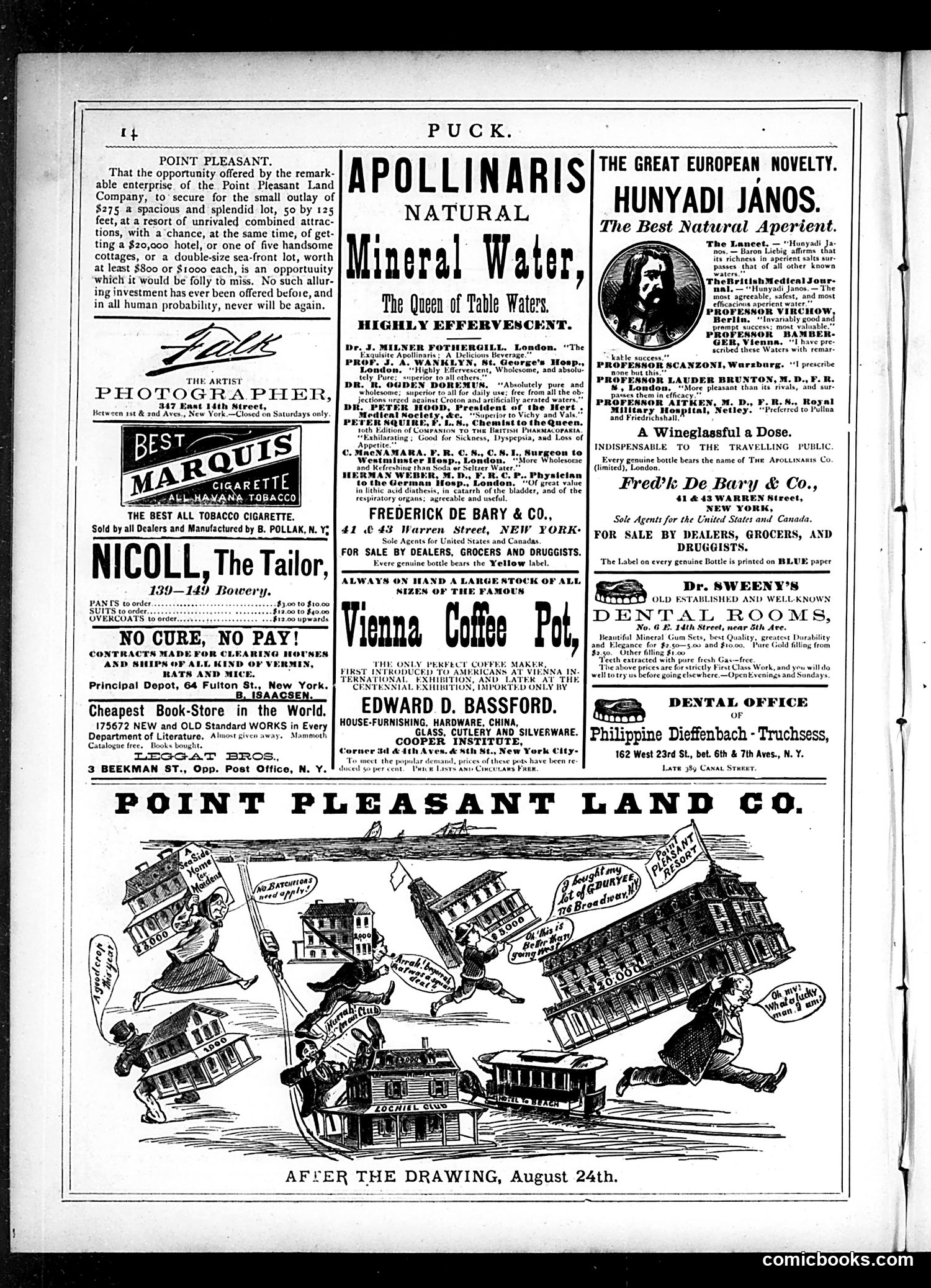
This page is primarily **advertising**, not political satire. The main cartoon illustrates the "Point Pleasant Land Co." development, showing anthropomorphized buildings and structures literally running or fleeing across a landscape. The visual joke appears to satirize **land speculation and development schemes** of the era—the buildings are depicted as animated, active agents "chasing" potential buyers or fleeing from them, suggesting the chaotic, fast-moving nature of real estate promotion. The caption "AFTER THE DRAWING, August 24th" indicates this depicts an actual land lottery or property drawing event. The surrounding advertisements (Apollinaris water, Hunyadi Janos mineral water, Vienna Coffee, dental services) are typical period commercial content unrelated to the main cartoon's social commentary.
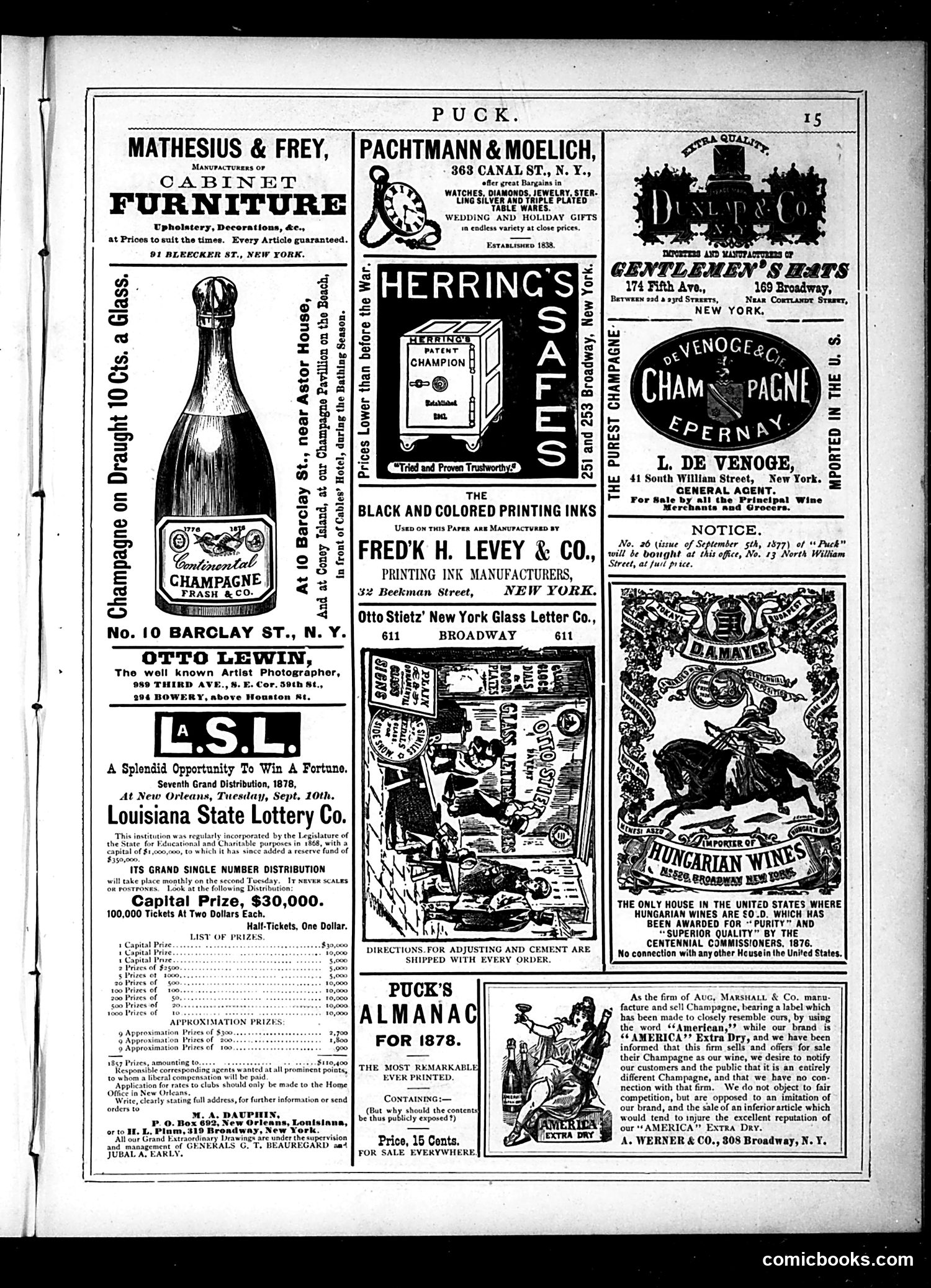
This page is primarily **advertising** rather than editorial content or political cartoons. It contains circa 1878 advertisements for various commercial products and services: furniture, champagne, printing inks, photography, a lottery, wines, and "Puck's Almanac." The only image with potential satirical content is the **Bamaioli Hungarian Wines advertisement** (lower right), which depicts a bull or similar animal in an ornate frame—likely using exaggerated imagery to promote the product rather than making a political point. The **Louisiana State Lottery advertisement** is notable historically: such lotteries were common in the 19th century but became controversial and were eventually banned. Overall, this appears to be a standard advertising page from an 1878 Puck issue, with minimal editorial or satirical commentary.
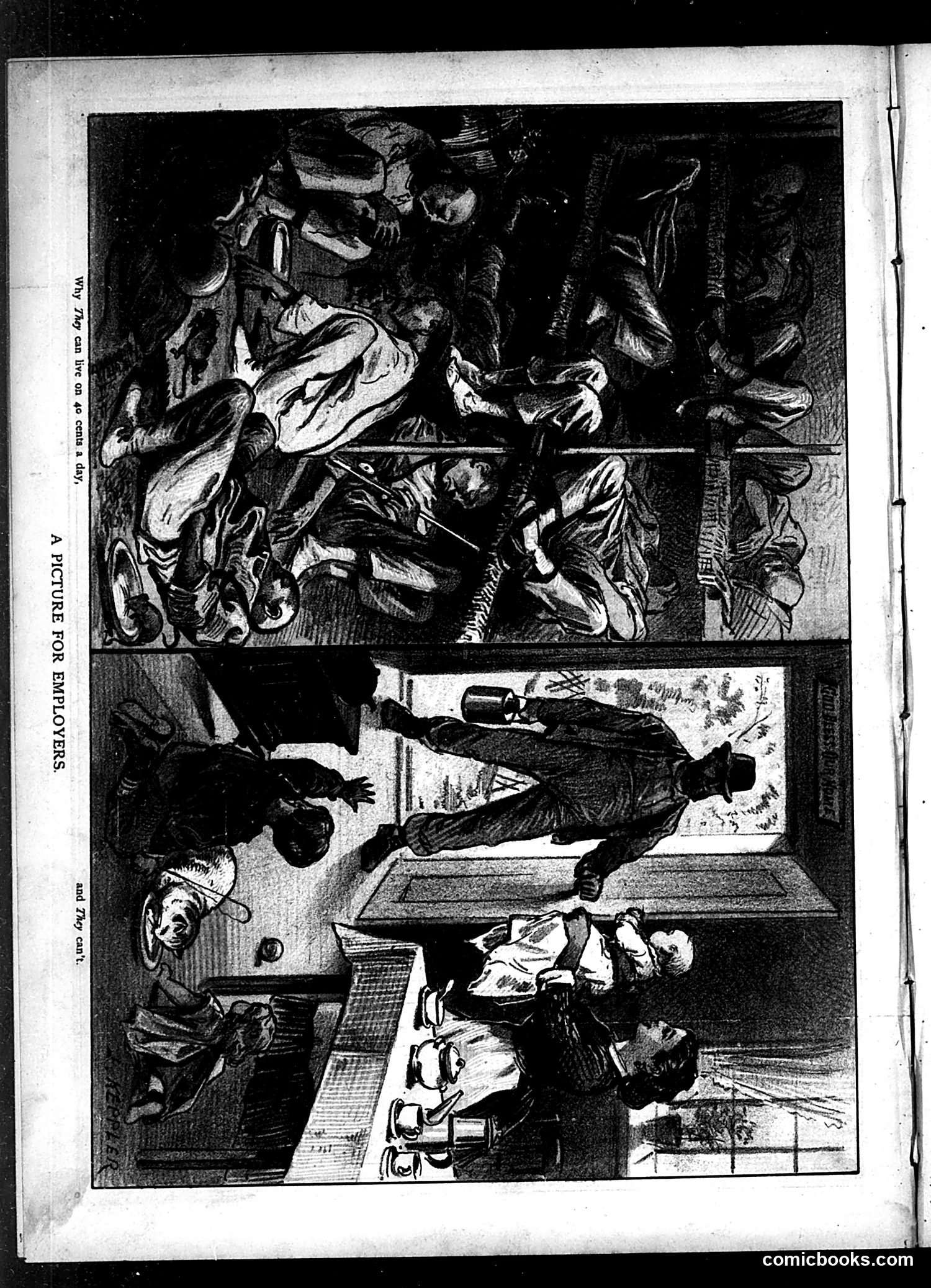
This page appears to be a satirical illustration with the title "A Picture for Embalmers" oriented vertically on the left side. The image shows two distinct scenes: The upper portion depicts a chaotic, dramatically rendered classical or allegorical scene with multiple figures in dynamic poses—possibly referencing death, struggle, or classical mythology. The lower portion shows what appears to be a more contemporary Victorian-era scene with figures in formal dress examining or discussing something, possibly a body or artwork. The satire likely mocks the funeral industry or embalming practices of the era, using the contrast between grand classical death imagery and mundane professional reality. However, **without additional context or clearer OCR text identifying specific figures or events**, the precise political or social target remains unclear.