
Puck, 1878-08-21 · page 3 of 16
Puck — August 21, 1878 — page 3: what you’re looking at
What you’re looking at
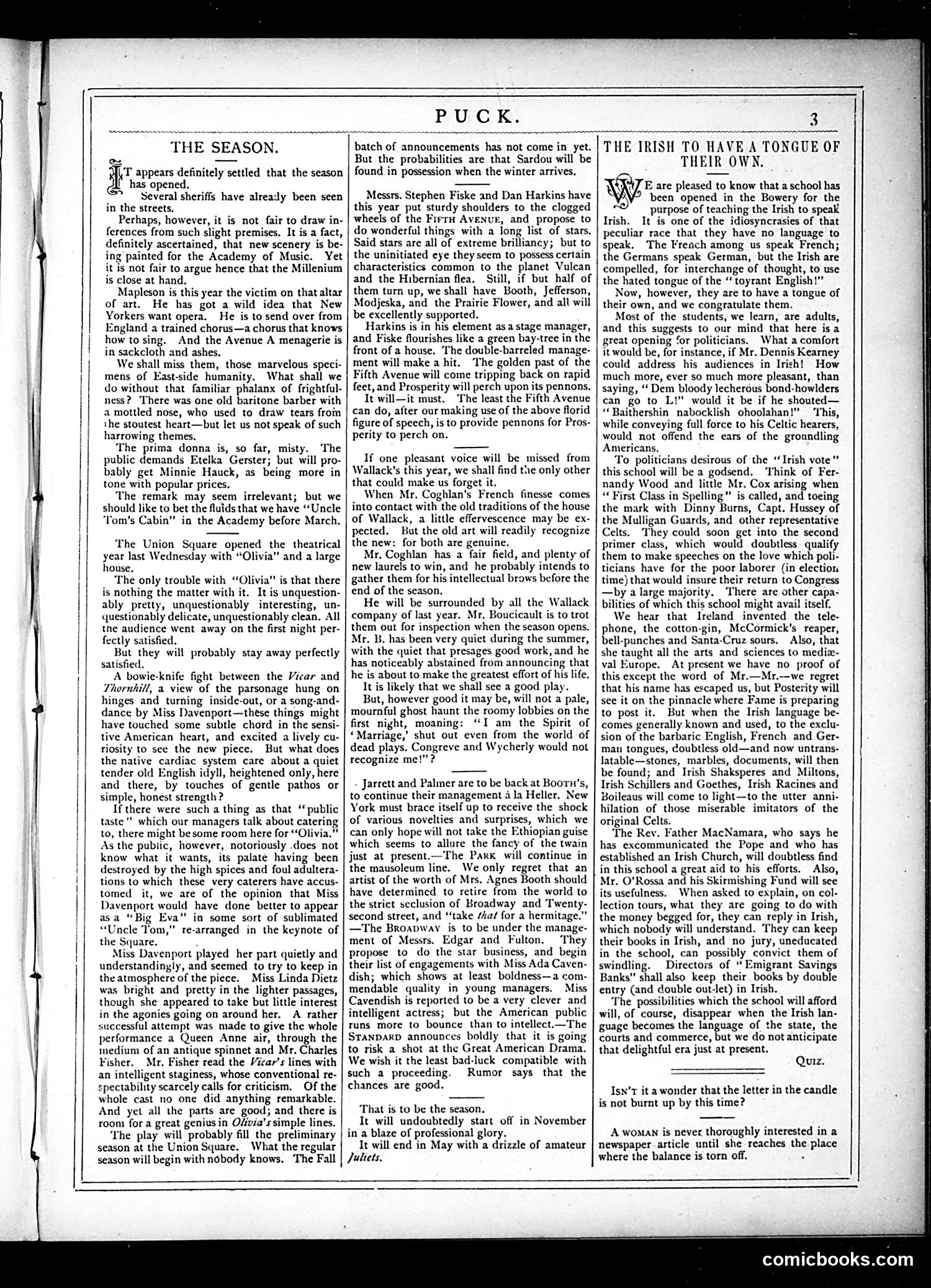
This page is primarily **text-based editorial content** rather than political cartoons. The main article, "The Season," discusses the opening of New York's theatrical season, mentioning specific venues like the Union Square Theatre and Fifth Avenue Theatre. The piece satirizes theatrical management and performers of the era, referencing specific figures like **Mr. Coghlain** (likely actor Charles Coghlan) and **Miss Davenport**. The satire targets: - Pretentious theatrical productions - Managers' grandiose ambitions - The quality of contemporary American drama compared to European standards - Specific performers' abilities and reputations The secondary article, "The Irish to Have a Tongue of Their Own," satirizes a school teaching Irish language and culture, mocking Irish-American identity politics and linguistic nationalism—reflecting period attitudes toward Irish immigrants.
📄 Transcribed text from this page (OCR, searchable)
Machine-transcribed from the original scan — historical spelling and the odd misread are preserved.
THE SEASON. it appears definitely settled that the season has opened. Several sheriffs have already been seen in the streets, Perhaps, however, it is not fair to draw in- ferences from such slight premises. It is a fact, definitely ascertained, that new scenery is be- ing painted for the Academy of Music. Yet it is not fair to argue hence that the Millenium is close at hand. Mapleson is this year the victim on that altar of art. He has got a wild idea that New Yorkers want opera. He is to send over from England a trained chorus—a chorus that knows how to sing. And the Avenue A menagerie is in sackcloth and ashes. We shall miss them, those marvelous speci- mens of East-side humanity. What shall we do without that familiar phalanx of frightful- ness? There was one old baritone barber with a mottled nose, who used to draw tears from the stoutest heart—but let us not speak of such harrowing themes. The prima donna is, so far, misty. ‘The public demands Etelka Gerster; but will pro- bably get Minnie Hauck, as being more in tone with popular prices, ‘The remark may seem irrelevant; but we should like to bet the fluids that we have ‘Uncle ‘lom’s Cabin” in the Academy before March, ‘The Union Square opened the theatrical year last Wednesday with “Olivia” and a large house, The only trouble with “Olivia” is that there is nothing the matter with it. It is unquestion- ably pretty, unquestionably interesting, un- questionably delicate, unquestionably clean. All tne audience went away on the first night per- fectly satisfied. But they will probably stay away perfectly satisfied, A bowie-knife fight between the Vicar and Thornhill, a view of the parsonage hung on hinges and turning inside-out, or a song-and- dance by Miss Davenport—these things might have touched some subtle chord in the sensi- tive American heart, and excited a lively cu- riosity to see the new piece. But what does the native cardiac system care about a quiet tender old English idyll, heightened only, here and there, by touches of gentle pathos or simple, honest strength ? Ifthere were such a thing as that “public taste” which our managers talk about catering to, there might be some room here for “Olivia.” As the public, however, notoriously .does not know what it wants, its palate having been destroyed by the high spices and foul adultera- tions to which these very caterers have accus- tomed it, we are of the opinion that Miss Davenport would have done better to appear asa “Big Eva” in some sort of sublimated “Uncle Tom,” re-arranged in the keynote of the Square. Miss Davenport played her part quietly and understandingly, and scemed to try to keep in the atmosphere of the piece. Miss Linda Dietz was bright and pretty in the lighter passages, though she appeared to take but little interest in the agonies going on around her. A rather successful attempt was made to give the whole performance a Queen Anne air, through the inedium of an antique spinnet and Mr. Charles Fisher. Mr. Fisher read the Vicar’s lines with an intelligent staginess, whose conventional re- spectability scarcely calls for criticism. Of the whole cast no one did anything remarkable. And yet all the parts are good; and there is room fora great genius in O/iva’s simple lines. ‘The play will probably fill the preliminary season at the Union Square. What the regular season will begin with nobody knows. ‘The Fall 3 batch of announcements has not come in yet. But the probabilities are that Sardou will be found in possession when the winter arrives. Messrs. Stephen Fiske and Dan Harkins have this year put sturdy shoulders to the clogged wheels of the Firr! AVENUE, and propose to do wonderful things with a long list of stars. Said stars are all of extreme brilliancy; but to the uninitiated eye they seem to possess certain characteristics common to the planet Vulcan and the Hibernian flea. Still, if but half of them turn up, we shall have Booth, Jefferson, Modjeska, and the Prairie Flower, and all will be excellently supported. Harkins is in his element asa stage manager, and Fiske flourishes like a green bay-tree in the front of a house. The double-barreled manage- ment will make a hit. The golden past of the Fifth Avenue will come tripping back on rapid feet, and Prosperity will perch upon its pennons, It will—it must. ‘The least the Fifth Avenue can do, after our making use of the above florid figure of speech, is to provide pennons for Pros- perity to perch on, If one pleasant voice will be missed from Wallack’s this year, we shall find the only other that could make us forget it. When Mr. Coghlan’s French finesse comes into contact with the old traditions of the house of Wallack, a little effervescence may be ex- pected. But the old art will readily recognize the new: for both are genuine. Mr. Coghlan has a fair field, and plenty of new laurels to win, and_he probably intends to gather them for his intellectual brows before the end of the season. He will be surrounded by all the Wallack company of last year. Mr. Boucicault is to trot them out for inspection when the season opens. Mr. B. has been very quict during the summer, with the quiet that presages good work, and he has noticeably abstained from announcing that he is about to make the greatest effort of his life. It is likely that we shall see a good play. But, however good it may be, will not a pale, mournful ghost haunt the roomy lobbies on the first night, moaning: ‘I am the Spirit of « Marriage,’ shut out even from the world of dead plays. Congreve and Wycherly would not recognize me!” ? Jarrett and Palmer are to be back at Boorn’s, to continue their management a la Heller. New York must brace itself up to receive the shock of various novelties and surprises, which we can only hope will not take the Ethiopian guise which seems to allure the fancy of the twain just at present.—The Park will continue in the mausoleum line. We only regret that an artist of the worth of Mrs. Agnes Booth should have determined to retire from the world to the strict seclusion of Broadway and Twenty- second street, and ‘take ¢hat for a hermitage.” —The Broapway is to be under the manage- ment of Messrs, Edgar and Fulton, ‘They propose to do the star business, and begin their list of engagements with Miss Ada Caven- dish; which shows at least boldness—a com- mendable quality in young managers. Miss Cavendish is reported to be a very clever and intelligent actress; but the American public runs more to bounce than to intellect.—The STANDARD announces boldly that it is going to risk a shot at the Great American Drama. We wish it the least bad-luck compatible with such a proceeding. Rumor says that the chances are good. That is to be the season. It will undoubtedly start off in November in a blaze of professional glory. It will end in May with a drizzle of amateur Juliets, THEIR OWN. AZ E are pleased to know that a school has been opened in the Bowery for the purpose of teaching the Irish to speak Irish. It is one of the idiosyncrasies of that peculiar race that they have no language to speak. The Freach among us speak French; the Germans speak German, but the Irish are compelled, for interchange of thought, to use the hated tongue of the “ toyrant English!” Now, however, they are to have a tongue of their own, and we congratulate them. Most of the students, we learn, are adults, and this suggests to our mind that here isa great opening ‘or politicians. What a comfort it would be, for instance, if Mr. Dennis Kearney could address his audiences in Irish! How much more, ever so much more pleasant, than saying, “ Dem bloody lecherous bond-howlders can go to L!” would it be if he shouted— “‘Baithershin nabocklish ohoolahan!” ‘This, while conveying full force to his Celtic hearers, would not offend the ears of the groundling Americans. To politicians desirous of the “Irish vote" this school will be a godsend. ‘Think of Fer- nandy Wood and little Mr. Cox arising when “ First Class in Spelling” is called, and toeing the mark with Dinny Burns, Capt. Hussey of the Mulligan Guards, and other representative Celts. They could soon get into the second primer class, which would doubtless qualify them to make speeches on the love which poli- ticians have for the poor laborer (in election time) that would insure their return to Congress —by a large majority. There are other capa- bilities of which this school might avail itself. We hear that Ireland invented the tele- phone, the cotton-gin, McCormick’s reaper, bell-punches and Santa-Cruz sours. Also, that she taught all the arts and sciences to mediw- val Europe. At present we have no proof of this except the word of Mr.—Mr.—we regret that his name has escaped us, but Posterity will see it on the pinnacle where Fame is preparing to post it. But when the Irish language be- comes generally known and used, to the exclu- sion of the barbaric English, French and Ger- maui tongues, doubtless old—and now untrans- latable—stones, marbles, documents, will then be found; and Irish Shaksperes and Miltons, Irish Schillers and Goethes, Irish Racines and Boileaus will come to light—to the utter anni- hilation of those miserable imitators of the original Celts. The Rev. Father MacNamara, who says he has excommunicated the Pope and who has established an Irish Church, will doubtless find in this school a great aid to his efforts. Also, Mr. O’Rossa and his Skirmishing Fund will see its usefulness. When asked to explain, on col- lection tours, what they are going to do with the money begged for, they can reply in Irish, which nobody will understand. They can keep their books in Irish, and no jury, uneducated in the school, can possibly convict them of swindling. Directors of “Emigrant Savings Banks” shall also keep their books by double entry (and double out-let) in Irish. The possibilities which the school will afford will, of course, disappear when the Irish lan- guage becomes the language of the state, the courts and commerce, but we do not anticipate that delightful era just at present. Quiz. Isn’r it a wonder that the letter in the candle is not burnt up by this time? A woman is never thoroughly interested in a newspaper article until she reaches the place where the balance is torn off. . comicbooks.com