
Puck, 1878-08-21 · page 2 of 16
Puck — August 21, 1878 — page 2: what you’re looking at
What you’re looking at
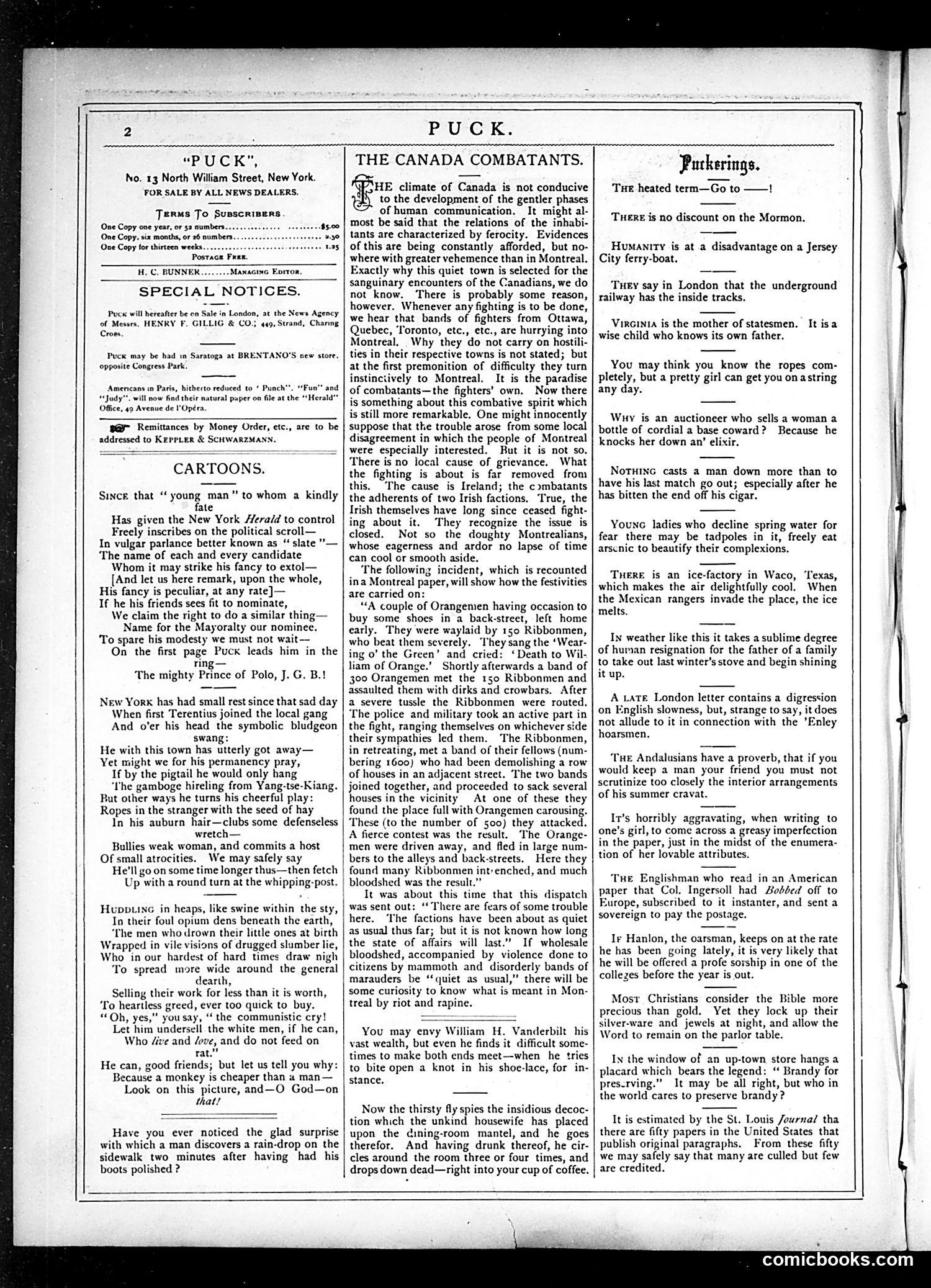
This page contains primarily **text content rather than cartoons**: satirical short pieces and social commentary typical of Puck magazine's editorial section. The visible content includes: - "The Canada Combatants" - discussing violent faction fights in Montreal between Irish groups (Orangemen and Ribbonmen), describing street battles where gangs attacked homes and people - "Puckerings" - brief humorous observations on social absurdities (Mormon discounts, underground railways, spring water safety, etc.) - Social satire targeting hypocrisy: Christians valuing gold over charity, English newspaper readers, landlords The magazine's approach is **satirical commentary on contemporary social issues** — documenting actual violence in Canada while mocking American social pretensions and contradictions. No specific identified political figures appear prominent on this particular page.
📄 Transcribed text from this page (OCR, searchable)
Machine-transcribed from the original scan — historical spelling and the odd misread are preserved.
PUCK. “PUCK”, No. 13 North William Street, New York. FOR SALE BY ALL NEWS DEALERS. Terms To Suascriaer One Copy one year, or 52 numbers... ee ‘One Copy. six months, or 26 numbers. Ove Copy tor thirteen weeks... Postace Fran. H.C. BUNNER.......-Mas SPECIAL NOTICES. ‘MAnacina Eprror, Puck will hereafter be on Sale in London, at the News Agency of Messrs. HENRY F. GILLIG & CO.; 449, Strand, Channg. Crors. Puck may be had in Saratoga at BRENTANO’S new store. opposite Congress Park. Amencans in Paris, hitherto reduced to ‘ Punch". “Fun” and **Judy"’. will now find their natural paper on file at the ‘Herald’ Office, 49 Avenue de I'Opéra. ‘s@- Remittances by Money Order, etc., are to be addressed to Kerrier & ScHwWarzM CARTOONS. Since that “young man” to whom a kindly fate Has given the New York Hera/d to control Freely inscribes on the political scroll— In vulgar parlance better known as “slate "— ‘The name of each and every candidate Whom it may strike his fancy to extol— [And let us here remark, upon the whole, His fancy is peculiar, at any rate]— If he his friends sees fit to nominate, We claim the right to do a similar thing— Name for the Mayoralty our nominee. To spare his modesty we must not wait— On the first page Puck leads him in the ring— ‘The mighty Prince of Polo, J. G. B.! New York has had small rest since that sad day When first Terentius joined the local gang And o'er his head the symbolic bludgeon swang: He with this town has utterly got away— Yet might we for his permanency pray, If by the pigtail he would only hang ‘rhe gamboge hireling from Yang-tse-Kiang. But other ways he turns his cheerful play: Ropes in the stranger with the seed of hay In his auburn hair—clubs some defenseless wretch— Bullies weak woman, and commits a host Of small atrocities. We may safely say He'll go on some time longer thus—then fetch | Up with a round turn at the whipping-post. Huppttinc in heaps, like swine within the sty, In their foul opium dens beneath the earth, ‘Phe men who drown their little ones at birth Wrapped in vile visions of drugged slumber lie, Who in our hardest of hard times draw nigh To spread more wide around the general dearth, Selling their work for less than it is worth, ‘To heartless greed, ever too quick to buy. “Oh, yes,” you say, “ the communistic cry! Let him undersell the white men, if he can, Who dive and /ove, and do not feed on rat.” He can, good friends; but let us tell you why: Because a monkey is cheaper than a man— Look on this picture, and—O God—on that! Have you ever noticed the glad surprise with which a man discovers a rain-drop on the sidewalk two minutes after having had his boots polished ? THE CANADA COMBATANTS. 'HE climate of Canada is not conducive to the development of the gentler phases of human communication. It might al- most be said that the relations of the inhabi- tants are characterized by ferocity. Evidences of this are being constantly afforded, but no- where with greater vehemence than in Montreal. Exactly why this quiet town is selected for the sanguinary encounters of the Canadians, we do not know. There is probably some reason, however. Whenever any fighting is to be done, we hear that bands of fighters from Ottawa, Quebec, Toronto, etc., etc., are hurrying into Montreal. Why they do not carry on hostili- ties in their respective towns is not stated; but at the first premonition of difficulty they turn instinctively to Montreal. It is the paradise of combatants—the fighters’ own. Now there is something about this combative spirit which is still more remarkable, One might innocently suppose that the trouble arose from some local disagreement in which the people of Montreal were especially interested. But it is not so. There is no local cause of grievance. What the fighting is about is far removed from this. The cause is Ireland; the c»mbatants the adherents of two Irish factions, True, the Irish themselves have long since ceased fight- ing about it. They recognize the issue is closed. Not so the doughty Montrealians, whose eagerness and ardor no lapse of time can cool or smooth aside. The following incident, which is recounted ina Montreal paper, will show how the festivities are carried on: “A couple of Orangemen having occasion to buy some shoes in a back-street, left home early. They were waylaid by 130 Ribbonmen who beat them severely. ‘They sang the ‘Wea ing o’ the Green’ and cried: ‘Death to Wil- liam of Orange.’ Shortly afterwards a band of 300 Orangemen met the 150 Ribbonmen and assaulted them with dirks and crowbars. After a severe tussle the Ribbonmen were routed. The police and military took an active part in the fight, ranging themselves on whichever side their sympathies led them. The Ribbonmen, in retreating, met a band of their fellows (num- bering 1600) who had been demolishing a row of houses in an adjacent street. The two bands joined together, and proceeded to sack several houses in the vicinity At one of these they found the place full with Orangemen carousing. These (to the number of 500) they attacked. A fierce contest was the result. The Orange- men were driven away, and fled in large num- bers to the alleys and back-streets. Here they found many Ribbonmen intenched, and much bloodshed was the result.” It was about this time that this dispatch was sent out: ‘ There are fears of some trouble here. The factions have been about as quiet as usual thus far; but it is not known how long the state of affairs will last.” If wholesale bloodshed, accompanied by violence done to citizens by mammoth and disorderly bands of marauders be ‘quiet as usual,” there will be some curiosity to know what is meant in Mon- treal by riot and rapine. You may envy William H. Vanderbilt his vast wealth, but even he finds it difficult some- times to make both ends meet—when he tries to bite open a knot in his shoe-lace, for in- stance. Now the thirsty fly spies the insidious decoc- tion which the unkind housewife has placed upon the dining-room mantel, and he goes therefor. And having drunk thereof, he cir- cles around the room three or four times, and drops down dead—right into your cup of coffee. Packerings. Tue heated term—Go to —! Tuere is no discount on the Mormon. Humanity is at a disadvantage on a Jersey City ferry-boat. Tuey say in London that the underground railway has the inside tracks. Viroinia is the mother of statesmen. It isa wise child who knows its own father. You may think you know the ropes com- pletely, but a pretty girl can get you on astring any day. Wuy is an auctioneer who sells a woman a bottle of cordial a base coward? Because he knocks her down an’ elixir. NotTHING casts a man down more than to have his last match go out; especially after he has bitten the end off his cigar. Younc ladies who decline spring water for fear there may be tadpoles in it, freely eat arscnic to beautify their complexions. Tere is an ice-factory in Waco, ‘Texas, which makes the air delightfully cool. When the Mexican rangers invade the place, the ice melts. In weather like this it takes a sublime degree of human resignation for the father of a family to take out last winter's stove and begin shining it up. A tate London letter contains a digression on English slowness, but, strange to say, it does not allude to it in connection with the ’Enley hoarsmen. ‘Tue Andalusians have a proverb, that if you would keep a man your friend you must not scrutinize too closely the interior arrangements of his summer cravat. Iv’s horribly aggravating, when writing to one’s girl, to come across a greasy imperfection in the paper, just in the midst of the enumera- tion of her lovable attributes. ‘Tue Englishman who read in an American paper that Col. Ingersoll had Bodbed off to Europe, subscribed to it instanter, and sent a sovereign to pay the postage. Ir Hanlon, the oarsman, keeps on at the rate he has been going lately, it is very likely that he will be offered a profe sorship in one of the collezes before the year is out. Mosr Christians consider the Bible more precious than gold, Yet they lock up their silver-ware and jewels at night, and allow the Word to remain on the parlor table. Iv the window of an up-town store hangs a placard which bears the legend: “ Brandy for preserving.” It may be all right, but who in the world cares to preserve brandy? It is estimated by the St. Louis Journa/ tha there are fifty papers in the United States that publish original paragraphs. From these fifty we may safely say that many are culled but few are credited. comicbooks.com