
Puck, 1878-08-21 · page 6 of 16
Puck — August 21, 1878 — page 6: what you’re looking at
What you’re looking at
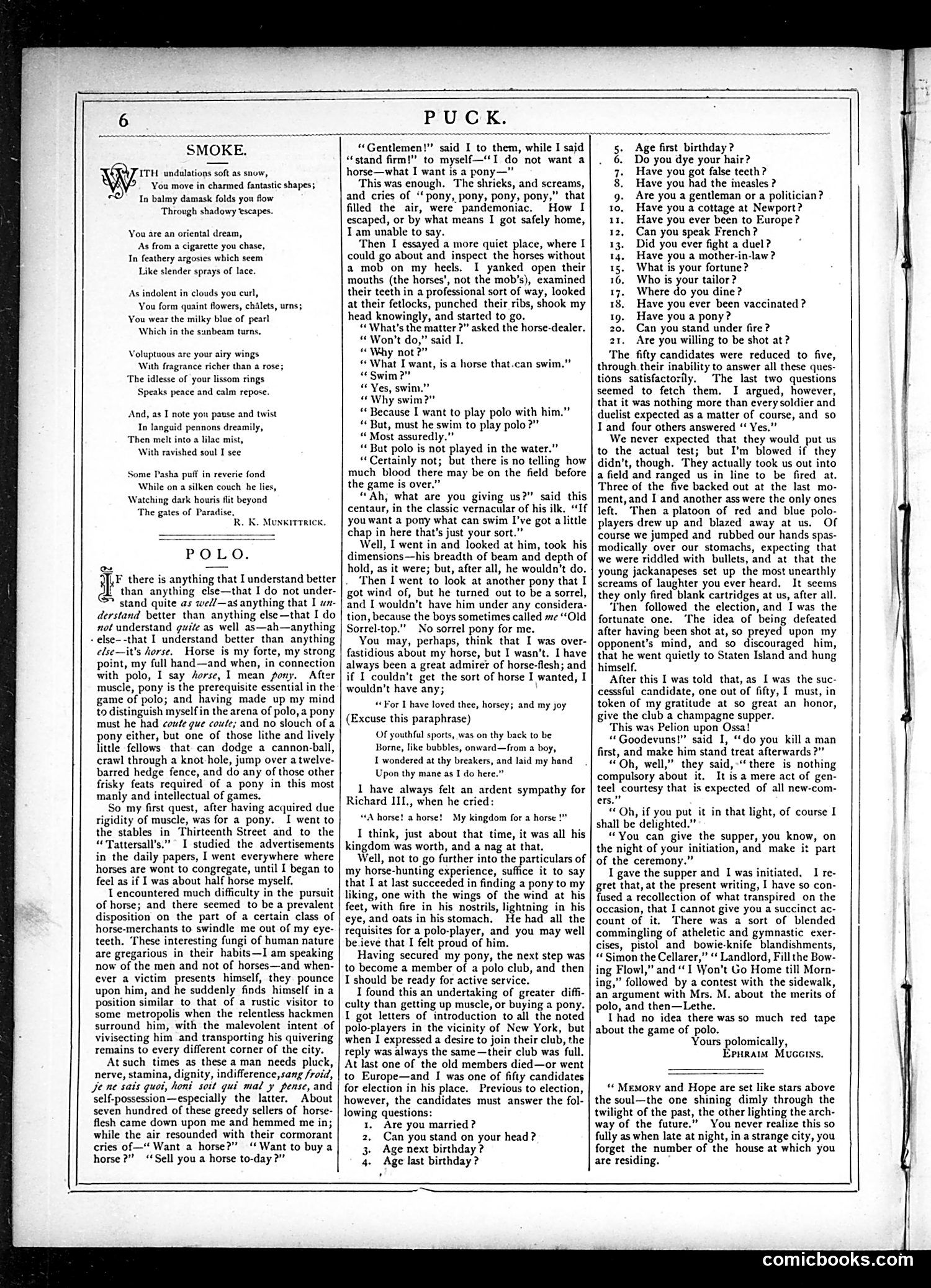
This page contains two distinct articles: "SMOKE" (a poem) and "POLO" (prose narrative). The "POLO" section is a satirical first-person account of a character attempting to join an exclusive polo club in New York. The narrator describes his struggle to acquire an appropriate horse, his uncertainty about polo's rules, and ultimately his initiation into the club through answering fifty examination questions about membership eligibility. The satire targets **exclusive social clubs and their gatekeeping pretensions**—the rigorous, almost absurd screening process mirrors how elite institutions maintained class barriers in Gilded Age America. The emphasis on horse-ownership and arcane sporting knowledge reflects how wealth and leisure pursuits determined social standing. The "SMOKE" poem appears unrelated, offering romantic verse about nature and idealization. Both pieces appear to be satirizing **upper-class affectation and exclusionary social practices** characteristic of late 19th-century American society.
📄 Transcribed text from this page (OCR, searchable)
Machine-transcribed from the original scan — historical spelling and the odd misread are preserved.
ITH undulations soft as snow, You move in charmed fantastic shapes; In balmy damask folds you flow Through shadowy escapes. You are an oriental dream, As from a cigarette you chase, In feathery argosies which seem Like slender sprays of lace. As indolent in clouds you curl, You form quaint flowers, chalets, urns; You wear the milky blue of pearl Which in the sunbeam turns, Voluptuous are your airy wings With fragrance richer than a rose; ‘The idlesse of your lissom rings Speaks peace and calm repose. And, as I note you pause and twist In languid pennons dreamily, Then melt into a lilac mist, With ravished soul I see Some Pasha puff in reverie fond While on a silken couch he lies, Watching dark houris flit beyond The gates of Paradise, R. K. Munxrrtrick. POLO. Te there is anything that I understand better ties anything else—that I do not under- i stand quite as we//—as anything that I wn- derstand better than anything else—that I do not understand guwite as well as—ah—anything + else--that I understand better than anything else—it's horse. Horse is my forte, my strong point, my full hand—and when, in connection with ‘polo, I say horse, 1 mean pony. After muscle, pony is the prerequisite essential in the game of polo; and having made up my mind to distinguish myselfin the arena of polo,a pony must he had coufe gue coufe; and no slouch of a pony either, but one of those lithe and lively little fellows that can dodge a cannon-ball, crawl through a knot hole, jump over atwelve- barred hedge fence, and do any of those other frisky feats required of a pony in this most manly and intellectual of games. So my first quest, after having acquired due rigidity of muscle, was for a pony. I went to the stables in Thirteenth Street and to the “ Tattersall’s.” I studied the advertisements in the daily papers, I went everywhere where horses are wont to congregate, until I began to feel as if I was about half horse myself, I encountered much difficulty in the pursuit of horse; and there seemed to be a prevalent disposition on the part of a certain class of horse-merchants to swindle me out of my eye- teeth. These interesting fungi of human nature are gregarious in their habits—I am speaking now of the men and not of horses—and when- ever a victim presents himself, they pounce upon him, and he suddenly finds himself in a position similar to that of a rustic visitor to some metropolis when the relentless hackmen surround him, with the malevolent intent of vivisecting him and transporting his quivering remains to every different corner of the city. At such times as these a man needs pluck, nerve, stamina, dignity, indifference,sang /roid, je ne sais quoi, honi soit qui mal y pense, and self-possession—especially the latter. About seven hundred of these greedy sellers of horse- flesh came down upon me and hemmed me in; while the air resounded with their cormorant cries of—“ Want a horse?” ‘‘ Want to buy a horse ?” ‘Sell you a horse to-day ?” “Gentlemen!”’ said I to them, while I said “stand firm!” to myself—“ I do’ not want a horse—what I want is a pony—” This was enough. The shrieks, and screams, and cries of “pony, pony, pony, pony,” that filled the air, were pandemoniac. How I escaped, or by what means I got safely home, Tam unable to say. Then I essayed a more quiet place, where I could go about and inspect the horses without a mob on my heels. I yanked open their mouths (the horses’, not the mob’s), examined their teeth in a professional sort of way, looked at their fetlocks, punched their ribs, shook my head knowingly, and started to go. “What's the matter ?” asked the horse-dealer. “ Won't do,” said I. “Why not ?” “ What I want, is a horse that.can swim.” “ Swim ?” “Yes, swim.” “Why swim?” « Because I want to play polo with him,” “ But, must he swim to play polo?” “ Most assuredly.” “« But polo is not played in the water.” “Certainly not; but there is no telling how much blood there may be on the field before the game is over.” “Ah, what are you giving us?” said this centaur, in the classic vernacular of his ilk. “If you want a pony what can swim I’ve got alittle chap in here that’s just your sort.” Well, I went in and looked at him, took his dimensions—his breadth of beam and depth of hold, as it were; but, after all, he wouldn’t do. ‘Then I went to look at another pony that I got wind of, but he turned out to be a sorrel, and I wouldn’t have him under any considera- tion, because the boys sometimes called me “Old Sorrel-top.” No sorrel pony for me. You may, perhaps, think that I was over- fastidious about my horse, but I wasn’t. I have always been a great admirer of horse-flesh; and if I couldn’t get the sort of horse I wanted, I wouldn't have any; «For I have loved thee, horsey; and my joy (Excuse this paraphrase) Of youthful sports, was on thy back to be Borne, like bubbles, onward—from a boy, I wondered at thy breakers, and laid my hand Upon thy mane as I do here.” 1 have always felt an ardent sympathy for Richard IIL., when he cried: “A horse! a horse! My kingdom for a horse !” I think, just about that time, it was all his kingdom was worth, and a nag at that. Well, not to go further into the particulars of my horse-hunting experience, suffice it to say that I at last succeeded in finding a pony to my liking, one with the wings of the wind at his feet, with fire in his nostrils, lightning in his eye, and oats in his stomach, He had all the requisites for a polo-player, and you may well be.ieve that I felt proud of him. Having secured my pony, the next step was to become a member of a polo club, and then I should be ready for active service. I found this an undertaking of greater diffi- culty than getting up muscle, or buying a pony. I got letters of introduction to all the noted polo-players in the vicinity of New York, but when I expressed a desire to join their club, the reply was always the same—their club was full. At last one of the old members died—or went to Europe—and I was one of fifty candidates for election in his place. Previous to election, however, the candidates must answer the fol- lowing questions: 1. Are you married ? 2. Can you stand on your head? 3. Age next birthday ? 4. Age last birthday ? Age first birthday? Do you dye your hair? Have you got false teeth? Have you had the ineasles ? Are you a gentleman or a politician? Have you a cottage at Newport? Have you ever been to Europe? Can you speak French? Did you ever fight a duel? Have you a mother-in-law? What is your fortune? Who is your tailor? Where do you dine? Have you ever been vaccinated ? Have you a pony? 20. Can you stand under fire? 21. Are you willing to be shot at? The fifty candidates were reduced to five, through their inability to answer all these ques- tions satisfactorily. The last two questions seemed to fetch them. I argued, however, that it was nothing more than every soldier and duelist expected as a matter of course, and so land four others answered ‘ Yes.” We never expected that they would put us to the actual test; but I'm blowed if they didn’t, though. They actually took us out into a field and ranged us in line to be fired at. Three of the five backed out at the last mo- ment, and I and another ass were the only ones left. ‘Then a platoon of red and blue polo- players drew up and blazed away at us. Of course we jumped and rubbed our hands spas- modically over our stomachs, expecting that we were riddled with bullets, and at that the young jackanapeses set up the most unearthly screams of laughter you ever heard. It seems they only fired blank cartridges at us, after all. ‘Then followed the election, and I was the fortunate one. The idea of being defeated after having been shot at, so preyed upon my opponent's mind, and so discouraged him, that he went quietly to Staten Island and hung himself. After this I was told that, as I was the suc- cesssful candidate, one out of fifty, I must, in token of my gratitude at so great an honor, give the club a champagne supper. ‘This was Pelion upon Ossa! “ Goodevuns!” said 1, ‘do you killa man first, and make him stand treat afterwards?” “Oh, well,” they said,-‘‘there is nothing compulsory about it. It is a mere act of gen- teel courtesy that is expected of all new-com- ers.”” «Oh, if you put it in that light, of course I shall be delighted.” “You can give the supper, you know, on the night of your initiation, and make it part of the ceremony.” I gave the supper and I was initiated, 1 re- gret that, at the present writing, I have so con- fused a recollection of what transpired on the occasion, that I cannot give you a succinct ac- count of it. There was a sort of blended commingling of atheletic and gymnastic exer- cises, pistol and bowie-knife blandishments, “Simon the Cellarer,” “ Landlord, Fill the Bow- ing Flow,” and “1 Won't Go Home till Morn- ing,” followed by a contest with the sidewalk, an argument with Mrs. M. about the merits of polo, and then—Lethe. Ihad no idea there was so much red tape about the game of polo. Yours polomically, Epuraim Mucins. 13. 14. 15. 16. 17. 18, 19. “« Memory and Hope are set like stars above the soul—the one shining dimly through the twilight of the past, the other lighting the arch- way of the future.” You never realize this so fully as when late at night, in a strange city, you forget the number of the house at which you are residing. comicbooks.com