
Puck, 1878-08-21 · page 5 of 16
Puck — August 21, 1878 — page 5: what you’re looking at
What you’re looking at
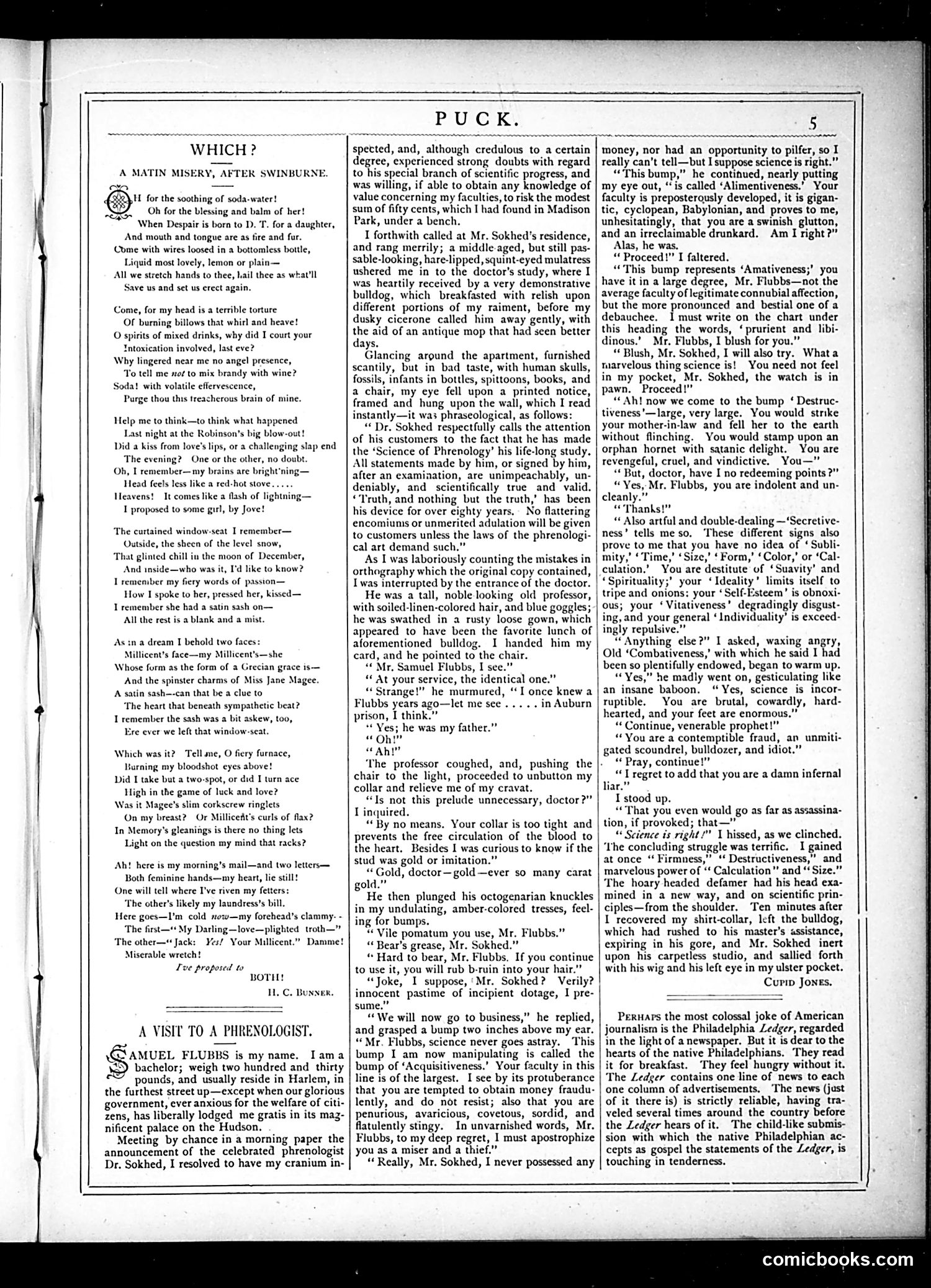
This page contains two satirical pieces from Puck magazine: 1. **"A Matin Misery, After Swinburne"** (top): A poem mocking overly sentimental Victorian poetry, likely parodying Algernon Charles Swinburne's ornate romantic style. It humorously catalogs domestic annoyances (hangover, noise, etc.) in grandiose language to ridicule the era's affected literary conventions. 2. **"A Visit to a Phrenologist"** (bottom): A humorous sketch about Samuel Flubbs visiting Dr. Sokhed, a phrenologist (someone claiming to read character through skull bumps). The doctor insults Flubbs extensively while examining his head, telling him he's a coward, fool, and miser. The satire targets both phrenology—a now-discredited pseudoscience popular in the 19th century—and the pretentiousness of practitioners who used it to disparage clients while charging fees.
📄 Transcribed text from this page (OCR, searchable)
Machine-transcribed from the original scan — historical spelling and the odd misread are preserved.
WHICH ? A MATIN MIS AETER SWINBUR: val @)" for the soothing of soda-water! Bs Oh for the blessing and balm of her! When Despair is born to D. ‘T. for a daughter, And mouth and tongue are as fire and fur. Come with wires loosed in a bottomless bottle, Liquid most lovely, lemon or plain— All we stretch hands to thee, hail thee as what'll Save us and set us erect again. Come, for my head is a terrible torture OF burning billows that whirl and heave! O spirits of mixed drinks, why did I court your Intoxication involved, last eve? Why lingered near me no angel presence, To tell me of to mix brandy with wine? Soda! with volatile effervescence, Purge thou this treacherous brain of mine. Help me to think—to think what happened Last night at the Robinson's big blow-out! Did a kiss from love's lips, or a challenging slap end The evening? One or the other, no doubt. Ob, I remember—my brains are bright'ni Head feels less like a red-hot stove Heavens! It comes like a flash of lightning— I proposed to some girl, by Jove! ‘The curtained window-seat I remember— Outside, the sheen of the level snow, That glimted chill in the moon of December, Je —who was it, I'd like to know? I remember my fiery words of passton— How I spoke to her, pressed her, kissed — I remember she had a satin sash on— All the rest is a blank and a mist. And 1 As ina dream I behold two faces: Millicent’s face—my Millicent’s—she Whose form as the form of a Grecian grace is— And the spinster charms of Miss Jane Magee. A satin sash—-can that be a clue to ‘The heart that beneath sympathetic beat? I remember the sash was a bit askew, too, Ere ever we left that window-seat. Which was it? Tell me, O fiery furnace, Hurning my bloodshot eyes above! Did I take but a two-spot, or did I turn ace High in the game of luck and love? Was it Magee’s slim corkscrew ringlets On my breast? Or Milliceat’s curls of flax? In Memory’s gleaniags is there no thing lets Light on the question my mind that racks? Ab! here is my morning’s mail—and two letters— Both feminine hands—my heart, lie still! One will tell where I've riven my fetter ‘The other's likely my laundress’s bill. Here gocs—I’m cold now—my forehead’s clammy- - The first—* My Darling—love—plighted troth—” ‘The other—* Jack: Yes! Your Millicent.” Damme! Miserable wretch! Lve proposed to BOTH! 11, C. Bunxer. A VISIT TO A PHRENOLOGIST. GS AMUEL FLUBBS is my name. Iama ) bachelor; weigh two hundred and thirty © pounds, and usually reside in Harlem, in the furthest street up—except when our glorious government, ever anxious for the welfare of citi- zens, has liberally lodged _me gratis in its mag- nificent palace on the Hudson. Meeting by chance in a morning paper the announcement of the celebrated phrenologist Dr. Sokhed, I resolved to have my cranium in- spected, and, although credulous to a certain degree, experienced strong doubts with regard to his special branch of scientific progress, and was willing, if able to obtain any knowledge of value concerning my faculties, to risk the modest sum of fifty cents, which I had found in Madison Park, under a bench, I forthwith called at Mr. Sokhed’s residence, and rang merrily; a middle-aged, but still pas- sable-looking, hare-lipped, squint-eyed mulatress ushered me in to the doctor's study, where I was heartily received by a very demonstrative bulldog, which breakfasted with relish upon different portions of my raiment, before my dusky cicerone called him away gently, with the aid of an antique mop that had scen better days. ncing around the apartment, furnished but in bad taste, with human skulls, fossils, infants in bottles, spittoons, books, and a chair, my eye fell upon a printed notice, framed and hung upon the wall, which I read instantly—it was phraseological, as follows: “Dr. Sokhed respectfully calls the attention of his customers to the fact that he has made the ‘Science of Phrenology’ his life-long study. All statements made by him, or signed by him, after an examination, are unimpeachably, un- deniably, and scientifically true and valid. «Truth, and nothing but the truth,’ has been his device for over eighty years. No flattering encomiumis or unmerited adulation will be given to customers unless the laws of the phrenologi- cal art demand such,” As I was laboriously counting the mistakes in orthography which the original copy contained, I was interrupted by the entrance of the doctor. He was a tall, noble looking old professor, with soiled-linen-colored hair, and blue goggles; he was swathed in a rusty loose gown, which appeared to have been the favorite lunch of aforementioned bulldog. I handed him my card, and he pointed to the chair. “« Mr, Samuel Flubbs, I see."” ‘At your service, the identical one.” “Strange!” he murmured, “I once knew a Flubbs years ago—let me see... . . in Auburn prison, I think.” “Yes; he was my father.” ‘The professor coughed, and, pushing the |- chair to the light, proceeded to unbutton my collar and relieve me of my cravat. “Is not this prelude unnecessary, doctor?” I inquired. “By no means. Your collar is too tight and prevents the free circulation of the blood to the heart, Besides I was curious to know if the stud was gold or imitation.” “Gold, doctor—gold—ever so many carat gold.” He then plunged his octogenarian knuckles in my undulating, amber-colored tresses, feel- ing for bumps. “Vile pomatum you use, Mr. Flubbs.” “Bear's grease, Mr. Sokhed.”” “ Hard to bear, Mr. Flubbs. If you continue to use it, you will rub b-ruin into your hair.” Joke, I suppose, ‘Mr. Sokhed? Verily? innocent pastime of incipient dotage, I pre- sume.” Ve will now go to business,” he replied, and grasped a bump two inches above my ear. “Mr. Flubbs, science never goes astray. This bump I am now manipulating is called the bump of ‘Acquisitiveness.’ Your faculty in this line is of the largest. I see by its protuberance that you are tempted to obtain money fraudu- lently, and do not resist; also that you are penurious, avaricious, covetous, sordid, and flatulently stingy. In unvarnished words, Mr. Flubbs, to my deep regret, 1 must apostrophize you as a miser and a thief.” “Really, Mr. Sokhed, I never possessed any money, nor had an opportunity to pilfer, so I really can’t tell—but I suppose science is right.” “This bump,” he continued, nearly putting my eye out, ‘is called ‘Alimentiveness.’ Your faculty is preposterously developed, it is gigan- tic, cyclopean, Babylonian, and proves to me, unhesitatingly, that you are a swinish glutton, and an irreclaimable drunkard. Am I right?” Alas, he was. “Proceed!” I faltered. “This bump represents ‘Amativeness;’ you have it in a large degree, Mr. Flubbs—not the average faculty of legitimate connubial affection, but the more pronounced and bestial one of a debauchee. 1 must write on the chart under this heading the words, ‘prurient and libi- dinous.’ Mr. Flubbs, I blush for you.” “Blush, Mr. Sokhed, I will also try. What a tuarvelous thing science is! You need not feel in my pocket, Mr. Sokhed, the watch is in pawn. Proceed!” “Ah! now we come to the bump ‘ Destruc- tiveness’—large, very large. You would strike your mother-in-law and fell her to the earth without flinching. You would stamp upon an orphan hornet with satanic delight. You are revengeful, cruel, and vindictive. You “But, doctor, have I no redeeming points “Yes, Mr. Flubbs, you are indolent and un- cleanly.” “Thanks!” “ Also artful and double-dealing —‘Secretive- ness’ tells me so. These different signs also prove to me that you have no idea of ‘ Subli- mity,’ ‘Time,’ ‘Size,’ ‘Form,’ ‘Color,’ or ‘Cal- culation,’ You are destitute of ‘Suavity’ and ‘Spirituality;’ your ‘Ideality’ limits itself to tripe and onions: your ‘Self-Esteem’ is obnoxi- ous; your ‘Vitativeness’ degradingly disgust- ing, and your general ‘Individuality’ is exceed- ingly repulsive.” “Anything else?” I asked, waxing angry, Old ‘Combativeness,’ with which he said I had been so plentifully endowed, began to warm up. “Yes,” he madly went on, gesticulating like an insane baboon. “Yes, science is incor- ruptible, You are brutal, cowardly, hard- hearted, and your feet are enormous.” “Continue, venerable prophet!” “You are a contemptible fraud, an unmiti- gated scoundrel, bulldozer, and idiot.” “ Pray, continue!” “T regret to add that you are a damn infernal liar.” I stood up. “That you even would go as far as assassina- tion, if provoked; that—' “ Science is right!" I hissed, as we clinched. ‘Phe concluding struggle was terrific. I gained at once ‘ Firmness,” ‘ Destructiveness,” and marvelous power of ‘ Calculation” and “Size.” The hoary headed defamer had his head exa- mined in a new way, and on scientific prin- ciples—from the shoulder. Ten minutes after I recovered my shirt-collar, left the bulldog, which had rushed to his master’s assistance, expiring in his gore, and Mr. Sokhed inert upon his carpetless studio, and sallied forth with his wig and his left eye in my ulster pocket. Curip Jones. Pernars the most colossal joke of American journalism is the Philadelphia Ledger, regarded in the light of anewspaper. But it is dear to the hearts of the native Philadelphians. They read it for breakfast. They feel hungry without it. The Ledger contains one line of news to each one column of advertisements. The news (just of it there is) is strictly reliable, having tra- veled several times around the country before the Ledger hears of it. The child-like submis- sion with which the native Philadelphian ac- cepts as gospel the statements of the Ledger, is touching in tenderness. . comicbooks.com