
Puck, 1878-08-21 · page 12 of 16
Puck — August 21, 1878 — page 12: what you’re looking at
What you’re looking at
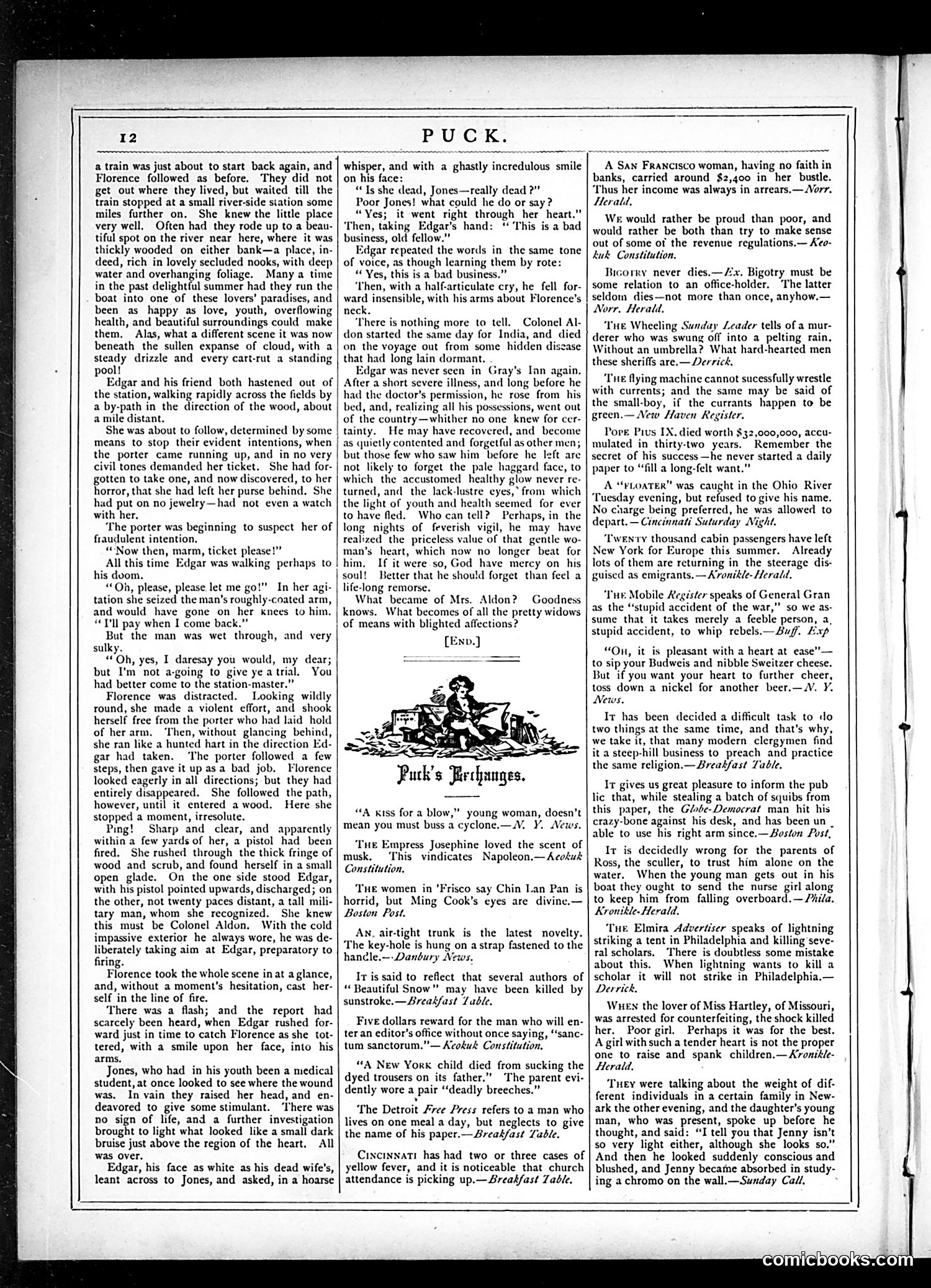
This page contains satirical commentary and short humorous pieces typical of Puck magazine, rather than a single political cartoon. The visible illustration titled "Puck's Beginnings" depicts a cherub or cupid figure in classical style. The text includes various brief satirical items mocking contemporary figures and situations. References include mentions of Edgar (apparently a deceased romantic figure), Mrs. Aldon, and various social situations. The pieces employ Puck's characteristic approach: witty, sometimes caustic commentary on everyday life and society. Without clearer identification of specific individuals or dated events in the visible text, the precise political targets remain unclear. The humor appears focused on social manners, relationships, and human foibles rather than major political events.
📄 Transcribed text from this page (OCR, searchable)
Machine-transcribed from the original scan — historical spelling and the odd misread are preserved.
12 a train was just about to start back again, and Florence followed as before. They did not get out where they lived, but waited till the train stopped at a small river-side siation some miles further on. She knew the little place very well, Often had they rode up to a beau- tiful spot on the river near here, where it was thickly wooded on either bank—a place, in- deed, rich in lovely secluded nooks, with deep water and overhanging foliage. Many a time in the past delightful summer had they run the boat into one of these lovers’ paradises, and been as happy as love, youth, overflowing health, and beautiful surroundings could make them, Alas, what a different scene it was now beneath the sullen expanse of cloud, with a steady drizzle and every cart-rut a standing pool! Edgar and his friend both hastened out of the station, walking rapidly across the fields by a by-path in the direction of the wood, about a mile distant. She was about to follow, determined by some | means to stop their evident intentions, when the porter came running up, and in no very civil tones demanded her ticket. She had for- gotten to take one, and now discovered, to her horror, that she had left her purse behind. She had put on no jewelry—had not even a watch with her, ‘The porter was beginning to suspect her of fraudulent intention, ““Now then, marm, ticket please!”” All this time Edgar was walking perhaps to his doom. “Oh, please, please let me go!” In her agi- tation she seized the man’s roughly-coated arm, and would have gone on her knees to him. “Tl pay when I come back.” But the man was wet through, and very sulky. “Oh, yes, I daresay you would, my dear; but I'm not a-going to give ye atrial, You had better come to the station-master.”” Florence was distracted. Looking wildly round, she made a violent effort, and shook herself free from the porter who had laid hold of herarm, ‘Then, without glancing behind, she ran like a hunted hart in the direction Ed- gar had taken. ‘The porter followed a few steps, then gave it up as a bad job. Florence looked eagerly in all directions; but they had entirely disappeared. She followed the path, however, until it entered a wood. Here she stopped a moment, irresolute. Ping! Sharp and clear, and apparently within a few yards of her, a pistol had been fired. She rushed through the thick fringe of wood and scrub, and found herself in a small open glade. On the one side stood Edgar, with his pistol pointed upwards, discharged; on the other, not twenty paces distant, a tall mili- tary man, whom she recognized. She knew this must be Colonel Aldon, With the cold impassive exterior he always wore, he was de- liberately taking aim at Edgar, preparatory to firing. Florence took the whole scene in at a glance, and, without a moment’s hesitation, cast her- self in the line of fire. There was a flash; and the report had scarcely been heard, when Edgar rushed for- ward just in time to catch Florence as she tot- tered, with a smile upon her face, into his arms. Jones, who had in his youth been a medical student, at once looked to see where the wound was. In vain they raised her head, and en- deavored to give some stimulant. ‘There was no sign of life, and a further investigation brought to light what looked like a small dark bruise just above the region of the heart. was over. Edgar, his face as white as his dead wife's, leant across to Jones, and asked, in a hoarse All whisper, and with a ghastly incredulous smile on his face: “Is she dead, Jones—really dead ?” Poor Jones! what could he do or say? “Yes; it went right through her heart.” ‘Then, taking Edgar’s hand: This is a bad business, old fellow.” Edgar repeated the words in the same tone of voice, as though learning them by rote: “Yes, this is a bad business.” ‘Then, with a half-articulate cry, he fell for- ward insensible, with his arms about Florence's neck, ‘There is nothing more to tell. Colonel Al- don started the same day for India, and died on the voyage out from some hidden disease that had long lain dormant. Edgar was never seen in Gray's Inn again. After a short severe illness, and long before he had the doctor's permission, he rose from his bed, and, realizing all his possessions, went out of the country—whither no one knew for cer- tainty. He may have recovered, and become as quietly contented and forgetful as other men; but those few who saw him before he left are not likely to forget the pale haggard face, to which the accustomed healthy glow never re- turned, and the lack-lustre cyes,* from which the light of youth and health seemed for ever to have fled. Who can tell? Perhaps, in the long nights of feverish vigil, he may have realized the priceless value of that gentle wo- man’s heart, which now no longer beat for him. If it were so, God have mercy on his soul! Better that he should forget than feel a life-long remorse. What became of Mrs. Aldon? Goodness knows. What becomes of all the pretty widows of means with blighted affections? [Exp] Sy ge oe Puck's Firchanges, “A kiss for a blow,” young woman, doesn’t mean you must buss a cyclone—V, ¥. News. ‘Tne Empress Josephine loved the scent of musk. ‘This vindicates Napoleon.—Acokuk Constitution, ‘Tue women in "Frisco say Chin Lan Pan is horrid, but Ming Cook’s eyes are divine.— Boston Post. AN, air-tight trunk is the latest novelty. The key-hole is hung on a strap fastened to the handle.—-Danbury News, Ir is said to reflect that several authors of “ Beautiful Snow” may have been killed by sunstroke.—Breakfast Table. Five dollars reward for the man who will en- teran editor’s office without once saying, ‘‘sanc- tum sanctorum.”— Acokuk Constitution, “A New York child died from sucking the dyed trousers on its father.” The parent evi- dently wore a pair “deadly breeches.” ‘The Detroit Free Press refers to a man who lives on one meal a day, but neglects to give the name of his paper.— Breakfast Table, Cincinnati has had two or three cases of yellow fever, and it is noticeable that church attendance is picking up.— Breakfast Zable. A Saw Francisco woman, having no faith in banks, carried around $2,400 in her bustle. ‘Thus her income was always in arrears.—Norr. Herald, We would rather be proud than poor, and would rather be both than try to make sense out of some of the revenue regulations.— Aco- kuk Constitution, Bicorny never dies.—/x. Bigotry must be some relation to an office-holder. ‘The latter seldom dies—not more than once, anyhow.— Norr. Herald. ‘Te Wheeling Sunday Leader tells of a mur- derer who was swung off into a pelting rain, Without an umbrella? What hard-hearted men these sheriffs are.— Derrick, 1e flying machine cannot sucessfully wrestle with currents; and the same may be said of the small-boy, if the currants happen to be green.— New Haven Register. Pore Pius IX. died worth $32,000,000, accu- mulated in thirty-two years. Remember the secret of his success —he never started a daily paper to “fill a long-felt want.”” A “eLoaTeR” was caught in the Ohio River ‘Tuesday evening, but refused to give his name. No charge being preferred, he was allowed to depart. — Cincinnati Suturday Night. ‘Twenty thousand cabin passengers have left New York for Europe this summer. Already lots of them are returning in the steerage dis- guised as emigrants, —Avonikle- Herald. TH as the “stupid accident of the war,” so we as- sume that it takes merely a feeble person, a, stupid accident, to whip rebels.— Buf. Exp Mobile Register speaks of General Gran “On, it is pleasant with a heart at ease”— to sip your Budweis and nibble Sweitzer cheese. But if you want your heart to further cheer, toss down a nickel for another beer.—. Y. News. Ir has been decided a difficult task to do two things at the same time, and that's why, we take it, that many modern clergymen find it a steep-hill business to preach and practice the same religion.— Breakfast Table. Ir gives us great pleasure to inform the pub lic that, while stealing a batch of squibs from this paper, the Globe- Democrat man hit his crazy-bone against his desk, and has been un _ able to use his right arm since.—Boston Post, Ir is decidedly wrong for the parents of Ross, the sculler, to trust him alone on the water. When the young man gets out in his boat they ought to send the nurse girl along to keep him from falling overboard.— ila. Kronikle-Herald. ‘Tue Elmira Advertiser speaks of lightning striking a tent in Philadelphia and killing seve- ral scholars. There is doubtless some mistake about this. When lightning wants to kil scholar it will not strike in Philadelphi: Derrick. Wuen the lover of Miss Hartley, of Missouri, was arrested for counterfeiting, the shock killed her. Poor girl. Perhaps it was for the best. A girl with such a tender heart is not the proper one to raise and spank children.—Kvonikle- Herald, ‘Tuey were talking about the weight of dif- ferent individuals in a certain family in New- ark the other evening, and the daughter's young man, who was present, spoke up before he thought, and said: “I tell you that Jenny isn’t so very light either, although she looks so.” And then he looked suddenly conscious and blushed, and Jenny became absorbed in study- ing a chromo on the wall.— Sunday Call, [eee