
A complete issue · 16 pages · 1878
Puck — July 17, 1878
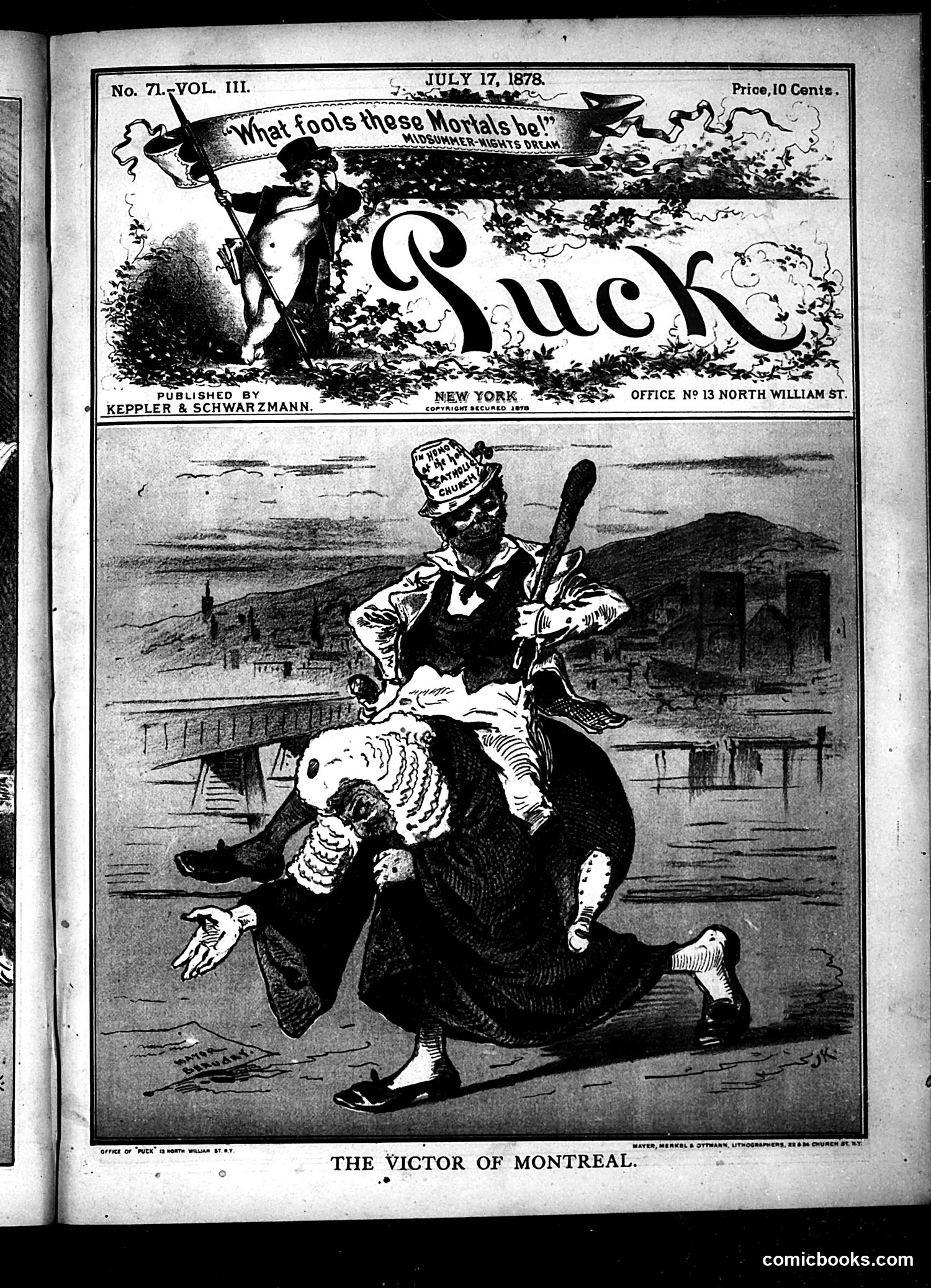
This cartoon satirizes a figure labeled "Victor of Montreal" who appears to be a pompous politician or military leader. He's depicted riding an elephant (representing political power or influence) while wielding a baseball bat, suggesting he's using force or aggression for personal gain. The hat reads what appears to be a political or civic title. The satire likely mocks someone who achieved a contested victory in Montreal—possibly in an election or civic matter—and is now boasting about their triumph while riding on something unwieldy and potentially dangerous. The baseball bat reinforces the image of crude, aggressive tactics rather than legitimate governance. Without more context about Montreal politics in 1878, the specific target remains unclear, but the cartoon critiques opportunistic use of power.
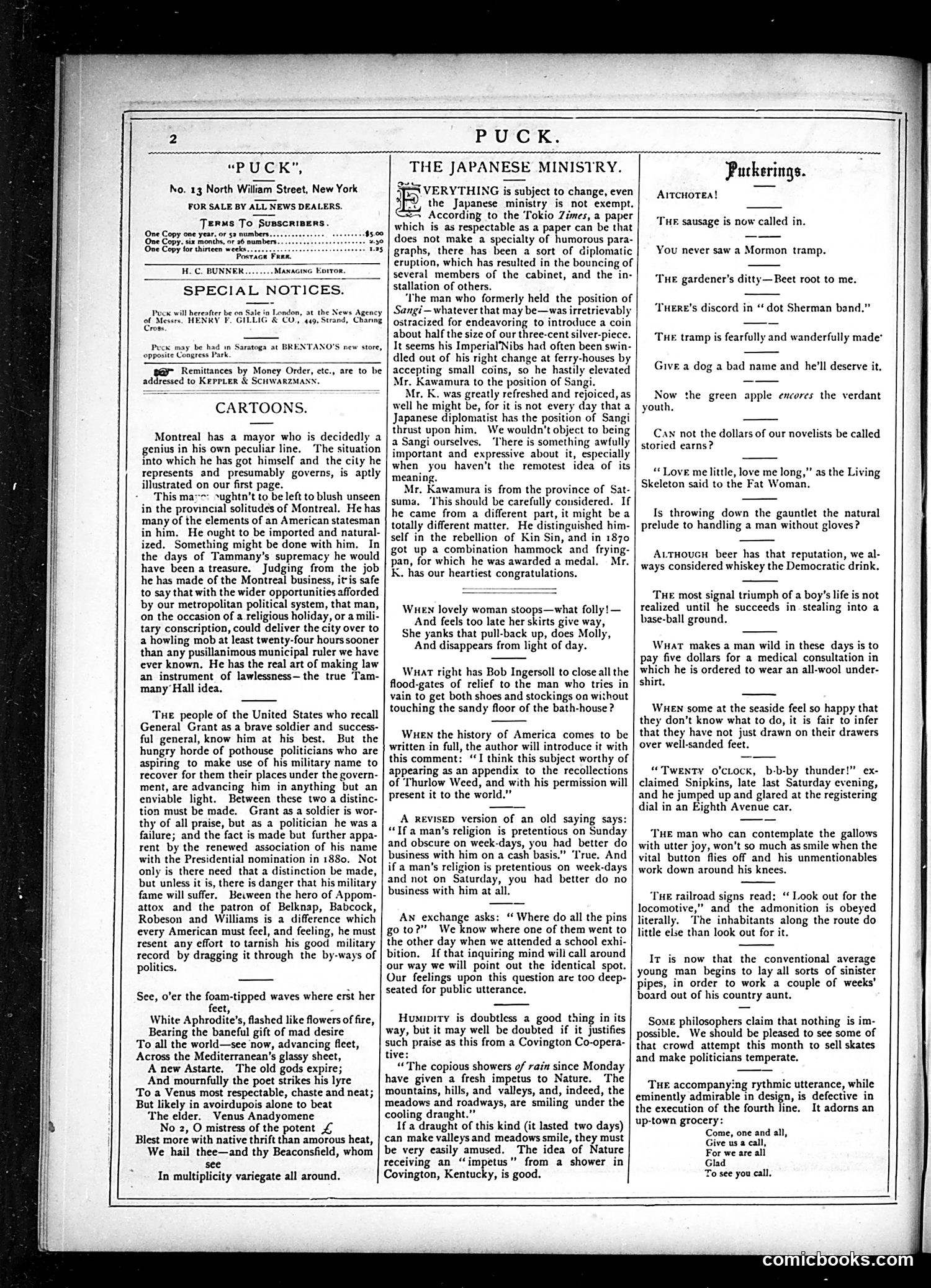
This page consists primarily of **text content rather than cartoons**: a "Special Notices" section, several humorous short items labeled "Puckerings," and importantly, a substantial article titled "THE JAPANESE MINISTRY" discussing political upheaval in Japan's government. The article references a former official named Sangi who was "elevated" to a different position, and mentions Mr. Kawamura from Satsuma province. It critiques Japan's political instability and ministerial changes. The "Puckerings" section contains brief satirical quips on American topics—Mormon traps, Sherman's discord, novelists' earnings, whiskey, baseball, and politics. **Without visible cartoon illustrations, the satire operates through punchy text commentary** on contemporary American and international affairs rather than visual caricature.
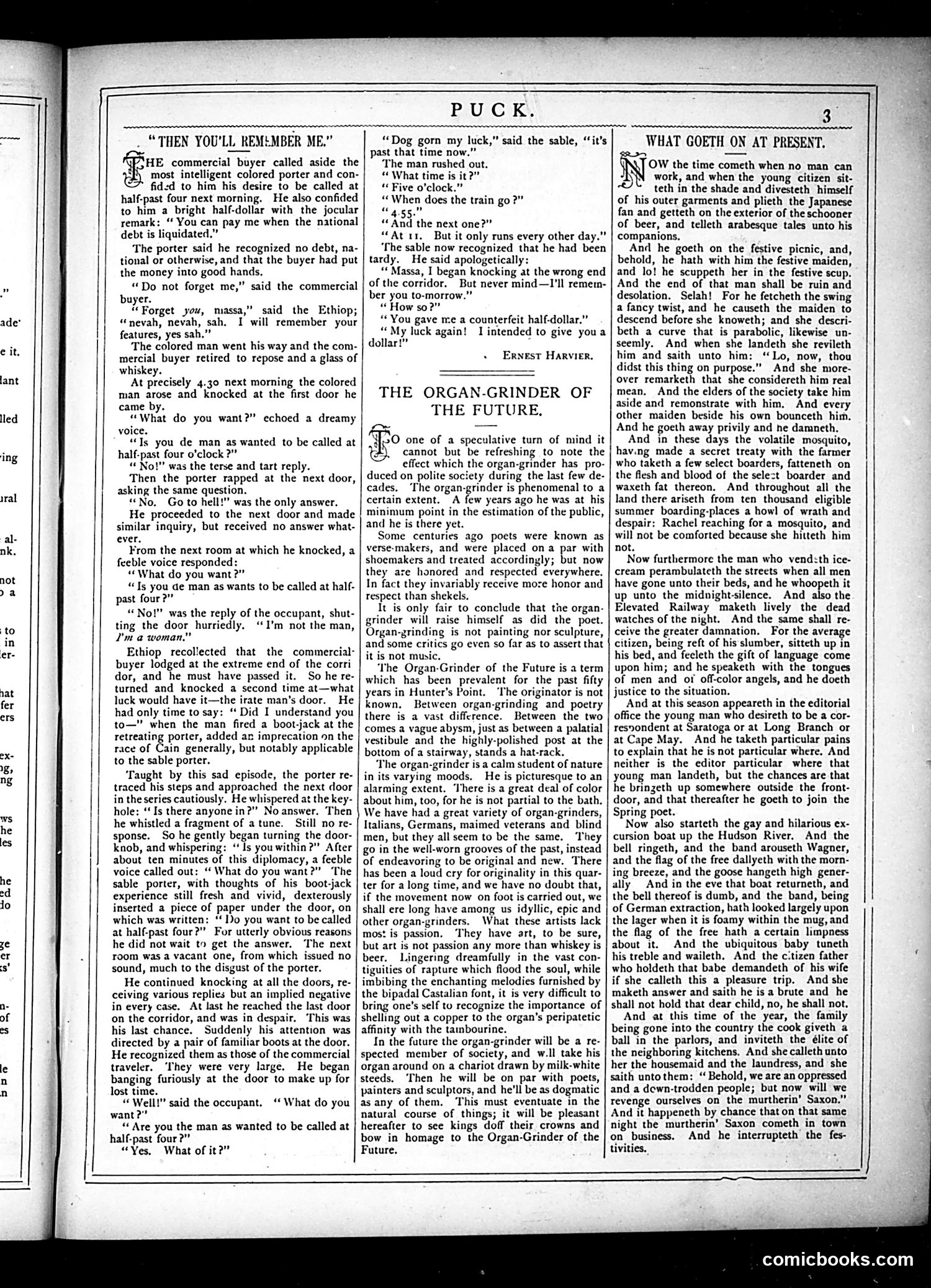
This page contains two distinct pieces: a humorous dialogue on the left and a satirical essay on the right titled "The Organ-Grinder of the Future." **Left column:** A comedic exchange between a sable (fur seller) and a colored porter negotiating over payment for an allegedly "counterfeit half-dollar." The joke plays on racial stereotypes and dialect humor common to late-19th-century American comedy, involving misunderstandings about currency and employment. **Right column:** "The Organ-Grinder of the Future" satirizes upper-class social pretension. It suggests that organ-grinders—street musicians of low social status—will eventually become respected members of society, attending fashionable balls and being honored by the wealthy. The satire mocks both the absurdity of elevating such humble workers and contemporary society's arbitrary class distinctions, using exaggerated social climbing as the humor.
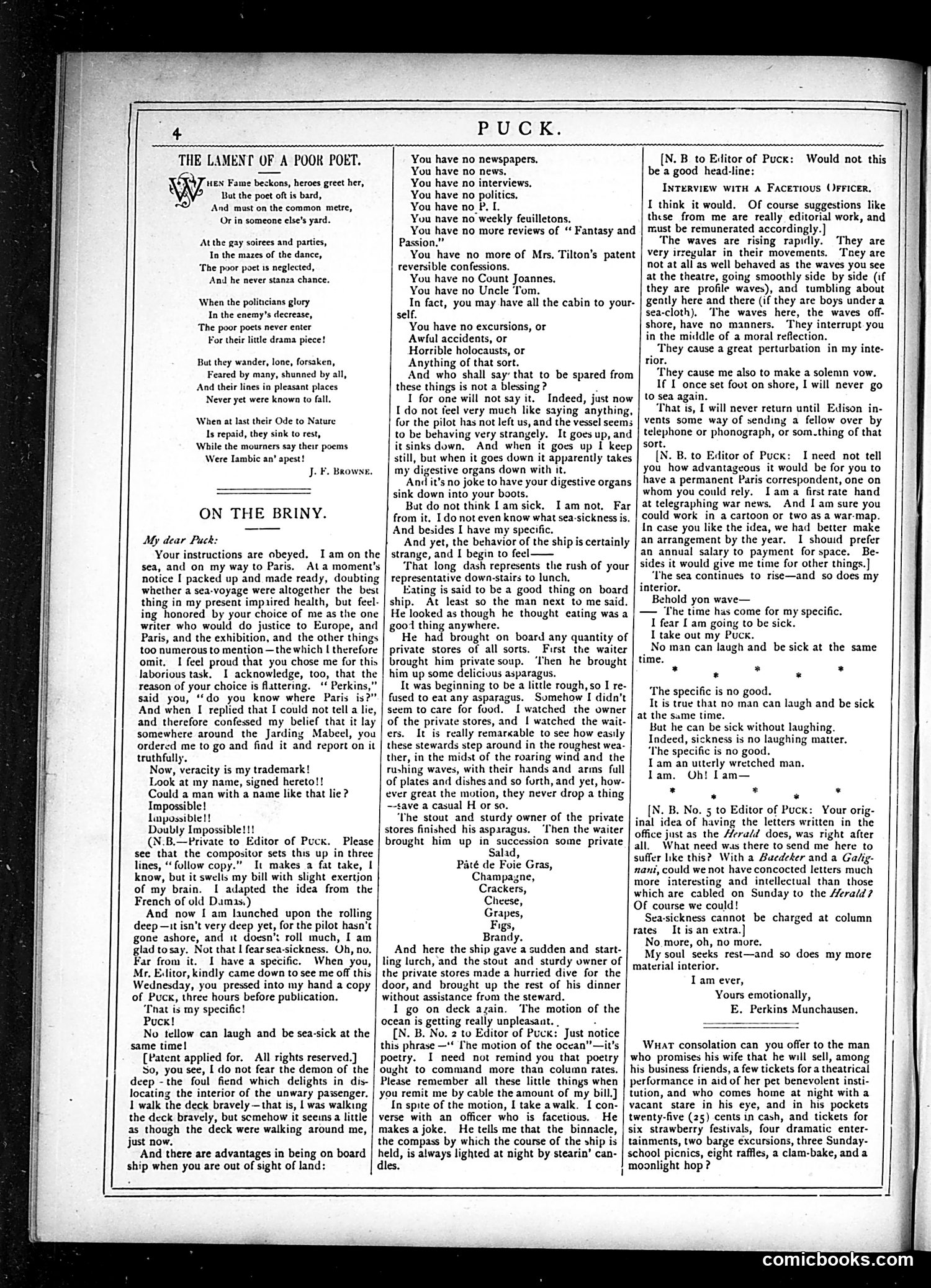
This satirical poem mocks the difficult circumstances of struggling writers in the late 19th century. The poet laments having "no newspapers," "no news," "no interviews," and crucially, "no more reviews of 'Fantasy' and 'Tragedy.'" The satire targets the publishing industry's indifference to poor poets—they're excluded from the social and professional networks that sustain literary careers. References to lacking "Uncle Tom" and missing "excursions" suggest the poet is excluded from both commercial success and social circles. The piece satirizes how fame, critical attention, and even basic professional opportunities depend on connections and patronage rather than merit. It's a commentary on the gatekeeping mechanisms of the literary establishment that left many writers economically marginalized and professionally invisible.
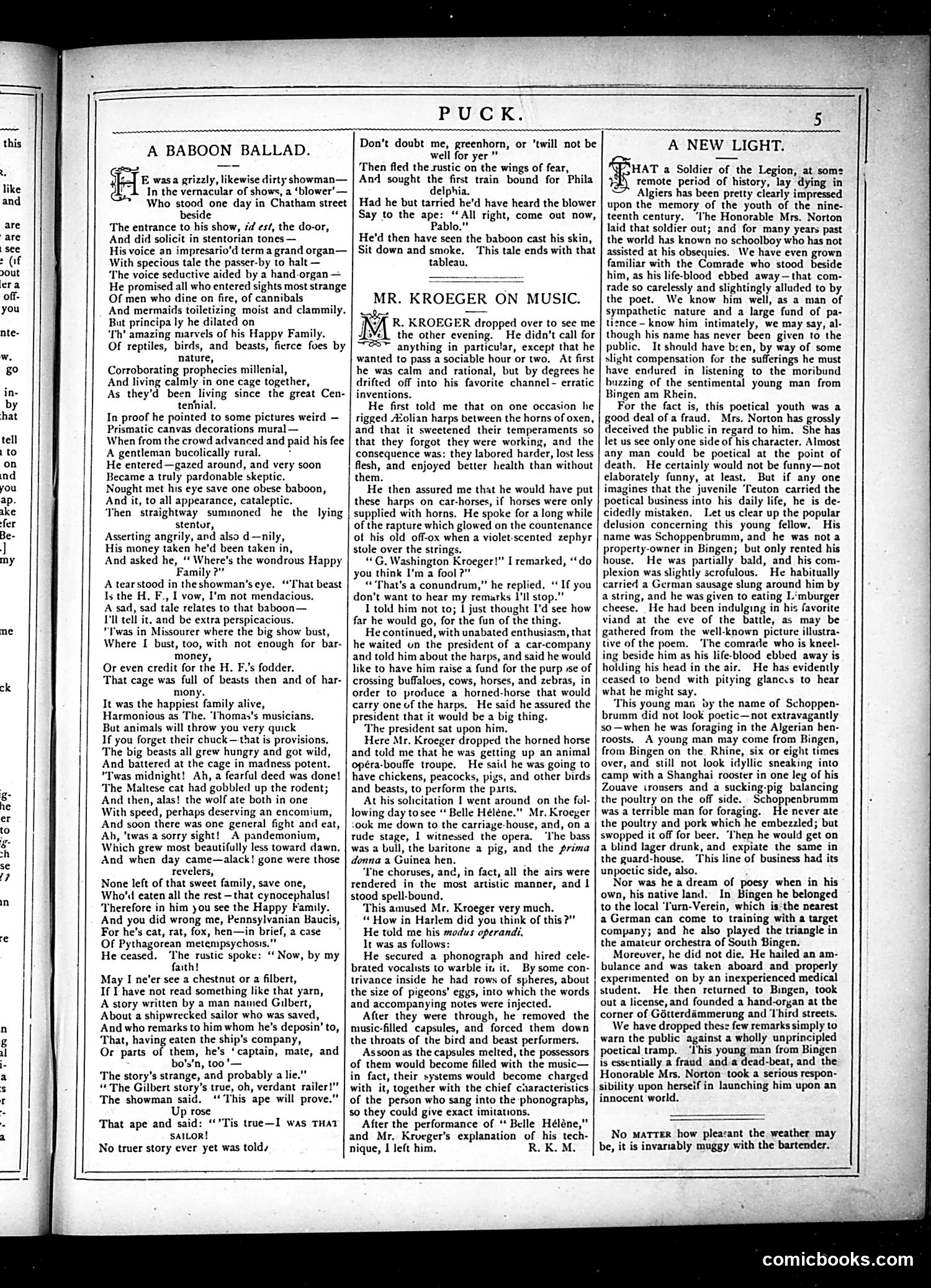
This page contains three distinct pieces: 1. **"A Baboon Ballad"** (left column): A narrative poem satirizing someone's dirty, unkempt appearance and behavior in Chatham Street, describing them as animal-like and ignoble. 2. **"Mr. Kroeger on Music"** (center): A humorous anecdote about a man named Kroeger discussing his eccentric musical inventions and performances, including attempts to create a "horned-horse" act and phonograph recordings. The piece mocks pretentious or absurd musical experimentation. 3. **"A New Light"** (right column): Commentary on a young soldier from the Legion of Honor, praising his character while noting the public was initially deceived about his true nature—apparently criticizing public gullibility or misplaced admiration. The page represents typical Puck content: satirical poetry and anecdotes targeting social types and public follies.
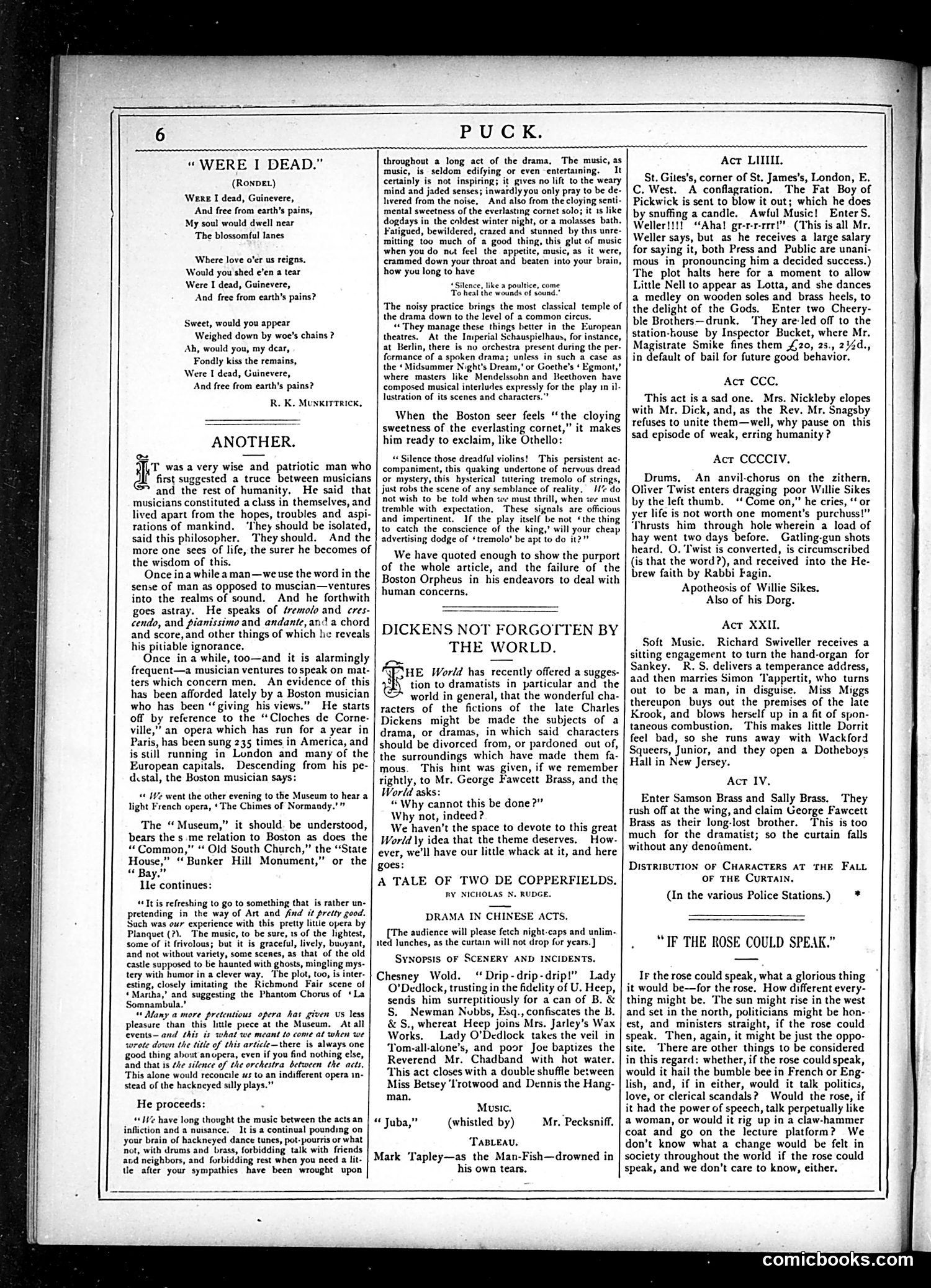
This page contains theatrical reviews and drama critiques rather than political cartoons. The content discusses: **"Dickens Not Forgotten by the World"** - An article proposing that dramatists adapt Charles Dickens characters for stage productions, suggesting this theme deserves theatrical attention. **Various theatrical reviews** including "A Tale of Two Copperflelds" and "If the Rose Could Speak" - These appear to be contemporary Broadway or London stage productions being reviewed and critiqued. **"Drama in Chinese Acts"** - References a theatrical production with Chinese scenery and incidents. The page focuses on entertainment criticism and literary adaptation discussions rather than political satire. Without clear identifying caricatures or political references visible in the readable text, this represents Puck's coverage of contemporary theater and dramatic arts rather than its typical satirical commentary on politics or social issues.
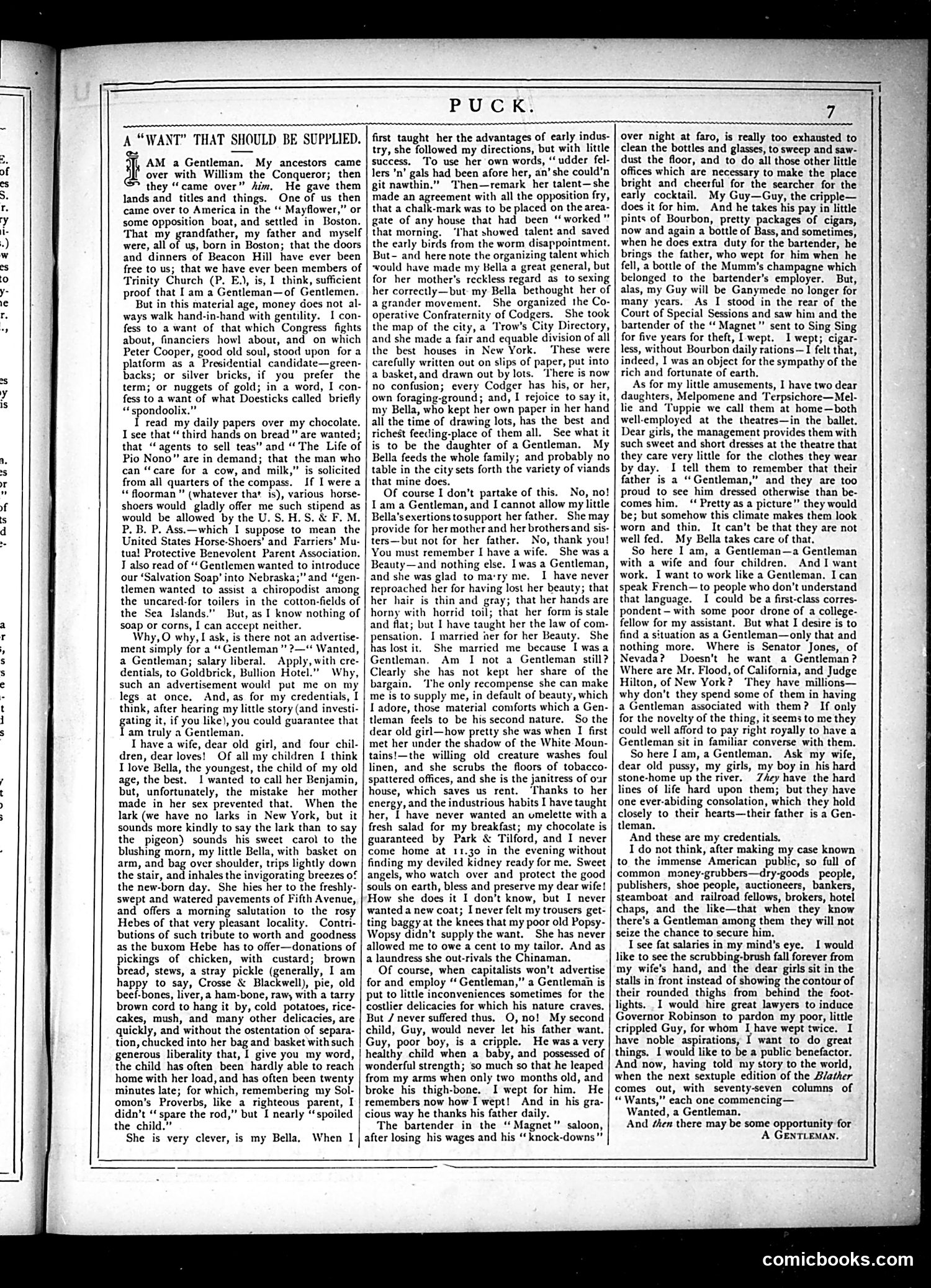
This page contains a lengthy personal essay or letter titled "A 'WANT' THAT SHOULD BE SUPPLIED," not a political cartoon. The author, identifying himself as "A Gentleman," discusses his frustrations with American society and his desire for a properly trained "Gentleman" — someone educated, refined, and equipped to serve as his assistant or companion. He laments that such cultivated men are unavailable, attributing this to America's lack of aristocratic tradition and proper gentleman's training. The piece critiques American materialism and the absence of a leisure class, contrasting this with European societies. It's satirical commentary on American social structure rather than traditional political satire, reflecting Puck's recurring theme of mocking American pretensions and social anxieties during the Gilded Age.
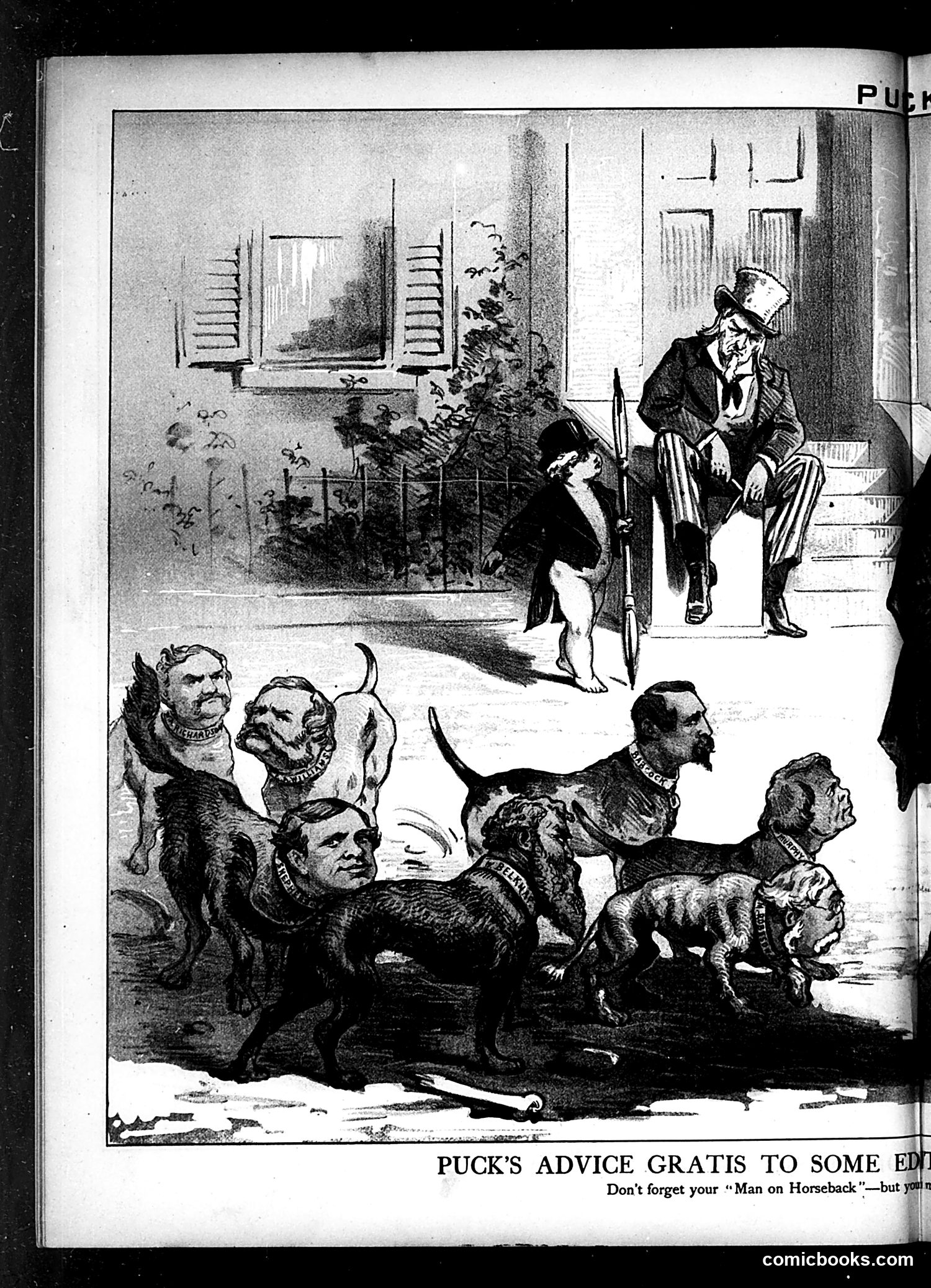
This Puck cartoon satirizes political corruption through animal imagery. The upper portion shows a well-dressed gentleman (likely a politician) receiving a small child on the steps of a building—possibly representing innocence or a constituent. The lower section depicts several dogs with human faces wearing collars, suggesting political "hacks" or corrupt party loyalists controlled like trained animals. The dogs appear to be begging or waiting obediently, implying they follow orders without question. The caption reads "PUCK'S ADVICE GRATIS TO SOME ED[ITORS]" and references "Don't forget your 'Man on Horseback,'" suggesting satire about editorial endorsements and backroom political control. The cartoon critiques how politicians manipulate the press and manage loyal followers without genuine principle or independence.
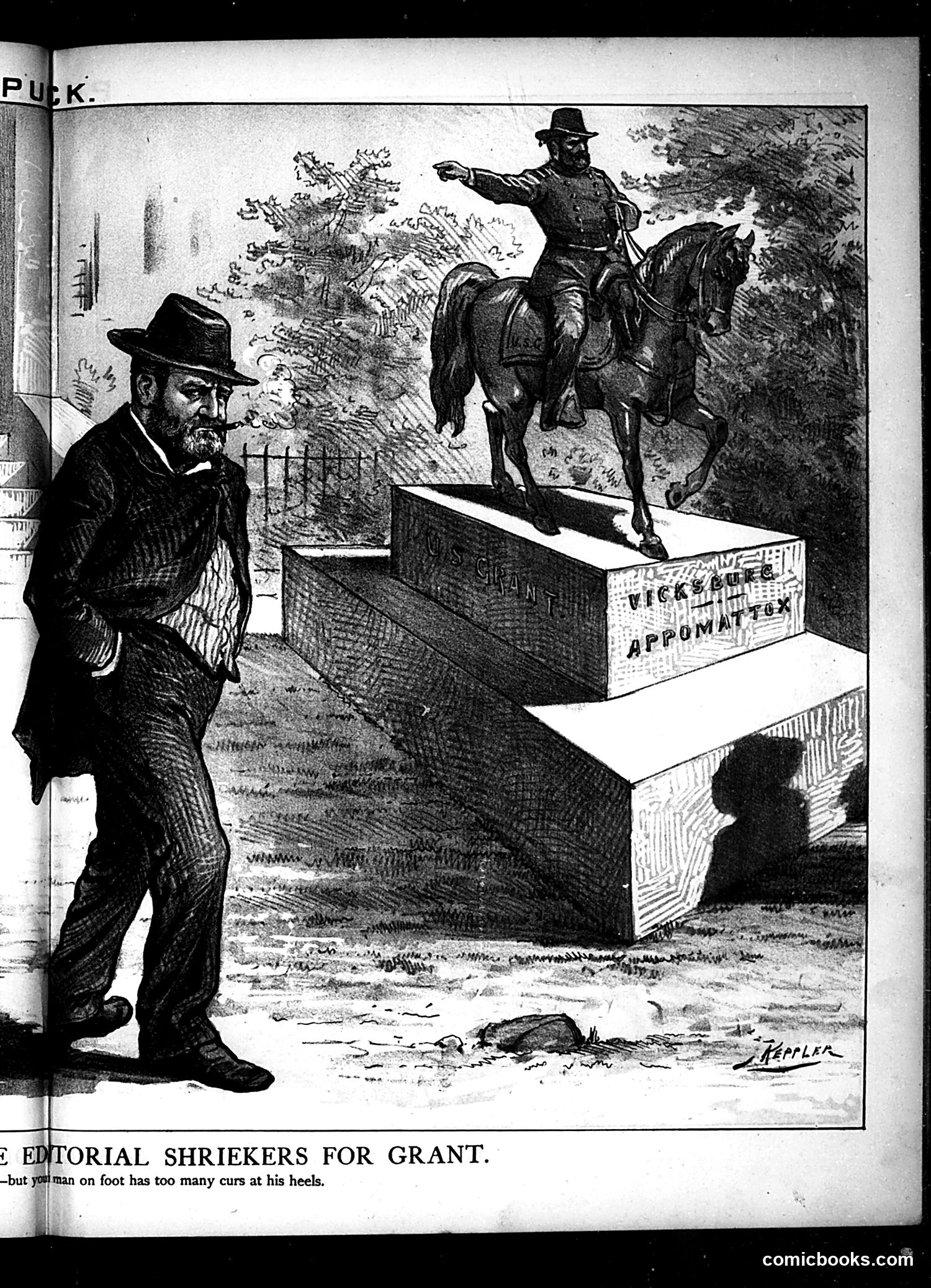
This Puck cartoon satirizes newspaper editors opposing Ulysses S. Grant (likely his presidency or a political campaign). The left figure represents a critical journalist or editor—depicted as anxious and agitated. The right shows Grant as a confident military figure on horseback, riding above a large box labeled "VICKSBURG APPOMATTOX"—referencing his major Civil War victories. The caption reads: "but yet man on foot has too many curs at his heels," suggesting Grant's critics are like bothersome dogs nipping at his feet. The satire mocks editors who shriek opposition to Grant despite his celebrated military record, implying their criticism is petty compared to his accomplishments. The artist uses the contrast between Grant's elevated, authoritative pose and the editor's diminished stance to convey the cartoon's mockery.
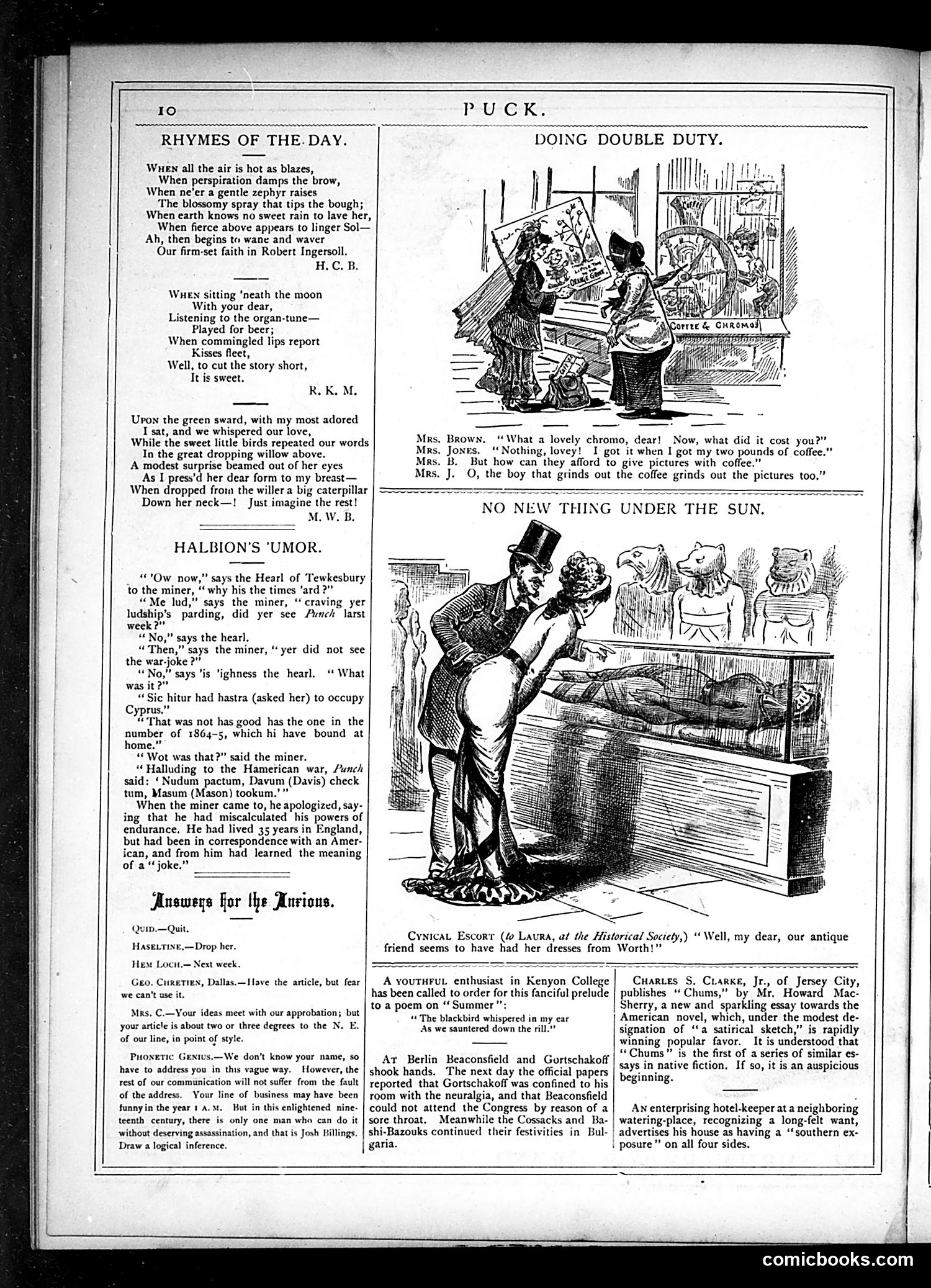
This cartoon satirizes the economic struggles of working-class families. The illustration shows women obtaining chromos (cheap color prints) by collecting coffee grounds—a common depression-era practice where retailers offered premiums for saved packaging. The dialogue reveals the joke: Mrs. Jones obtained her chromolithograph "free" with two pounds of coffee, but the real cost was labor—her son grinds the coffee grounds, making the "free" item actually extracted through his unpaid work. The title "Doing Double Duty" refers to how the boy simultaneously helps his mother acquire goods while performing commercial labor for the coffee company. This mocks both corporate marketing tactics and the economic desperation forcing families to exploit children's labor for basic household items.
This page presents a serialized short story rather than political satire. "Nils Jensen" (credited to "The Cornhill") tells of a Norwegian swimmer rescued from drowning by a farmer's daughter. The narrative focuses on themes of gratitude, class differences, and courtship. Jensen, a young gentleman, recovers at the farmer's home and develops feelings for his rescuer. The story explores social dynamics of the era—the tension between Jensen's refined background and the farmer's family's simpler station, resolved through romantic interest transcending class boundaries. This represents Puck's literary content alongside its famous satirical cartoons, offering serialized fiction to maintain reader engagement between humorous political commentary.
This page contains **no political cartoon**—it's the continuation of a literary story titled "Puck" (visible at the top). The text is a narrative about a character named Nils, a Norwegian artist and peasant who has gained social standing and patronage from Gustav Richardt and the Aandahl family. The story discusses Nils's artistic talents, his painting of Norwegian peasant life and landscapes, and his interactions with wealthy patrons. There are references to his work depicting rural scenes and his growing reputation among the village community. This is a **serialized fiction piece**, not satirical content. It appears to be a romantic or social drama exploring class dynamics and artistic ambition in 19th-century Scandinavia.
This page contains "Puck's Briganties"—a satirical advice column mixing humor with social commentary. The main feature, "The Power of Love," is a poem about romantic devotion. The surrounding brief satirical items mock contemporary issues: watermelon consumption among African Americans ("the Gazette came to us to-day with empty insides"); smoking's health effects; political corruption; and newspaper competition. References include the Springfield *Republican* and *Detroit Free Press*—real newspapers of the era. Items joke about standing in backyards singing, Chicago revenue officers detecting illegal stills, and various social hypocrisies. The tone is light mockery of American institutions, customs, and public figures, typical of Puck's satirical approach to the period's political and social landscape.
This page is primarily **advertising and notices**, not satirical cartoons. The bulk consists of commercial advertisements for products (Apollinaris mineral water, cabinet furniture, dental services, printing inks) and financial instruments (bonds, steamship lines). The only illustrated content appears to be **"Hunyadi János"** — a European novelty product with a portrait — and various company logos and product packaging illustrations. The small editorial items at the top left discuss American clergymen traveling abroad and anecdotes about social situations, but these are brief humorous notes rather than political satire or cartoons. This represents a typical **late 19th-century magazine page** mixing editorial content with paid advertising that funded publication.
This is primarily an **advertising page** from Puck magazine (1878), not a political cartoon page. The page features various commercial advertisements typical of the era, including: - **Lottery advertisements** (Louisiana State Lottery Co.) - **Product ads** (champagne, hats, tailor services, book-binding) - **Puck's own promotional material** for its 1878 Almanac and back issues The only editorial content is the question "WHY IS IT?" at top left—a humorous feature where Puck posed rhetorical questions about society, here about why people crowded dental offices. The page demonstrates how 19th-century magazines like Puck relied heavily on advertising revenue. There are no political cartoons or satirical commentary visible—this was a commercial page designed to generate income for the publisher.
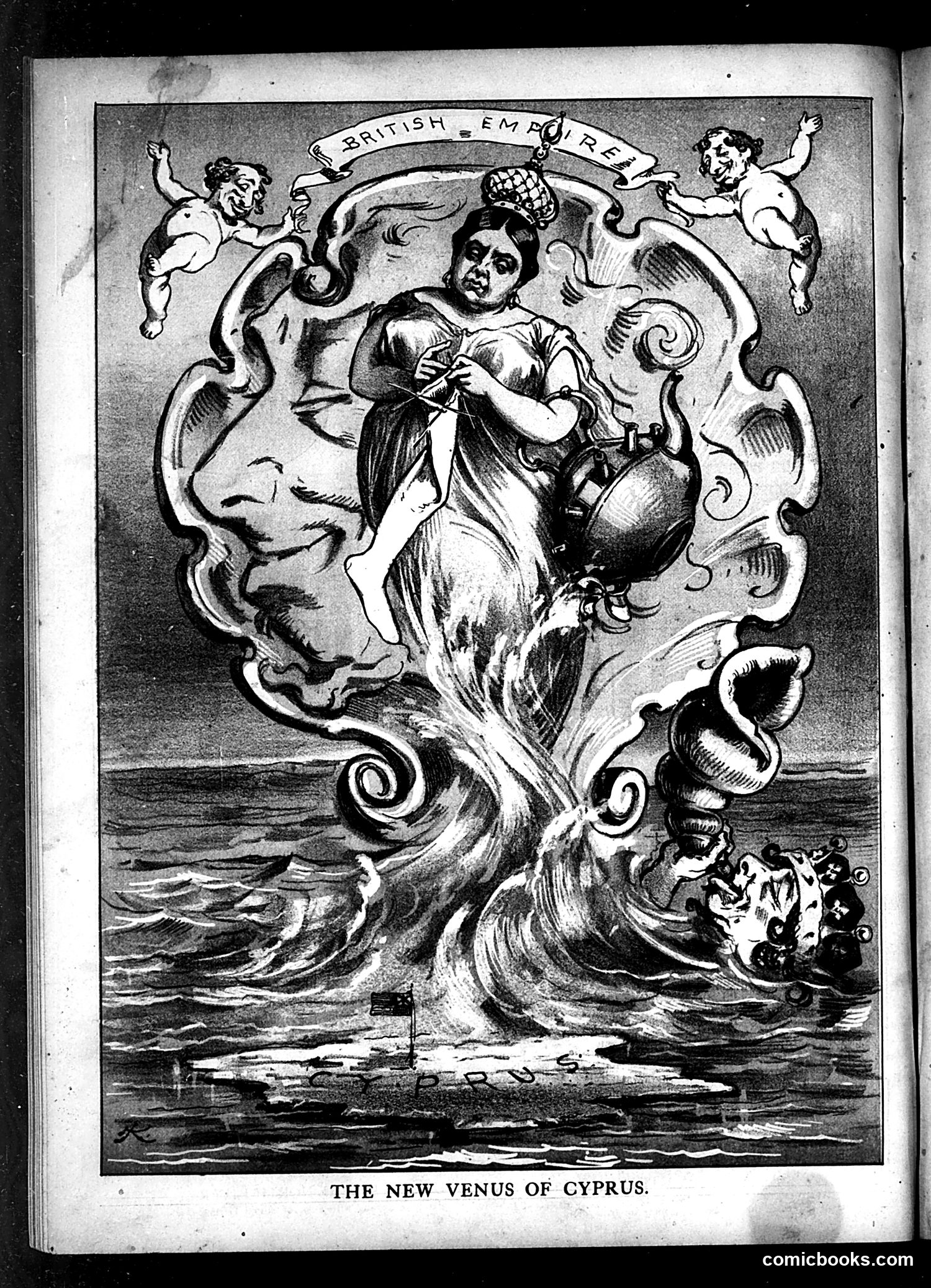
This political cartoon depicts **Britannia** (the female figure representing the British Empire) emerging from the sea, styled after the classical Venus/Aphrodite myth. The banner reads "BRITISH EMPIRE," and cherubs accompany her. The satire likely references **British colonial expansion**, particularly regarding **Cyprus**. The "New Venus" comparison suggests Britain is presenting itself as a civilizing, beautiful force bringing culture and refinement to newly acquired territories. However, the grandiose mythological framing appears **mocking**—Puck is satirizing British imperial rhetoric and self-aggrandizement about colonial acquisition. Without the publication date visible, the specific historical context of Cyprus's colonial status remains unclear, but the cartoon critiques how imperial powers romanticized their territorial expansion as noble or culturally superior endeavors.