
Puck, 1878-07-17 · page 6 of 16
Puck — July 17, 1878 — page 6: what you’re looking at
What you’re looking at
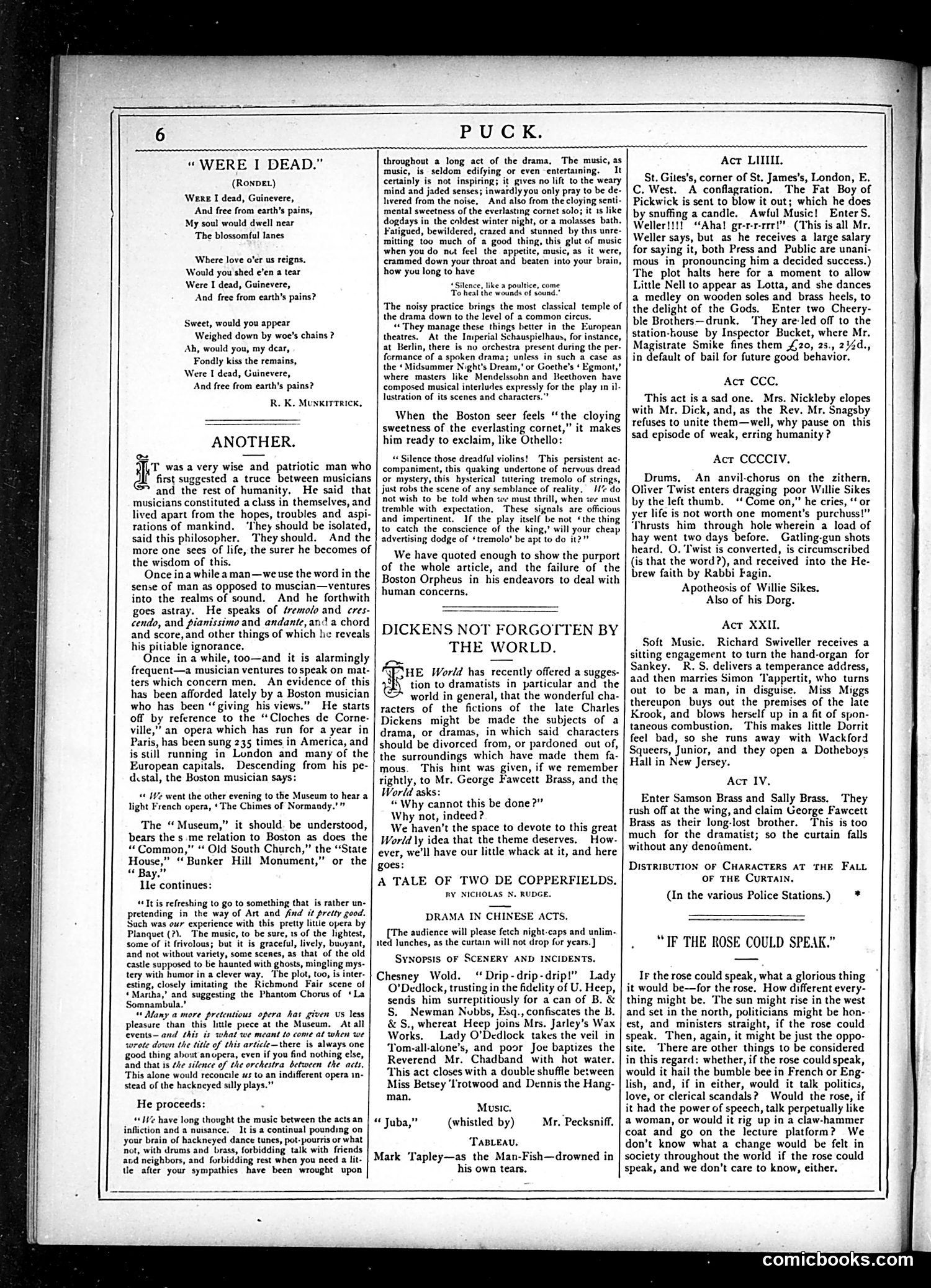
This page contains theatrical reviews and drama critiques rather than political cartoons. The content discusses: **"Dickens Not Forgotten by the World"** - An article proposing that dramatists adapt Charles Dickens characters for stage productions, suggesting this theme deserves theatrical attention. **Various theatrical reviews** including "A Tale of Two Copperflelds" and "If the Rose Could Speak" - These appear to be contemporary Broadway or London stage productions being reviewed and critiqued. **"Drama in Chinese Acts"** - References a theatrical production with Chinese scenery and incidents. The page focuses on entertainment criticism and literary adaptation discussions rather than political satire. Without clear identifying caricatures or political references visible in the readable text, this represents Puck's coverage of contemporary theater and dramatic arts rather than its typical satirical commentary on politics or social issues.
📄 Transcribed text from this page (OCR, searchable)
Machine-transcribed from the original scan — historical spelling and the odd misread are preserved.
PUCK. “WERE I DEAD.” (Rowvet) Were I dead, Guinevere, And free from earth’s pains, My soul would dwell near The blossomful lanes Where love o'er us reigns, Would you shed e’en a tear Were I dead, Guinevere, And free from earth’s pains? Sweet, would you appear Weighed down by woe's chains ? Ah, would you, my dear, Fondly kiss the remains, Were I dead, Guinevere, And free from earth’s pains? R. K. Munxittrick, ANOTHER. =4 ‘T. was a very wise and patriotic man who first suggested a truce between musicians = and the rest of humanity. He said that musicians constituted a class in themselves, and lived apart from the hopes, troubles and_aspi- rations of mankind. ‘I'hey should be isolated, said this philosopher. They should. And the more one sees of life, the surer he becomes of the wisdom of this. Once ina while a man—we use the word in the sense of man as opposed to muscian—ventures into the realms of sound. And he forthwith goes astray. He speaks of ¢remolo and cres- cendo, and pianissimo and andante, an‘ a chord and score, and other things of which he reveals his pitiable ignorance. Once in a while, too—and it is alarmingly frequent—a musician ventures to speak on mat- ters which concern men. An evidence of this has been afforded lately by a Boston musician who has been “giving his views.” He starts off by reference to the “Cloches de Corne- ville,” an opera which has run for a year in Paris, has been sung 235 times in America, and is still running in London and many of the European capitals. Descending from his pe- dcstal, the Boston musician says: ++ We went the other evening to the Museum to hear a light French opera, ‘ The Chimes of Normandy.” The “Museum,” it should. be understood, bears the s me relation to Boston as does the “Common,” “ Old South Church,” the ‘State House,” “Bunker Hill Monument,” or the He continues: “Te is refreshing to go to something that is rather un- pretending in the way of Art and find it pretty good. Such was our experience with this pretty little opera by Planquet (?). The music, to be sure, 1s of the lightest, some of it frivolous; but it is graceful, lively, buoyant, and not without variety, some scenes, as that of the old castle supposed to be haunted with ghosts, mingling mys- tery with humor in a clever way. ‘The plot, too, is inter- esting, closely imitating the Richmond Fair scene of “ Martha,’ and suggesting the Phantom Chorus of ‘La Somnambula.’ “Many a more pretentious opera has given vs less pleasure than this little piece at the Museum. At all events—and this is what we meant to come at when we wrote down the title of this article—there is always one good thing about anopera, even if you find nothing else, and that is the silence of the orchestra between the acts. This alone would reconcile ws to an indifferent opera in- stead of the hackneyed silly plays.” He proceeds: IW’ have long thought the music between the acts an infliction and a nuisance. It is a continual pounding on your brain of hackneyed dance tunes, pot-pourris or what not, with drums and brass, forbidding talk with friends and neighbors, and forbidding rest when you need a lit- Ue after your sympathies have been wrought upon throughout a long act of the drama, The music, as music, is seldom edifying or even entertaining. — It certainly is not inspiring; it gives no lift to the weary mind and jaded senses; inwardly you only pray to be de- wvered from the noise, And also from the cloying senti- mental sweetness of the everlasting cornet solo; it 1s like dogdays in the coldest winter night, or a molasses bath. Fatigued, bewildered, crazed and stunned by this unre- mitting too much of a good thing, this glut of music when you do not feel the appetite, music, as it were, crammed down your throat and beaten into your brain, how you long to have «Silence, like a poultice, come The noisy practice brings the most classical temple of the drama down to the level of a common circus. “They manage these things hetter in the European theatres. At the Imperial Schauspielhaus, for instance, at Berlin, there is no orchestra present during the per- formance of a spoken drama; unless in such a case as the ‘ Midsummer Night's Dream,’ or Goethe's Egmont,’ where masters like Mendelssohn and Beethoven have composed musical interludes expressly for the play in il lustration of its scenes and characters.” When the Boston seer feels ‘the cloying sweetness of the everlasting cornet,” it makes him ready to exclaim, like Othello: «Silence those dreadful violins! This persistent ac- companiment, this quaking undertone of nervous dread or mystery, this hysterical tittering tremolo of strings, just robs the scene of any semblance of reality. IN’ do not wish to be told when ze must thrill, when we must tremble with expectation, These signals are officious and impertinent. If the play itself be not ‘the thing to catch the conscience of the king,’ will your cheap advertising dodge of ‘tremolo’ be apt to do it?” We have quoted enough to show the purport of the whole article, and the failure of the Boston Orpheus in his endeavors to deal with human concerns, DICKENS NOT FORGOTTEN BY THE WORLD. ee World has recently offered a sugges- tion to dramatists in particular and the world in general, that the wonderful cha- racters of the fictions of the late Charles Dickens might be made the subjects of a drama, or dramas, in which said characters should be divorced from, or pardoned out of, the surroundings which have made them fa- mous. This hint was given, if we remember rightly, to Mr. George Fawcett Brass, and the World asks: “ Why cannot this be done?” Why not, indeed? We haven't the space to devote to this great World \y idea that the theme deserves. How- ever, we'll have our little whack at it, and here goes: A TALE OF TWO DE COPPERFIELDS. RY NICHOLAS N. RUDGE. DRAMA IN CHINESE ACTS. ¢ audience will please fetch night-caps and unlim- ated lunches, as the curtain will not drop for years. Synopsis OF SCENERY AND INCIDENTS. Chesney Wold. “ Drip-drip-drip!” Lady O'Dedlock, trusting in the fidelity of U. Heep, sends him surreptitiously for a can of B. & S. Newman Nubbs, Esq., confiscates the B. & S., whereat Heep joins Mrs. Jarley’s Wax Works. Lady O’Dedlock takes the veil in ‘Tom-all-alone’s, and poor Joe baptizes the Reverend Mr. Chadband with hot water. This act closes with a double shuffle be:ween Miss Betsey ‘l'rotwood and Dennis the Hang- man. Music, (whistled by) ‘TABLEAU. Mark Tapley—as the Man-Fish—drowned in his own tears. “ Juba,” Mr, Pecksniff. Acr LUI. St. Giles’s, corner of St. James’s, London, E. C. West. A conflagration, The Fat Boy of Pickwick is sent to blow it out; which he does by snuffing a candle, Awful Music! EnterS. Weller!!! “Aha! gr-r-r-rrr!”” (This is all Mr. Weller says, but as he receives a large salary for saying it, both Press and Public are unani- mous in pronouncing him a decided success.) The plot halts here for a moment to allow Little Nell to appear as Lotta, and she dances a medley on wooden soles and brass heels, to the delight of the Gods. Enter two Cheery- ble Brothers—drunk. ‘They are-led off to the station-house by Inspector Bucket, where Mr, 24d, Magistrate Smike fines them £20, 2: in default of bail for future good beha' Act CCC, This act is asad one. Mrs. Nickleby elopes with Mr. Dick, and, as the Rev. Mr. Snagsby refuses to unite them—well, why pause on this sad episode of weak, erring humanity ? Acr CCCCIV. Drums, An anvil-chorus on the zithern. Oliver Twist enters dragging poor Willie Sikes by the left thumb.“ Come on,” he cries, ‘‘ or yer life is not worth one moment's purchuss!” ‘Thrusts him through hole wherein a load of hay went two days before. Gatling-gun shots heard. O.‘I'wist is converted, is circumscribed (is that the word?), and received into the He- brew faith by Rabbi Fagin. Apotheosis of Willie Sikes. Also of his Dorg. Act XXII. Soft Music. Richard Swiveller receives a sitting engagement to turn the hand-organ for Sankey. R. S, delivers a temperance address, aad then marries Simon Tappertit, who turns out to be a man, in disguise. Miss Miggs thereupon buys out the premises of the late Krook, and blows herself up in a fit of spon- taneous combustion. This makes little Dorrit feel bad, so she runs away with Wackford Squeers, Junior, and they open a Dotheboys Hall in New Jersey. Act IV. Enter Samson Brass and Sally Brass. They rush off at the wing, and claim George Fawcett Brass as their long-lost brother. This is too much for the dramatist; so the curtain falls without any denofiment. DistRipuTion OF CHARACTERS AT THE Fay OF THE CURTAIN, (In the various Police Stations.) * “IF THE ROSE COULD SPEAK.” Ir the rose could speak, what a glorious thing it would be—for the rose. How different every- thing might be. The sun might rise in the west and set in the north, politicians might be hon- est, and ministers straight, if the rose could speak. Then, again, it might be just the oppo- site. There are other things to be considered in this regard: whether, if the rose could speak, would it hail the bumble bee in French or Eng- lish, and, if in either, would it talk politics, love, or clerical scandals? Would the rose, if it had the power of speech, talk perpetually like a woman, or would it rig up in a claw-hammer coat and go on the lecture platform? We don’t know what a change would be felt in society throughout the world if the rose could speak, and we don’t care to know, either. comicbooks.com