
Puck, 1878-07-17 · page 5 of 16
Puck — July 17, 1878 — page 5: what you’re looking at
What you’re looking at
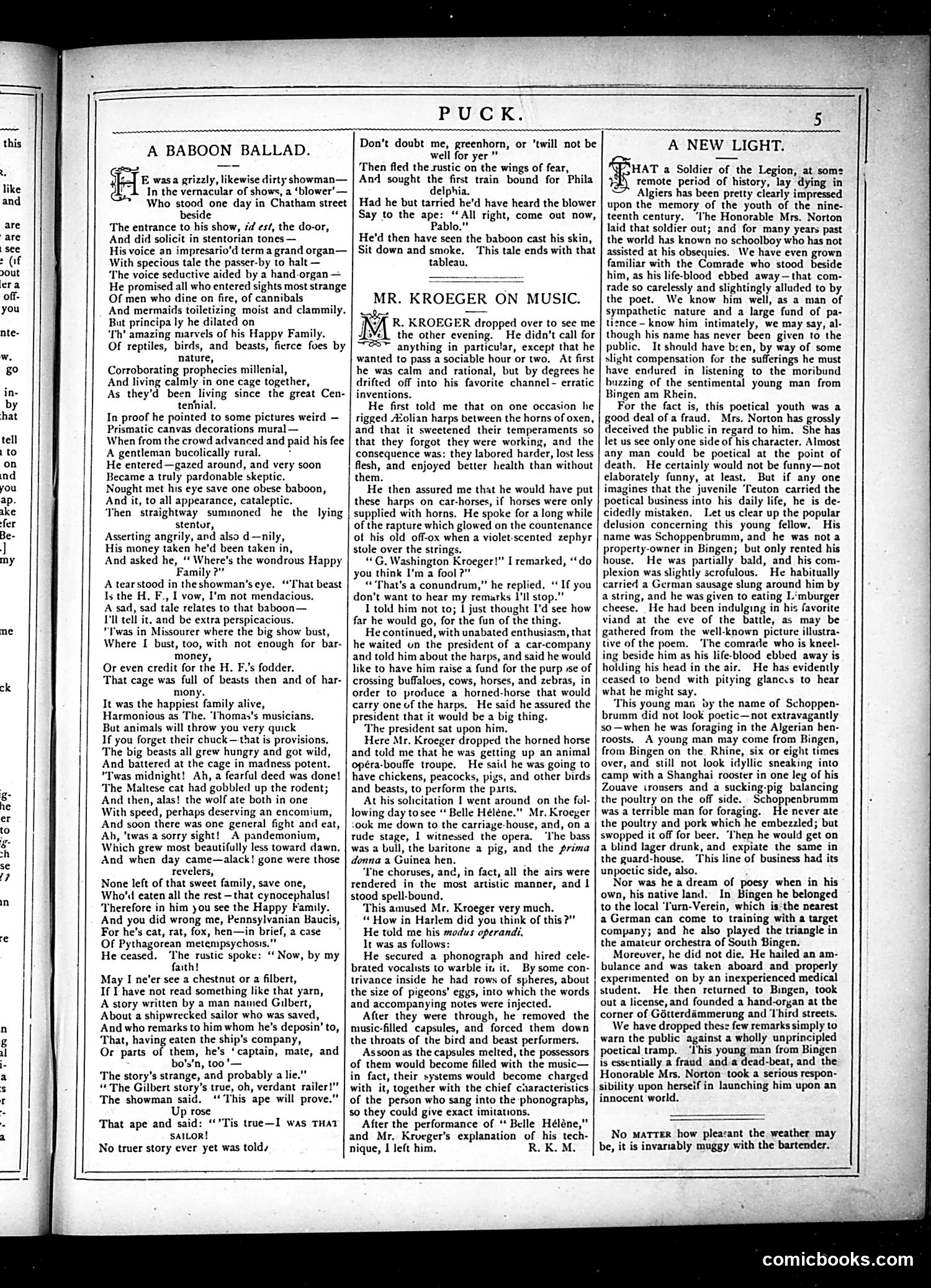
This page contains three distinct pieces: 1. **"A Baboon Ballad"** (left column): A narrative poem satirizing someone's dirty, unkempt appearance and behavior in Chatham Street, describing them as animal-like and ignoble. 2. **"Mr. Kroeger on Music"** (center): A humorous anecdote about a man named Kroeger discussing his eccentric musical inventions and performances, including attempts to create a "horned-horse" act and phonograph recordings. The piece mocks pretentious or absurd musical experimentation. 3. **"A New Light"** (right column): Commentary on a young soldier from the Legion of Honor, praising his character while noting the public was initially deceived about his true nature—apparently criticizing public gullibility or misplaced admiration. The page represents typical Puck content: satirical poetry and anecdotes targeting social types and public follies.
📄 Transcribed text from this page (OCR, searchable)
Machine-transcribed from the original scan — historical spelling and the odd misread are preserved.
PUCK. A BABOON BALLAD. Bot JAE wasa grizzly, likewise dirty showman— ce In the vernacular of shows, a ‘blower’ — Who stood one day in Chatham street beside The entrance to his show, #d est, the do-or, And did solicit in stentorian tones — His voice an impresario'd term a grand organ— With specious tale the passer-by to halt — ‘The voice seductive aided by a hand-organ = He promised all who entered sights most strange Of men who dine on fire, of cannibals And mermaids toiletizing moist and clammily. But principa ly he dilated on ‘Th’ amazing marvels of his Happy Family. Of reptiles, birds, and beasts, fierce foes by nature, Corroborating prophecies millenial, And living calmly in one cage together, As they’d been living since the great Cen- tenhhial. In proof he pointed to some pictures weird — Prismatic canvas decorations mural— When from the crowd advanced and paid his fee A gentleman bucolically rural. He entered—gazed around, and very soon Became a truly pardonable skeptic. Nought met his eye save one obese baboon, And it, to all appearance, cataleptic. ‘Then ‘straightway suminoned he the lying stentur, Asserting angrily, and also d—nily, His money taken he'd been taken in, And asked he, ‘ Where's the wondrous Happy Family 2” A tearstood in theshowman'seye. ‘That beast Is the H. F., I vow, I’m not mendacious. A sad, sad tale relates to that baboon— I'll tell it, and be extra perspicacious. "Twas in Missourer where the big show bust, Where I bust, too, with not enough for bar- money, Or even credit for the H. F.’s fodder. That cage was full of beasts then and of har- Harmonious as The. ‘Mhomas’s musicians. But animals will throw you very quick If you forget their chuck—that is provisions. The big beasts all grew hungry and got wild, And battered at the cage in madness potent. ‘Twas midnight! Ah, a fearful deed was done! The Maltese cat had gobbled up the rodent; And then, alas! the wolf ate both in one With speed, perhaps deserving an encomium, And soon there was one general fight and eat, Ah, ’twas a sorry sight! A pandemonium, Which grew most beautifully less toward dawn, And when day came—alack! gone were those revelers, None left of that sweet family, save one, Who'd eaten all the rest —that cynocephalus! ‘Therefore in him you see the Happy Family. And you did wrong me, Pennsylvanian Baucis, For he’s cat, rat, fox, hen—in brief, a case Of Pythagorean metempsychosis.”” He ceased. ‘The rustic spoke: “Now, by my faith! May I ne'er see a chestnut or a filbert, If I have not read something like that yarn, A story written by a man named Gilbert, About a shipwrecked sailor who was saved, And who remarks to him whom he’s deposin’ to, That, having eaten the ship's company, Or parts of them, he’s ‘captain, mate, and bo's'n, too’"— ‘The story’s strange, and probably a lie.” “The Gilbert story's true, oh, verdant railer!” The showman said. ‘This ape will prove.” p Tose That ape and said: “’Tis true—I was THAT SAILOR! No truer story ever yet was tolds Don't doubt me, greenhorn, or ’twill not be well for yer” Then fled the rustic on the wings of fear, And sought the first train bound for Phila delphia. Had he but tarried he'd have heard the blower Say to the ape: “All right, come out now, Pablo.” He'd then have seen the baboon cast his skin, Sit down and smoke. ‘This tale ends with that tableau. MR. KROEGER ON MUSIC. j of R. KROEGER dropped over to see me Mel the other evening. He didn't call for ~ anything in particular, except that he wanted to pass a sociable hour or two, At first he was calm and rational, but by degrees he drifted off into his favorite channel - erratic inventions. He first told me that on one occasion he rigged AZolian harps between the horns of oxen, and that it sweetened their temperaments so that they forgot they were working, and the consequence was: they labored harder, lost less flesh, and enjoyed better health than without them. He then assured me that he would have put these harps on car-horses, if horses were only supplied with horns, He spoke for a long while of the rapture which glowed on the countenance of his old off-ox when a violet-scented zephyr stole over the strings. “G, Washington Kroeger!” I remarked, “do you think I'm a fool ?” “That's a conundrum,” he replied. ‘If you don’t want to hear my remarks I'll stop.” I told him not to; | just thought I'd see how far he would go, for the fun of the thing. He continued, with unabated enthusiasm, that he waited un the president of a car-company and told him about the harps, and said he would like to have him raise a fund for the purp se of crossing buffalues, cows, horses, and zebras, in order to produce a horned-horse that would carry one of the harps, He said he assured the president that it would be a big thing. The president sat upon him. Here Mr. Kroeger dropped the horned horse and told me that he was getting up an animal opéra-bouffe troupe. He said he was going to have chickens, peacocks, pigs, and other birds and beasts, to perform the parts. At his solicitation | went around on the fol- lowing day tosee “Belle Héléne.” Mr. Kroeger ook me down to the carriage-house, and, on a tude stage, I witnessed the opera. ‘I'he bass was a bull, the baritone a pig, and the prima donna a Guinea hen. ‘The choruses, and, in fact, all the airs were rendered in the most artistic manner, and 1 stood spell-bound, This amused Mr. Kroeger very much, “ How in Harlem did you think of this?” He told me his modus operandi. It was as follows: He secured a phonograph and hired cele- brated vocalists to warble in it. By some con- trivance inside he had rows of spheres, about the size of pigeons’ eggs, into which the words and accompanying notes were injected. After they were through, he removed the music-filled capsules, and forced them down the throats of the bird and beast performers. Assoon as the capsules melted, the possessors of them would become filled with the music— in fact, their systems would become charged with it, together with the chief characteristics of the person who sang into the phonographs, so they could give exact imitations. After the performance of ‘ Belle Héléne,” and Mr. Kroeger’s explanation of his tech- nique, 1 left him. _K. .M. A NEW LIGHT. HAT a Soldier of the Legion, at som: + remote period of history, lay dying in Algiers has been pretty clearly impressed upon the memory of the youth of the nine- teenth century. ‘I'he Honorable Mrs. Norton laid that soldier out; and for many years past the world has known no schoolboy who has not assisted at his obsequies. We have even grown familiar with the Comrade who stood beside him, as his life-blood ebbed away—that com- rade so carelessly and slightingly alluded to by the poet. We know him well, as a man of sympathetic nature and a large fund of pa- tiznce - know him intimately, we may say, al- though his name has never been given to the public, It should have been, by way of some slight compensation for the sufferings he must have endured in listening to the moribund buzzing of the sentimental young man from Bingen am Rhein. For the fact is, this poetical youth was a good deal of a fraud. Mrs. Norton has grossly deceived the public in regard to him. She has let us see only one side of his character. Almost any man could be poetical at the point of death. He certainly would not be funny—not elaborately funny, at least. But if any one imagines that the juvenile ‘Teuton carried the poetical business into his daily life, he is de- cidedly mistaken. Let us clear up the popular delusion concerning this young fellow. His name was Schoppenbrumm, and he was not a property-owner in Bingen; but only rented his house. He was partially bald, and his com- plexion was slightly scrofulous. | He habitually carried a German sausage slung around him by a string, and he was given to eating Lmburger cheese. He had been indulging in his favorite viand at the eve of the battle, as may be gathered from the well-known picture illustra- tive of the poem. ‘The comrade who is kneel- ing beside him as his life-blood ebbed away is holding his head in the air. He has evidently ceased to bend with pitying glanc.s to hear what he might say. ‘This young man dy the name of Schoppen- brumm did not look poetic—not extravagantly so—when he was foraging in the Algerian hen- roosts, A young man may come from Bingen, from Bingen on the. Rhine, six or eight times over, and still not look idyllic sneaking into camp with a Shanghai rooster in one leg of his Zouave irousers and a sucking-pig balancing the poultry on the off side. Schoppenbrumm was a terrible man for foraging. He never ate the poultry and pork which he embezzled; but swopped it off for beer. ‘hen he would get on a blind lager drunk, and expiate the same in the guard-house. This line of business had its unpoctic side, also. Nor was he a dream of poesy when in his own, his native land. In Bingen he belonged to the local ‘lurn-Verein, which is:the nearest a German can come to training with a target company; and he also played the triangle in the amateur orchestra of South Bingen. Moreover, he did not die. He hailed an am- bulance and was taken aboard and properly experimented on by an inexperienced medical student. He then returned to Bingen, took out a license, and founded a hand-organ at the corner of Gétterdimmerung and Third streets. We have dropped thes: few remarks simply to warn the public against a wholly unprincipled poetical tramp. ‘This young man from Bingen is essentially a fraud and a dead-beat, and the Honorable Mrs. Norton took a serious respon- sibility upon herseif in launching him upon an innocent world. No MATTER how pleasant the weather may be, it is invariably muggy with the bartender. comicbooks.com