
Puck, 1878-07-17 · page 12 of 16
Puck — July 17, 1878 — page 12: what you’re looking at
What you’re looking at
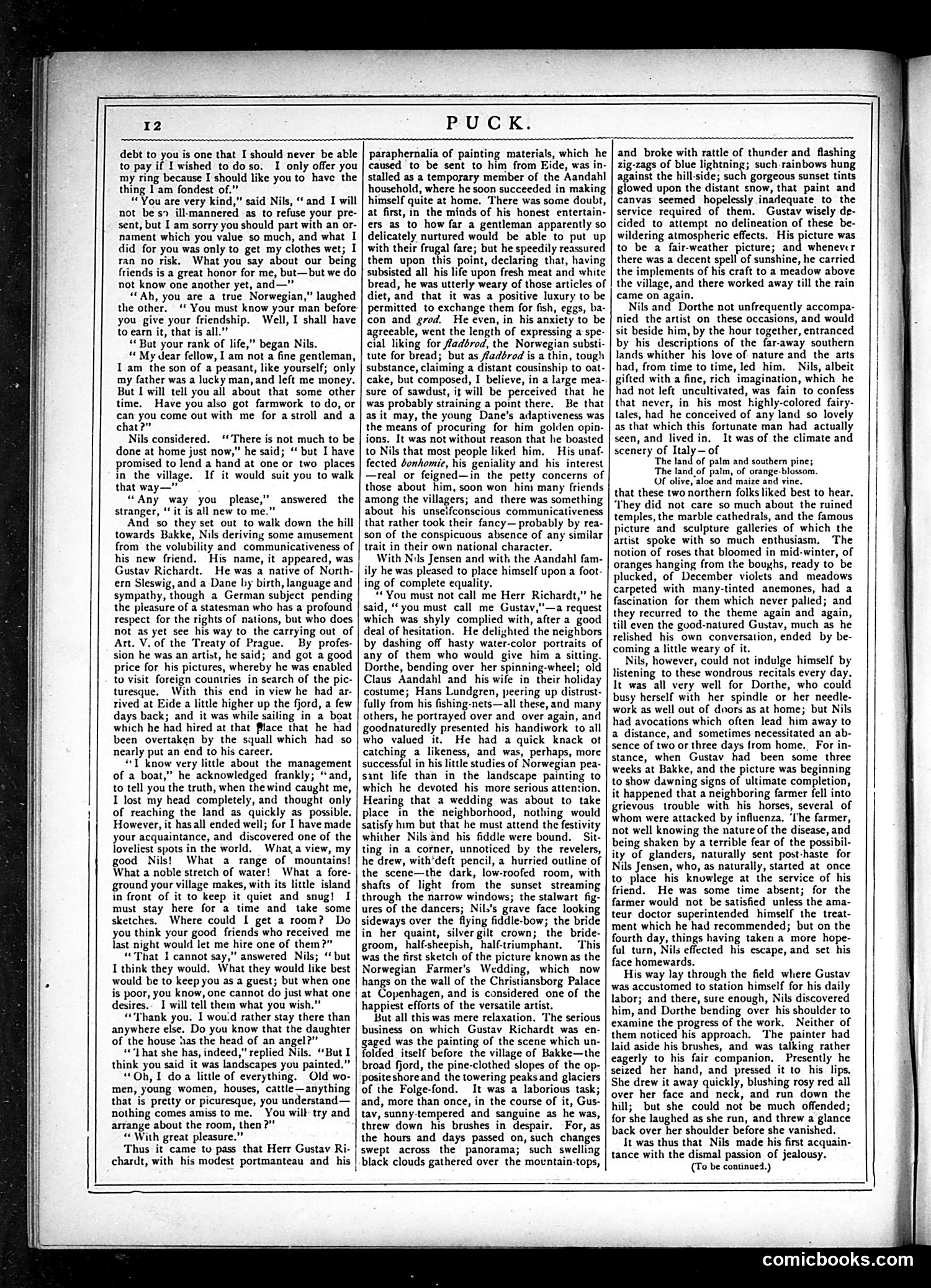
This page contains **no political cartoon**—it's the continuation of a literary story titled "Puck" (visible at the top). The text is a narrative about a character named Nils, a Norwegian artist and peasant who has gained social standing and patronage from Gustav Richardt and the Aandahl family. The story discusses Nils's artistic talents, his painting of Norwegian peasant life and landscapes, and his interactions with wealthy patrons. There are references to his work depicting rural scenes and his growing reputation among the village community. This is a **serialized fiction piece**, not satirical content. It appears to be a romantic or social drama exploring class dynamics and artistic ambition in 19th-century Scandinavia.
📄 Transcribed text from this page (OCR, searchable)
Machine-transcribed from the original scan — historical spelling and the odd misread are preserved.
PUCK. debt to you is one that I should never be able to pay if I wished to do so. I only offer you my ring because I should like you to have the thing I am fondest of.” “You are very kind,” said Nils, ‘and I will not bes» ill-mannered as to refuse your pre- sent, but I am sorry you should part with an or- nament which you value so much, and what 1 did for you was only to get my clothes wet; I ran no risk. What you say about our being friends is a great honor for me, but—but we do not know one another yet, and—"" “Ah, you are a true Norwegian,” laughed the other. ‘ You must know your man before: you give your friendship. Well, I shall have to earn it, that is all.” “But your rank of life,” began Nils. “ My dear fellow, I am not a fine gentleman, I am the son of a peasant, like yourself; only my father was a lucky man, and left me money. But I will tell you all about that some other time. Have you also got farmwork to do, or can you come out with me for a stroll and a chat?" Nils considered. ‘There is not much to be done at home just now,” he said; “ but I have promised to lend a hand at one or two places in the village. If it would suit you to walk that way—” “Any way you please,” stranger, “it is all new to me.” And so they set out to walk down the hill towards Bakke, Nils deriving some amusement from the volubility and communicativeness of his new friend. His name, it appeared, was Gustav Richardt. He was a native of North- ern Sleswig, and a Dane by birth, language and sympathy, though a German subject pending the pleasure of a statesman who has a profound respect for the rights of nations, but who does not as yet see his way to the carrying out of Art. V. of the Treaty of Prague. By profes- sion he was an artist, he said; and got a good price for his pictures, whereby he was enabled to visit foreign countries in search of the pic- turesque. With this end in view he had ar- rived at Eide a little higher up the fjord, a few days back; and it was while sailing in a boat which he had hired at that Place that he had been overtaken by the squall which had so nearly put an end to his career. “T know very little about the management of a boat,” he acknowledged frankly; “and, to tell you the truth, when the wind caught me, I lost my head completely, and thought only of reaching the land as quickly as possible. However, it has all ended well; for I have made your acquaintance, and discovered one of the loveliest spots in the world. What.a view, my good Nils! What a range of mountains! What a noble stretch of water! What a fore- answered the ground your village makes, with its little island in front of it to keep it quiet and snug! I must stay here for a time and take some sketches. Where could I get a room? Do you think your good friends who received me last night would let me hire one of them?” “That I cannot say,” answered Nils; “ but I think they would. What they would like best would be to keep you as a guest; but when one is poor, you know, one cannot do just what one desires. I will tell them what you wish.” “Thank you. I wou:d rather stay there than anywhere else. Do you know that the daughter of the house ‘nas the head of an angel?” ‘That she has, indeed,” replied Nils. “But I think you said it was landscapes you painted.” “Oh, I doa little of everything. Old wo- men, young women, houses, cattle—anything that is pretty or picuresque, you understand— nothing comes amiss to me. You wilh try and arrange about the room, then ?”” “With great pleasure.” Thus it came to pass that Herr Gustav Ri- chardt, with his modest portmanteau and his paraphernalia of painting materials, which he caused to be sent to him from Eide, was in- stalled as a temporary member of the Aandahl household, where he soon succeeded in making himself quite at home. There was some doubt, at first, in the minds of his honest entertain- ers as to how far a gentleman apparently so delicately nurtured would be able to put up with their frugal fare; but he speedily reassured them upon t this point, declaring that, having subsisted all his life upon fresh meat and white bread, he was utterly weary of those articles of diet, and that it was a positive luxury to be permitted to exchange them for fish, eggs, ba- con and grod. He even, in his anxiety to be agreeable, went the length of expressing a spe- cial liking for fadbrod, the Norwegian substi- tute for bread; but as ffadbrod is a thin, tough substance, claiming a distant cousinship to oat- cake, but composed, I believe, in a large mea- sure of sawdust, it will be perceived that he was probably straining a point there. Be that as it may, the young Dane’s adaptiveness was the means of procuring for him golden opin- ions. It was not without reason that he boasted to Nils that most people liked him. His unaf- fected onhomie, his geniality and his interest —real or feigned—in the petty concerns of those about him, soon won him many friends among the villagers; and there was something about his unseifconscious communicativeness that rather took their fancy— probably by rea- son of the conspicuous absence of any similar trait in their own national character. With Nils Jensen and with the Aandahl fam- ily he was pleased to place himself upon a foot- ing of complete equality. “You must not call me Herr Richardt,” he said, ‘you must call me Gustav,”—a request which was shyly complied with, after a good deal of hesitation. He delighted the neighbors by dashing off hasty water-color portraits of any of them who would give him a sitting. Dorthe, bending over her spinning-wheel; old Claus Aandahl and his wife in their holiday costume; Hans Lundgren, peering up distrust- fully from his fishing-nets—all these, and many others, he portrayed over and over again, and goodnaturedly presented his handiwork to all who valued it. He had a quick knack ot catching a likeness, and was, perhaps, more successful in his little studies of Norwegian pea- sant life than in the landscape painting to which he devoted his more serious atten:ion. Hearing that a wedding was about to take place in the neighborhood, nothing would satisfy him but that he must attend the festivity whither Nils and his fiddle were bound. Sit- ting in a corner, unnoticed by the revelers, he drew, with’deft pencil, a hurried outline of the scene—the dark, low-roofed room, with shafts of light from the sunset streaming through the narrow windows; the stalwart fig- ures of the dancers; Nils’s grave face looking sideways over the flying fiddle-bow; the bride in her quaint, silver gilt crown; the bride- groom, half-sheepish, half-triumphant. This was the first sketch of the picture known as the Norwegian Farmer's Wedding, which now hangs on the wall of the Christiansborg Palace at Copenhagen, and is considered one of the happiest efforts of the versatile artist. But all this was mere relaxation. The serious business on which Gustav Richardt was en- gaged was the painting of the scene which un- folded itself before the village of Bakke—the broad fjord, the pine-clothed slopes of the op- positeshoreand the towering peaksand glaciers of the Folge-fond. It was a laborious task; and, more than once, in the course of it, Gus- tav, sunny-tempered and sanguine as he was, threw down his brushes in despair. For, as the hours and days passed on, such changes swept across the panorama; such swelling black clouds gathered over the movntain-tops, and broke with rattle of thunder and flashing zig-zags of blue lightning; such.rainbows hung against the hill-side; such gorgeous sunset tints glowed upon the distant snow, that paint and canvas seemed hopelessly inadequate to the service required of them. Gustav wisely de- cided to attempt no delineation of these be- wildering atmospheric effects. His picture was to be a fair-weather picture; and whenever there was a decent spell of sunshine, he carried the implements of his craft to a meadow above the village, and there worked away till the rain came on again, Nils and Dorthe not unfrequently accompa- nied the artist on these occasions, and would sit beside him, by the hour together, entranced by his descriptions of the far-away southern lands whither his love of nature and the arts had, from time to time, led him. Nils, albeit gifted with a fine, rich imagination, which he had not left uncultivated, was fain to confess that never, in his most highly-colored fairy- tales, had he conceived of any land so lovely as that which this fortunate man had actually seen, and lived i ae It was of the climate and scenery of Ataly— 9) The land of ae and southern pine; The land of palm, of orange-blossom. Of olive, aloe and maize and vine. that these two northern folks liked best to hear. ‘They did not care so much about the ruined temples, the marble cathedrals, and the famous picture and sculpture galleries of which the artist spoke with so much enthusiasm. The notion of roses that bloomed in mid-winter, of oranges hanging from the boughs, ready to be plucked, of December violets and meadows carpeted with many-tinted anemones, had a fascination for them which never palled; and they recurred to the theme again and again, till even the good-natured Gustav, much as he relished his own conversation, ended by be- coming a little weary of it. Nils, however, could not indulge himself by listening to these wondrous recitals every day. It was all very well for Dorthe, who could busy herself with her spindle or her needle- work as well out of doors as at home; but Nils had avocations which often lead him away to a distance, and sometimes necessitated an ab- sence of two or three days from home. For in- stance, when Gustav had been some three weeks at Bakke, and the picture was beginning to show dawning signs of ultimate completion, it happened that a neighboring farmer fell into grievous trouble with his horses, several of whom were attacked by influenza. ‘Ihe farmer, not well knowing the nature of the disease, and being shaken by a terrible fear of the possibil- ity of glanders, naturally sent post-haste for Nils Jensen, who, as naturally, started at once to place his knowlege at the service of his friend. He was some time absent; for the farmer would not be satisfied unless the ama- teur doctor superintended himself the treat- ment which he had recommended; but on the fourth day, things having taken a more hope- ful turn, Nils effected his escape, and set his face homewards. His way lay through the field where Gustav was accustomed to station himself for his daily labor; and there, sure enough, Nils discovered him, and Dorthe bending over his shoulder to examine the progress of the work. Neither of them noticed his approach. The painter had laid aside his brushes, and was talking rather eagerly to his fair companion. Presently he seized her hand, and pressed it to his lips. She drew it away quickly, blushing rosy red all over her face and neck, and run down the hill; but she could not be much offended; for she laughed as she run, and threw a glance back over her shoulder before she vanished. It was thus that Nils made his first acquain- tance with the dismal passion of jealousy. (To be continued.) comicbooks.com