
Puck, 1878-07-17 · page 11 of 16
Puck — July 17, 1878 — page 11: what you’re looking at
What you’re looking at
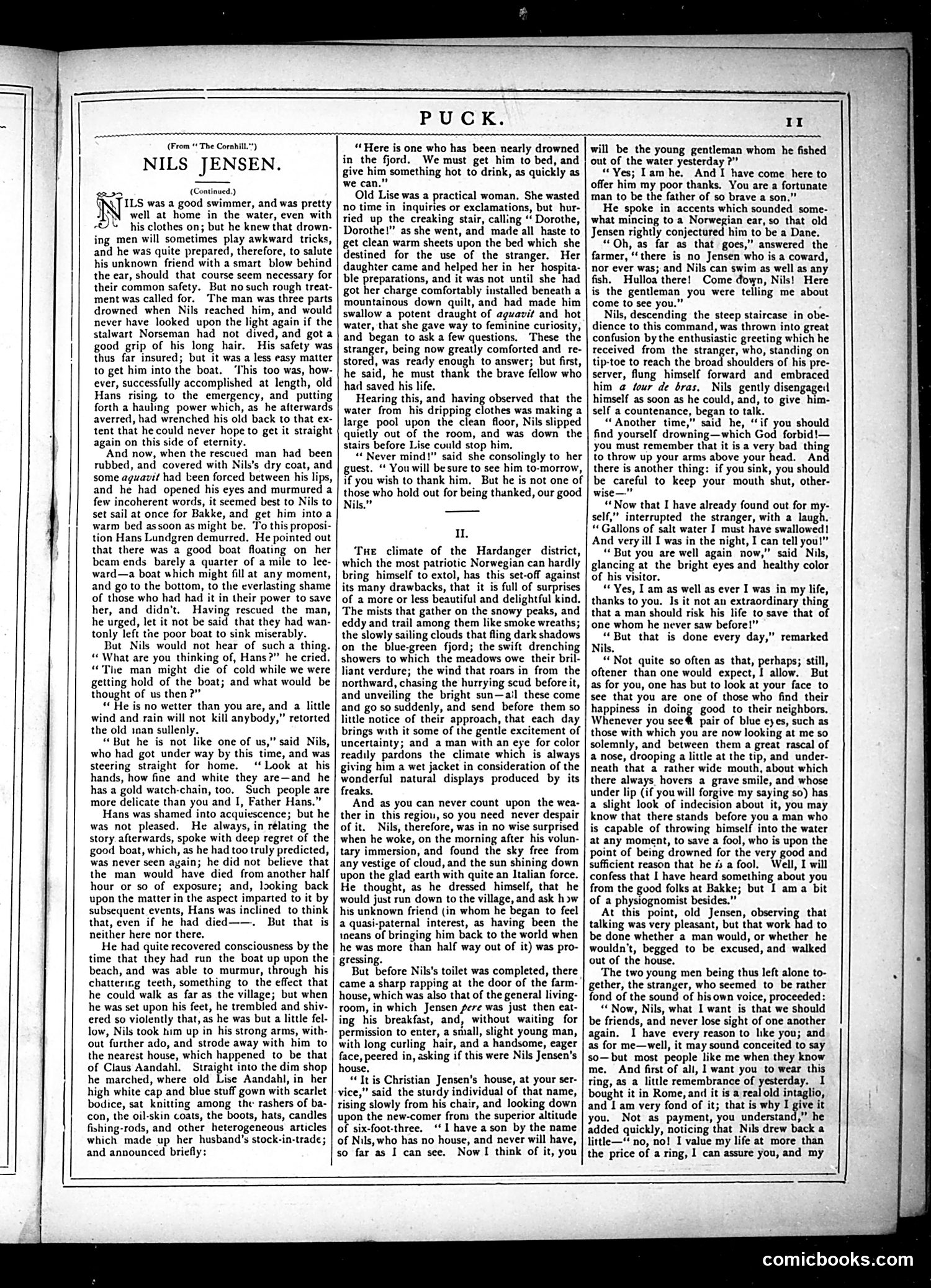
This page presents a serialized short story rather than political satire. "Nils Jensen" (credited to "The Cornhill") tells of a Norwegian swimmer rescued from drowning by a farmer's daughter. The narrative focuses on themes of gratitude, class differences, and courtship. Jensen, a young gentleman, recovers at the farmer's home and develops feelings for his rescuer. The story explores social dynamics of the era—the tension between Jensen's refined background and the farmer's family's simpler station, resolved through romantic interest transcending class boundaries. This represents Puck's literary content alongside its famous satirical cartoons, offering serialized fiction to maintain reader engagement between humorous political commentary.
📄 Transcribed text from this page (OCR, searchable)
Machine-transcribed from the original scan — historical spelling and the odd misread are preserved.
PUCK. (From “ The Cornhill.”’) NILS JENSEN. (Continued. Si] ILS was a good swimmer, and was pretty well at home in the water, even with \ his clothes on; but he knew that drown- ing men will sometimes play awkward tricks, and he was quite prepared, therefore, to salute his unknown friend with a smart blow behind the ear, should that course seem necessary for their common safety. But no such rough treat- ment was called for. The man was three parts drowned when Nils reached him, and would never have looked upon the light again if the stalwart Norseman had not dived, and gota good grip of his long hair. His safety was thus far insured; but it was a less easy matter to get him into the boat. ‘This too was, how- ever, successfully accomplished at length, old Hans rising to the emergency, and putting forth a hauling power which, as he afterwards averred, had wrenched his old back to that ex- tent that he could never hope to get it straight again on this side of eternity. And now, when the rescued man had been rubbed, and covered with Nils’s dry coat, and some aguavit had been forced between his lips, and he had opened his eyes and murmured a few incoherent words, it seemed best to Nils to set sail at once for Bakke, and get him intoa warm bed assoon as might be. To this proposi- tion Hans Lundgren demurred. He pointed out that there was a good boat floating on her beam ends barely a quarter of a mile to lee- ward—a boat which might fill at any moment, and go to the bottom, to the everlasting shame of those who had had it in their power to save her, and didn't. Having rescued the man, he urged, let it not be said that they had wan- tonly left the poor boat to sink miserably. But Nils would not hear of such a thing. “What are you thinking of, Hans?” he cried. “The man might die of cold while we were getting hold of the boat; and what would be thought of us then?” “ He is no wetter than you are, and a little wind and rain will not kill anybody,” retorted the old ian sullenly. “But he is not like one of us,” said Nils, who had got under way by this time, and was steering straight for home. ‘ Look at his hands, how fine and white they are—and he has a gold watch-chain, too. Such people are more delicate than you and I, Father Hans.” Hans was shamed into acquiescence; but he was not pleased. He always, in rélating the story afterwards, spoke with deep regret of the good boat, which, as he had too truly predicted, was never seen again; he did not believe that the man would have died from another half hour or so of exposure; and, looking back upon the matter in the aspect imparted to it by subsequent events, Hans was inclined to think that, even if he had died——. But that is neither here nor there, He had quite recovered consciousness by the time that they had run the boat up upon the beach, and was able to murmur, through his chattering teeth, something to the effect that he could walk as far as the village; but when he was set upon his feet, he trembled and shiv- ered so violently that, as he was but a little fel- low, Nils took him up in his strong arms, with- out further ado, and strode away with him to the nearest house, which happened to be that of Claus Aandahl. Suniphe into the dim shop he marched, where old Lise Aandahl, in her high white cap and blue stuff gown with scarlet bodice, sat knitting among the rashers of ba- con, the oil-skin coats, the boots, hats, candles fishing-rods, and other heterogeneous articles which made up her husband’s stock-in-trade; and announced briefly: “Here is one who has been nearly drowned in the fjord. We must get him to bed, and give him something hot to drink, as quickly as we can.” Old Lise was a practical woman. She wasted no time in inquiries or exclamations, but hur- ried up the creaking stair, calling ‘‘ Dorothe, Dorothe!" as she went, and made all haste to get clean warm sheets upon the bed which she destined for the use of the stranger. Her daughter came and helped her in her hospita- ble preparations, and it was not until she had got her charge comfortably installed beneath a mountainous down quilt, and had made him swallow a potent draught of aguavit and hot water, that she gave way to feminine curiosity, and began to ask a few questions. These the stranger, being now greatly comforted and_re- stored, was ready enough to answer; but first, he said, he must thank the brave fellow who had saved his life. Hearing this, and having observed that the water from his dripping clothes was making a large pool upon the clean floor, Nils slipped quietly out of the room, and was down the stairs before Lise could stop him, “Never mind!” said she consolingly to her guest. ‘ You will be sure to see him to-morrow, if you wish to thank him, But he is not one of those who hold out for being thanked, our good Nils.” Il. Tue climate of the Hardanger district, which the most patriotic Norwegian can hardly bring himself to extol, has this set-off against its many drawbacks, that it is full of surprises of a more or less beautiful and delightful kind. The mists that gather on the snowy peaks, and eddy and trail among them like smoke wreaths; the slowly sailing clouds that fling dark shadows on the blue-green fjord; the swift drenching showers to which the meadows owe their bril- liant verdure; the wind that roars in from the northward, chasing the hurrying scud before it, and unveiling the bright sun—ail these come and go so suddenly, and send before them so little notice of their approach, that each day brings with it some of the gentle excitement of uncertainty; and a man with an eye for color readily pardons the climate which is always giving him a wet jacket in consideration of the wonderful natural displays produced by its freaks, And as you can never count upon the wea- ther in this region, so you need never despair of it. Nils, therefore, was in no wise surprised when he woke, on the morning after his volun- tary immersion, and found the sky free from any vestige of cloud, and the sun shining down upon the glad earth with quite an Italian force. He thought, as he dressed himself, that he would just run down to the village, and ask how his unknown friend (in whom he began to feel a quasi-paternal interest, as having been the ineans of bringing him back to the world when he was more than half way out of it) was pro- gressing. But before Nils’s toilet was completed, there came a sharp rapping at the door of the farm- house, which was also that of the general living- room, in which Jensen pere was just then eat- ing his breakfast, and, without waiting for permission to enter, a small, slight young man, with long curling hair, and a handsome, eager face, peered in, asking if this were Nils Jensen's house, “It is Christian Jensen’s house, at your ser- vice,” said the sturdy individual of that name, rising slowly from his chair, and looking down upon the new-comer from the superior altitude of six-foot-three. ‘¢ 1 have a son by the name of Nils, who has no house, and never will have, so far as I can see. Now think of it, you will be the young gentleman whom he fished out of the water yesterday ?” “Yes; Iam he, And I have come here to offer him my poor thanks. You are a fortunate man to be the father of so brave a son.” He spoke in accents which sounded some- what mincing to a Norwegian ear, so that old Jensen rightly conjectured him to be a Dane, “Oh, as far as that goes,” answered the farmer, ‘there is no Jensen who is a coward, nor ever was; and Nils can swim as well as any fish. Hulloa there! Come down, Nils! Here is the gentleman you were telling me about come to see you.” : Nils, descending the steep staircase in obe- dience to this command, was thrown into great confusion by the enthusiastic greeting which he received from the stranger, who, standing on tip-toe to reach the broad shoulders of his pre- server, flung himself forward and embraced him @ tour de bras, Nils gently disengage: himself as soon as he could, and, to give him- self a countenance, began to talk. “ Another time,” said he, “if you should find yourself drowning—which God forbid!— you must remember that it is a very bad thin; to throw up your arms above your head. Ani there is another thing: if you sink, you should be careful to keep your mouth shut, other- wise—" “ Now that I have already found out for my- self,” interrupted the stranger, with a laugh. “Gallons of salt water I must have swallowed! And very ill I was in the night, I can tell you!” “ But you are well again now,” said Nils, glancing at the bright eyes and healthy color of his visitor. “Yes, I am as well as ever I was in my life, thanks to you. Is it not an extraordinary thing that a man should risk his life to save that of one whom he never saw before!" “But that is done every day,” remarked Nils. “Not quite so often as that, perhaps; still, oftener than one would expect, I allow. But as for you, one has but to look at your face to see that you are one of those who find their happiness in doing good to their neighbors. Whenever you see@ pair of blue eyes, such as those with which you are now looking at me so solemnly, and between them a great rascal of a nose, drooping a little at the tip, and under- neath that a rather wide mouth, about which there always hovers a grave smile, and whose under lip (if you will forgive my saying so) has a slight look of indecision about it, you may know that there stands before you a man who is capable of throwing himself into the water at any moment, to save a fool, who is upon the point of being drowned for the very good and sufficient reason that he #s a fool. Well, I will confess that 1 have heard something about you from the good folks at Bakke; but I am a bit of a physiognomist besides.” At this point, old Jensen, observing that talking was very pleasant, but that work had to be done whether a man would, or whether he wouldn't, begged to be excused, and walked out of the house. The two young men being thus left alone to- gether, the stranger, who seemed to be rather fond of the sound of his own voice, proceeded: “Now, Nils, what I want is that we should be friends, and never lose sight of one another again. I have every reason to like you; and as for me—well, it may sound conceited to say so—but most people like me when they know me. And first of all, 1 want you to wear this ring, as a little remembrance of yesterday. 1 bought it in Rome, and it is a real old intaglio, and I am very fond of it; that is why I give it you. Not as payment, you understand,” he added quickly, noticing that Nils drew back a little—“ no, no! I value my life at more than the price of a ring, 1 can assure you, and my comicbooks.com