
Puck, 1878-07-17 · page 3 of 16
Puck — July 17, 1878 — page 3: what you’re looking at
What you’re looking at
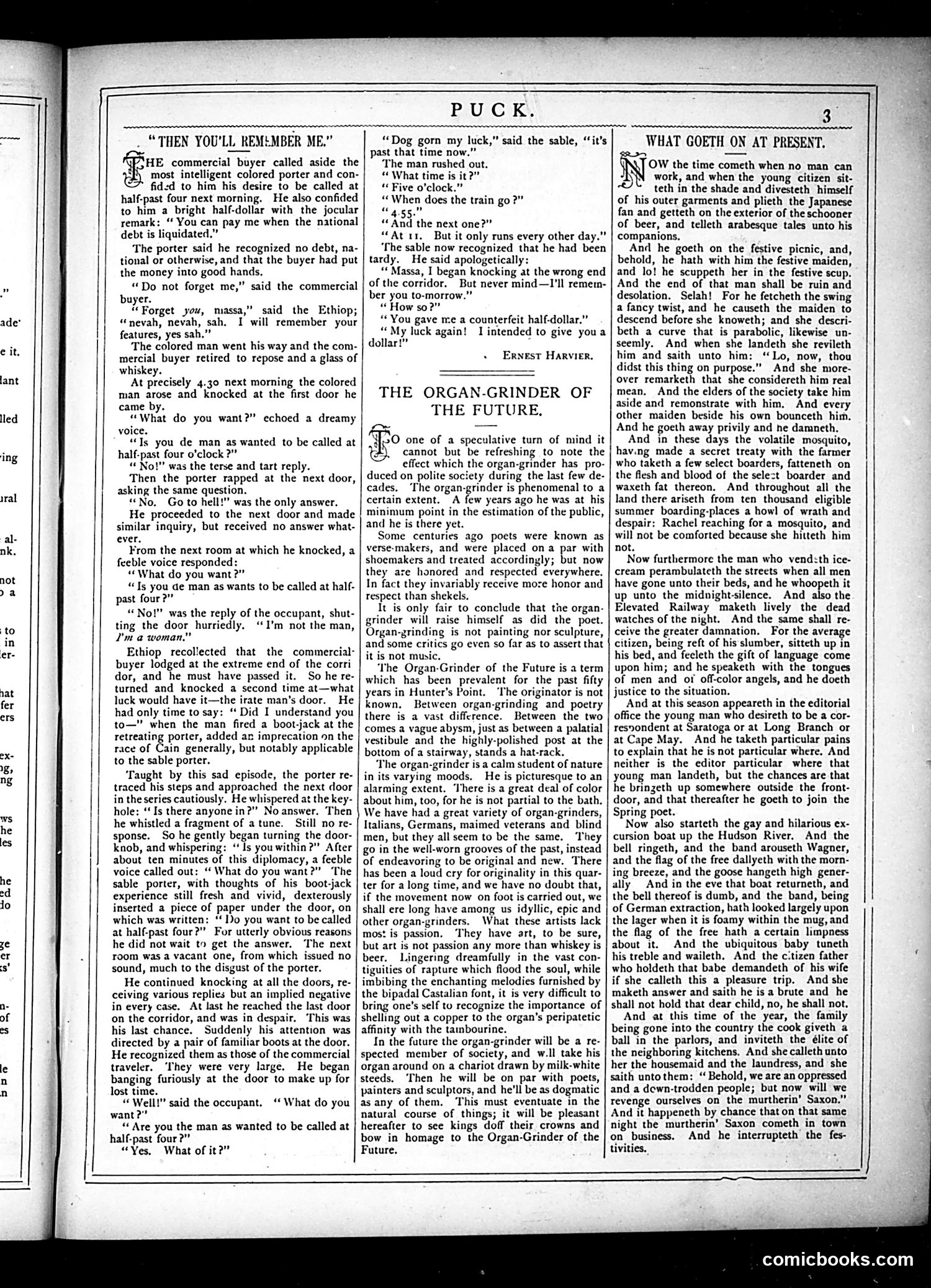
This page contains two distinct pieces: a humorous dialogue on the left and a satirical essay on the right titled "The Organ-Grinder of the Future." **Left column:** A comedic exchange between a sable (fur seller) and a colored porter negotiating over payment for an allegedly "counterfeit half-dollar." The joke plays on racial stereotypes and dialect humor common to late-19th-century American comedy, involving misunderstandings about currency and employment. **Right column:** "The Organ-Grinder of the Future" satirizes upper-class social pretension. It suggests that organ-grinders—street musicians of low social status—will eventually become respected members of society, attending fashionable balls and being honored by the wealthy. The satire mocks both the absurdity of elevating such humble workers and contemporary society's arbitrary class distinctions, using exaggerated social climbing as the humor.
📄 Transcribed text from this page (OCR, searchable)
Machine-transcribed from the original scan — historical spelling and the odd misread are preserved.
ade" e it, lant led ing tral ex> PUCK. . “THEN YOU'LL REMEMBER ME.” -}HE commercial buyer called aside the “J') most intelligent colored porter and con- fided to him his desire to be called at half-past four next morning. He also confided to him a bright half-dollar with the jocular remark: “ You can pay me when the national debt is liquidated.” The porter said he recognized no debt, na- tional or otherwise, and that the buyer had put the money into good hands, “Do not forget me,” said the commercial buyer. “Forget you, massa,” said the Ethiop; “nevah, nevah, sah. I will remember your features, yes sah.” The colored man went his way and the com- mercial buyer retired to repose and a glass of whiskey. At precisely 4.30 next morning the colored man arose and knocked at the first door he came by. “What do you want?” echoed a dreamy voice, “Is you de man as wanted to be called at half-past four o’clock ?”” “‘ No!" was the terse and tart reply. Then the porter rapped at the next door, asking the same question. **No. Go to hell!” was the only answer, He proceeded to the next door and made similar inquiry, but received no answer what- ever. From the next room at which he knocked, a feeble voice responded: “What do you want?” “Ts you de man as wants to be called at half- past four ?”” “Nol” was the reply of the occupant, shut- ting the door hurriedly, ‘I’m not the man, i'm a woman.” Ethiop recollected that the commercial- buyer lodged at the extreme end of the corri dor, and he must have passed it. So he re- turned and knocked a second time at—what luck would have it—the irate man’s door. He had only time to say: “ Did I understand you to—" when the man fired a boot-jack at the retreating porter, added ar imprecation on the race of Cain generally, but notably applicable to the sable porter. ‘Taught by this sad episode, the porter re- traced his steps and approached the next door in the series cautiously. He whispered at the key- hole: ‘Is there anyone in?” No answer. Then he whistled a fragment of atune. Still no re- sponse. So he gently began turning the door- knob, and whispering: “Is you within?” After about ten minutes of this diplomacy, a feeble voice called out: “ What do you want?” ‘The sable porter, with thoughts of his boot-jack experience still fresh and vivid, dexterously inserted a piece of paper under the door, on which was written: ‘Io you want to be called at half-past four?” For utterly obvious reasons he did not wait to get the answer. The next room was a vacant one, from which issued no sound, much to the disgust of the porter. He continued knocking at all the doors, re- ceiving various replies but an implied negative in every case. At last he reached the last door on the corridor, and was in despair. ‘This was his last chance. Suddenly his attention was directed by a pair of familiar boots at the door. He recognized them as those of the commercial traveler. ‘They were very large. He began banging furiously at the door to make up for lost time. “ Well!” said the occupant. want?” “ Are you the man as wanted to be called at half-past four 2” “Yes, What of it?” “What do you ‘Dog gorn my luck,” said the sable, ‘it’s past that time now.” ‘The man rushed out. “ What time is it?” «Five o'clock.” “When does the train go ?” “ ” “And the next one?” “At 1, But it only runs every other day.” ‘The sable now recognized that he had been tardy. He said apologetically: “« Massa, I began knocking at the wrong end of the corridor. But never mind—I'll remem- ber you to-morrow.” “How so?” “You gave me a counterfeit half-dollar.” “ My luck again! 1 intended to give youa dollar!” + Ernest HARvIER. THE ORGAN-GRINDER OF THE FUTURE, ‘Fo one of a speculative turn of mind it re cannot but be refreshing to note the effect which the organ-grinder has. pro- duced on polite society during the last few de- cades, ‘The organ-grinder is phenomenal to a certain extent. A few years ago he was at his minimum point in the estimation of the public, and he is there yet. Some centuries ago poets were known as verse-makers, and were placed ona par with shoemakers and treated accordingly; but now they are honored and respected everywhere. In fact they invariably receive moze honor and respect than shekels, It is only fair to conclude that the organ- grinder will raise himself as did the poet. Organ-grinding is not painting nor sculpture, and some critics go even so far as to assert that it is not music, ‘The Organ-Grinder of the Future is a term which has been prevalent for the past fifty years in Hunter's Point. ‘The originator is not known. Between organ-grinding and poetry there is a vast difference. Between the two comes a vague abysm, just as between a palatial vestibule and the highly-polished post at the bottom of a stairway, stands a hat-rack. ‘The organ-grinder is a calm student of nature in its varying moods. He is picturesque to an alarming extent, There is a great deal of color about him, too, for he is not partial to the bath. We have had a great variety of organ-grinders, Italians, Germans, maimed veterans and blind men, but they all seem to be the same, They go in the well-worn grooves of the past, instead of endeavoring to be original and new. There has been a loud cry for originality in this quar- ter for a long time, and we have no doubt that, if the movement now on foot is carried out, we shall ere long have among us idyllic, epic and other organ-grinders. What these artists lack most is passion. ‘They have art, to be sure, but art is not passion any more than whiskey is beer. Lingering dreamfully in the vast con- tiguities of rapture which flood the soul, while imbibing the enchanting melodies furnished by the bipadal Castalian font, it is very difficult to bring one’s self to recognize the importance of shelling out a copper to the organ's peripatetic affinity with the tambourine. In the future the organ-grinder will be a re- spected member of society, and wall take his organ around on a chariot drawn by milk-white steeds. Then he will be on par with poets, painters and sculptors, and he'll be as dogmatic as any of them. This must eventuate in the natural course of things; it will be pleasant hereafter to see kings doff their crowns and bow in homage to the Organ-Grinder of the Future. WHAT GOETH ON AT PRESENT. OW the time cometh when no man can : work, and when the young citizen sit- </™ teth in the shade and divesteth himself of his outer garments and plieth the Japanese fan and getteth on the exterior of the schooner of beer, and telleth arabesque tales unto his companions, And he goeth on the festive picnic, and, behold, he hath with him the festive maiden, and lo! he scuppeth her in the festive scup. And the end of that man shall be ruin and desolation, Selah! For he fetcheth the swing a fancy twist, and he causeth the maiden to descend before she knoweth; and she descri- beth a curve that is parabolic, likewise un- seemly, And when she landeth she revileth him and saith unto him: “Lo, now, thou didst this thing on purpose.” And she more- over remarketh that she considereth him real mean. And the elders of the society take him aside and remonstrate with him. And every other maiden beside his own bounceth him. And he goeth away privily and ne damneth, And in these days the volatile mosquito, hav.ng made a secret treaty with the farmer who taketh a few select boarders, fatteneth on the flesh and blood of the selezt boarder and waxeth fat thereon, And throughout all the land there ariseth from ten thousand eligible summer boarding-places a howl of wrath and despair: Rachel reaching for a mosquito, and will not be comforted because she hitteth him n ot. Now furthermore the man who vendsth ice- cream perambulateth the streets when all men have gone unto their beds, and he whoopeth it up unto the midnight-silence. And also the Elevated Railway maketh lively the dead watches of the night. And the same shall re- ceive the greater damnation. For the average citizen, being reft of his slumber, sitteth up in his bed, and feeleth the gift of language come upon him; and he speaketh with the tongues of men and of off-color angels, and he doeth justice to the situation. And at this season appeareth in the editorial office the young man who desireth to be a cor- resnondent at Saratoga or at Long Branch or at Cape May. And he taketh particular pains to explain that he is not particular where, And neither is the editor particular where that young man landeth, but the chances are that he bringeth up somewhere outside the front- door, and that thereafter he goeth to join the Spring poet. Now also starteth the gay and hilarious ex- cursion boat up the Hudson River, And the bell ringeth, and the band arouseth Wagner, and the flag of the free dallyeth with the morn- ing breeze, and the goose hangeth high gencr- ally And in the eve that boat returneth, and the bell thereof is dumb, and the band, being of German extraction, hath looked largely upon the lager when it is foamy within the mug, and the flag of the free hath a certain limpness about it. And the ubiquitous baby tuneth his treble and waileth, And the citizen father who holdeth that babe demandeth of his wife if she calleth this a pleasure trip. And she maketh answer and saith he is a brute and he shall not hold that dear child, no, he shall not. And at this time of the year, the family being gone into the country the cook giveth a ball in the parlors, and inviteth the élite of the neighboring kitchens. And she calleth unto her the housemaid and the laundress, and she saith untothem: “ Behold, we are an oppressed and a dewn-trodden people; but now will we revenge ourselves on the murtherin’ Saxon.” And it happeneth by chance that on that same night the murtherin’ Saxon cometh in town on business. And he interrupteth the fes- tivities. comicbooks.com