
A complete issue · 16 pages · 1878
Puck — July 3, 1878
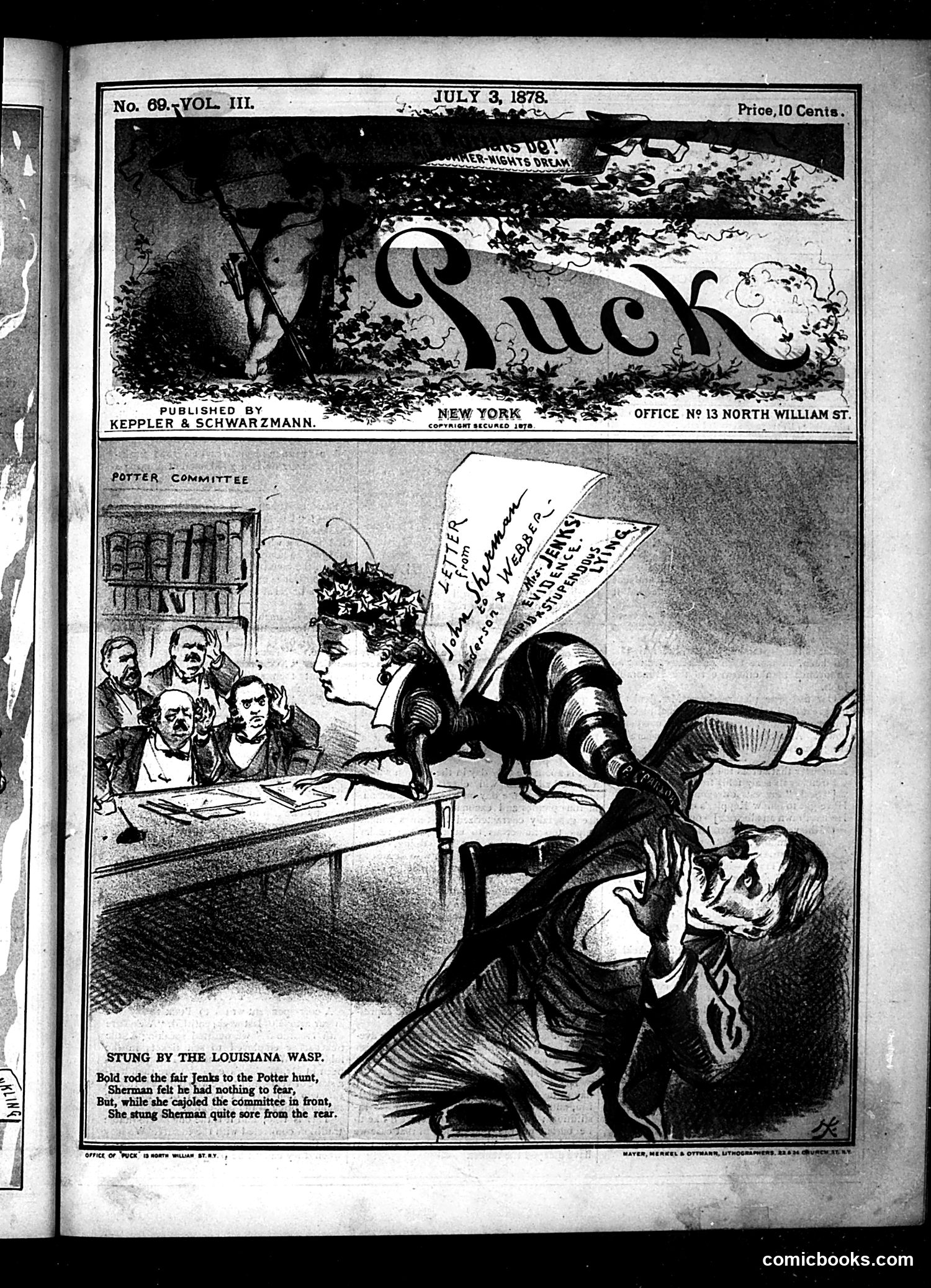
This July 1878 *Puck* cartoon satirizes a Potter Committee proceeding—likely investigating Republican corruption during Reconstruction. The caption describes General Sherman being "stung quite sore from the rear" by a female figure (the "Louisiana Wasp"), depicted as an aggressive insect-woman attacking a man before the committee. The cartoon suggests Sherman faced embarrassing revelations or accusations from a Louisiana source during testimony. The "Potter Committee" reference (visible on the left) indicates this relates to formal congressional investigations of the era. The imagery implies Sherman was caught off-guard by unexpected testimony or evidence, portrayed humorously as an undignified physical attack rather than formal political critique.
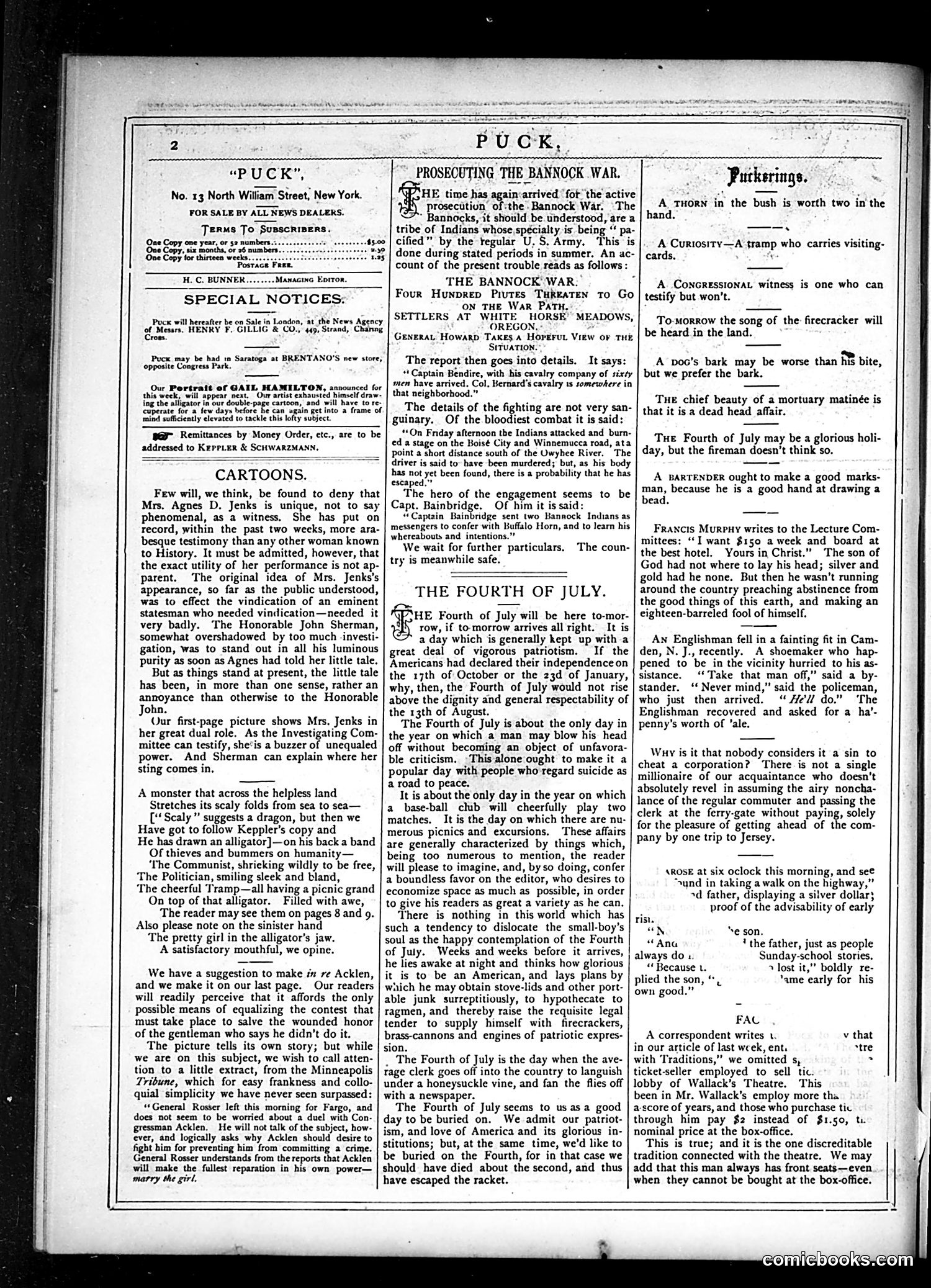
This page contains editorial commentary and satirical pieces rather than political cartoons. The main article discusses the **Bannock War**, a conflict involving Native Americans and U.S. Army forces in the Pacific Northwest. The text critiques the government's military response, suggesting the Bannock tribe has been "specially" targeted by the Army during summer campaigns. The "Puckerings" section offers short satirical observations on American society—mocking firecracker enthusiasts, congressional witnesses, and mortuary practices around Independence Day. The page also includes commentary on the Fourth of July itself, questioning whether it truly represents patriotic values given contemporary social issues. The content reflects 1870s concerns about Native American conflicts and holiday hypocrisy.
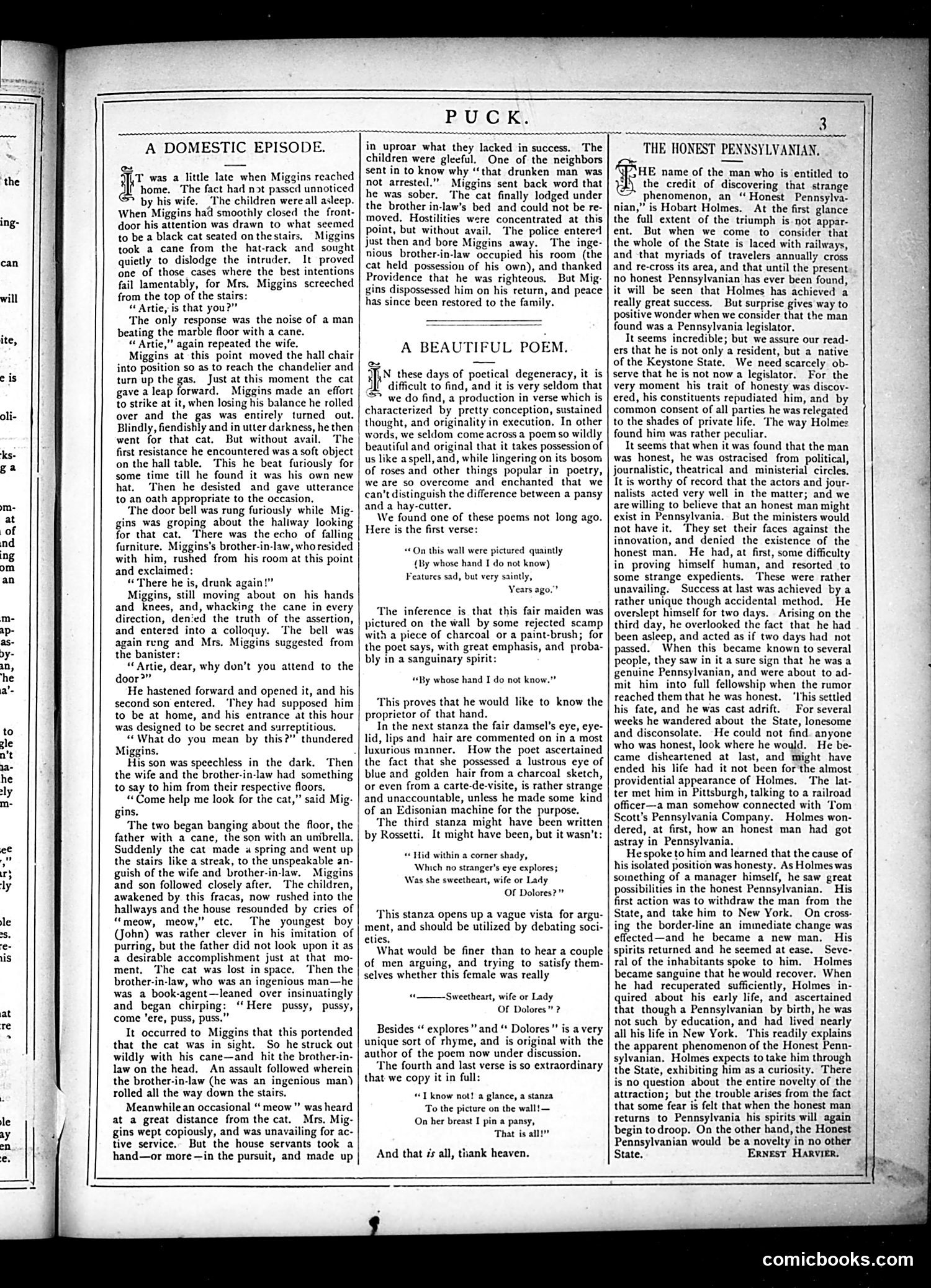
This page contains three separate pieces: a domestic humor story ("A Domestic Episode"), a poem ("A Beautiful Poem"), and an article titled "The Honest Pennsylvanian." The main content targets an unnamed Pennsylvania legislator who claims to be "honest" and resists political pressure. The satirical article suggests this reputation is exaggerated—the legislator withdrew from Pennsylvania politics and relocated to New York, working for a railroad. The piece implies his "honesty" was selective: he avoided state corruption scandals by simply leaving the state entirely. The satire mocks both the legislator's self-serving departure and the absurdity of celebrating someone as "honest" primarily for avoiding political entanglement rather than actively serving constituents. The other pieces appear to be filler content typical of Puck's mixed entertainment format.
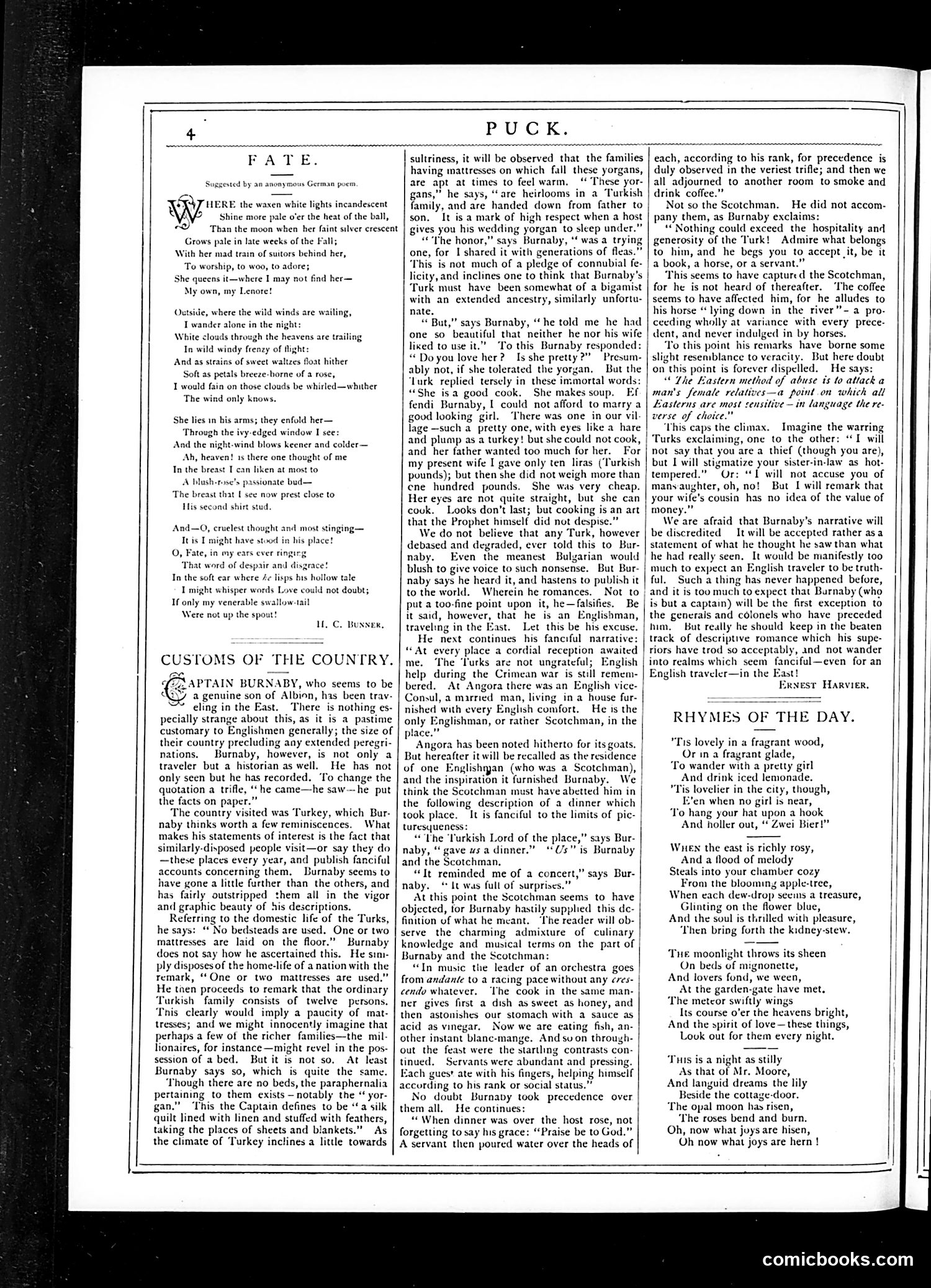
This page contains three distinct literary sections rather than political cartoons: "Fate" (a poem), "Customs of the Country" (prose about Captain Burnaby's travels in the East), and "Rhymes of the Day" (poetry). The "Customs of the Country" section discusses Captain Burnaby's observations of Turkish life, including commentary on Turkish hospitality, domestic customs, and comparisons with Scottish practices. The piece appears satirical in tone, mocking both Turkish and Scottish cultural practices through Burnaby's supposedly factual accounts—likely poking fun at travel narratives and cultural stereotyping common in the Victorian era. The other sections are straightforward literary contributions without clear political satire or caricature.
This page is entirely text—a satirical essay titled "The Astronomer," not a visual cartoon. It mocks amateur astronomers and their social pretensions, particularly focusing on Mr. Locker of Ransom Street in Keokuk, Iowa. The satire ridicules Locker's obsession with his new telescope and his attempts to impress friends by discovering astronomical phenomena (asteroids, Venus observations). The piece humorously describes how his wife tolerates his hobby while he neglects domestic responsibilities, and how his neighbors regard him as an eccentric. The underlying joke critiques the vanity of hobby enthusiasts who seek glory through minor discoveries and their tedious social boasting about technical accomplishments.
This page contains three separate pieces of satirical content: 1. **"Album Verses"** - Brief humorous poems on various topics, including one mocking someone's pretensions about "good beginnings." 2. **"A Tale of a Jack"** - A story about Sir Giles Morelands, a "little colored youth" and maid named Jack in Georgia. The narrative satirizes the character through exaggerated dialect and depicts stereotypical scenarios. This reflects the racist caricatures common in 19th-century American humor. 3. **"A Fellow of Infant Jest"** - A letter from someone claiming reduced mental capacity, criticizing Communism and Russian politics, likely referencing contemporary debates of the 1870s-80s. The page exemplifies Puck's blend of social satire, though much content reflects deeply problematic racial attitudes typical of the period.
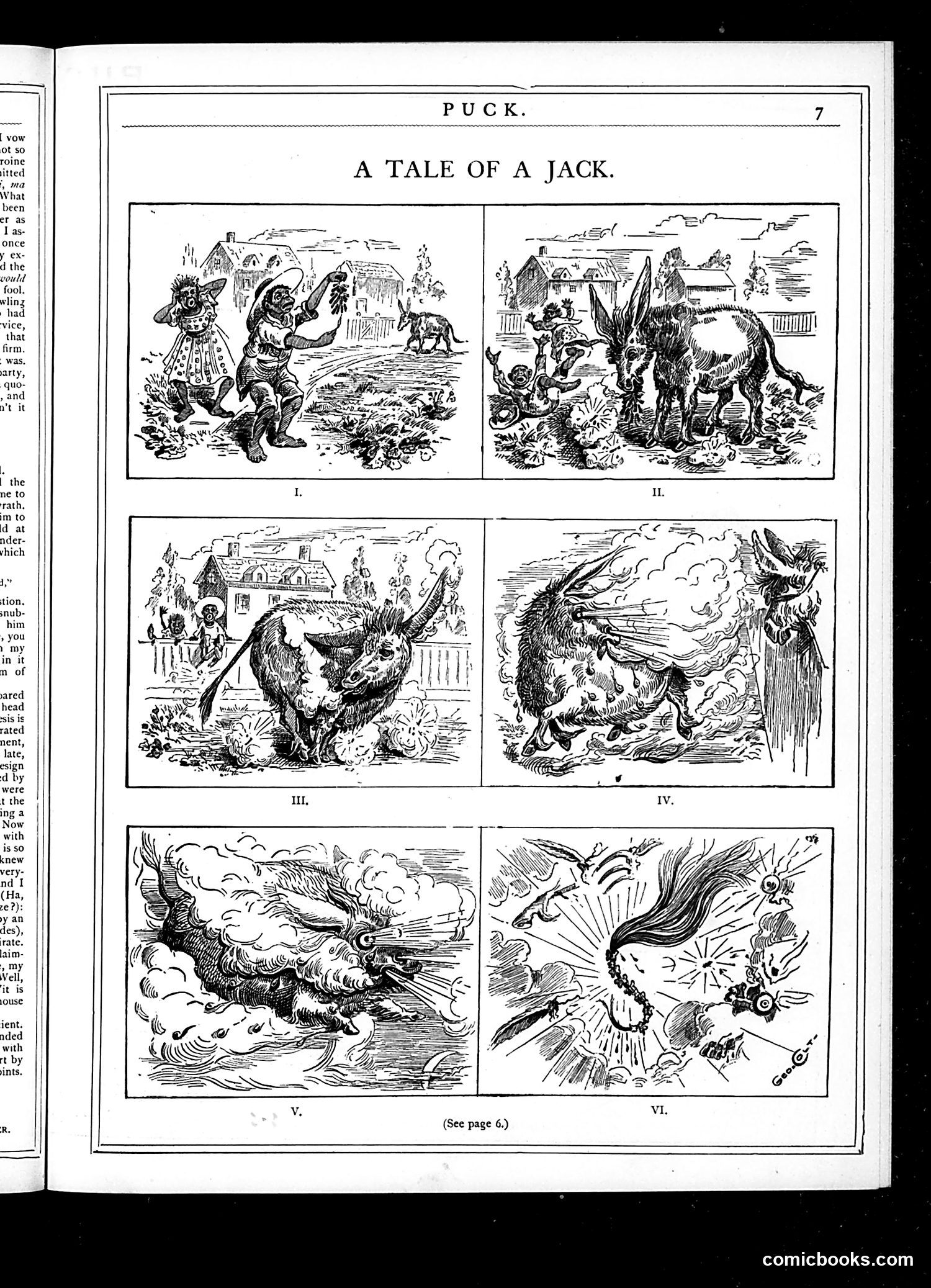
This is a six-panel satirical sequence titled "A Tale of a Jack," though the specific political figures and context aren't entirely clear from the image alone. The panels depict anthropomorphic characters (appearing to be a jack or donkey and other creatures) in escalating situations of chaos and violence. The progression suggests a narrative about consequences: panels I-II show characters in domestic/rural settings; panels III-IV depict increasingly aggressive confrontations; panels V-VI show explosive, chaotic results. This appears to be satirizing political conflict or social discord through the metaphor of animal behavior spiraling into destructive violence. The style is typical of Puck's visual satire, though without additional context, the specific political target remains unclear.
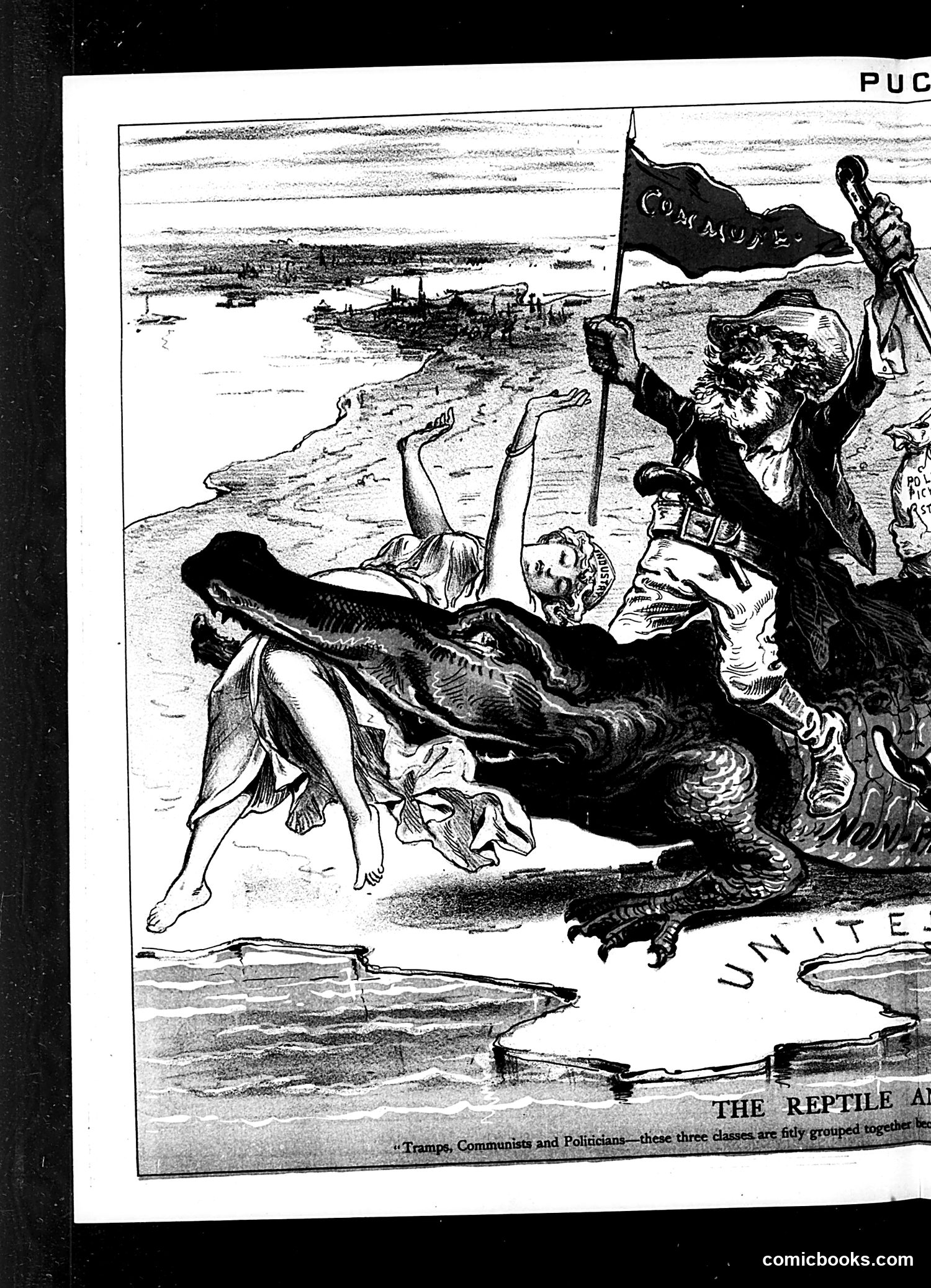
This Puck cartoon depicts a allegorical battle scene. A figure representing "Communism" (labeled on the flag) appears as a reptilian creature attacking a woman, likely representing Liberty or a democratic ideal. Armed figures—appearing to be soldiers or defenders—stand ready to combat the threat. The caption references "Tramps, Communists and Politicians—these three classes are aptly grouped together" (visible at bottom), suggesting the cartoonist equated communism with social disorder and undesirable elements. This reflects late 19th or early 20th-century American anti-communist and anti-radical sentiment, when communism and anarchism were viewed as existential threats to democratic institutions. The imagery portrays communism as a monstrous, dangerous force requiring military defense against civilization itself.
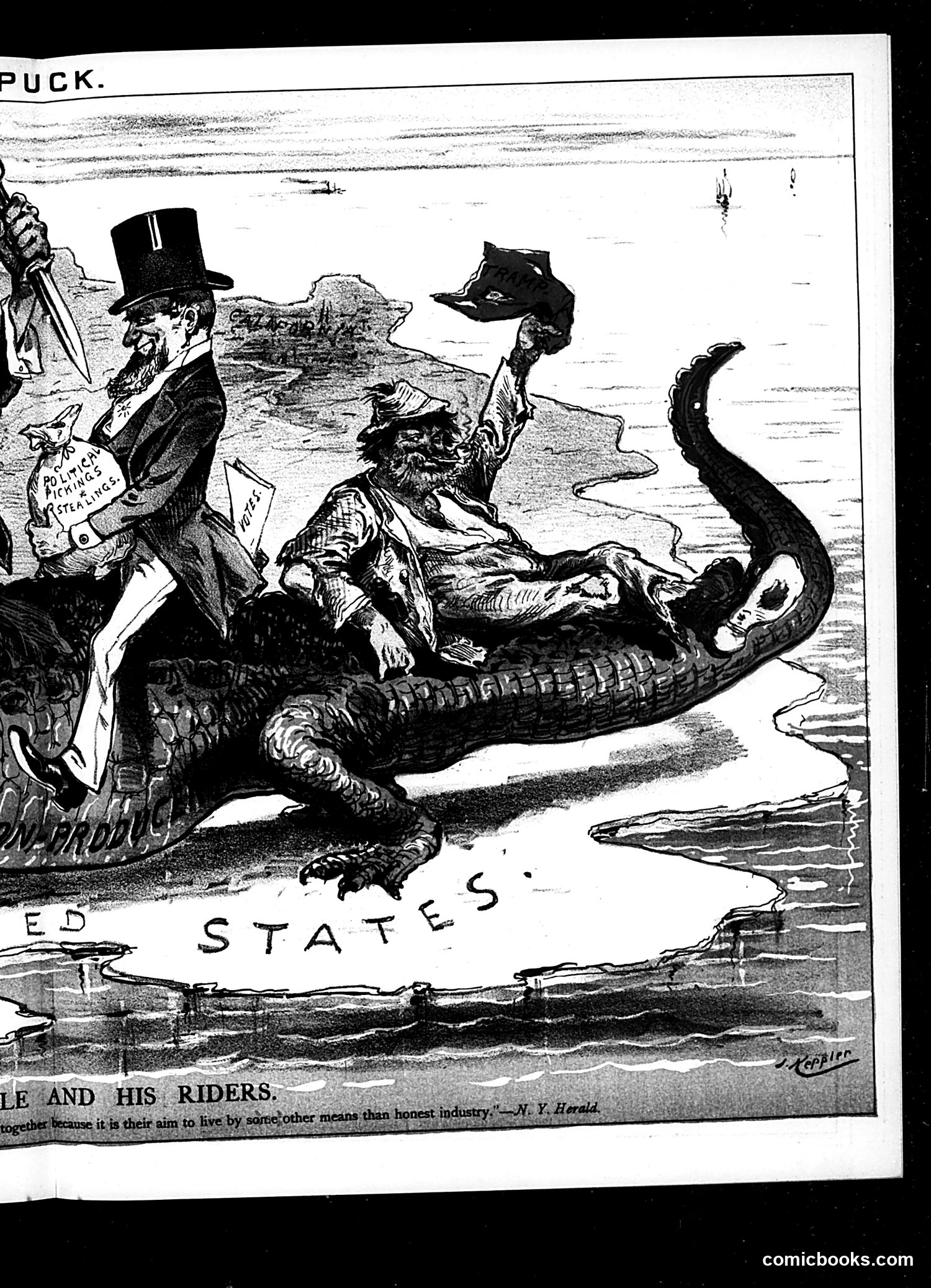
This cartoon depicts the "United States" as a large crocodile being ridden by two figures in top hats. The left figure holds a bag labeled "POLITICAL STEAMSHIPS" (text partially visible), suggesting he represents political or business interests exploiting American resources or policy. The caption references "honest industry," indicating the satire criticizes how these riders—likely representing corrupt politicians or monopolistic businessmen—control or "ride" the nation for their own gain rather than the public good. The crocodile metaphor portrays America as a dangerous, predatory force when controlled by such figures. This appears to be Progressive Era criticism of political corruption and industrial monopolies that dominated American governance in the late 19th/early 20th century.
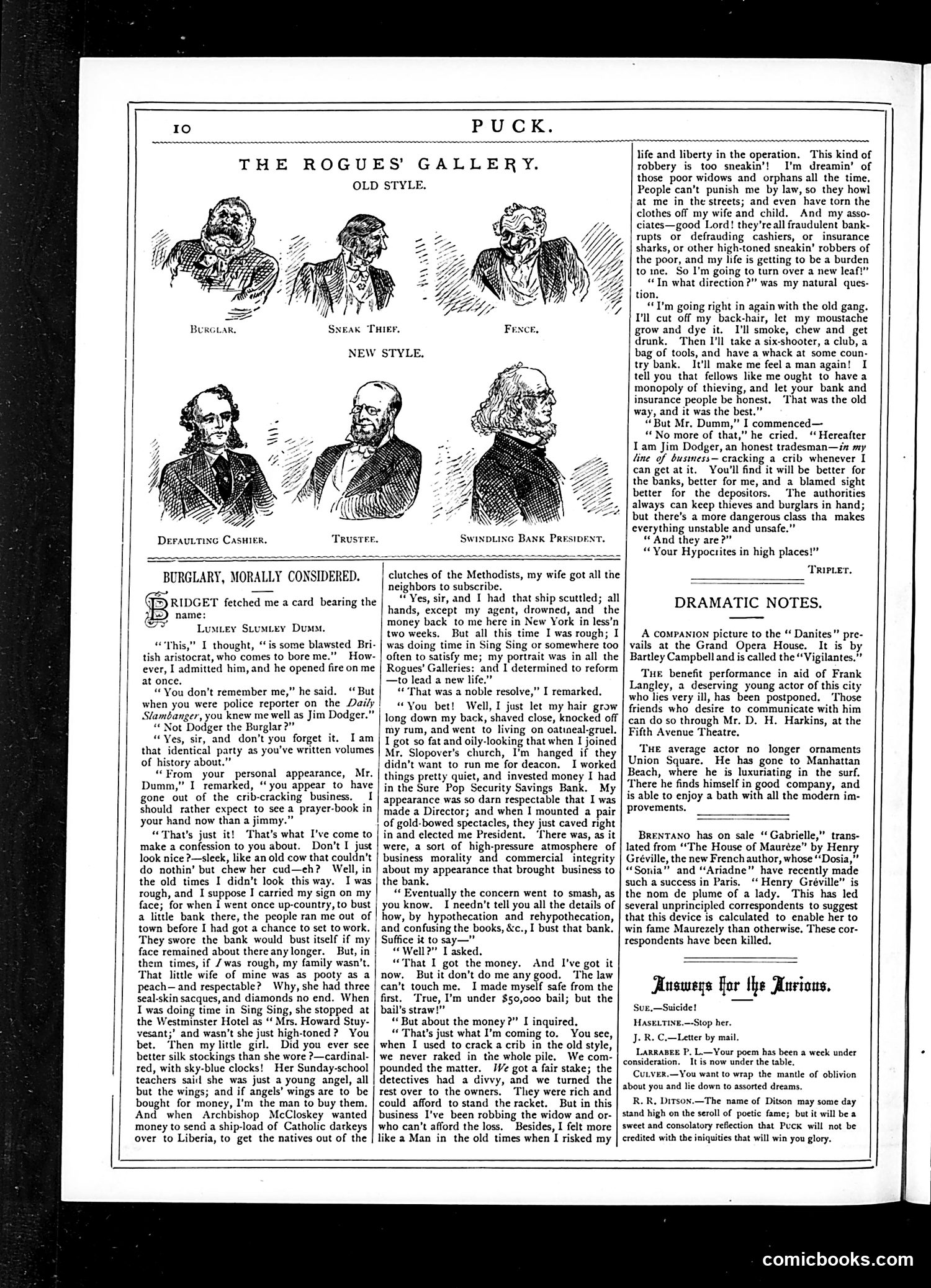
This page presents two sets of caricatured criminal types. The "Old Style" section depicts three figures labeled Burglar, Sneak Thief, and Fence—representing traditional street criminals. The "New Style" section shows three more respectable-looking criminals: a Defaulting Cashier, Trustee, and Swindling Bank President. The satire's point is clear: the accompanying article "Burglary, Morally Considered" argues that white-collar financial crimes—embezzlement, fraud, mismanagement of depositors' funds—are morally equivalent to or worse than street robbery, yet perpetrators escape punishment while poor criminals hang. The cartoon contrasts appearance with moral reality, suggesting that respectable-looking bankers and officials are essentially criminals in better clothing.
This is a humorous short story by E.S.L. about Pickerel Q. Bowles, a drummer (traveling salesman) from the American West. The narrative satirizes both frontier life and the challenges of matrimony. The plot follows Bowles's failed attempt at marriage: he marries a widow but discovers she's a relentless spender and schemer. After divorcing, he encounters her again years later when she tries to manipulate him into marriage once more—this time for her financial gain. The story concludes that Bowles remains a bachelor because of this traumatic experience. The satire targets both women's mercenary marriage tactics and the complications of frontier commerce and domestic life. The menus and detailed descriptions emphasize the era's regional cuisine and social customs.
This page is primarily a **collection of short satirical items and quips** rather than a single cartoon. The content targets various social and cultural topics of the era: - **"Shakspere with Variations"**: A poem mocking pretentious theatrical recitation - **"The Cream of the Bucket"**: Brief satirical notes on contemporary issues, including criticism of German immigrants, transcendental philosophy, and social customs - Multiple short jokes about marriage, business, pedestrian contests, and Colonial/Native American relations The right column includes items like mockery of a Boston lecture committee, complaints about "codgers" in cats, and commentary on newspaper coverage of various events. **No prominent political figures** appear to be caricatured on this visible page. The satire is broadly social rather than directed at specific individuals.
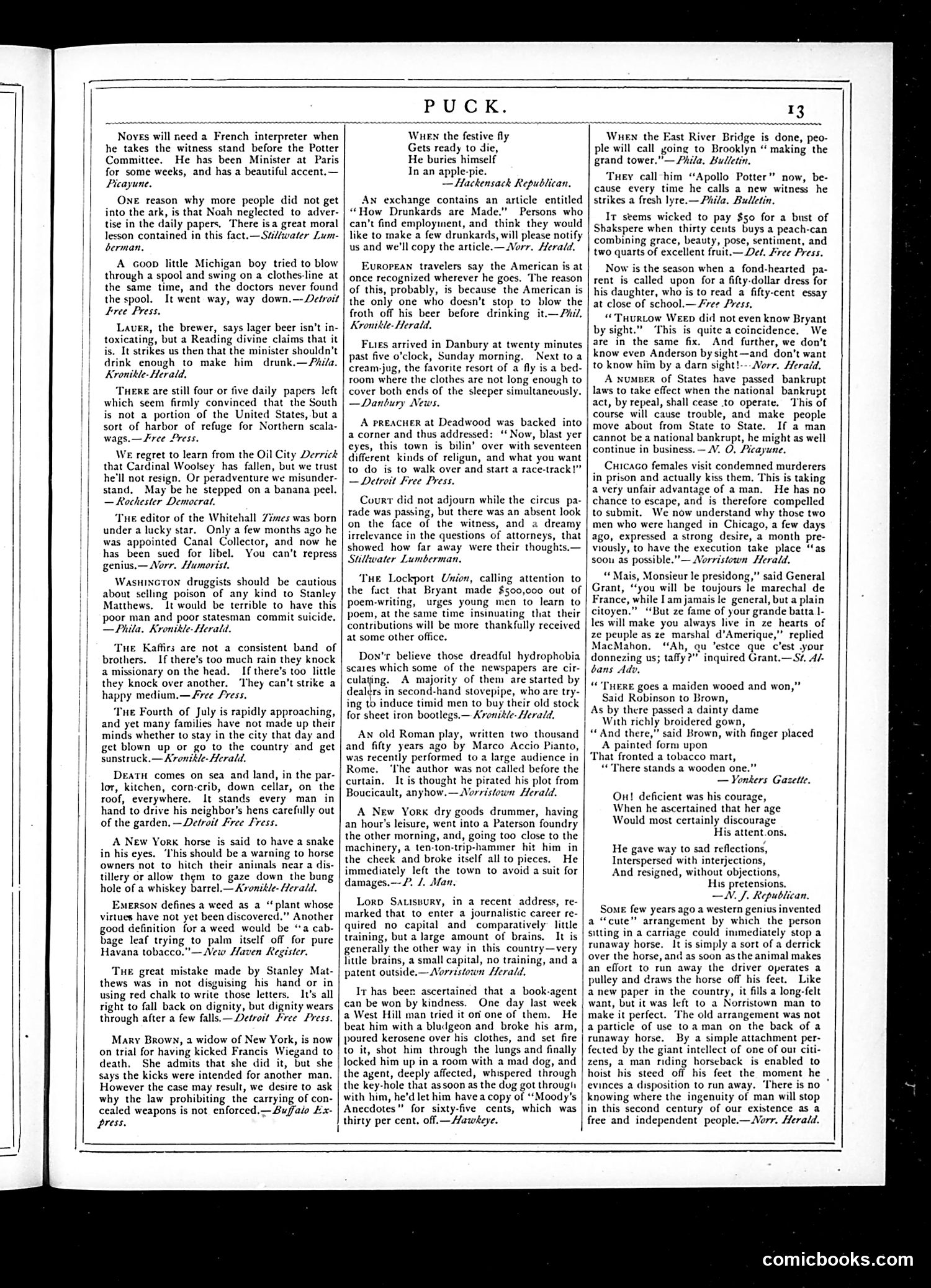
This page consists primarily of **text-based humor columns** rather than illustrated cartoons. The content includes brief satirical anecdotes and observations on contemporary social issues, each credited to various newspapers as sources. The humor covers diverse topics: a Michigan man's failed attempt to blow through a pool and siphon; complaints about beer advertising; absurd newspaper articles (flies at Danbury, circuses missing witnesses); and social commentary on topics like poison sales, the Kafirs, and Fourth of July celebrations. Notable is a piece criticizing Bryant for fundraising, and another about a book agent's deception. The satire targets **American social hypocrisy, journalistic absurdity, and commercial opportunism** of the era. Without visible illustrations accompanying these columns, the satirical impact relies entirely on **witty wordplay and ironic storytelling** typical of Puck's written humor sections.
This page is primarily **advertisements and notices** rather than political cartoons or satirical content. The visible ads include: - **Apollinaris Natural Mineral Water** (prominently featured with a portrait) - **Gaff's Compressed Yeast** - **Mathesius & Frey Furniture** - **Louisiana State Lottery** (promoting a drawing with $30,000 grand prize) - **Herring's Safes** - **Nicoll, The Tailor** - Various other commercial products and services The only substantive editorial content visible is a brief column titled "Why Is It?" discussing reasons for Colonial Dental Association's popularity, but this appears to be filler advertising copy rather than satire. This represents a typical Puck revenue page, where advertisements subsidized the magazine's publication costs.
This page is **primarily advertising and announcements**, not a political cartoon. It contains: 1. **Puck's Pictorial Department announcement** — promoting their new General Designing Office, staffed by cartoonist Joseph Keppler, offering illustrations for theatrical professionals and lithographic portraits at reasonable rates. 2. **Various commercial ads** — for a hatter, jewelry store, printing ink manufacturer, dental office, photographer, and champagne. 3. **Puck's Almanac for 1878** promotion — advertised as "the most remarkable ever published," selling for 15 cents. 4. **Back numbers availability** — noting that past issues can be obtained through Willmer & Rogers News Co. The page serves primarily as a business/promotional document rather than satirical content, typical of 19th-century magazine layouts mixing editorial matter with revenue-generating advertisements.
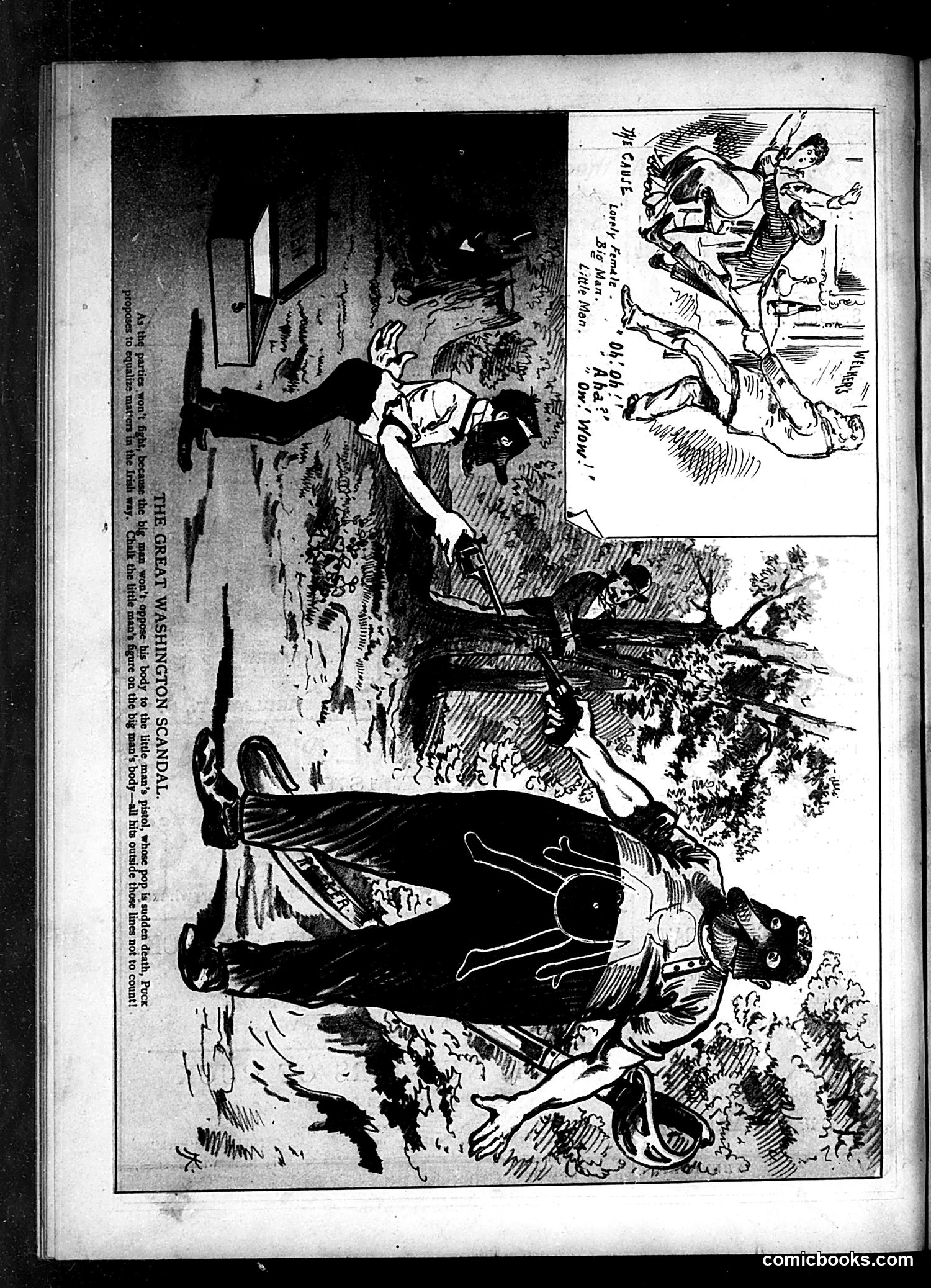
I can see this is a page from *Puck* magazine featuring satirical illustrations, but the OCR text provided is largely illegible in the transcription you've given me. From the **image alone**, I can observe: - A large central figure in dark formal dress (appears to be a woman or caricatured figure) - Multiple smaller figures engaged in various activities around this central character - A smaller inset illustration in the upper right showing figures in what appears to be a chaotic or comedic scene - The style is typical of late 19th/early 20th-century satirical cartooning **However**, without legible text identifying the specific political figures, events, or social issues being referenced, I cannot reliably explain what satire or political point this cartoon makes. To accurately interpret this page, I would need either clearer OCR text or additional publication information (date, title).