
Puck, 1878-07-03 · page 4 of 16
Puck — July 3, 1878 — page 4: what you’re looking at
What you’re looking at
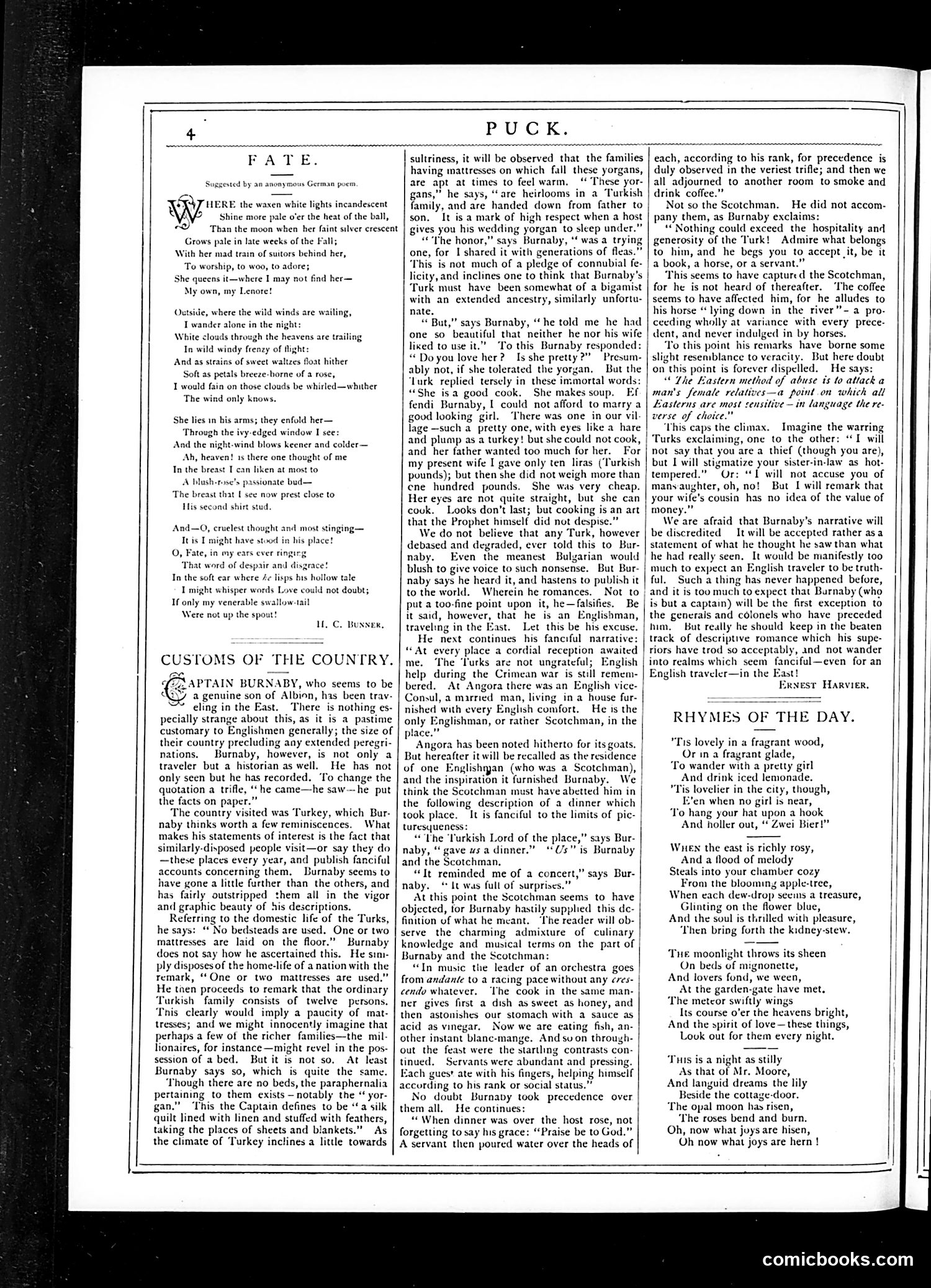
This page contains three distinct literary sections rather than political cartoons: "Fate" (a poem), "Customs of the Country" (prose about Captain Burnaby's travels in the East), and "Rhymes of the Day" (poetry). The "Customs of the Country" section discusses Captain Burnaby's observations of Turkish life, including commentary on Turkish hospitality, domestic customs, and comparisons with Scottish practices. The piece appears satirical in tone, mocking both Turkish and Scottish cultural practices through Burnaby's supposedly factual accounts—likely poking fun at travel narratives and cultural stereotyping common in the Victorian era. The other sections are straightforward literary contributions without clear political satire or caricature.
📄 Transcribed text from this page (OCR, searchable)
Machine-transcribed from the original scan — historical spelling and the odd misread are preserved.
FATE. Suggested by an anonymous German poem. HERE the waxen white lights incandescent Shine more pale o'er the heat of the ball, ‘Than the moon when her faint silver crescent Grows pale in late weeks of the Fall With her mad train of suitors behind her, To worship, to woo, to adore; a) She queens it—where I may not find her— My own, my Lenore! Outside, where the wild winds are wailing, I wander alone in the night: White clouds through the heavens are trailing In wild windy frenzy of flight: And as strains of sweet waltzes float hither Soft as petals breeze-borne of a rose, I would fain on those clouds be whirled—whuther The wind only knows, She lies in his arms; they enfold her— ‘Through the ivy-edged window I see: And the night-wind blows keener and colder— Ah, heaven! 1 there one thou; In the breast I can liken at most to A blush-rase’s passionate bud— The breast that { see now prest close to Ilis second shirt stud And—O, cruelest thought and ave stood in his plac t stinging — Ieis I might O, Fate, in my ears ever ringing ‘That word of despair and disgrace! In the soft ear where Ze lisps bis hollow tale I might whisper words Love could not doubt; If only my venerable swallow-tail Were not up the spout! 1, C. Buyyer, CUSTOMS OF THE COUNTRY. on - GZ APTAIN BURNABY, who seems to be AWS a genuine son of Albion, has been trav: * eling in the East. There is nothing es- pecially strange about this, as it is a pastime customary to Englishmen generally; the size of their country precluding any extended peregri- nations. Burnaby, however, is not only a traveler but a historian as well. He has not only scen but he has recorded. To change the quotation a trifle, “he came—he saw—he put the facts on paper.” The country visited was Turkey, which Bur- naby thinks worth a few reminiscences. What makes his statements of interest is the fact that similarly-disposed people visit—or say they do —these places every year, and publish fanciful accounts concerning them. Burnaby seems to have gone a little further than the others, and has fairly outstripped them all in the vigor and graphic beauty of his descriptions. Referring to the domestic life of the Turks, he says: “No bedsteads are used. One or two mattresses are laid on the floor.” Burnaby does not say how he ascertained this. He sim- ply disposes of the home-life of a nation with the remark, “One or two mattresses are used,” He ten proceeds to remark that the ordinary Turkish family consists of twelve persons, ‘This clearly would imply a paucity of mat- tresses; and we might innocently imagine that perhaps a few of the richer families—the mil- lionaires, for instance—might revel in the pos- session of a bed. But it is not so, At least Burnaby says so, which is quite the same. ‘Though there are no beds, the paraphernalia pertaining to them exists — notably the “ yor- gan.” ‘This the Captain defines to be “a silk quilt lined with linen and stuffed with feathers, taking the places of sheets and blankets.” As the climate of Turkey inclines a little towards sultriness, it will be observed that the families having mattresses on which fall these yorgans, are apt at times to feel warm. “ These yor- gans,” he says, “are heirlooms in a Turkish | family, and are handed down from father to son. It is a mark of high respect when a host gives you his wedding yorgan to sleep under. “The honor,” says Burnaby, “ was a tryin, one, for I shared it with generations of fleas ‘This is not much of a pledge of connubial fe: licity, and inclines one to think that Burnab; Turk must have been somewhat of a bigamist with an extended ancestry, similarly unfortu- nate. “But,” says Burnaby, “he told me he had one so beautiful that neither he nor his wife liked to use it.” To this Burnaby responded “Doyou love her? Is she pretty?” Presum- ably not, if she tolerated the yorgan, But the ‘Lurk replied tersely in these immortal words “She isa good cook. She makes soup. Ef fendi Burnaby, I could not afford to marry a good looking girl. ‘There was one in our vil lage —such a pretty one, with eyes like a hare and plump as a turkey! but she could not cook, and her father wanted too much for her. For my present wife I gave only ten liras (‘Turkish pounds); but then she did not weigh more than cne hundred pounds. She was very cheap. Her eyes are not quite straight, but she can couk. Looks don’t last; but cooking is an art that the Prophet himself did not despise.” We do not believe that any Turk, however debased and degraded, ever told this to Bur- naby. Even the meanest Bulgarian would blush to give voice to such nonsense. But Bur naby says he heard it, and hastens to publish it to the world. Wherein he romances. Not to put a too-fine point upon it, he—falsifies. Be it said, however, that he is an Englishman, traveling in the East. Let. this be his excuse. He next continues his fanciful narrative: “At every place a cordial reception awaited me. The Turks are not ungrateful; English help during the Crimean war is still remem- bered. At Angora there was an English vic Consul, a married man, living in a house fur- nished with every English comfort. He is the only Englishman, or rather Scotchman, in the place.” Angora has been noted hitherto for its goats. But hereafter it will be recalled as the residence | of one Englishtyan (who was a Scotchman), | and the inspiration it furnished Burnaby. We think the Scotchman must have abetted him in the following description of a dinner which took place. It is fanciful to the limits of pic- turesqueness: “The ‘Turkish Lord of the place,” says Bur- naby, “gave ws a dinner.” “Us” is Burnaby and the Scotchman, “It reminded me of a concert,” sa: naby. It was full of surprises.” At this point the Scotchman seems to have | objected, tor Burnaby hastily supplied this de- finition of what he meant. ‘The reader will ob- serve the charming admixture of culinary | knowledge and musical terms on the part of | Burnaby and the Scotchman: “In music the leader of an orchestra goes from andante to a racing pace without any ¢res- | cendo whatever. ‘The cook in the same man- ner gives first a dish as sweet as honey, and then astonishes our stomach with a sauce as acid as vinegar. Now we are cating fish, an- other instant blanc-mange. And sv on through- out the feast were the startling contrasts con- | tinued. Servants were abundant and pressing. Each guest ate with his fingers, helping himself according to his rank or social status.” No doubt Burnavy took precedence over them all. He continues: | “When dinner was over the host rose, not forgetting to say his grace: “Praise be to God.” A servant then poured water over the heads of | man's female relatives Easterns are most sensiti verse of choice.” | ‘This caps the climax. Imagine the warring | Turks exclaiming, one to the other: “I will not say that you are a thief (though you are), but I will stigmatize your sister-in-law as hot- tempered.” Or: “1 will not accuse you of mans aughter, oh, no! But I will remark that your wife’s cousin has no idea of the value of money.” We are afraid that Burnaby’s narrative will be discredited It will be accepted rather asa statement of what he thought he saw than what | he had really seen, It would be manifestly too much to expect an English traveler to be truth- ful. Such a thing has never happened before, and it is too much to expect that Burnaby (who | is but a captain) will be the first exception to the generals and colonels who have preceded him. But really he should keep in the beaten track of descriptive romance which his supe- riors have trod so acceptably, and not wander into realms which seem fanciful—even for an English traveler—in the East! | Eryn | Bur- each, according to his rank, for precedence is duly observed in the veriest trifle; and then we all adjourned to another room to smoke and drink coffee.” Not so the Scotchman. He did not accom. pany them, as Burnaby exclaims: ‘Nothing could exceed the hospitality and generosity of the Turk! Admire what belongs to him, and he begs you to accept it, be it a book, a horse, or a servant.” | This seems to have captured the Scotchman, for he is not heard of thereafter. ‘The coffee seems to have affected him, for he alludes to his horse “lying down in the river"- a pro- ceeding wholly at variance with every prece- dent, and never indulged in by horses. To this point his remarks have borne some slight resemblance to verac But here doubt on this point is forever dispelled. He says: “* The Eastern method of abuse is to attack a a point on which all ~ in language the re- Harvier. RHYMES OF THE DAY. "Tis lovely in a fragrant wood, Or ina fragrant glade, ‘To wander with a pretty girl And drink iced lemonade. "Tis lovelier in the city, though, E’en when no girl is near, ‘To hang your hat upon a hook And holler out, Zwei Bier!” Wuen the east is richly rosy, And a flood of melody Steals into your chamber cozy From the blooming apple-tree, When each dew-drop seems a treasure, Glinting on the flower blue, And the soul is thrilled with pleasure, ‘Then bring forth the kidney-stew. ‘Tue moonlight throws its sheen On beds of mignonette, And lovers fond, we ween, At the garden-gate have met. ‘The meteor swiftly wings Its course o'er the heavens bright, And the spirit of love—these things, Louk out for them every night. Tus is a night as stilly As that of Mr. Moore, And languid dreams the lily Beside the cottage: ‘The opal moon has ris ‘The roses bend and burn. Oh, now what joys are hisen, Oh now what joys are hern ! comicbooks.com