
Puck, 1878-07-03 · page 6 of 16
Puck — July 3, 1878 — page 6: what you’re looking at
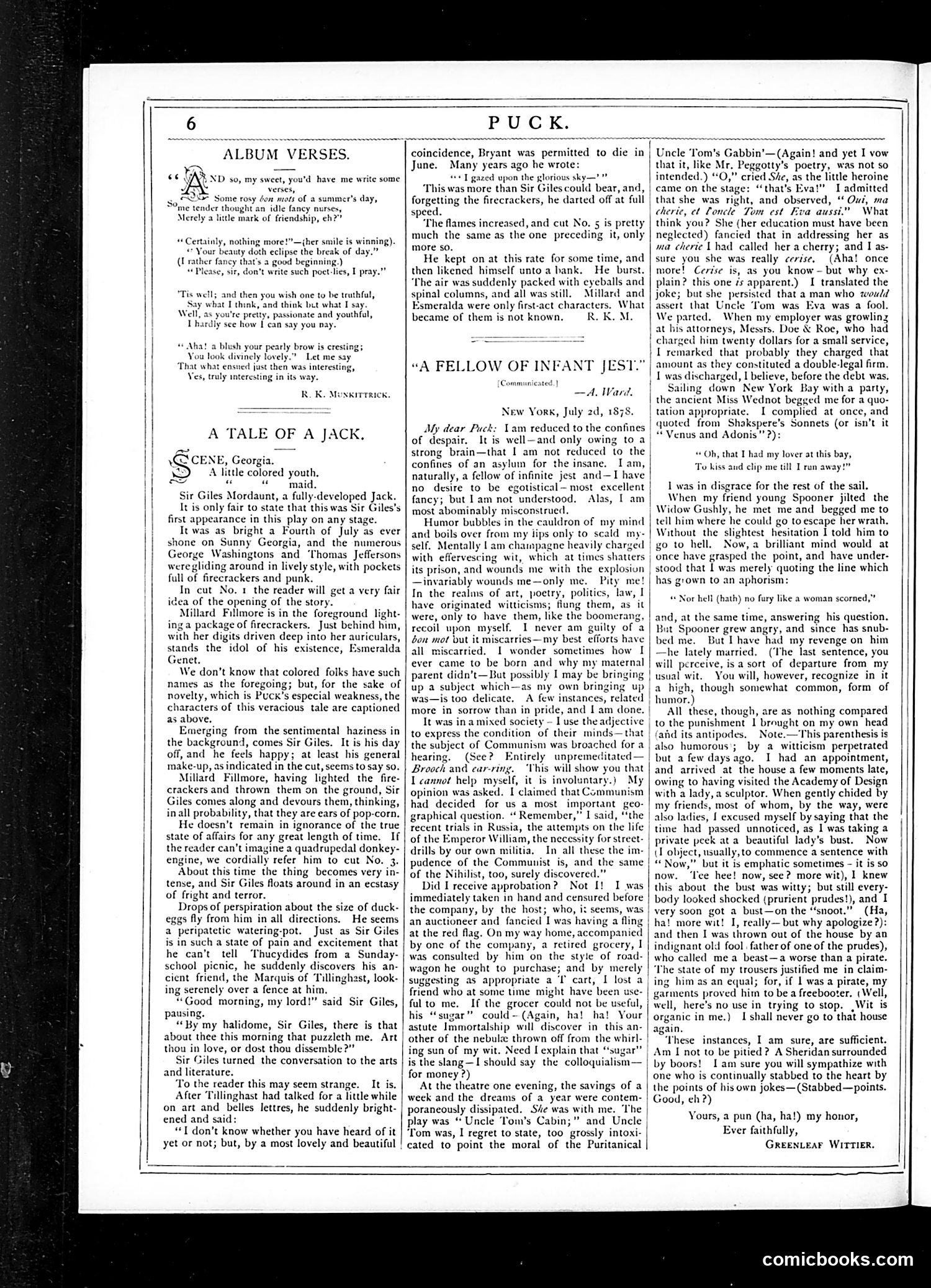
What you’re looking at
This page contains three separate pieces of satirical content: 1. **"Album Verses"** - Brief humorous poems on various topics, including one mocking someone's pretensions about "good beginnings." 2. **"A Tale of a Jack"** - A story about Sir Giles Morelands, a "little colored youth" and maid named Jack in Georgia. The narrative satirizes the character through exaggerated dialect and depicts stereotypical scenarios. This reflects the racist caricatures common in 19th-century American humor. 3. **"A Fellow of Infant Jest"** - A letter from someone claiming reduced mental capacity, criticizing Communism and Russian politics, likely referencing contemporary debates of the 1870s-80s. The page exemplifies Puck's blend of social satire, though much content reflects deeply problematic racial attitudes typical of the period.
📄 Transcribed text from this page (OCR, searchable)
Machine-transcribed from the original scan — historical spelling and the odd misread are preserved.
ALBUM VERSES. SX ND so, my sweet, you'd have me write some a verses, SOF Some rosy bon mots of a summer's day, 1 tender thought an idle fancy Merely a little mark of friendship, “Certainly, nothing more!”—(her smile is winning). «Your beauty doth eclipse the break of day.” (I rather fancy that’s a good beginning.) «Please, sir, don't write such poet-lies, I pray.” "Tis well; and then you wish one to be truthful, Say what I think, and think but what I say. Well, as you're pret nate and youthful, I hardly see how I can say you nay. + Nha! a blush your pearly brow is cresting; You look divinely lovely.” Let me say ‘That what ensned just then was interesting, Ves, truly interesting in its w R. K. Muygrrrrick A TALE OF A JACK, , Georgia. A little colored youth. a “maid. Sir Giles Mordaunt, a fully-developed Jack. It is only fair to state that this was Sir Giles’s first appearance in this play on any stage. It was as bright a Fourth of July as ever shone on Sunny Georgia, and the numerous George Washingtons and ‘Thomas Jeffersons were gliding around in lively style, with pockets full of firecrackers and punk. In cut No. 1 the reader will get a very fair idea of the opening of the story. Millard Fillmore is in the foreground light- ing a package of firecrackers. Just behind him, with her digits driven deep into her auriculars, stands the idol of his existence, Esmeralda Genet. We don’t know that colored folks have such names as the foregoing; but, for the sake of novelty, which is Puck’s especial weakness, the characters of this veracious tale are captioned as above. Emerging from the sentimental haziness in the background, comes Sir Giles. It is his day off, and he feels happy; at least his general make-up, as indicated in the cut, seems to say so. Millard Fillmore, having lighted the fire crackers and thrown them on the ground, Sir Giles comes along and devours them, thinking, inall probability, that they are ears of pop-corn. He doesn’t remain in ignorance of the true state of affairs for any great length of time. If the reader can’t imagine a quadrupedal donkey- engine, we cordially refer him to cut No. 3. About this time the thing becomes very in- tense, and Sir Giles floats around in an ecstasy of fright and terror. Drops of perspiration about the size of duck- eggs fly from him in all directions. He seems a peripatetic watering-pot. Just as Sir Giles is in such a state of pain and excitement that he can’t tell ‘Thucydides from a Sunday- school picnic, he suddenly discovers his an- cient friend, the Marquis of Tillinghast, look- ing serenely over a fence at him. “Good morning, my lord!” said Sir Giles, pausing. “By my halidome, Sir Giles, there is that about thee this morning that puzzleth me. Art thou in love, or dost thou dissemble ?”” ir Giles turned the conversation to the arts and literature. ‘To the reader this may seem strange. It is, After Tillinghast had talked for a little while on art and belles lettres, he suddenly bright- | ened and said: “I don’t know whether you have heard of it yet or not; but, by a most lovely and beautiful PUCK. coincidence, Bryant was permitted to die in June. Many years ago he wrote: «+L gazed upon the glorious sky— This was more than Sir Giles could bear, and, forgetting the firecrackers, he darted off at full speed. “The flames increased, and cut No. 5 is pretty much the same as the one preceding it, only more so. He kept on at this rate for some time, and then likened himself unto a bank. He burst. he air was suddenly packed with eyeballs and spinal columns, and all was still. Millard and Esmeralda were only first-act characters. W became of them is not known, R. K. M. “A FELLOW OF INFANT JEST.” ie —A. Ward. New York, July 2d, 1878. My dear Puck: Lam reduced to the confines of despair. It is well—and only owing to a strong brain—that I am not reduced to the confines of an asylum for the insane. I am, naturally, a fellow of infinite jest and—I hav no desire to be egotistical— most excellent fancy; but 1am not understood. Alas, I am most abominably misconstrued. Humor bubbles in the cauldron of my mind and boils over from my lips only to scald my- self, Mentally Lam champagne heavily charged with effervescing wit, which at times shatters its prison, and wounds me with the explosion —invariably wounds me—only me. Pity me! In the realms of art, poetry, politics, law, I have originated witticisms; flung them, as it were, only to have them, like the boomerang, recoil upon myself. I never am guilty of a bon mot but it miscarries—my best efforts have all miscarried. I wonder sometimes how I ever came to be born and why my maternal parent didn’t—But possibly I may be bringing up a subject which—as my own bringing up was—is too delicate. A few instances, related more in sorrow than in pride, and I am done, It was ina mixed society — Luse the adjective to express the condition of their minds—that the subject of Communism was broached for a hearing. (See? Entirely unpremeditated— Brooch and ear-ring. ‘Vhis will show you that I cannot help myself, it is involuntary.) My opinion was asked. I'claimed that Communism had decided for us a most important geo- graphical question. “Remember,” I said, “the recent trials in Russia, the attempts on the life of the Emperor William, the necessity for strect- drills by our own militia, In_all these the im- pudence of the Communist is, and the same of the Nihilist, too, surely discovered.” Did I receive approbation? Not I! I was immediately taken in hand and censured before the company, by the host; who, i: seems, was an auctioneer and fancied I was having a fling at the red flag. On my way home, accompanied by one of the company, a retired grocery, I was consulted by him on the style of road- wagon he ought to purchase; and by merely suggesting as appropriate a ‘I cart, I lost a friend who at some time might have been use fulto me. If the grocer could not be us his “sugar” could- (Again, ha! ha! Your astute _Immortalship will discover in this an- other of the nebulz thrown off from the whirl ing sun of my wit. Need I explain that “sugar” is the slang—I should say the colloquialism— for money ?) At the theatre one evening, the savings of a week and the dreams of a year were contem- poraneously dissipated. She was with me. The play was “Uncle Tom’s Cabin;” and Uncle ‘Tom was, I regret to state, too grossly intoxi- cated to point the moral of the Puritanical ful, | | Uncte ‘Tom's Gabbin '—(Again! and yet I vow | that it, like Mr. Peggotty’s poetry, was not so | intended.) “O,” cried She, as the little heroine came on the stage: “that’s Eva!" I admitted that she was right, and observed, “ Oui, ma cherie, et Concle Tom est Eva aussi” What think you? She (her education must have been neglected) fancied that in addressing her as ma cherie Uhad called her a cherry; and I as- sure you she was really cerise, (Aha! once more! Cerise is, as you know - but why ex- plain? this one ¢s apparent.) I translated the joke; but she persisted that a man who would assert that Uncte ‘Tom was Eva was a fool. We parted. When my employer was growling | at his attorneys, Messrs. Doe & Roe, who had | charged him twenty dollars for a small service, | L remarked that probably they charged that amount as they constituted a double-legal firm. | 1 was discharged, I believe, before the debt was. | ing down New York Bay with a party, | the ancient Miss Wednot begged me for a quo- | tation appropriate. I complied at once, and quoted from Shakspere’s Sonnets (or isn’t it “Venus and Adonis" ?): “Oh, that T had my lover at this bay, To kiss and clip me till Tran away 1 was in disgrace for the rest of the sail. When my friend young Spooner jilted the Widow Gushly, he met me and begged me to tell him where he could go to escape her wrath, Without the slightest hesitation I told him to go to hell. Now, a brilliant mind would at | once have grasped the point, and have under- stood that I was merely quoting the line which has grown to an aphorism: “ Nor hell (hath) no fury like a woman scorned,” | and, at the same time, answering his question, But Spooner grew angry, and since has snub- | bed me. But I have had my revenge on him —he lately married. (‘The last sentence, you will perceive, is a sort of departure from my | usual wit. You will, however, recognize in it a high, though somewhat common, form of humor.) All these, though, are as nothing compared to the punishment I’ brought on my own head and its antipodes. Note.—This parenthesis is also humorous}; by a witticism perpetrated but a few days ago. I had an appointment, and arrived at the house a few moments late, owing to having visited the Academy of Design with a lady, a sculptor. When gently chided by my friends, most of whom, by the way, were also ladies, 1 excused myself by saying that the time had ‘passed unnoticed, as I was taking a private peek at a beautiful lady’s bust. Now (I object, usually,to commence a sentence with | Now,” but it is emphatic sometimes - it is so now. ‘I'ce hee! now, see? more wit), 1 knew this about the bust was witty; but still every- body looked shocked (prurient prudes!), and I very soon got a bust—on the “‘snoot.” (Ha, | ha! more wit! I, really—but why apologize ?): and then I was thrown out of the house by an indignant old fool. father of one of the prudes), who called me a beast—a worse than a pirate. ‘The state of my trousers justified me in claim- ing him as an equal; for, if 1 was a pirate, my garments proved him to be a freebooter, (Well, well, here’s no use in trying to stop. ,Wit is organic in me.) I shall never go to that house again. “These instances, I am sure, are sufficient. Am I not to be pitied? A Sheridan surrounded by boors! Iam sure you will sympathize with | one who is continually stabbed to the heart by | the points of his own jokes—(Stabbed—points. | Good, eh?) Yours, a pun (ha, ha!) my honor, | Ever faithfully, GreenLear WITTIER. comicbooks.com