
Puck, 1878-07-03 · page 2 of 16
Puck — July 3, 1878 — page 2: what you’re looking at
What you’re looking at
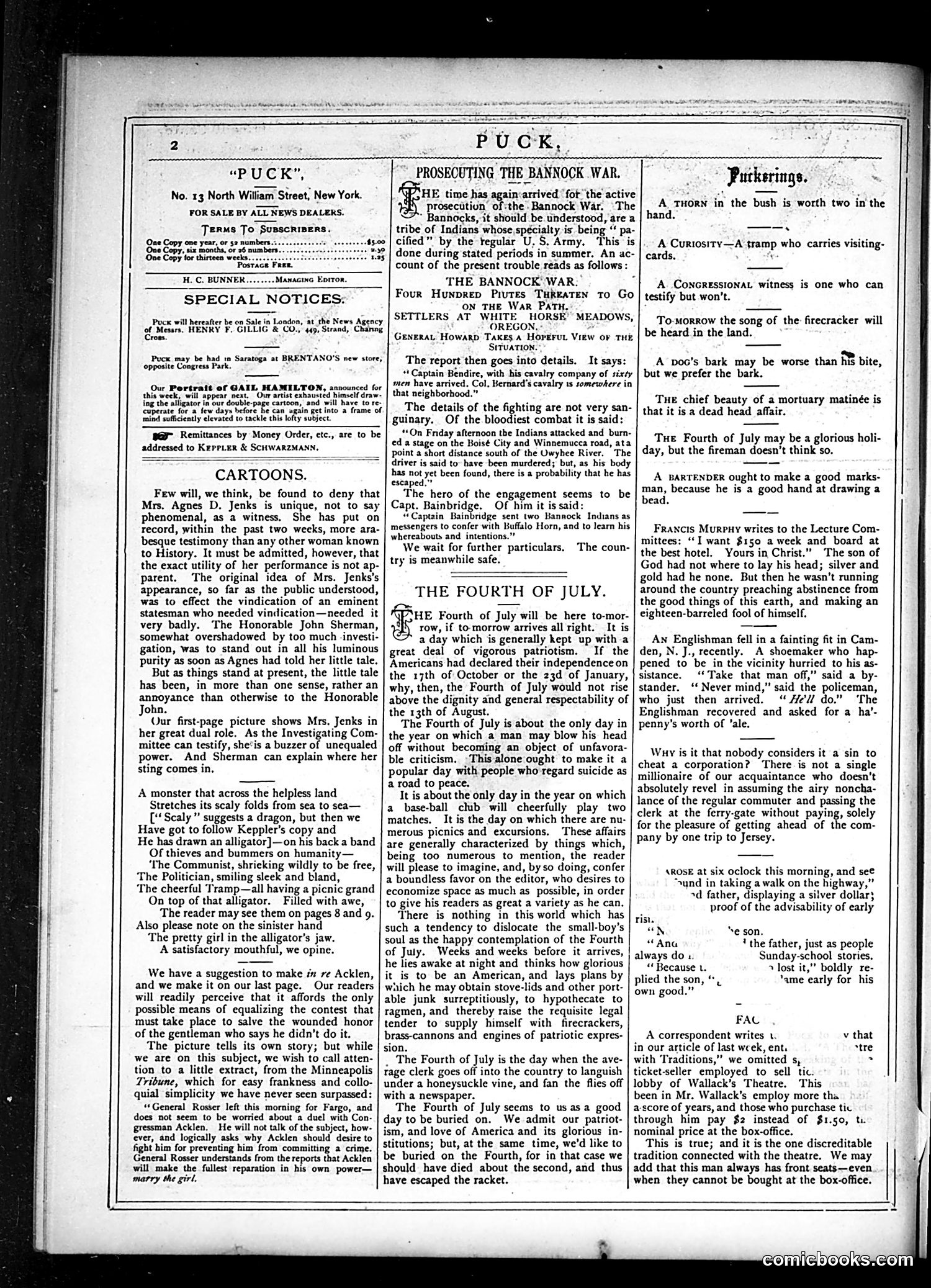
This page contains editorial commentary and satirical pieces rather than political cartoons. The main article discusses the **Bannock War**, a conflict involving Native Americans and U.S. Army forces in the Pacific Northwest. The text critiques the government's military response, suggesting the Bannock tribe has been "specially" targeted by the Army during summer campaigns. The "Puckerings" section offers short satirical observations on American society—mocking firecracker enthusiasts, congressional witnesses, and mortuary practices around Independence Day. The page also includes commentary on the Fourth of July itself, questioning whether it truly represents patriotic values given contemporary social issues. The content reflects 1870s concerns about Native American conflicts and holiday hypocrisy.
📄 Transcribed text from this page (OCR, searchable)
Machine-transcribed from the original scan — historical spelling and the odd misread are preserved.
; i | PUCK, “PUCK”, No. 13 North William Street, New York. FOR SALE BY ALL NEWS DEALERS. Terms To Susscrisers. One Copy A u bers. oe Copy, six months, cr 36 numbers 1H. C. BUNNER.. SPECIAL NOTICES. Puck will hereafter be on Sale in London, at the News Agency of Mesurs, HENRY F. GILLIG & CO. 449, Strand, Chang Foes. Puck may be had in Saratoga at BRENTANO’S new store, opposite Congress Park. Our Portrait of GAIL HAMILTON, announced for this week, will appear next. Our artist exhausted himself draw- ing the alligator in our double-page cartoon, and will have to re- cuperate for a few days before he can ugain get into a frame of mind sufficiently elevated to tackle this lofty subject. BaF Remittances by Money Order, etc., are to be addressed to Kerrier & SCHWARZMAN! CARTOONS. Few will, we think, be found to deny that Mrs. Agnes D. Jenks is unique, not to say phenomenal, as a witness, She has put on record, within the past two weeks, more ara- besque testimony than any other woman known to History. It must be admitted, however, that the exact utility of her performance is not ap- parent. The original idea of Mrs. Jenks's appearance, so far as the public understood, was to effect the vindication of an eminent statesman who needed vindication—needed it very badly. The Honorable John Sherman, somewhat overshadowed by too much -investi- gation, was to stand out in all his luminous purity as soon as Agnes had told her little tale. But as things stand at present, the little tale has been, in more than one sense, rather an annoyance than otherwise to the Honorable John. Our first-page picture shows Mrs. Jenks in her great dual role. As the Investigating Com- mittee can testify, she‘is a buzzer of unequaled power. And Sherman can explain where her sting comes in. A monster that across the helpless land Stretches its scaly folds from sea to sea— (‘‘Scaly ” suggests a dragon, but then we Have got to follow Keppler’s copy and He has drawn an alligator]—on his back a band Of thieves and bummers on humanity — ‘The Communist, shrieking wildly to be free, The Politician, smiling sleek and bland, The cheerful Tramp—all having a picnic grand On top of that alligator. Filled with awe, The reader may see them on pages 8 and 9. Also please note on the sinister hand The pretty girl in the alligator’s jaw. A satisfactory mouthful, we opine. We have a suggestion to make in re Acklen, and we make it on our last page. Our readers will readily perceive that it affords the only possible means of equalizing the contest that must take place to salve the wounded honor of the gentleman who says he didn’t do it. The picture tells its own story; but while we are on this subject, we wish to call atten- tion to a little extract, from the Minneapolis Tribune, which for easy frankness and collo- quial simplicity we have never seen surpassed: “General Rosser left this morning for Fargo, and does not seem to be worried about a duel with Con- gressman Acklen. He will not talk of the subject, how- ever, and logically asks why Acklen should desire to fight him for preventing him from committing a crime. General Rosser understands from the reports that Acklen will make the fullest reparation in his own power— marry the girl. PROSEOUTING. THE BANN OCK .WAR. HE time has again‘arrived ‘forthe’ active prosecition’ of:the Bannock War. ‘The * Bannocks, it should be. understood, are a tribe of Indians whose spécialty is being ‘ pa- cified” by the regular U,§. Army. This is done during stated periods in summer. An ac- count of the present trouble reads as follows : THE BANNOCK:WAR, 3 Four Hunprep Piutes TuREaTEN To Go ON THE War Patu, SETTLERS AT WHITE HORSE’ MEADOWS, OREGON, Generat Howarb Takes 4 Horgrut View or THE SITUATION. The report then goes into details. It says: “ Captain Bendire, with his cavalry company of sixty men have arrived. Col, Bernard's cavalry 1s somewhere in that neighborhood.” The details of the fighting are not very san- guinary. Of the bloodiest combat it is said: “On Friday afternoon the Indians attacked and burn- ed a stage on the Boisé City and Winnemucca road, ata point a short distance south of the Owyhee River. The driver is said to- have been murdered; but, as his body has not yet been found, there is a probability that he has escaped.” The hero of the engagement seems to be Capt. Bainbridge. Of him it is said: ‘aptain Bainbridge sent two Bannock Indians as messengers to confer with Buffalo Horn, and to learn his whereabouts and intentions.” We wait for further particulars. The coun- try is meanwhile safe. THE FOURTH OF JULY. FAHE Fourth of July will be here to-mor- row, if to-morrow arrives all right. It is a day which is generally kept up with a great deal of vigorous patriotism. If the Americans had declared their independenceon the 17th of October or the 23d of January, why, then, the Fourth of July would not rise above the dignity and general respectability of the 13th of August. ‘The Fourth of July is about the only day in the year on which a man may blow his head off without becoming an object of unfavora- ble criticism. This ‘alone ought to make it a popular day with people who regard suicide as a road to peace. It is about the only day in the year on which a base-ball club will cheerfully play two matches. It is the day on which there are nu- merous picnics and excursions. These affairs are generally characterized by things which, being too numerous to mention, the reader will please to imagine, and, by so doing, confer a boundless favor on the editor, who desires to economize space as much as possible, in order to give his readers as great a variety as he can. There is nothing in this world which has such a tendency to dislocate the small-boy’s soul as the happy contemplation of the Fourth of July. Weeks and weeks before it arrives, he lies awake at night and thinks how glorious it is to be an American, and lays plans by wnich he may obtain stove-lids and other port- able junk surreptitiously, to hypothecate to ragmen, and thereby raise the requisite legal tender to supply himself with firecrackers, brass-cannons and engines of patriotic expres- sion. _ The Fourth of July is the day when the ave- rage clerk goes off into the country to languish under a honeysuckle vine, and fan the flies off with a newspaper. The Fourth of July seems to us asa good day to be buried on. We admit our patriot- ism, and love of America and its glorious in- stitutions; but, at the same time, we'd like to be buried on the Fourth, for in that case we should have died about the second, and thus have escaped the racket. Pucksrings. ge A. tHoRN in the bush is worth two in the hand. A Curtosity—A tramp who carries visiting- cards, ee A. CONGRESSIONAL witness is one who can testify but won’t. To-morrow the song of the: firecracker will be heard in the land. A poo’s bark may be worse than hi bite, but we prefer the bark. Tue chief beauty of a mortuary matinée is that it is a dead head affair. Tue Fourth of July may be a glorious holi- day, but the fireman doesn’t think so. A BARTENDER ought to make a good marks- man, because he is a good hand at drawing a bead. Francis Murpuy writes to the Lecture Com- mittees: ‘I want $150 a week and board at the best hotel. Yours in Christ.” The son of God had not where to lay his head; silver and gold had he none. But then he wasn’t running around the country preaching abstinence from the good things of this earth, and making an eighteen-barreled fool of himself. An Englishman fell in a fainting fit in Cam- den, N. J., recently. A shoemaker who hap- pened to be in the vicinity hurried to his as- sistance. ‘(Take that man off,” said a by- stander. “Never mind,” said the policeman, who just then arrived. ‘“ He’l/ do.” ‘The Englishman recovered and asked for a ha’- penny’s worth of ‘ale. Wuy is it that nobody considers it a sin to cheat a corporation? There is not a single millionaire of our acquaintance who doesn't absolutely revel in assuming the airy noncha- lance of the regular commuter and passing the clerk at the ferry-gate without paying, solely for the pleasure of getting ahead of the com- pany by one trip to Jersey. sRose at six oclock this morning, and see “sund in taking a walk on the highway,” ad father, displaying a silver dollar; proof of the advisability of early rist. ON “se son. “Ana ‘the father, just as people always do Sunday-school stories. “ Because t. + lost it,” boldly re- plied the son, “, ‘ame early for his own good.” FAC A correspondent writes 1. v that in our article of last week, ent. vtre with Traditions,” we omitted s, ticket-seller employed to sell tic. lobby of Wallack’s Theatre. This been in Mr. Wallack’s employ more tha a-score of years, and those who purchase tic through him pay $2 instead of $1.50, ti. nominal price at the box-office. This is true; and it is the one discreditable tradition connected with the theatre. We may add that this man always has front seats—even when they cannot be bought at the box-office. Comicbooks=co