
Puck, 1878-07-03 · page 3 of 16
Puck — July 3, 1878 — page 3: what you’re looking at
What you’re looking at
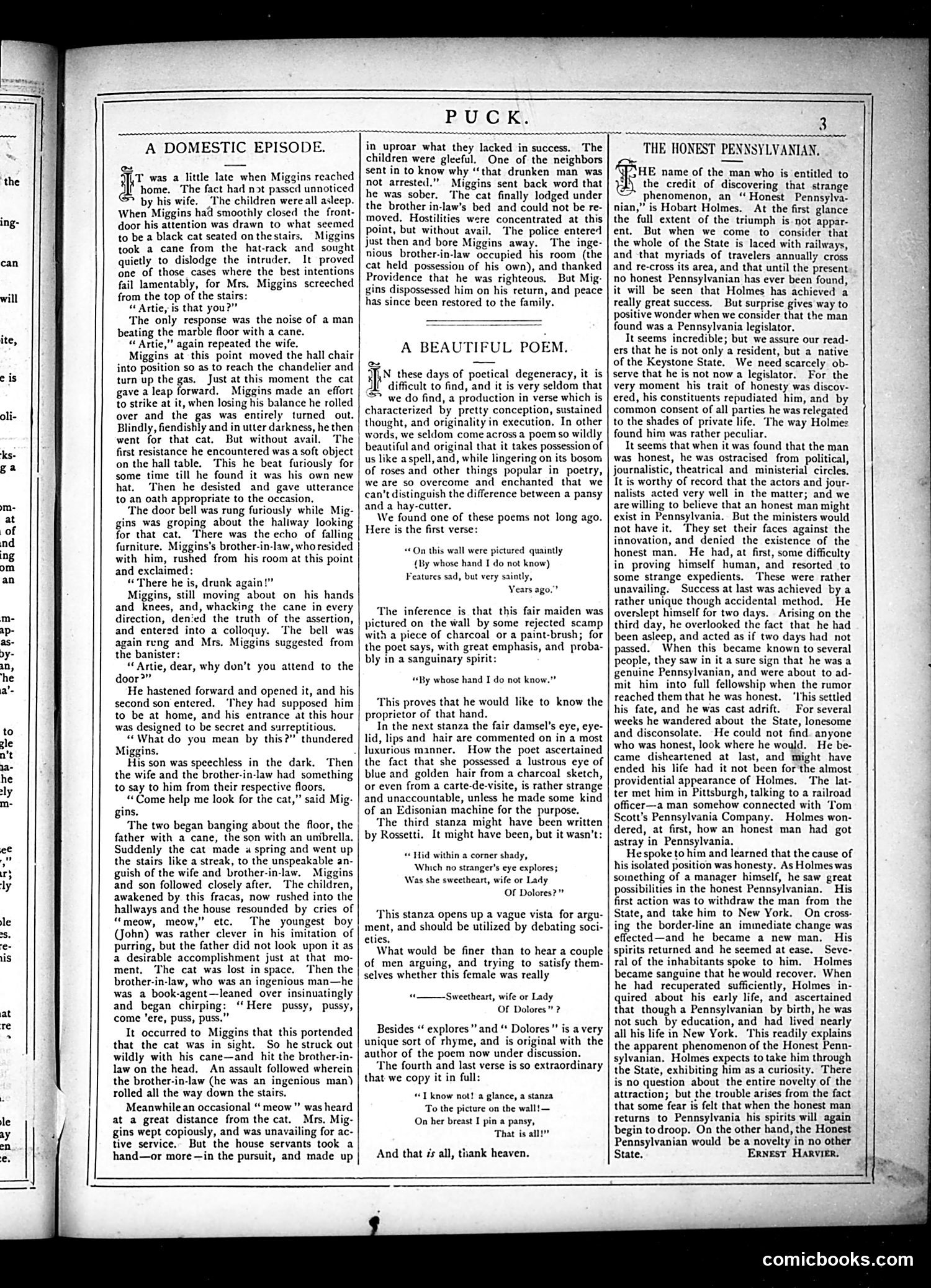
This page contains three separate pieces: a domestic humor story ("A Domestic Episode"), a poem ("A Beautiful Poem"), and an article titled "The Honest Pennsylvanian." The main content targets an unnamed Pennsylvania legislator who claims to be "honest" and resists political pressure. The satirical article suggests this reputation is exaggerated—the legislator withdrew from Pennsylvania politics and relocated to New York, working for a railroad. The piece implies his "honesty" was selective: he avoided state corruption scandals by simply leaving the state entirely. The satire mocks both the legislator's self-serving departure and the absurdity of celebrating someone as "honest" primarily for avoiding political entanglement rather than actively serving constituents. The other pieces appear to be filler content typical of Puck's mixed entertainment format.
📄 Transcribed text from this page (OCR, searchable)
Machine-transcribed from the original scan — historical spelling and the odd misread are preserved.
A DOMESTIC EPISODE. PUCK. 3 in uproar what they lacked in success. The children were gleeful. One of the neighbors THE HONEST PENNSYLVANIAN, =. F se oq | Sent in to know why “that drunken man was | ‘QY}HE name of the man who is entitled to 3 r Va oe rove ere he kale Met not arrested.” Miggins sent back word that F the credit of discovering that. strange & by his wife. The children were all asleep. Be Nas sober. | ‘The cat finally lodged under | “~~ phenomenon, an ‘Honest Pennsylva- When Miggins had smoothly closed the front- the ror er in-law’s bed and could not be re- | nian,” is Hobart Holmes. At the first glance ing- door his attention was drawn to what seemed mover ae Hostilities were concentrated at this} the full extent of the triumph is not appar- to be a black cat seated on thestairs, Miggins point, but without avail, The police entered | ent, But when we come to consider that took a cane from the hat-rack and sought | Just then and bore Miggins away. ‘The inge- | the whole of the State is laced with railways, ay quietly to dislodge the intruder. It proved nious brother-in-law occupied his room (the | and that myriads of travelers annually cross ne of those cases where the best intentions cat held possession of his own), and thanked | and re-cross its area, and that until the present fail lamentably, for Mrs. Miggins screeched | Providence that he was righteous. But Mig: | no honest Pennsylvanian has ever been found, P from the top of the stairs gins dispossessed him on his return, and peace | it will be seen that Holmes has achieved a will « Artie, is that you?” has since been restored to the family. really great success. But surprise gives way to ‘The only response was the noise of a man positive wonder when we consider that the man ; beating the marble floor with a cane. found was.) Penney lvaniailegiiaicrs é ite, “ ie.” ii i > “PrOT? . H > Dut we assure our read- Se ee eased eee wike hallchair| © BEAUTIFUL POEM. | ers that he is not only'a resident, but a. native into position so as to reach the chandelier and | $* leat ae | of the Keyntone State, We need scarcely ob- c is turn up the gas. Just at this moment the cat of these days of poetical degeneracy, it is | serve that he is not now a legislator. For the gave a leap forward. Miggins made an effort | & difficult to find, and it is very seldom that | very moment his trait of honesty was discov- fo strike at it, when losing his balance he rolled | -” W¢ 40 find, a production in verse which is | ered, his constituents repudiated him, and by oli over and the gas was entirely turned out. characterized by pretty conception, sustained | common consent of all parties he was relegated Blindly, fiendishly and in utter darkness, he then thought, and originality in execution. In other to the shades of private life. The way Holme: went for that cat, But without avail, ‘The | %ords, we seldom come across a poemso wildly | found him was rather peculiar. k first resistance he encountered was a soft object beautiful and original that it takes possession of It seems that when it was found that the man a onthe hall table. ‘This he beat furiously for | US like aspell, and, while lingering on its bosom | was honest, he was ostracised from political, Se Some time till he found it was his own new | f foses and other things popular in poetry, | journalistic, theatrical and ministerial circles. hat. Then he desisted and gave utterance | ¥€ 47€ 50 overcome and enchanted that we | It is worthy of record that the actors and jour- to an oath appropriate to the occasion. can’t distinguish the difference between a pansy | nalists acted very well in the matter; and we ym ‘The door bell was rung furiously while Mig- and a hay-cutter. are willing to believe that an honest man might at gins was groping about the hallway looking We found one of these poems not long ago. | exist in Pennsylvania. But the ministers would of for that cat. There was the echo of falling Here is the first verse: not have it. They eae faces against the nd i iggins’s Sndlaw. wi i . innovation, and denied the existence of the om gad exclaimed: ° ° {By whose hand I do not know) in proving himself human, and resorted to an «There he is, drunk again!” Features sad, but very saintly, some strange expedients. These were rather Miggins, still’ moving about on his hands Vears ago.” mnavalling: coast bat ge ceuted bya ii e i x + : * bs 1c sony le m and knees, and, whacking the cane in every | rhe inference is that this fair maiden was | overslept himself for two days, Arising on the ap- and entered into a colloquy. ‘The bell was | Pictured.on the wall by some rejected scamp | third day, he overlooked the fact that he had as- again reng and Mrs. Miggins suggested from | With 2 piece of charcoal or a paint-brush; for | been asleep, and acted as if two days had not Dy: the banister: “ the poet says, with great emphasis, and proba-| passed. When this became known to several “Artie, dear, why don’t you attend to the door?” He hastened forward and opened it, and his second son entered. ‘They had supposed him to be at home, and his entrance at this hour was designed to be secret and surreptitious, “What do you mean by this?” thundered Miggins. His son was speechless in the dark. Then the wife and the brother-in-law had something to say to him from their respective floors, «Come help me look for the cat,” said Mig- gins. The two began banging about the floor, the father with a cane, the son with an unibrella. bly in a sanguinary spirit: “By whose hand I do not know.”” This proves that he would like to know the proprictor of that hand. In the next stanza the fair damsel’s eye, eye- lid, lips and hair are commented on in a most luxurious manner. How the poet ascertained the fact that she possessed a lustrous eye of blue and golden hair from a charcoal sketch, or even from a carte-de-visite, is rather strange and unaccountable, unless he made some kind of an Edisonian machine for the purpose. The third stanza might have been written by Rossetti. It might have been, but it wasn’t: people, they saw in it a sure sign that he was a genuine Pennsylvanian, and were about to ad- mit him into full fellowship when the rumor reached them that he was honest. s settled his fate, and he was cast adrift. For several weeks he wandered about the State, lonesome and disconsolate. He could not find. anyone who was honest, look where he would. He be- came disheartened at last, and might have ended his life had it not been for the almost providential appearance of Holmes. The lat- ter met him in Pittsburgh, talking to a railroad officer—a man somehow connected with ‘Tom Scott's Pennsylvania Company. Holmes won- dered, at first, how an honest man had got astray in Pennsylvania. ec Suddenly the cat mide a4 ‘pring saree up «+ Hid within a corner shady, He spoke to him and learned that the cause of O the stairs like a streak, to the unspeakable an- Which no stranger’s eye explores; his isolated position was honesty. As Holmes was r} guish of the wife and brother-in-law. Miggins : ; : Taerer A dy W son followed closely after. ‘The child Was she sweetheart, wife or Lady something of a manager himself, he saw great ly and son followed closely after. The children, Ormeau” possibilities in the honest Pennsylvanian. His awakened by this fracas, now rushed into the hallways and the house resounded by cries of “meow, meow,” etc. The youngest boy (John) ‘was rather clever in his imitation of purring, but the father did not look upon it as a desirable accomplishment just at that mo- ment. The cat was lost in space. Then the brother-in-law, who was an ingenious man—he was a book-agent—leaned_ over insinuatingly and began chirping: ‘Here pussy, pussy, ‘This stanza opens up a vague vista for argu- ment, and should be utilized by debating soci- euies, What would be finer than to hear a couple of men arguing, and trying to satisfy them- selves whether this female was really ‘Sweetheart, wife or Lady Of Dolores” ? first action was to withdraw the man from the State, and take him to New York. On cross- ing the border-line an immediate change was effected—and he became a new man. His spirits returned and he seemed at ease. Seve- ral of the inhabitants spoke to him. Holmes became sanguine that he would recover. When he had recuperated sufficiently, Holmes in- quired about his early life, and ascertained that though a Pennsylvanian by birth, he was - come "ere, puss, puss.” | ace and“ Dolores" is avery | Rot such, by education, and had lived nearly > It occurred to Miggins that this portended | _ Besides “‘ explores” and “ Dolores” is avery | ait his life in New York. ‘This readily explains that the cat was in sight. So he struck out | Unique sort of rhyme, and is original with the | the apparent phenomenon of the Honest Penn- wildly with his cane—and hit the brother-in- | author of the poem now under discussion. —_| syivanian, Holmes expects to take him through law on the head, An assault followed wherein | | The fourth and last verse is so extraordinary | the State, exhibiting him as a curiosity. ‘There the brother-in-law (he was an ingenious man) | that we copy it in full: is no question about the entire novelty of the : rolled all the way down the stairs. “1 know not! a glance, a stanza attraction; but the trouble arises from the fact Meanwhile an occasional “ meow” was heard To the picture on the wall! — that some fear is felt that when the honest man le at a great distance from the cat. Mrs. Mig- On her breast I pin a pansy, returns to Pennsylvania his spirits will again ay gins wept copiously, and was unavailing for ac- ‘That is ail!” begin todroop. On the other hand, the Honest on tive service.. But the house servants took a F 3 Pennsylvanian would be a novelty in no other e. hand—or more—in the pursuit, and made up| And that ¢s all, thank heaven. State. Ernest HaARvIER. comicbooks.com