
Puck, 1878-07-03 · page 13 of 16
Puck — July 3, 1878 — page 13: what you’re looking at
What you’re looking at
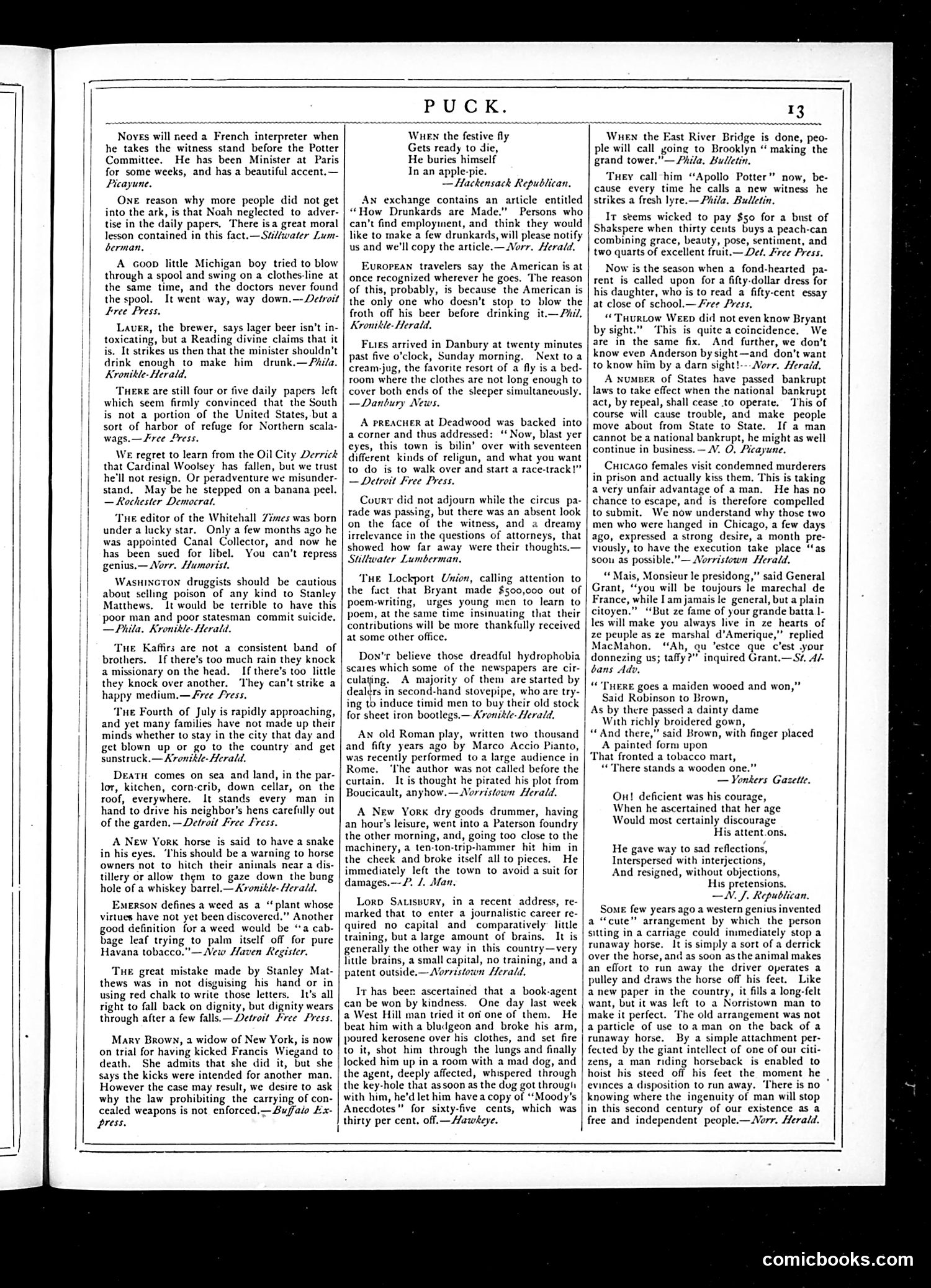
This page consists primarily of **text-based humor columns** rather than illustrated cartoons. The content includes brief satirical anecdotes and observations on contemporary social issues, each credited to various newspapers as sources. The humor covers diverse topics: a Michigan man's failed attempt to blow through a pool and siphon; complaints about beer advertising; absurd newspaper articles (flies at Danbury, circuses missing witnesses); and social commentary on topics like poison sales, the Kafirs, and Fourth of July celebrations. Notable is a piece criticizing Bryant for fundraising, and another about a book agent's deception. The satire targets **American social hypocrisy, journalistic absurdity, and commercial opportunism** of the era. Without visible illustrations accompanying these columns, the satirical impact relies entirely on **witty wordplay and ironic storytelling** typical of Puck's written humor sections.
📄 Transcribed text from this page (OCR, searchable)
Machine-transcribed from the original scan — historical spelling and the odd misread are preserved.
Noyes will need a French interpreter when he takes the witness stand before the Potter Committee. He has been Minister at Paris for some weeks, and has a beautiful accent.— Picayune. One reason why more people did not get into the ark, is that Noah neglected to adver- tise in the daily papers. ‘There isa great moral lesson contained in this fact.—Stiwater Lum- berman, A Goop little Michigan boy tried to blow through a spool and swing on a clothes-line at the same time, and the doctors never found the spool. It went way, way down,—Detroit Free Press. Laver, the brewer, says lager beer isn’t in- toxicating, but a Reading divine claims that it is. It strikes us then that the minister shouldn’t drink enough to make him drunk.—/ii/a. Kronikle-Herald, ‘Tuere are still four or five daily papers left which seem firmly convinced that the South is not a portion of the United States, but a sort of harbor of refuge for Northern scala- wags.—Free Press. We regret to learn from the Oil City Derrick that Cardinal Woolsey has fallen, but we trust he'll not resign. Or peradventure we misunder- stand. May be he stepped on a banana peel. — Rochester Democrat. ‘Tue editor of the Whitehall Zimes was born under a lucky star. Only a few months ago he was appointed Canal Collector, and now he has been sued for libel. You’ can’t repress genius.—Norr. Humorist, Wasnincron druggists should be cautious about selling poison of any kind to Stanley Matthews, It would be terrible to have this poor man and poor statesman commit suicide. —Phila. Kronikle-Herald. Tue Kaffirs are not a consistent band of brothers. If there’s too much rain they knock a missionary on the head. If there’s too little they knock over another. They can’t strike a happy medium.— Free Fress. ‘Tue Fourth of July is rapidly approaching, and yet many families have not made up their minds whether to stay in the city that day and get blown up or go to the country and get sunstruck.— Avonitkle-Herald. DeatH comes on sea and land, in the par- lor, kitchen, corn-crib, down cellar, on the roof, everywhere. It stands every man in hand to drive his neighbor's hens carefully out of the garden, —Detroit Free Fress. A New York horse is said to have a snake in his eyes. ‘This should be a warning to horse owners not to hitch their animals near a dis- tillery or allow them to gaze down the bung hole of a whiskey barrel.—Aronitle- Herald. Emerson defines a weed as a “plant whose virtues have not yet been discovered.” Another good definition for a weed would be “a cab- bage leaf trying to palm itself off for pure Havana tobacco."—New Haven Register. Tue great mistake made by Stanley Mat- thews was in not disguising his hand or in using red chalk to write those letters. It’s all right to fall back on dignity, but dignity wears through after a few falls.— Detroit Free Press. Mary Brown, a widow of New York, is now on trial for having kicked Francis Wiegand to death, She admits that she did it, but she says the kicks were intended for another man. However the case may result, we desire to ask why the law prohibiting the carrying of con- cealed weapons is not enforced.—Buffalo Ex- press. Wuen the festive fly Gets ready to die, He buries himself In an apple-pie. —Hackensack Republican. An exchange contains an article entitled “How Drunkards are Made.” Persons who can’t find employment, and think they would like to make a few drunkards, will please notify us and we'll copy the article.—Norr. Herald, European travelers say the American is at once recognized wherever he goes. ‘The reason of this, probably, is because the American is the only one who doesn’t stop to blow the froth off his beer before drinking it.—/ki/. Kronthle-Herald. Figs arrived in Danbury at twenty minutes past five o'clock, Sunday morning. Next toa cream-jug, the favorite resort of a fly is a bed- room where the clothes are not long enough to cover both ends of the sleeper simultaneously. —Dantury News. A PREACHER at Deadwood was backed into a corner and thus addressed: “Now, blast yer eyes, this town is bilin’ over with seventeen different kinds of religun, and what you want to do is to walk over and start a race-track!” —Detroit Free Press. Courr did not adjourn while the circus pa- rade was passing, but there was an absent look on the face of the witness, and a dreamy irrelevance in the questions of attorneys, that showed how far away were their thoughts.— Stillwater Lumberman, ‘THe Lockport Union, calling attention to the fact that Bryant made $500,000 out of poem-writing, urges young men to learn to poem, at the same time insinuating that their contributions will be more thankfully received at some other office. Don't believe those dreadful hydrophobia scates which some of the newspapers are cir- culaying. A majority of them are started by dealérs in second-hand stovepipe, who are try- ing to induce timid men to buy their old stock for sheet iron bootlegs.— Arontkle- Herald, An old Roman play, written two thousand and fifty years ago by Marco Accio Pianto, | was recently performed to a large audience in Rome. ‘Ihe author was not called before the curtain. It is thought he pirated his plot from Boucicault, anyhow.—ANorristown Herald. A New York dry goods drummer, having an hour's leisure, went into a Paterson foundry the other morning, and, going too close to the machinery, a ten-ton-trip-hammer hit him in the cheek and broke itself all to pieces. He immediately left the town to avoid a suit for damages.—-P. /. Man. Lorp Satisnury, in a recent address, re- marked that to enter a journalistic career re- quired no capital and comparatively’ little training, but a large amount of brains. It is generally the other way in this country—very little brains, a small capital, no training, and a patent outside.—Norristown Herald, Ir has beer ascertained that a book-agent can be won by kindness. One day last week a West Hill man tried it on one of them. He beat him with a bludgeon and broke his arm, poured kerosene over his clothes, and set fire to it, shot him through the lungs and finally locked him up in a room with a mad dog, and the agent, deeply affected, whispered through the key-hole that as soon as the dog got througi with him, he'd let him havea copy of “Moody’s Anecdotes” for sixty-five cents, which was H thirty per cent, off.—Hawheye. 13 t River Bridge is done, peo- ple will call going to Brooklyn “ making the grand tower.” — Phila, Bulletin. Tuey call him “Apollo Potter” now, be- cause every time he calls a new witness he strikes a fresh lyre.— Phila. Bulletin, Ir seems wicked to pay $50 for a bust of Shakspere when thirty cents buys a peach-can combining grace, beauty, pose, sentiment, and two quarts of excellent fruit.— Det. Free Press. Now is the season when a fond-hearted pa- rent is called upon for a fifty-dollar dress for his daughter, who is to read a fifty-cent essay at close of school.— Free Press. “Tuurtow Weep did not even know Bryant by sight." This is quite a coincidence. We are in the same fix. And further, we don’t know even Anderson by sight—and don’t want to know him by a darn sight!---orr. Herald, A number of States have passed bankrupt laws to take effect when the national bankrupt act, by repeal, shall cease to operate. This of course will cause trouble, and make people move about from State to State. If a man cannot bea national bankrupt, he might as well continue in business. —V. O. Picayune. Wuen the Cuicaco females visit condemned murderers in prison and actually kiss them. This is taking a very unfair advantage of a man. He has no chance to escape, and is therefore compelled to submit. We now understand why those two men who were hanged in Chicago, a few days ago, expressed a strong desire, a month pre- viously, to have the execution take place ‘as soon as possible.” — Norristown Herald. “ Mais, Monsieur le presidong,” said General Grant, “you will be toujours le marechal de France, while I am jamais le general, but a plain citoyen.” “But ze fame of your grande bata 1- | les will make you always live in ze hearts of ze peuple as ze marshal d’Amerique,” replied MacMahon. “Ah, qu estce que c'est your donnezing us; taffy?” inquired Grant.—S/, A/- “THERE goes a maiden wooed and won,” Said Robinson to Brown, As by there passed a dainty dame With richly broidered gown, “ And there,” said Brown, with finger placed A painted form upon ‘That fronted a tobacco mart, “There stands a wooden one.” — Yonkers Gazette. Out! deficient was his courage, When he ascertained that her age Would most certainly discourage His attent.ons. He gave way to sad reflections, Interspersed with interjections, And resigned, without objections, His pretensions. —N. J. Republican. Some few years ago a western genius invented a “cute” arrangement by which the person sitting in a carriage could inimediately stop a runaway horse. It is simply a sort of a derrick over the horse, and as soon as the animal makes an effort to run away the driver operates a pulley and draws the horse off his feet. Like a new paper in the country, it fills a long-felt want, but it was left to a Norristown man to make it perfect. The old arrangement was not a particle of use toa man on the back of a runaway horse. By a simple attachment p fected by the giant intellect of one of our citi- zens, a man riding horseback is enabled to hoist his steed off his feet the moment he _ evinces a disposition to run away. ‘There is no knowing where the ingenuity of man will stop in this second century of our existence as a free and independent people.—Norr. Herald. comicbooks.com