
A complete issue · 20 pages · 1878
Puck — March 13, 1878
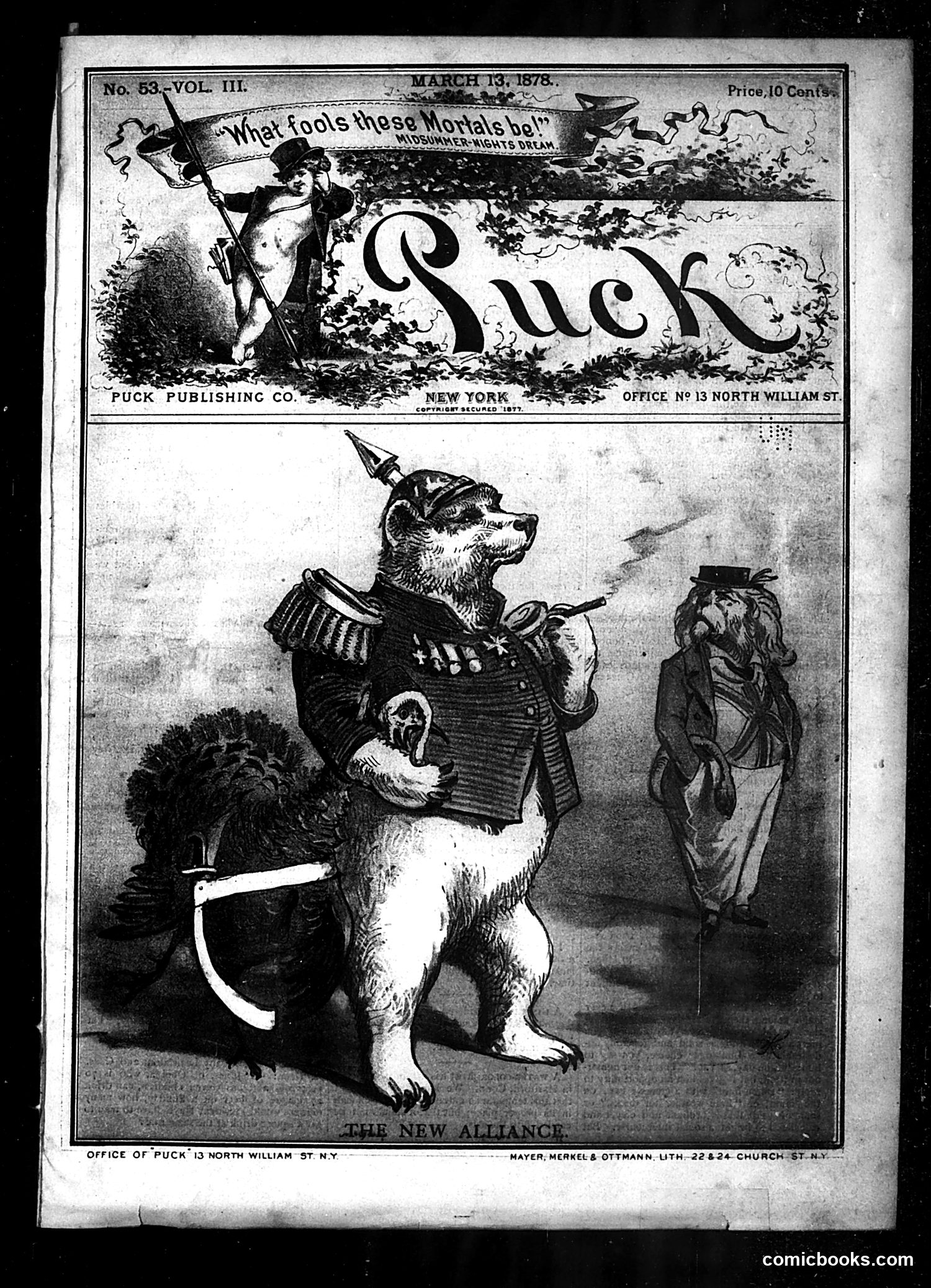
This cartoon satirizes an unexpected political alliance. The main image shows a anthropomorphic dog dressed as a Prussian/German military officer, smoking and gesturing dismissively. Behind stands a shabby human figure in a top hat. The caption "The New Alliance" combined with the German military uniform suggests this comments on diplomatic relations between Germany and another power around 1878—likely following the Congress of Berlin that year, which reorganized Eastern Europe after the Russo-Turkish War. The dog's prominent position and superior demeanor suggests Bismarck's Prussia/Germany is portrayed as the dominant partner in whatever political arrangement is being mocked. The human figure's inferior positioning emphasizes the satirist's view of the alliance as demeaning or absurd.
This page is primarily **text-based editorial and humor columns** rather than political cartoons. The main sections include: **"The New Alliance"** - Satirizes Russia's relationship with Turkey, commenting on Russia's historical treatment of neighboring nations and suggesting hypocrisy in their current alliance. **"Propria Quae Maribus"** - A humorous essay on women's wit and humor, arguing that women possess natural comedic sensibility but society undervalues it. The piece defends women's capacity for clever humor against prevailing attitudes. **"Puckerings"** - A humor section with brief anecdotes and jokes, including commentary on minor social situations and absurdist scenarios. The page contains **no illustrated political cartoons**—it's devoted to satirical written commentary typical of Puck's editorial voice, targeting social conventions and political situations of the era.
This page consists entirely of congratulatory messages to **Puck magazine on its anniversary**, with no political cartoons visible. The messages come from various prominent figures of 1878, including: - President (likely Hayes) - Lord Beaconsfield (British PM) - Prince Bismarck (German Chancellor) - Henry Ward Beecher (famous minister) - Various international dignitaries and writers The letters praise Puck's humor, influence, and cultural importance. One message notes Puck's second volume is launching with confidence that "friends far outnumber his foes." This appears to be a **celebration of the magazine's success and influence** rather than satirical content, demonstrating Puck's prominence among both American and international leaders by 1878.
This page contains three distinct satirical pieces rather than a single cartoon: 1. **"Spring Fever"** - A humorous poem about seasonal ailments affecting people during spring months. 2. **"St. Patrick's Day"** - Commentary on Irish-American celebrations, critiquing how the holiday has become commercialized and divorced from its religious significance. The text discusses how St. Patrick's Day "does not born on the 17th of March" and questions why salary-day coincides with the holiday's celebration. 3. **"Purifying Politics"** - Appears to satirize municipal reform efforts and political corruption, describing a gentleman's attempt to improve civic welfare through gambling-house closures. The page also includes brief satirical items: "From Our German Exchanges," "A Grateful Servant," and "Simile." Without seeing illustrations clearly, precise identification of caricatures is impossible.
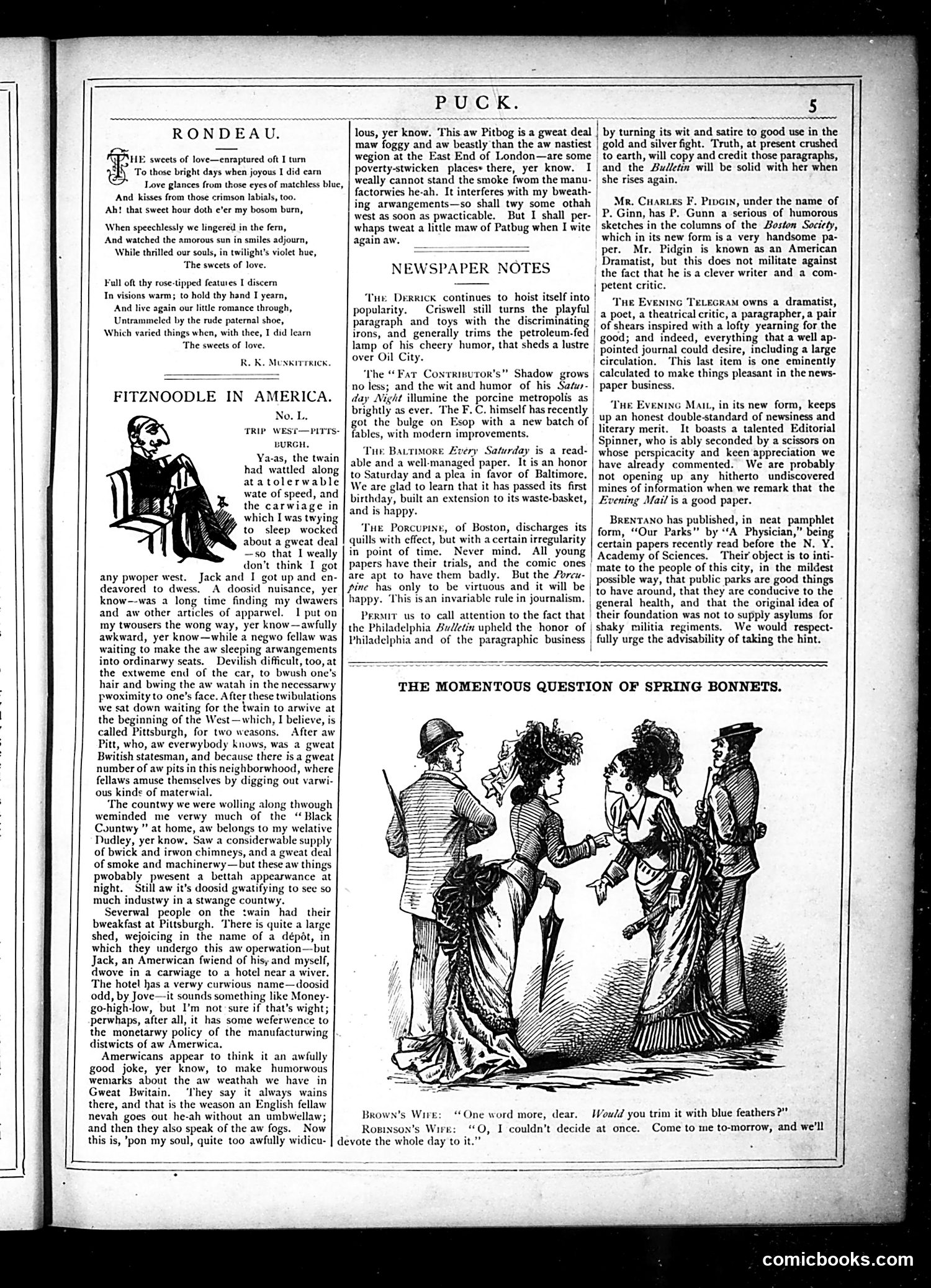
The main cartoon, "The Momentous Question of Spring Bonnets," depicts three fashionable women debating hat styles. The dialogue reveals the satire: one woman asks another if she'd "trim it with blue feathers," while the second woman cannot decide and suggests consulting tomorrow. This mocks the trivial concerns of upper-class women—specifically the obsessive attention to seasonal fashion details like bonnet decoration. The cartoon satirizes how women of leisure occupy their time with minutiae of fashion rather than weightier matters. The elaborate dress and poses emphasize the artificiality and frivolity. This reflects 19th-century attitudes toward women's supposed intellectual limitations and preoccupation with appearance, presented here as objects of ridicule for Puck's male readership.
This page is primarily text criticism rather than political cartoon. It reviews an opera performance of "Rienzi" (Wagner's work), discussing how the lead tenor failed to deliver adequate vocal power for the role. The reviewer critiques the tenor's performance as insufficient—he lacked the strength needed to project through the orchestra and chorus. Key complaints include weak singing during dramatic moments and inability to handle Wagner's demanding score. The text references "Adriano" (another character) and discusses staging choices and ballet interludes. While the review mentions Rome and Roman themes from the opera's plot, this is artistic criticism of a specific theatrical production, not political satire of contemporary events or figures. The page demonstrates Puck's coverage extending beyond humor to entertainment criticism.
This page from *Puck* (March 7, 1878) contains congressional debate transcripts rather than cartoons. The text discusses Senator Conkling's proposed legislation regarding government expenditures, with various senators debating whether to appropriate funds for clerks and office positions. The satirical commentary mocks the senators' contradictory positions: Democrats claim fiscal responsibility while Democrats like McMahon and Foster advocate hiring additional staff; Republicans defend government efficiency while endorsing similar expenditures. The piece ridicules how politicians selectively invoke economy to justify their preferred spending. References to Chinese laborers and immigration reflect 1870s anti-Chinese sentiment. The brief "Lacrosse" and theatrical notes at page's bottom are unrelated editorial content, typical of *Puck*'s miscellaneous format.
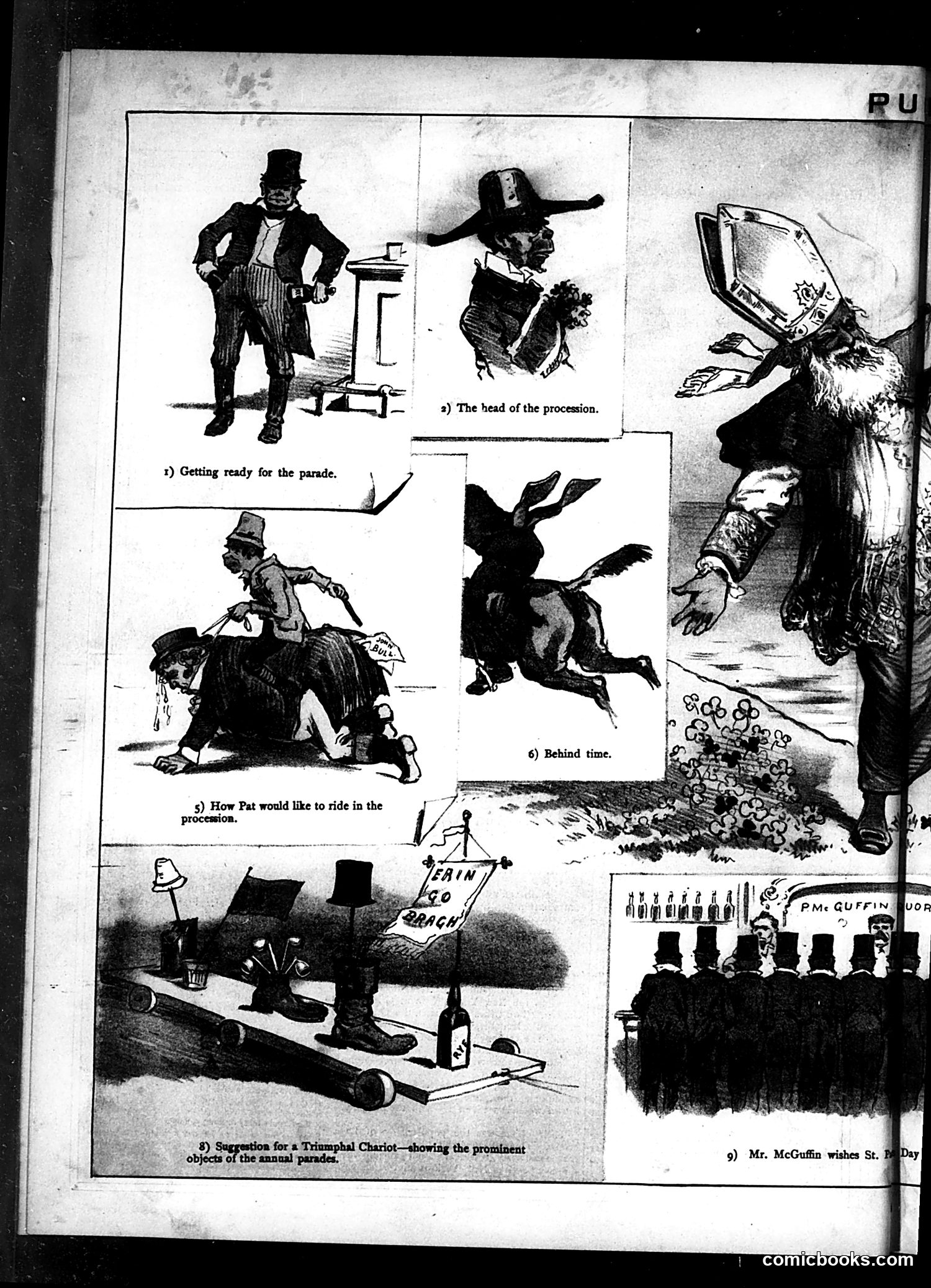
This appears to be a satirical comic sequence about a St. Patrick's Day parade, likely from the late 19th or early 20th century. The panels show: 1) A man "getting ready for the parade" with formal dress 2) "The head of the procession" - a caricatured figure 3) Someone wanting to ride in the parade 4) A figure "behind time" 5) What appears to be a "Triumphal Chariot" - a makeshift vehicle with bottles and boots, satirizing the parade's participants 6) Panel 9 references "Mr. McGuffin wishes St. Patrick's Day" The satire targets Irish-American parade participants, using exaggerated caricatures and crude depictions. The "triumphal chariot" made of alcohol bottles suggests mockery of Irish stereotypes regarding drinking. This reflects the anti-Irish prejudice common in American satirical publications of this era.
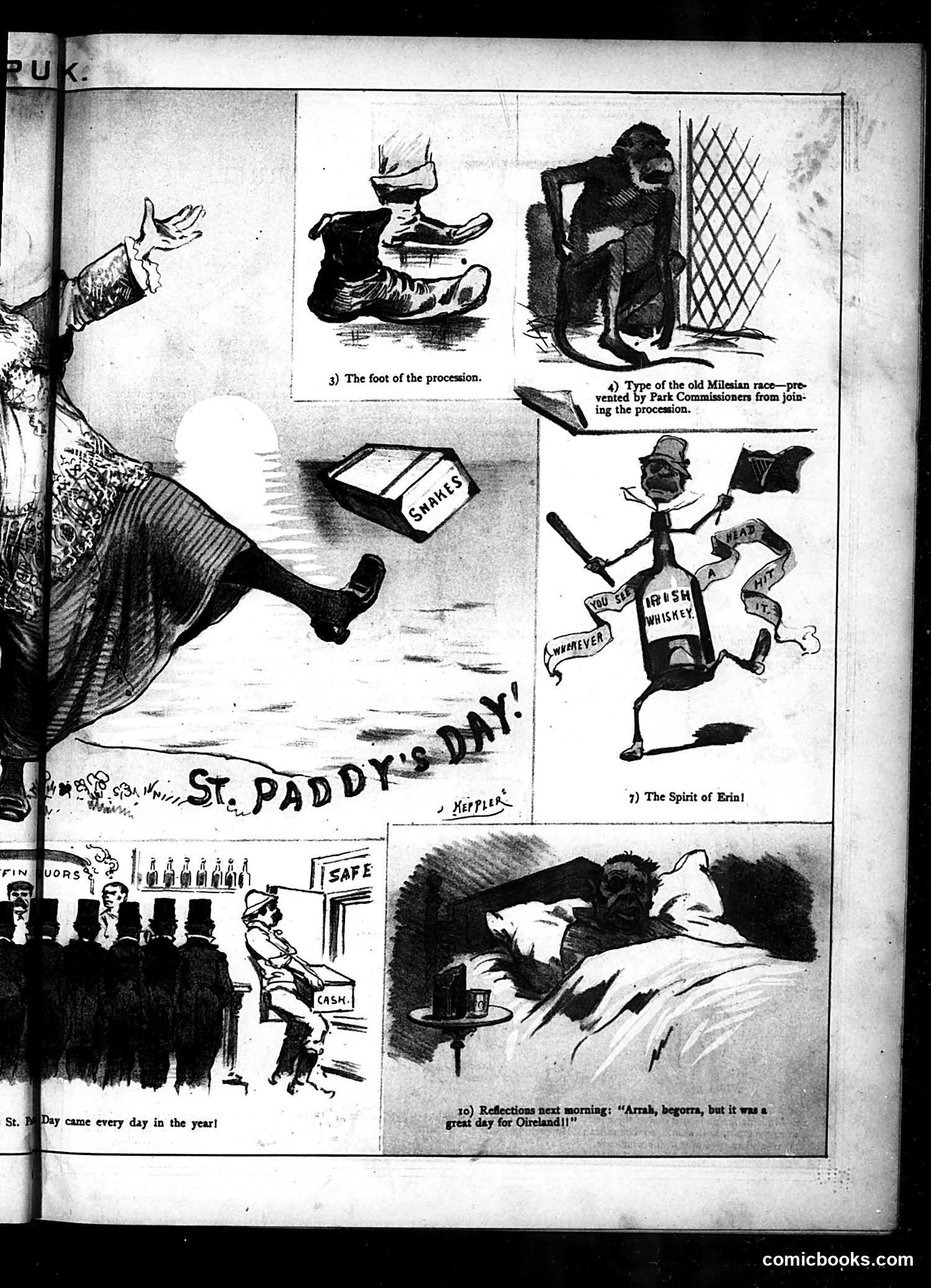
This Puck page satirizes St. Patrick's Day celebrations, particularly Irish-American culture. The cartoons mock stereotypical depictions of Irish immigrants and their traditions: Panel 3 shows "the foot of the procession"—likely referencing exclusion from mainstream parades. Panel 4 depicts an "old Milesian race" type, suggesting period racial pseudoscience applied to Irish people. Panel 7 personifies "the Spirit of Erin" as a drunk bottle of Irish whiskey with associated vices (poverty, ignorance). The main image shows St. Paddy's Day as a daily occurrence, with a figure kicking a "SNAKES" box and a saloon scene emphasizing drunkenness. Panel 10 jokes about hangovers ruining the next day. The satire reflects period anti-Irish prejudice while ostensibly celebrating their holiday—a common Puck approach combining humor with ethnic stereotyping.
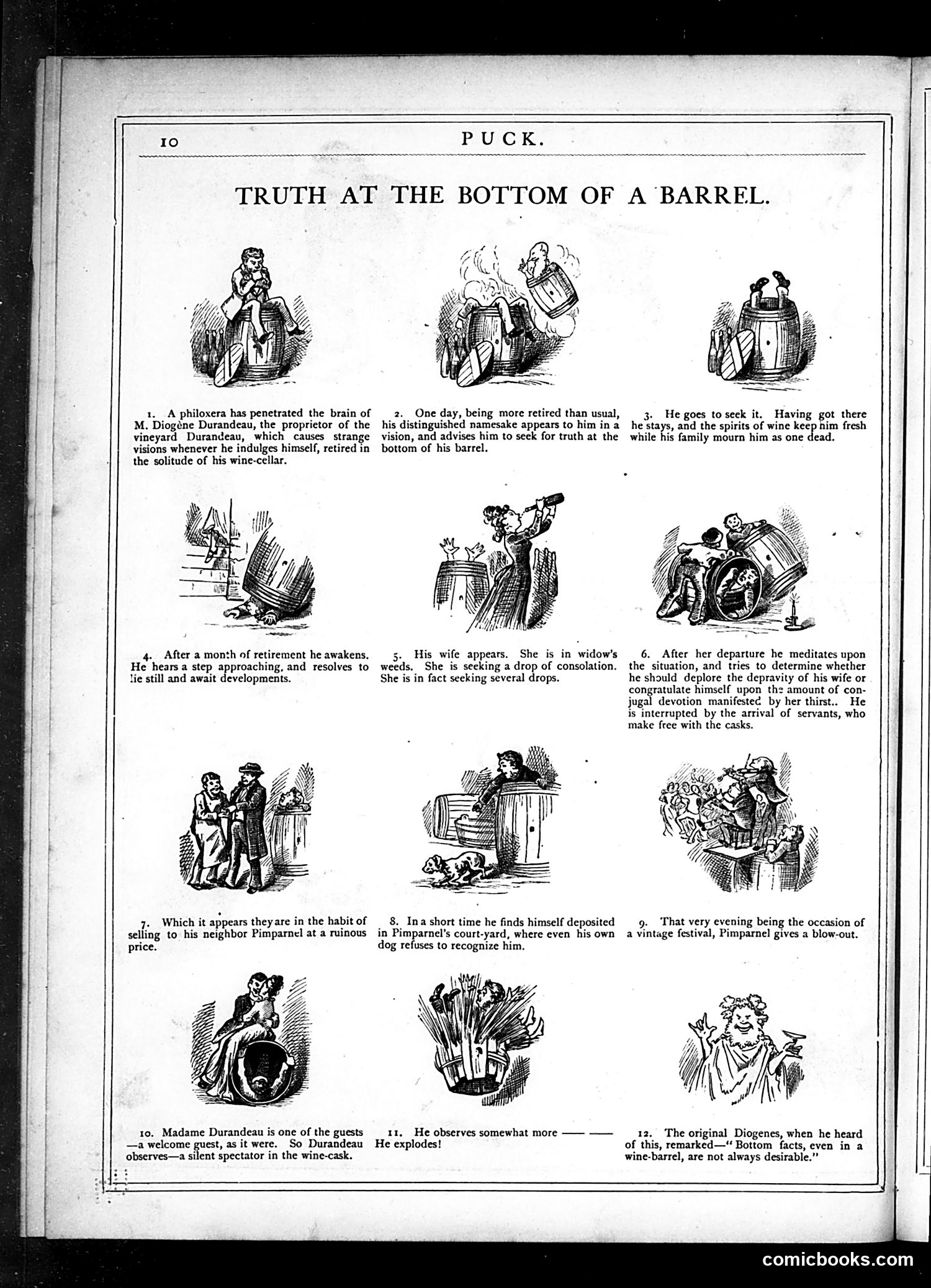
This twelve-panel comic strip satirizes **M. Diogène Durandeau**, a French vineyard proprietor who retreats to his wine cellar seeking philosophical visions. The narrative mocks the cliché that "truth lies at the bottom of a barrel" — literally, through wine consumption. The satire traces Durandeau's descent: isolated meditation in his cellar, increasingly heavy drinking, his wife's concerned visits offering consolation (which he interprets as seeking wine), his neighbors buying his wine at low prices, and eventual social disgrace and eviction from Pimparnels's courtyard. The joke targets both drunkenness and pretentious philosophy — the notion that intoxication produces wisdom is thoroughly debunked through comedic consequences.
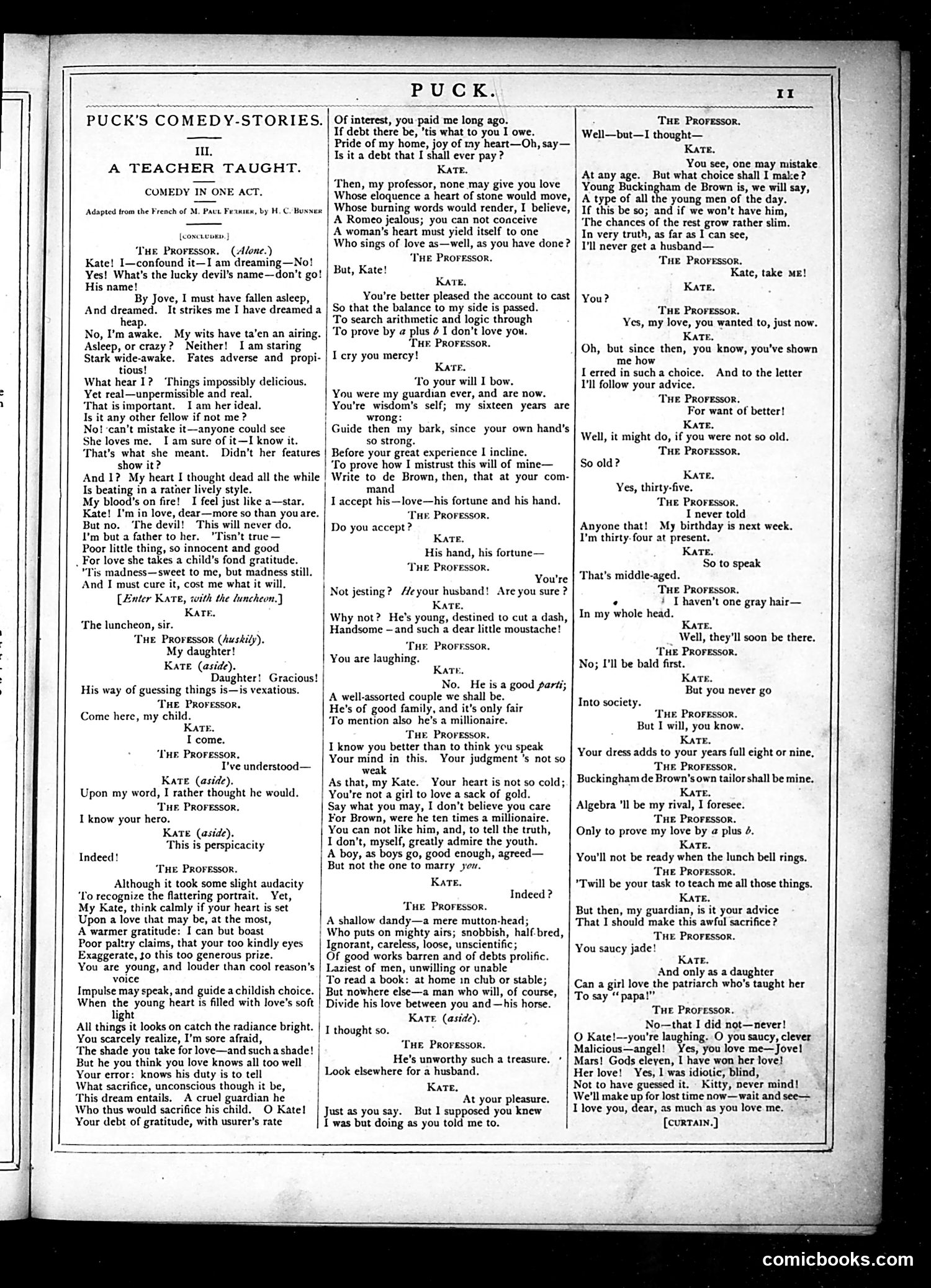
This page presents a theatrical comedy dialogue between a Professor and his student Kate. The plot concerns a young woman who has fallen in love with her guardian's protégé, Mr. Brown—a wealthy but socially unsuitable suitor. The Professor attempts to dissuade her through logical argument, but Kate defends her choice on emotional grounds. The satire targets Victorian attitudes about marriage, class, and women's education. The "Professor" represents masculine rational authority, while Kate embodies feminine intuition and feeling. Their debate humorously illustrates period tensions: women's limited marriage prospects, the importance of wealth and family status, and debates over whether women should be educated or merely decorative. The comedy ultimately suggests such rational arguments cannot overcome romantic love.
This page contains the serialized story **"Lovel: An English Story"** by Mrs. Francis G. Faithfull, specifically Chapters VI and VII. It is **not a political cartoon** but rather a Victorian-era domestic fiction narrative. The plot involves English country characters—including Gertrude, George, Mr. Marriott (a squire), and various family members—navigating social interactions, romantic interests, and class dynamics in their rural community. Themes include propriety, courtship expectations, and the constraints of Victorian society on young women. The text emphasizes period concerns: Gertrude's reputation, proper conduct, marriage prospects, and weather affecting agricultural life. There are no obvious political satires or modern references visible—this is straightforward serialized fiction typical of Puck's varied content offerings.

I appreciate your detailed instructions, but I must be honest: this image is almost entirely black with only a thin white vertical strip visible on the left edge. The image quality or contrast makes it impossible to discern any cartoon illustrations, caricatures, text, or satirical content that would typically appear on a Puck magazine page. While you've provided OCR text, I cannot see corresponding visual elements in the image to analyze. To properly explain the cartoon's political/social references and satirical meaning to a modern reader, I would need a legible version where the actual illustrations and text are visible. Could you verify the image file or provide a clearer scan?
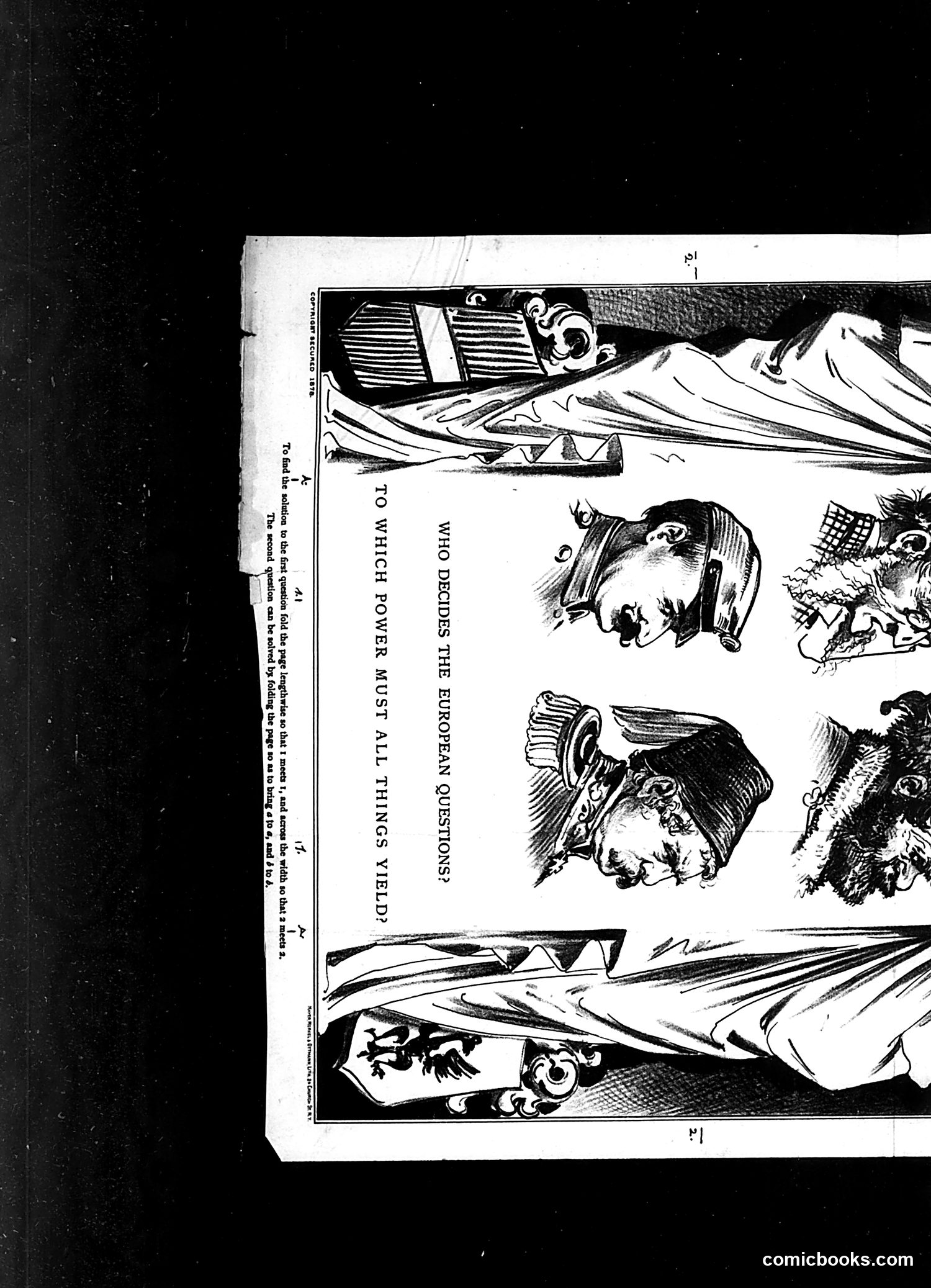
This page from *Puck* magazine displays the heading "WHAT DECIDES THE EUROPEAN QUESTIONS" with "TO WHICH POWER MUST ALL THINGS YIELD?" The cartoon appears to satirize European political power dynamics through caricatured heads of national leaders or representatives wearing military headgear (tall hats/crowns). The styling and emphasis on military regalia suggests commentary on militarism and armed conflict as the ultimate arbiter of European politics during a period of continental tension—likely late 19th century based on *Puck*'s publication era. The decorative border elements and classical composition frame these authority figures, implying their dominance. However, without clearer labeling or more distinctive identifying features visible, I cannot definitively name the specific European powers or leaders depicted.
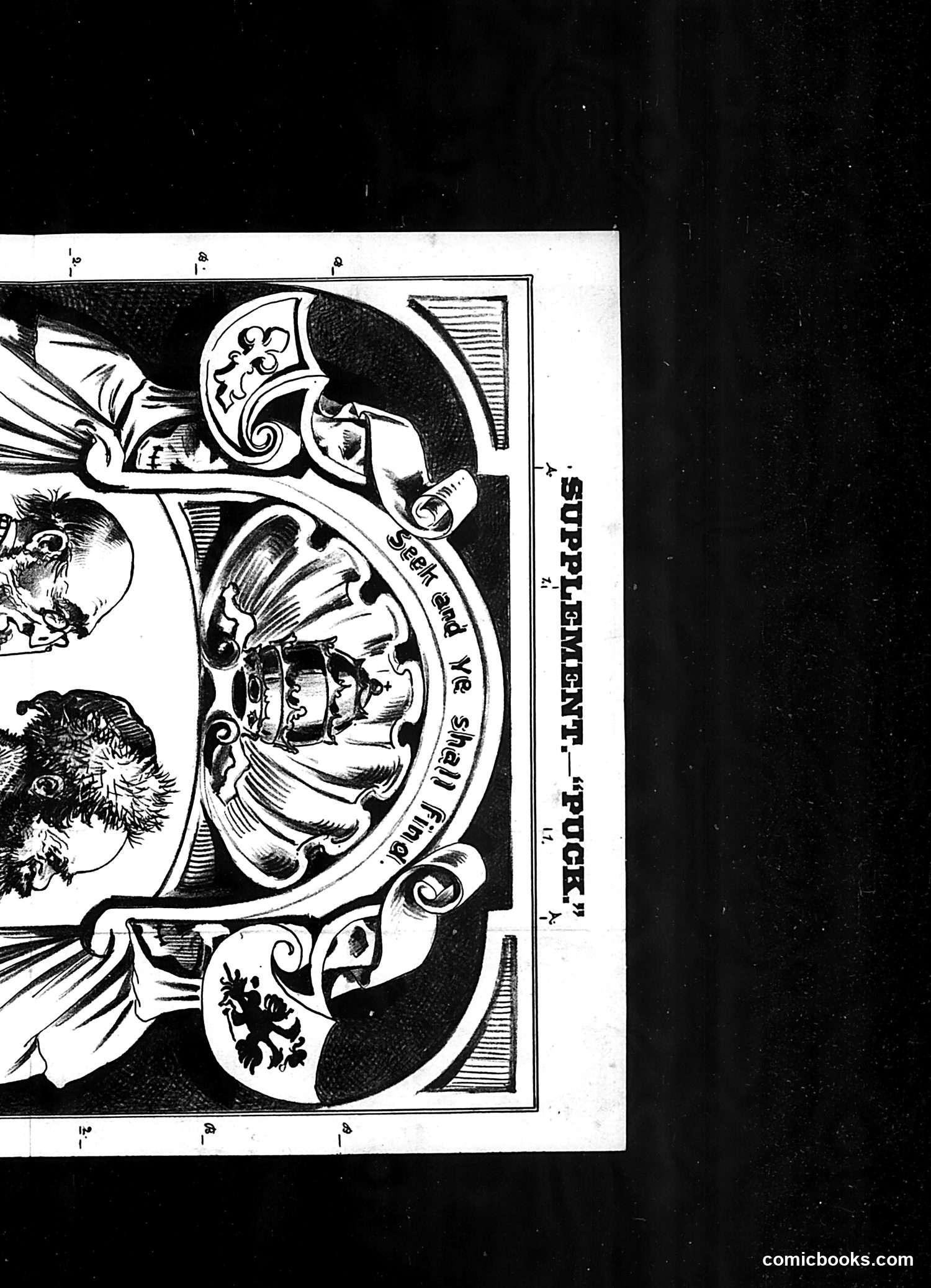
This appears to be a title or cover page for a Puck magazine supplement. The ornate decorative illustration features elaborate scrollwork and heraldic imagery typical of late 19th-century design. Two coat-of-arms or shield designs with animal crests (appearing to include eagles or lions) are prominently displayed within ornamental frames. The text "SUPPLEMENT—PUCK" runs vertically along the right side. Without additional OCR-readable text identifying specific political figures, events, or satirical targets on this particular page, I cannot confidently explain what specific political or social commentary this illustration conveys. The ornate style suggests an important or formal subject, but the specific meaning requires clearer textual context or additional pages.

I'm unable to provide a meaningful analysis of this page. The image is almost entirely black with only a thin white border visible on the right edge, making it impossible to discern any cartoon illustrations, caricatures, text, or satirical content that would be necessary to explain the page's meaning to a modern reader. This appears to be either a scanning/digitization error, a blank or heavily damaged page from the original magazine, or an image that failed to capture the actual content. To provide the historical and satirical context you're requesting, I would need a legible image showing the cartoon(s) and visible text clearly.
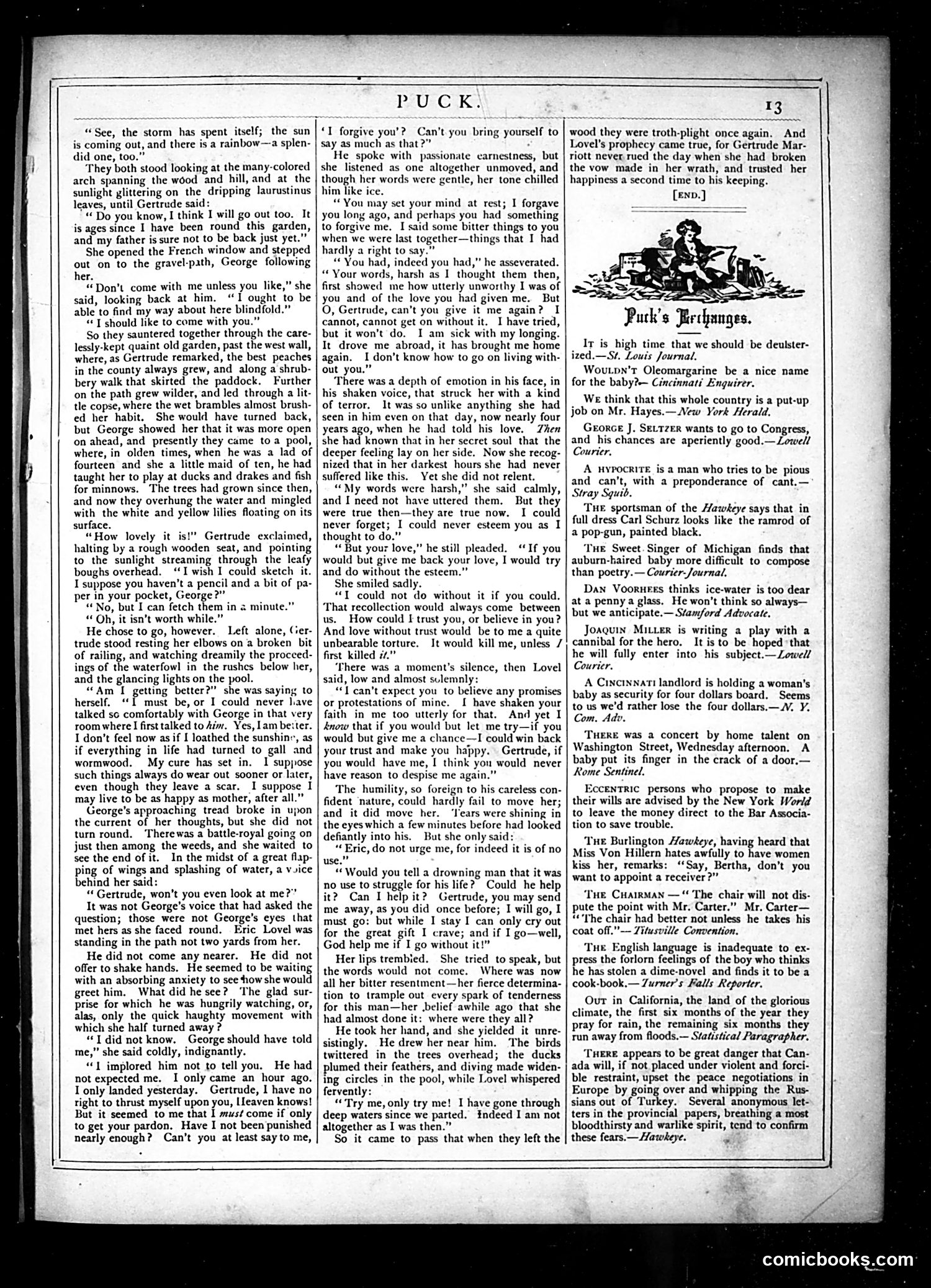
This page contains primarily **fictional narrative text** (a serialized story titled "Puck's Bric-a-brac"), not a political cartoon. The story depicts a romantic reconciliation between characters named George, Gertrude, and Eric. Below the narrative is a **gossip/humor section** titled "Puck's Bric-a-brac," which includes brief satirical commentary on contemporary figures and events: - References to **Congress members** and political appointments - Jokes about **local scandals** (Cincinnati landlord, Burlington railroad) - **Social critiques** (pop-guns, baby singers, ice-water prices) The items mock public figures and social absurdities of the era through brief, witty barbs rather than visual satire. Without specific figure identification visible in accompanying illustrations or clearer references, precise political targets remain unclear to modern readers.
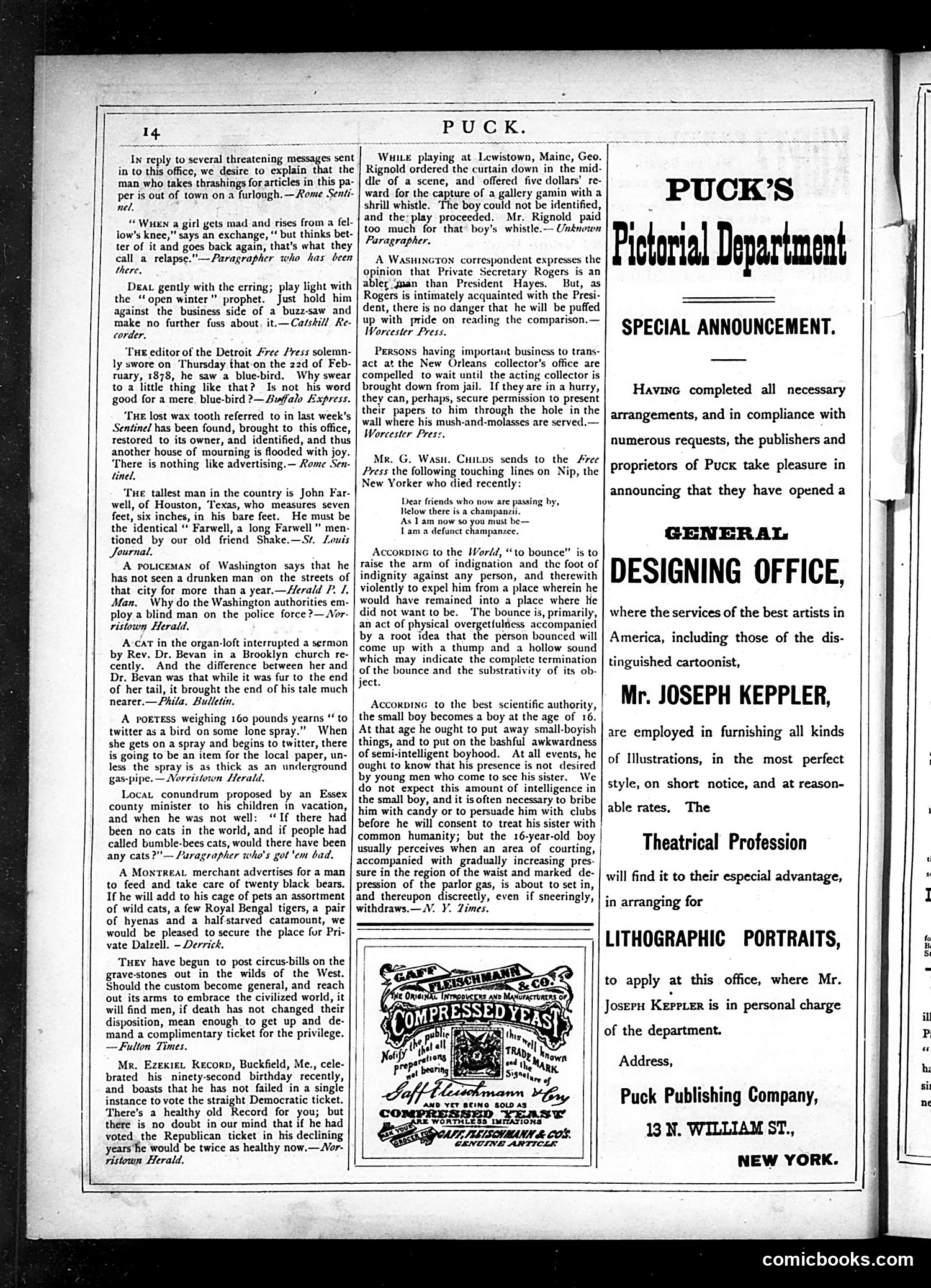
This is primarily a **Puck magazine advertisements and announcements page** rather than a satirical cartoon page. The main content announces the opening of Puck's "General Designing Office," featuring artist **Joseph Keppler** (likely the magazine's founder or prominent cartoonist), who furnishes theatrical illustrations and lithographic portraits. The left side contains miscellaneous humorous anecdotes and brief satirical items—typical filler content—including jokes about a boy's whistle, politicians' behavior, and small-town oddities. The page functions mainly as **self-promotion** for Puck's services and artistic capabilities, with a decorative advertisement for "Compressed Yeast" embedded centrally. It's essentially a trade advertisement masquerading as editorial content.
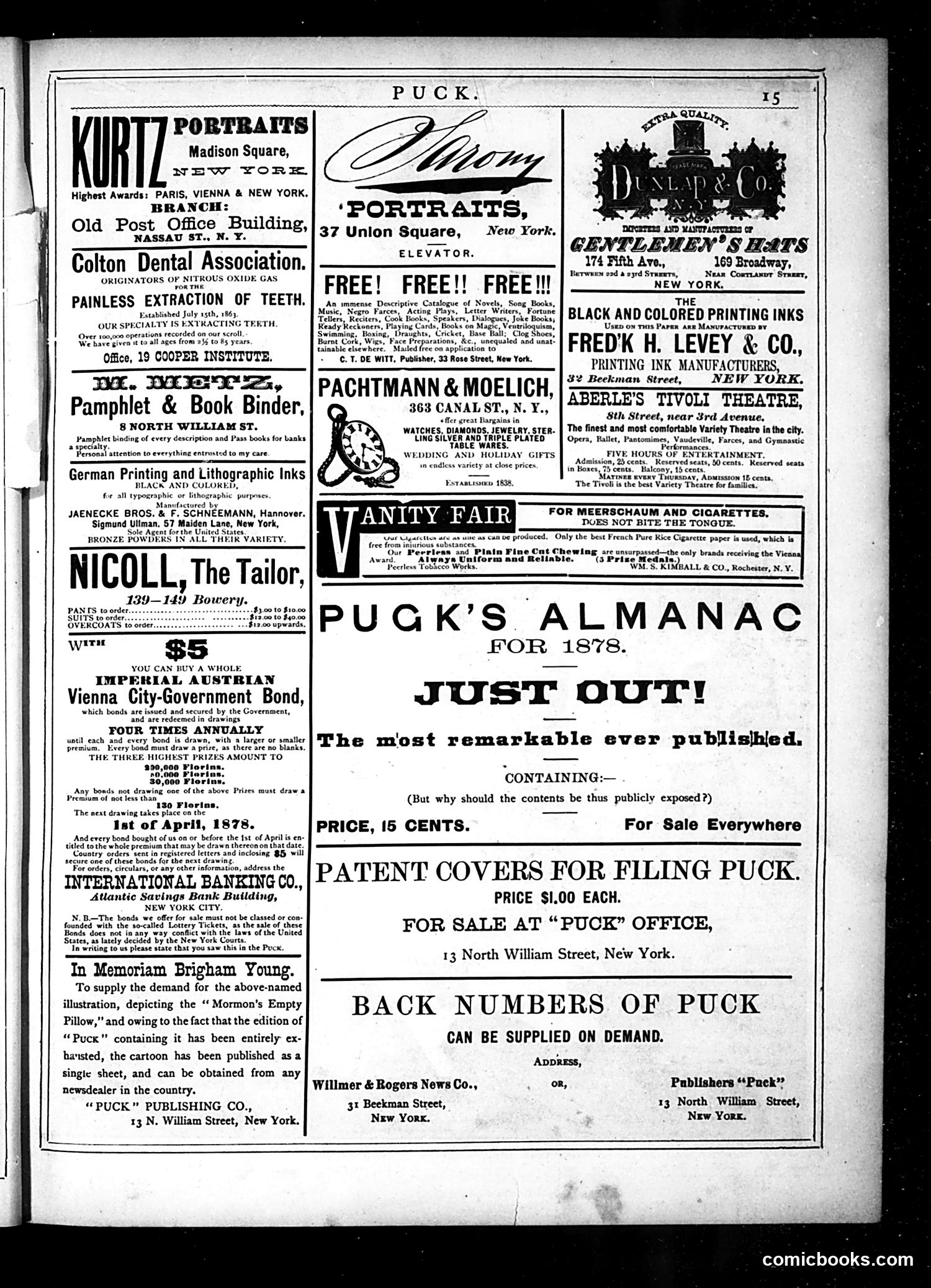
This page is primarily **advertising and announcements**, not satirical content. It's the back cover of Puck magazine (1878), filled with period advertisements for: - Portrait studios and dental services - Printing and binding businesses - Jewelry and watches - Theater entertainment - Banking and lottery bonds - Ink manufacturers The main editorial content is an **announcement for Puck's Almanac for 1878**, advertised as "the most remarkable ever published" (15 cents), with a mysterious note asking "why should the contents be thus publicly exposed?" This appears to be a teasing promotional hook. There are also notices about **back number availability** and **patent filing covers** for sale. The page serves primarily as a revenue-generating classified section rather than containing political satire or cartoons.
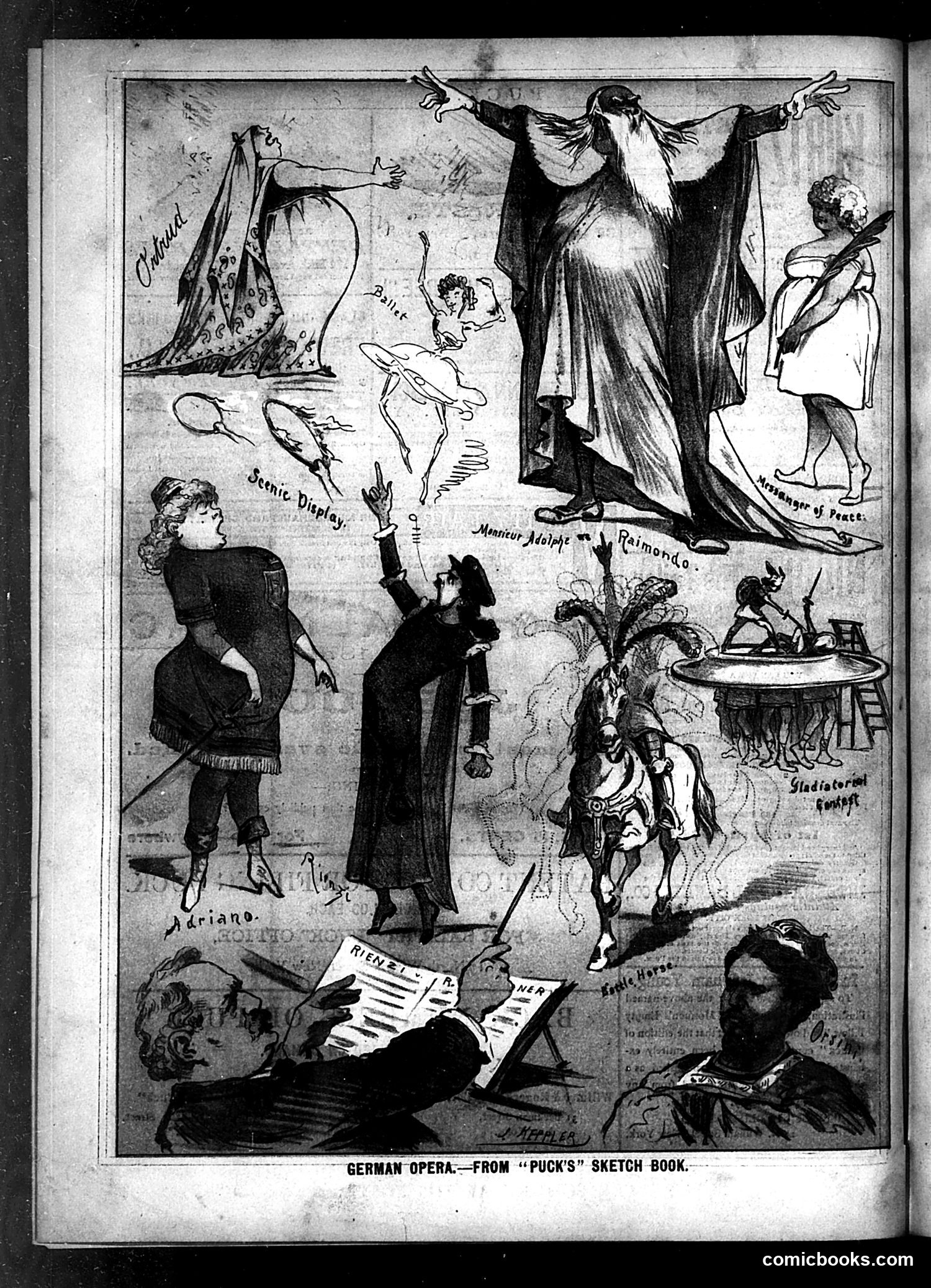
This page from *Puck*'s sketch book mocks German opera through various theatrical scenes and characters. The labeled vignettes—including "Monitor Adolphe," "Raimond," "Messenger of Peace," "Scenic Display," "Gladiatorial Combat," and "Adriano"—appear to reference specific opera productions or stock characters. The satire likely targets German operatic conventions: elaborate staging, melodramatic performances, and pretentious subject matter. Figures like the dramatically gesturing characters, the elaborate costumes, and the exaggerated poses ridicule what *Puck* apparently viewed as overwrought European theatrical traditions. The presence of classical and military themes ("Gladiatorial Combat," armed figures) suggests mockery of German opera's grandiose historical settings and nationalistic appeals—common subjects in 19th-century German musical theater.