
Puck, 1878-03-13 · page 6 of 20
Puck — March 13, 1878 — page 6: what you’re looking at
What you’re looking at
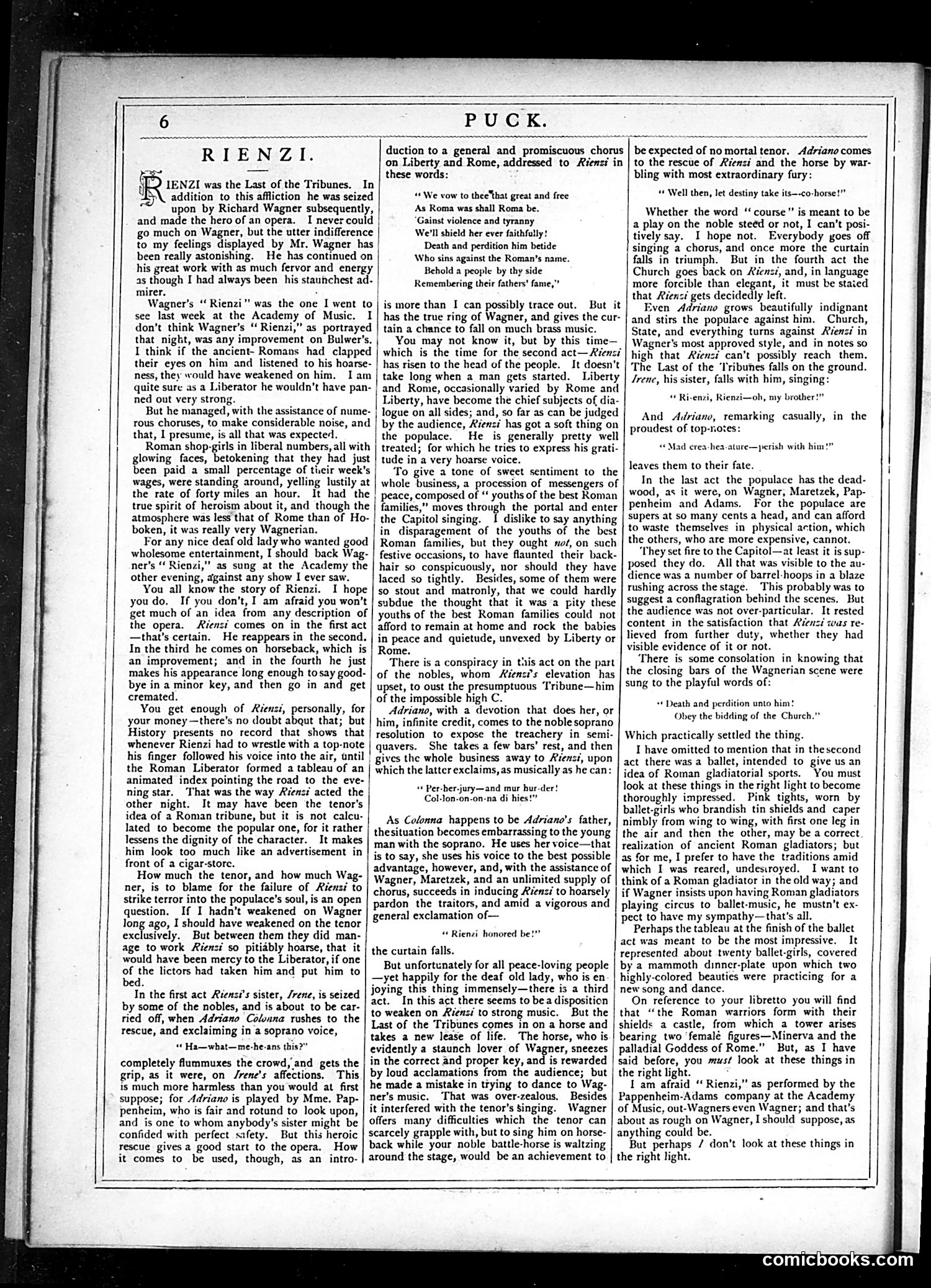
This page is primarily text criticism rather than political cartoon. It reviews an opera performance of "Rienzi" (Wagner's work), discussing how the lead tenor failed to deliver adequate vocal power for the role. The reviewer critiques the tenor's performance as insufficient—he lacked the strength needed to project through the orchestra and chorus. Key complaints include weak singing during dramatic moments and inability to handle Wagner's demanding score. The text references "Adriano" (another character) and discusses staging choices and ballet interludes. While the review mentions Rome and Roman themes from the opera's plot, this is artistic criticism of a specific theatrical production, not political satire of contemporary events or figures. The page demonstrates Puck's coverage extending beyond humor to entertainment criticism.
📄 Transcribed text from this page (OCR, searchable)
Machine-transcribed from the original scan — historical spelling and the odd misread are preserved.
RIENZI. Q IENZI was the Last of the Tribunes. In addition to this affliction he was seized upon by Richard Wagner subsequently, and made the hero of an opera. I never could go much on Wagner, but the utter indifference to my feelings displayed by Mr. Wagner has | been really astonishing. He has continued on his great work with as much fervor and energy as though I had always been his staunchest ad- | mirer. : Wagner's ‘“ Rienzi” was the one I went to see last week at the Academy of Music. I don’t think Wagner's “ Rienzi,” as portrayed that night, was any improvement on Bulwer’s, I think if the ancient- Romans had clapped their eyes on him and listened to his hoarse- | ness, they would have weakened on him. I am quite sure as a Liberator he wouldn't have pan- ned out very strong. But he managed, with the assistance of nume- rous choruses, to make considerable noise, and that, I presume, is all that was expected. Roman shop-girls in liberal numbers, all with glowing faces, betokening that they had just been paid a small percentage of ticir week’s | wages, were standing around, yelling lustily at the rate of forty miles an hour. It had the | true spirit of heroism about it, and though the atmosphere was less that of Rome than of Ho- boken, it was really very Wagnerian. For any nice deaf old lady who wanted good wholesome entertainment, I should back Wag- ner’s ‘ Rienzi,” as sung at the Academy the other evening, against any show I ever saw. You all know the story of Rienzi. I hope you do. If you don’t, I'am afraid you won't get much of an idea from any description of the opera. vensi comes on in the first act —that’s certain. He reappears in the second, In the third he comes on horseback, which is an improvement; and in the fourth he just makes his appearance long enough to say good- bye in a minor key, and then go in and get cremated, You get enough of Rienzi, personally, for your money —there's no doubt abqut that; but History presents no record that shows that whenever Rienzi had to wrestle with a top-note his finger followed his voice into the air, antil the Roman Liberator formed a tableau of an animated index pointing the road to the eve- | ning star. ‘That was the way Rienzi acted the other night. It may have been the tenor’s idea of a Roman tribune, but it is not calcu- lated to become the popular one, for it rather is more than I can possibly trace out. has the true ring of Wagner, and gives the cur- tain a chance to fall on much brass mt which is the time for the second act— Rye has risen to the head of the people. | take long when a man gets started. and Rome, occasionally varied by Rome and Liberty, have become the chief subjects of dia- logue on all sides; and, so far as can be judged by the audience, Xenzi has got a soft thing on the populace. treated; for which he tries to express his grati- tude in’a very hoarse voice. duction to a general and promiscuous chorus on Liberty and Rome, addressed to Rienzi in these words: + We vow to thee“that great and free ‘As Roma was shall Roma be. ‘Gainst violence and tyranny We'll shield her ever faithfully? Death and perdition him betide Who sins against the Roman's name. Behold a people by thy side Remembering their fathers’ fame," But it You may not know it, but by this time— It doesn’t Liberty He is generally pretty well To give a tone of sweet sentiment to the whole business, a procession of messengers of mposed of “ youths of the best Roman families,” moves through the portal and enter the Capitol singing. in disparagement of the youths of the best Roman families, but they ought nof, on such festive occasions, to have flaunted their back- hair so conspicuously, nor should they have laced so tightly. so stout and matronly, that we could hardly subdue the thought that it was a pity these youths of the best Roman families could not afford to remain at home and rock the babies in peace and quietude, unvexed by Liberty or Rome. T dislike to say anything Besides, some of them were There is a conspiracy in this act on the part of the nobles, whom Aiensi’s elevation has upset, to oust the presumptuous Tribune—him of the impossible high C. Adriano, with a devotion that does her, or him, infinite credit, comes to the noble soprano resolution to expose the treachery in semi- quavers. She takes a few bars’ rest, and then gives the whole business away to Rienzi, upon which the latter exclaims, as musically as he can: “ Per-ber.jury—and mur hur-der! Col-lon-on-on-na di hies!”” As Colonna happens to be Adriano's father, lessens the dignity of the character. front of a cigar-storc. It makes him look too much like an advertisement in How much the tenor, and how much Wag- ner, is to blame for the failure of Riensi to strike terror into the populace’s soul, is an open thesituation becomes embarrassing to the young man with the soprano. He uses her voice—that is to say, she uses his voice to the best possible advantage, however, and, with the assistance of Wagner, Maretzek, and an unlimited supply of chorus, succeeds in inducing Xvenzi to hoarsely pardon the traitors, and amid a vigorous and question. If I hadn't weakened on Wagner long ago, I should have weakened on the tenor exclusively. But between them they did man- age to work Rienzi so pitiably hoarse, that it would have been mercy to the Liberator, if one of the lictors had taken him and put him to bed. In the first act Rienss’s sister, /rene, is seized by some of the nobles, and is about to be car- ried off, when Adriano Colonna rushes to the general exclamation of — “ Rienzi honored be!” the curtain falls. But unfortunately for all peace-loving people —yet happily for the deaf old lady, who is en joying this thing immensely—there is a third act. to weaken on Riensi to strong music. Last of the Tribunes comes in on a horse and In this act there seems to bea disposition But the rescue, and exclaiming in a soprano voice, “ Ha—what—me-he-ans this?” grip, as it were, on Jrene’s affections. rescue gives a good start to the opera. completely flummuxes the crowd, and gets the This is much more harmless than you would at first suppose; for Adriano is played by Mme. Pap- penheim, who is fair and rotund to look upon, and is one to whom anybody's sister might be confided with perfect safety. But this heroic i How it comes to be used, though, as an intro- takes a new lease of life. The horse, who is evidently a staunch lover of Wagner, sneezes in the correct and proper key, and is rewarded by loud acclamations from the audience; but he made a mistake in trying to dance to Wag- ner’s music. ‘That was over-zealous. Besides it interfered with the tenor’s Singing. Wagner offers many difficulties which the tenor can scarcely grapple with, but to sing him on horse- back while your noble battle-horse is waltzing be expected of no mortal tenor. Adriano comes to the rescue of Riensi and the horse by war- bling with most extraordinary fury: « Well then, let destiny take its—-co-horse!”” Whether the word “course” is meant to be a play on the noble steed or not, I can’t posi- tively say. I hope not. Everybody goes off singing a chorus, and once more the curtain falls in triumph. But in the fourth act the Church goes back on Kienzi, and, in language more forcible than elegant, it must be staied that Riencé gets decidedly left. Even Adriano grows beautifully indignant and stirs the populace against him. Church, State, and everything turns against Riensi in Wagner’s most approved style, and in notes so high that Xiensi can’t possibly reach them. The Last of the ‘l'ribunes falls on the ground. Jrene, his sister, falls with him, singing: « Ri-enzi, Rienzi—oh, my brother! And Adriano, remarking casually, in the proudest of top-noves: “Mad crea-hea-ature—perish with him!” leaves them to their fate. In the last act the populace has the dead- wood, as it were, on Wagner, Maretzek, Pap- penheim and Adams. For the populace are supers at so many cents a head, and can afford to waste themselves in physical action, which the others, who are more expensive, cannot. ‘They set fire to the Capitol—at least it is sup- posed ‘they do. All that was visible to the au- dience was a number of barrel-hoops in a blaze rushing across the stage. This probably was to suggest a conflagration behind the scenes. But the audience was not over-particular. It rested content in the satisfaction that Arenzi was re- lieved from further duty, whether they had visible evidence of it or not. There is some consolation in knowing that the closing bars of the Wagnerian scene were sung to the playful words of: + Death and perdition unto him! Obey the bidding of the Church.” Which practically settled the thing. I have omitted to mention that in the second act there was a ballet, intended to give us an idea of Roman gladiatorial sports. You must look at these things in the right light to become thoroughly impressed. Pink tights, worn by ballet-girls who brandish tin shields and caper nimbly from wing to wing, with first one leg in the air and then the other, may be a correct realization of ancient Roman gladiators; but as for me, I prefer to have the traditions amid which I was reared, undesiroyed. I want to think of a Roman gladiator in the old way; and if Wagner insists upon having Roman gladiators playing circus to ballet-music, he mustn’t ex- pect to have my sympathy—that's all. Perhaps the tableau at the finish of the ballet act was meant to be the most impressive. It represented about twenty ballet-girls, covered by a mammoth dinner-plate upon which two highly-colored beauties were practicing for a new song and dance. ‘On reference to your libretto you will find that “the Roman warriors form with their shields a castle, from which a tower arises bearing two ‘femalé figures—Minerva and the palladial Goddess of Rome.” But, as I have said before, you must look at these things in | the right light. I am afraid “ Rienzi,” as performed by the Pappenheim-Adams company at the Academy of Music, out-Wagners even Wagner; and that’s about as rough on Wagner, I should suppose, as anything could be. But perhaps / don’t look at these things in around the stage, would be an achievement to the right light. comicbooks.com