
Puck, 1878-03-13 · page 17 of 20
Puck — March 13, 1878 — page 17: what you’re looking at
What you’re looking at
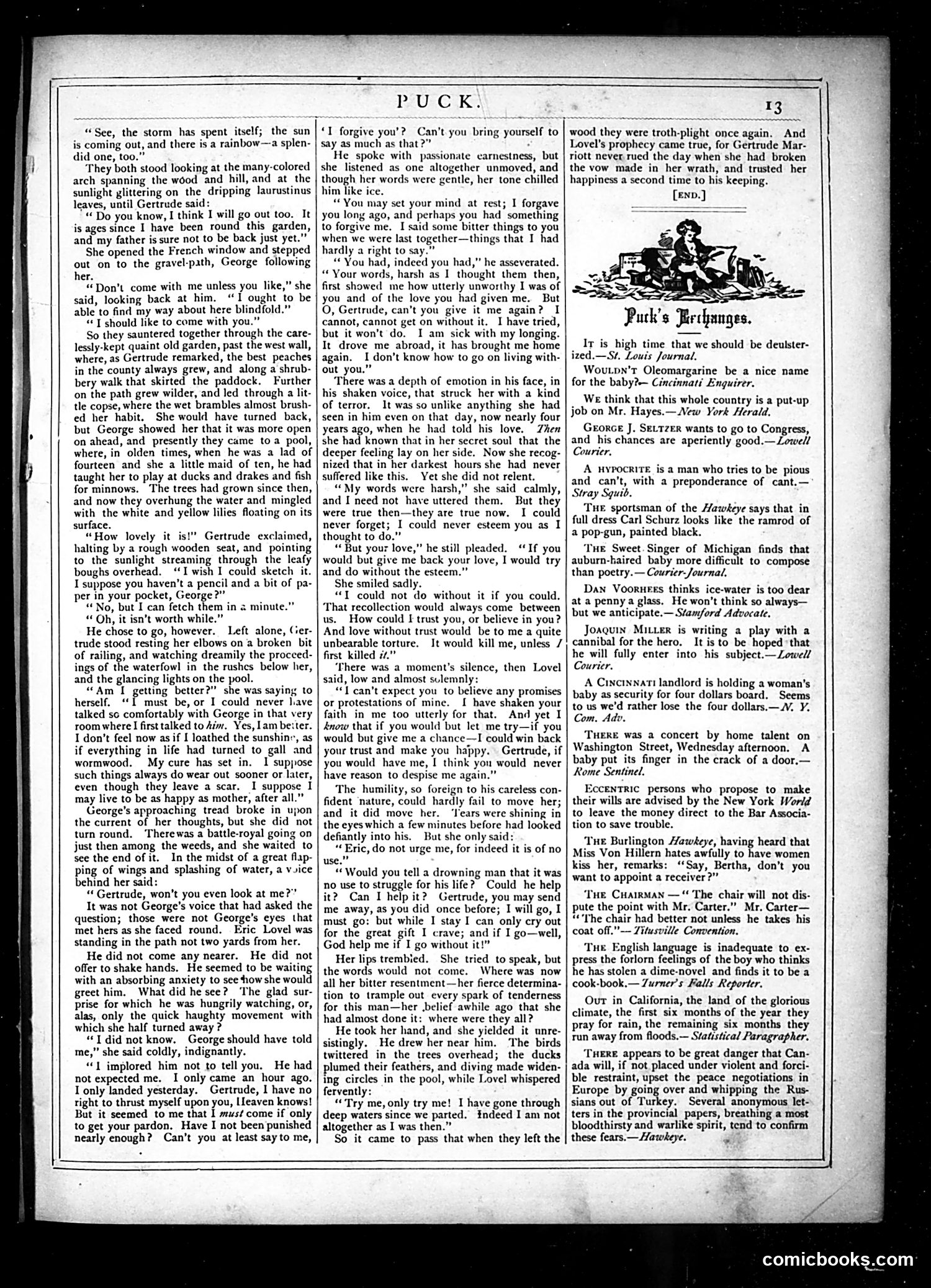
This page contains primarily **fictional narrative text** (a serialized story titled "Puck's Bric-a-brac"), not a political cartoon. The story depicts a romantic reconciliation between characters named George, Gertrude, and Eric. Below the narrative is a **gossip/humor section** titled "Puck's Bric-a-brac," which includes brief satirical commentary on contemporary figures and events: - References to **Congress members** and political appointments - Jokes about **local scandals** (Cincinnati landlord, Burlington railroad) - **Social critiques** (pop-guns, baby singers, ice-water prices) The items mock public figures and social absurdities of the era through brief, witty barbs rather than visual satire. Without specific figure identification visible in accompanying illustrations or clearer references, precise political targets remain unclear to modern readers.
📄 Transcribed text from this page (OCR, searchable)
Machine-transcribed from the original scan — historical spelling and the odd misread are preserved.
“See, the storm has spent itself; the sun is coming out, and there is a rainbow—a splen- did one, too.” They both stood looking at the many-colored arch spanning the wood and hill, and at the sunlight glittering on the dripping laurustinus leaves, until Gertrude said: “Do you know, I think I will go out too. It is ages since I have been round this garden, and my father is sure not to be back just yet.” She opened the French window and stepped out on to the gravel-path, George following her. “Don’t come with me unless you like,” she said, looking back at him. “I ought to be able to find my way about here blindfold.” “T should like to come with you.” So they sauntered together through the care- lessly-kept quaint old garden, past the west wall, where, as Gertrude remarked, the best peaches in the county always grew, and along a shrub- bery walk that skirted the paddock. Further on the path grew wilder, and led through a lit- tle copse, where the wet brambles almost brush- ed her habit. She would have turned back, but George showed her that it was more open on ahead, and presently they came to a pool, where, in olden times, when he was a lad of fourteen and she a little maid of ten, he had taught her to play at ducks and drakes and fish for minnows. The trees had grown since then, and now they overhung the water and mingled with the white and yellow lilies floating on its surface. “How lovely it is!" Gertrude exclaimed, halting by a rough wooden seat, and pointing to the sunlight streaming through the leafy boughs overhead. “I wish I could sketch it. I suppose you haven't a pencil and a bit of pa- per in your pocket, George ?” “No, but I can fetch them in minute.” “Oh, it isn’t worth while.” He chose to go, however. Left alone, (ier- trude stood resting her elbows on a broken bit of railing, and watching dreamily the proceed- ings of the waterfowl in the rushes below her, and the glancing lights on the pool. “Am [ getting better?” she was saying to herself. of must be, or I could never lave talked so comfortably with George in that very room where] first talked to Aim. Yes, lam beiter. I don’t feel now as if I loathed the sunshine, as if everything in life had turned to gall and wormwood. My cure has set in. I suppose such things always do wear out sooner or later, even though they leave a scar. I suppose I may live to be as happy as mother, after all.” George's approaching tread broke in upon the current of her thoughts, but she did not turn round. Therewas a battle-royal going on just then among the weeds, and she waited to see the end of it. In the midst of a great flap- ping of wings and splashing of water, a vice behind her said: “Gertrude, won’t you even look at me?” It was not George's voice that had asked the question; those were not George's eyes that met hers as she faced round. Eric Lovel was standing in the path not two yards from her. He did not come any nearer. He did not offer to shake hands. He seemed to be waiting with an absorbing anxiety to see how she would greet him. What did he see? ‘The glad sur- prise for which he was hungrily watching, or, alas, only the quick haughty movement with which she half turned away ? “I did not know. George should have told me,” she said coldly, indignantly. “1 implored him not to tell you. He had not expected me. I only came an hour ago. I only landed yesterday. Gertrude, I have no right to thrust myself upon you, Lleaven knows! But it seemed to me that I must come if only to get your pardon. Have I not been punished nearly enough? Can’t you at least say to me, PUCK. “I forgive you’? Can't you bring yourself to say as much as that?” : He spoke with passionate earnestness, but she listened as one altogether unmoved, and though her words were gentle, her tone chilled him like ice. “You may set your mind at rest; I forgave you long ago, and perhaps you had something to forgive me. I said some bitter things to you when we were last together—things that I had hardly a right to say.” “You had, indeed you had,” he asseverated. “ Your words, harsh as I thought them then, first showed me how utterly unworthy I was of you and of the love you had given me. But O, Gertrude, can't you give it me again? I cannot, cannot get on without it. I have tried, but it won't do. I am sick with my longing. It drove me abroad, it has brought me home again. I don’t know how to go on living with- out you.” ‘There was a depth of emotion in his face, in his shaken voice, that struck her with a kind of terror. It was so unlike anything she had seen in him even on that day, now nearly four years ago, when he had told his love. Zhen she had known that in her secret soul that the deeper feeling lay on her side. Now she recog- nized that in her darkest hours she had never suffered like this. Yet she did not relent. “My words were harsh,” she said calmly, and I need not have uttered them. But they were true then—they are true now. I could never forget; I could never esteem you as I thought to do.” “But your love,” he still pleaded. “If you would but give me back your love, I would try and do without the esteem.” She smiled sadly. “T could not do without it if you could. That recollection would always come between us. How could f trust you, or believe in you? And love without trust would be to me a quite unbearable torture. It would kill me, unless / first killed #4.” ‘There was a moment's silence, then Lovel said, low and almost sulemnl, “I can't expect you to believe any promises or protestations of mine. { have shaken your faith in me too utterly for that. And yet I know that if you would but let me try—if you would but give me a chance—I could win back your trust and make you happy. Gertrude, if you would have me, I think you would never have reason to despise me again.” The humility, so foreign to his careless con- fident ‘nature, could hardly fail to move her; and it did move her. ‘l'ears were shining in the eyes which a few minutes before had looked defiantly into his. But she only said: “Eric, do not urge me, for indeed it is of no use.” “Would you tell a drowning man that it was no use to struggle for his life? Could he help it? Can I help it? Gertrude, you may send me away, as you did once before; I will go, I must go: but while I stay I can only cry out for the great gift I crave; and if I go—well, God help me if I go without it!” Her lips trembied. She tried to speak, but the words would not come. Where was now all her bitter resentment —her fierce determina- tion to trample out every spark of tenderness for this man—her belief awhile ago that she had almost done it: where were they all? He took her hand, and she yielded it unre- sistingly. He drew her near him. The birds twittered in the trees overhead; the ducks lumed their feathers, and diving made widen- ing circles in the pool, while Lovel whispered fervently: “Try me, only try me! I have gone through deep waters since we parted. indeed I am not altogether as I was then.” So it came to pass that when they left the wood they were troth-plight once again, And Lovel’s prophecy came true, for Gertrude Mar- riott never rued the day when she had broken the vow made in her wrath, and trusted her happiness a second time to his keeping. Eerchanges, Ir is high time that we should be deulster- ized.—St. Louis Journal. Woutpn'r Oleomargarine be a nice name for the baby?-— Cincinnati Enguirer. We think that this whole country is a put-up job on Mr. Hayes.—New York Herald. Georce J. Se-tzer wants to go to Congress, and his chances are aperiently good.—Zowell Courier, A uypocritE is a man who tries to be pious and can’t, with a preponderance of cant.— Stray Squib. THE sportsman of the Hawéeye says that in full dress Carl Schurz looks like the ramrod of a pop-gun, painted black. ‘THe Sweet.Singer of Michigan finds that auburn-haired baby more difficult to compose than poetry.— Courier-Journal, Dan Vooruees thinks ice-water is too dear at a penny a glass, He won’t think so always— but we anticipate.— Stamford Advocate, Joaquin Mitter is writing a play with a cannibal for the hero. It is to be hoped 'that he will fully enter into his subject.— Lowell Courier. A Cixcixnatt landlord is holding a woman's baby as security for four dollars board, Seems to us we'd rather lose the four dollars.—W. Y. Com, Adv. THERE was a concert by home talent on Washington Street, Wednesday afternoon. A baby put its finger in the crack of a door,.— Rome Sentinel. Eccentric persons who propose to make their wills are advised by the New York World to leave the money direct to the Bar Associa- tion to save trouble. Tue Burlington Hawkeye, having heard that Miss Von Hillern hates awfully to have women kiss her, remarks: ‘Say, Bertha, don’t you want to appoint a receiver?” ‘Tue Carman —“ The chair will not dis- pute the point with Mr. Carter.” Mr. Carter— “The chair had better not unless he takes his coat off." — Titusville Convention. ‘Tue English language is inadequate to ex- press the forlorn feelings of the boy who thinks he has stolen a dime-novel and finds it to be a cook-book.— Zurner’s Falls Reporter. Our in California, the land of the glorious climate, the first six months of the year they pray for rain, the rem: ig six months they run away from floods.— Statistical Paragrapher. ‘THERE appears to be great danger that Can- ada will, if not placed under violent and forci- ble restraint, upset the peace negotiations in Europe by going over and whipping the Rus- sians out of Turkey. Several anonymous let- ters in the provincial papers, breathing a most bloodthirsty and warlike spirit, tend to confirm these fears.— Hawkeye. - comicbooks.com