
Puck, 1878-03-13 · page 12 of 20
Puck — March 13, 1878 — page 12: what you’re looking at
What you’re looking at
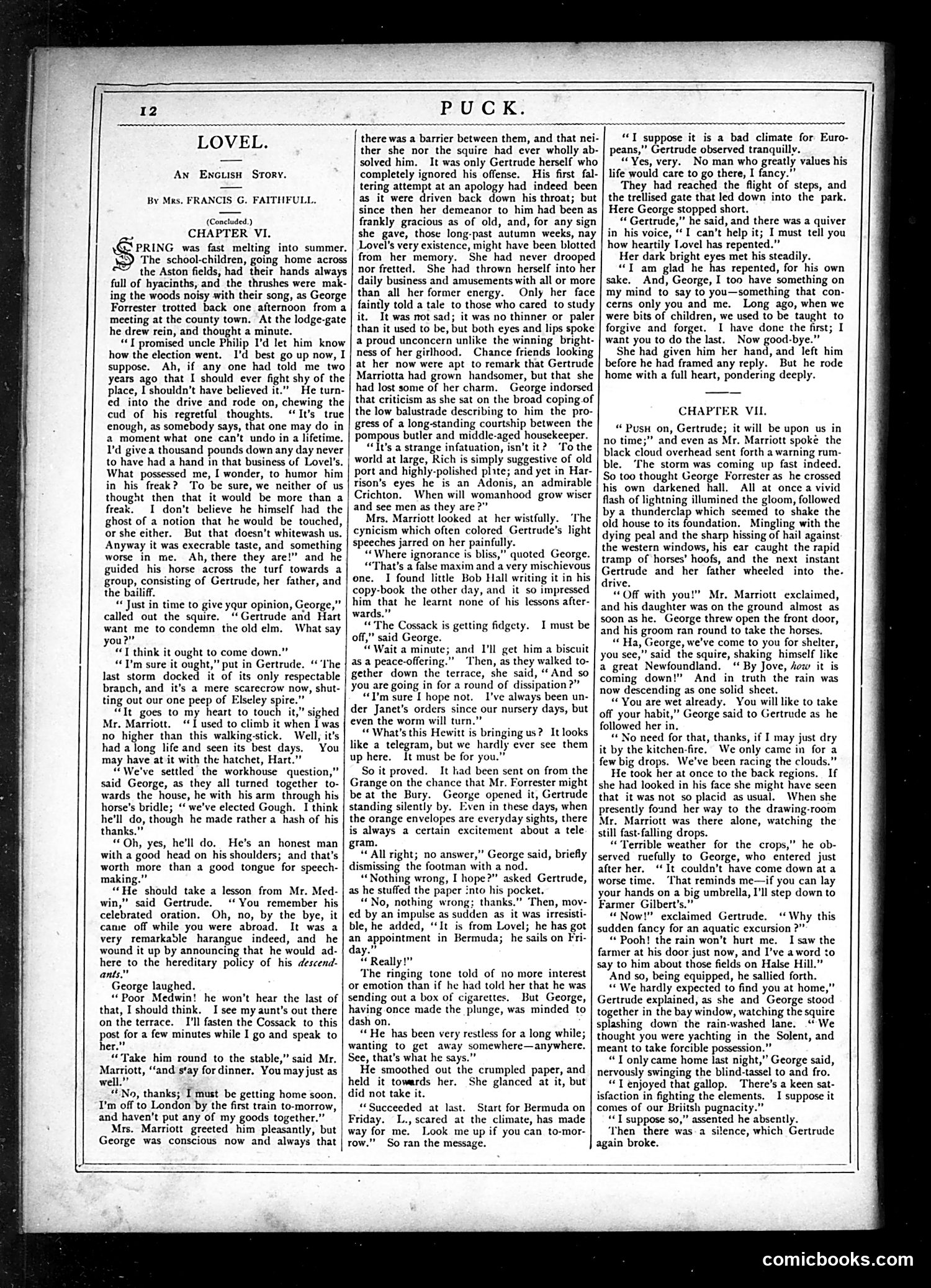
This page contains the serialized story **"Lovel: An English Story"** by Mrs. Francis G. Faithfull, specifically Chapters VI and VII. It is **not a political cartoon** but rather a Victorian-era domestic fiction narrative. The plot involves English country characters—including Gertrude, George, Mr. Marriott (a squire), and various family members—navigating social interactions, romantic interests, and class dynamics in their rural community. Themes include propriety, courtship expectations, and the constraints of Victorian society on young women. The text emphasizes period concerns: Gertrude's reputation, proper conduct, marriage prospects, and weather affecting agricultural life. There are no obvious political satires or modern references visible—this is straightforward serialized fiction typical of Puck's varied content offerings.
📄 Transcribed text from this page (OCR, searchable)
Machine-transcribed from the original scan — historical spelling and the odd misread are preserved.
LOVEL. An Encush Story. By Mrs. FRANCIS G. FAITHFULL. (Conctuded.) CHAPTER VI. PRING was fast melting into summer. 8) The school-children, going home across the Aston fields, had their hands always full of hyacinths, and the thrushes were mak- ing the woods noisy with their song, as George Forrester trotted back one afternoon from a meeting at the county town. At the lodge-gate he drew rein, and thought a minute. “T promised uncle Philip I’d let him know how the election went. I'd best go up now, I suppose. Ah, if any one had told me two years ago that I should ever fight shy of the place, I shouldn't have believed it.” He turn- ed into the drive and rode on, chewing the cud of his regretful thoughts. ‘It’s true enough, as somebody says, that one may do in a moment what one can’t undo in a lifetime. I'd give a thousand pounds down any day never to have had a hand in that business of Lovel’s. What possessed me, I wonder, to humor him in his freak? To be sure, we neither of us thought then that it would be more than a freak. I don’t believe he himself had the ghost of a notion that he would be touched, or she either. But that doesn’t whitewash us. Anyway it was execrable taste, and something worse in me, Ah, there they are!” and he guided his horse across the turf towards a group, consisting of Gertrude, her father, and the bailiff. “ Just in time to give yqur opinion, George,” called out the squire. ‘Gertrude and Hart want me to condemn the old elm. What say you?” “T think it ought to come down.” “I’m sure it ought,” put in Gertrude. “ ‘The last storm docked it of its only respectable branch, and it’s a mere scarecrow now, shut- ting out our one peep of Elseley spire.” “It goes to my heart to touch it,” sighed Mr. Marriott. ‘I used to climb it when I was no higher than this walking-stick. Well, it’s had a long life and seen its best days. You may have at it with the hatchet, Hart.”” “We've settled the workhouse question,” said George, as they all turned together to- wards the house, he with his arm through his horse's bridle; “ we've elected Gough. I think he'll do, though he made rather a hash of his thanks.” “Oh, yes, he'll do, He’s an honest man with a good head on his shoulders; and that’s worth more than a good tongue for speech- making.” “He should take a lesson from Mr. Med- win,” said Gertrude. ‘You remember his celebrated oration. Oh, no, by the bye, it came off while you were abroad. It was a very remarkable harangue indeed, and he wound it up by announcing that he would ad- here to the hereditary policy of his descend- ants.” George laughed. “Poor Medwin! he won't hear the last of that, I should think. I see my aunt’s out there on the terrace. I'll fasten the Cossack to this post for a few minutes while I go and speak to her.” “Take him round to the stable,” said Mr. Marriott, ‘‘and stay for dinner. You may just as well.” ‘"'No, thanks; I must be getting home soon. I’m off to London by the first train to-morrow, and haven't put any of my goods together.” Mrs. Marriott greeted him pleasantly, but George was conscious now and always that | Friday. | way for me. there was a barrier between them, and that nei- ther she nor the squire had ever wholly ab- solved him. It was only Gertrude herself who completely ignored his offense. His first fal- tering attempt at an apology had indeed been as it were driven back down his throat; but since then her demeanor to him had been as frankly gracious as of old, and, for any sign she gave, those long-past autumn weeks, nay Lovel’s very existence, might have been blotted from her memory. She had never drooped nor fretted. She had thrown herself into her daily business and amusements with all or more than all her former energy. Only her face faintly told a tale to those who cared to study it. It was not sad; it was no thinner or paler than it used to be, but both eyes and lips spoke a proud unconcern unlike the winning bright- ness of her girlhood. Chance friends looking at her now were apt to remark that Gertrude Marriotta had grown handsomer, but that she had lost some of her charm. George indorsed that criticism as she sat on the broad coping of the low balustrade describing to him the pro- gress of a long-standing courtship between the pompous butler and middle-aged housekeeper. “It’s a strange infatuation, isn’t it? ‘To the world at large, Rich is simply suggestive of old port and highly-polished plate; and yet in Har- rison’s eyes he is an Adonis, an admirable Crichton. When will womanhood grow wiser and see men as they are ?” Mrs, Marriott looked at her wistfully. ‘The cynicism which often colored Gertrude’s light speeches jarred on her painfully. “Where ignorance is bliss,” quoted George. “That's a false maxim and a very mischievous one. I found little Bob Hall writing it in his copy-book the other day, and it so impressed him that he learnt none of his lessons after- wards.” “The Cossack is getting fidgety. I must be off,” said George “Wait a minute; and I'll get him a biscuit as a peace-offering.” ‘Then, as they walked to- gether down the terrace, she said, “And so you are going in for a round of dissipation?” “I'm sure I hope not. I’ve always been un- der Janet's orders since our nursery days, but even the worm will turn.” “What's this Hewitt is bringing us? It looks like a telegram, but we hardly ever see them up here. It must be for you.” So it proved. It had been sent on from the Grange on the chance that Mr. Forrester might be at the Bury. George opened it, Gertrude standing silently by. Even in these days, when the orange envelopes are everyday sights, there is always a certain excitement about a tele ram. “All right; no answer,” George said, briefly dismissing the footman with a nod. “Nothing wrong, I hope?” asked Gertrude, as he stuffed the paper into his pocket. “No, nothing wrong; thanks.” ‘Then, mov- ed by an impulse as sudden as it was irresisti- ble, he added, ‘It is from Lovel; he has got an appointment in Bermuda; he sails on Fri- day.” “Really!” ‘The ringing tone told of no more interest or emotion than if he had told her that he was sending out a box of cigarettes. But George, having once made the plunge, was minded to dash on. “He has been very restless for a long while; wanting to get away somewhere—anywhere. See, that’s what he says.” He smoothed out the crumpled paper, and held it towards her. She glanced at it, but did not take it. “Succeeded at last. Start for Bermuda on L., scared at the climate, has made Look me up if you can to-mor- row.” So ran the message. “I suppose it is a bad climate for Euro- peans,” Gertrude observed tranquilly. “Yes, very. No man who greatly values his life would care to go there, I fancy.” They had reached the flight of steps, and the trellised gate that led down into the park. Here George stopped short. “ Gertrude,” he said, and there was a quiver in his voice, ‘I can’t help it; I must tell you how heartily Lovel has repented.” Her dark bright eyes met his steadily. “T am glad he has repented, for his own sake. And, George, I too have something on my mind to say to you—something that con- cerns only you and me. Long ago, when we were bits of children, we used to be taught to forgive and forget. I have done the first; I want you to do the last. Now good-bye.” She had given him her hand, and left him before he had framed any reply.’ But he rode home with a full heart, pondering deeply. CHAPTER VIL. “ Pusu on, Gertrude; it will be upon us in no time;” and even as Mr. Marriott spoké the black cloud overhead sent forth a warning rum- ble. ‘The storm was coming up fast indeed. So too thought George Forrester as he crossed his own darkened hall. All at once a vivid flash of lightning illumined the gloom, followed by a thunderclap which seemed to shake the old house to its foundation. Mingling with the dying peal and the sharp hissing of hail against the western windows, his car caught the rapid tramp of horses’ hoofs, and the next instant Gertrude and her father wheeled into the. drive. “Off with you!” Mr. Marriott exclaimed, and his daughter was on the ground almost as soon as he. George threw open the front door, and his groom ran round to take the horses. “ Ha, George, we've come to you for shelter, you see,” said the squire, shaking himself like a great Newfoundland. “ By Jove, how it is coming down!” And in truth the rain was now descending as one solid sheet. “You are wet already. You will like to take off your habit,” George said to Gertrude as he followed her in, “No need for that, thanks, if I may just dry it by the kitchen-fire. We only came in for a few big drops. We've been racing the clouds.” He took her at once to the back regions. If she had looked in his face she might have seen that it was not so placid as usual. When she presently found her way to the drawing-room Mr. Marriott was there alone, watching the still fast-falling drops. “Terrible weather for the crops,” he ob- served ruefully to George, who entered just after her. ‘It couldn’t have come down at a worse time. ‘That reminds me—if you can lay your hands on a big umbrella, I'll step down to Farmer Gilbert's.” “Now!” exclaimed Gertrude. ‘Why this sudden fancy for an aquatic excursion ?” “Pooh! the rain won’t hurt me. I saw the farmer at his door just now, and I’ve aword to say to him about those fields on Halse Hill.” ‘And so, being equipped, he sallied forth. “We hardly expected to find you at home,” Gertrude explained, as she and George stood together in the bay window, watching the squire splashing down the rain-washed lane. “We thought you were yachting in the Solent, and meant to take forcible possession.” “T only came home last night,” George said, nervously swinging the blind-tassel to and fro. “T enjoyed that gallop. ‘There’s a keen sat- isfaction in fighting the elements. I suppose it comes of our Briitsh pugnacity.” “T suppose so,” assented he absently. ‘Then there was. a silence, which Gertrude again broke. comicbooks.com