
Puck, 1878-03-13 · page 7 of 20
Puck — March 13, 1878 — page 7: what you’re looking at
What you’re looking at
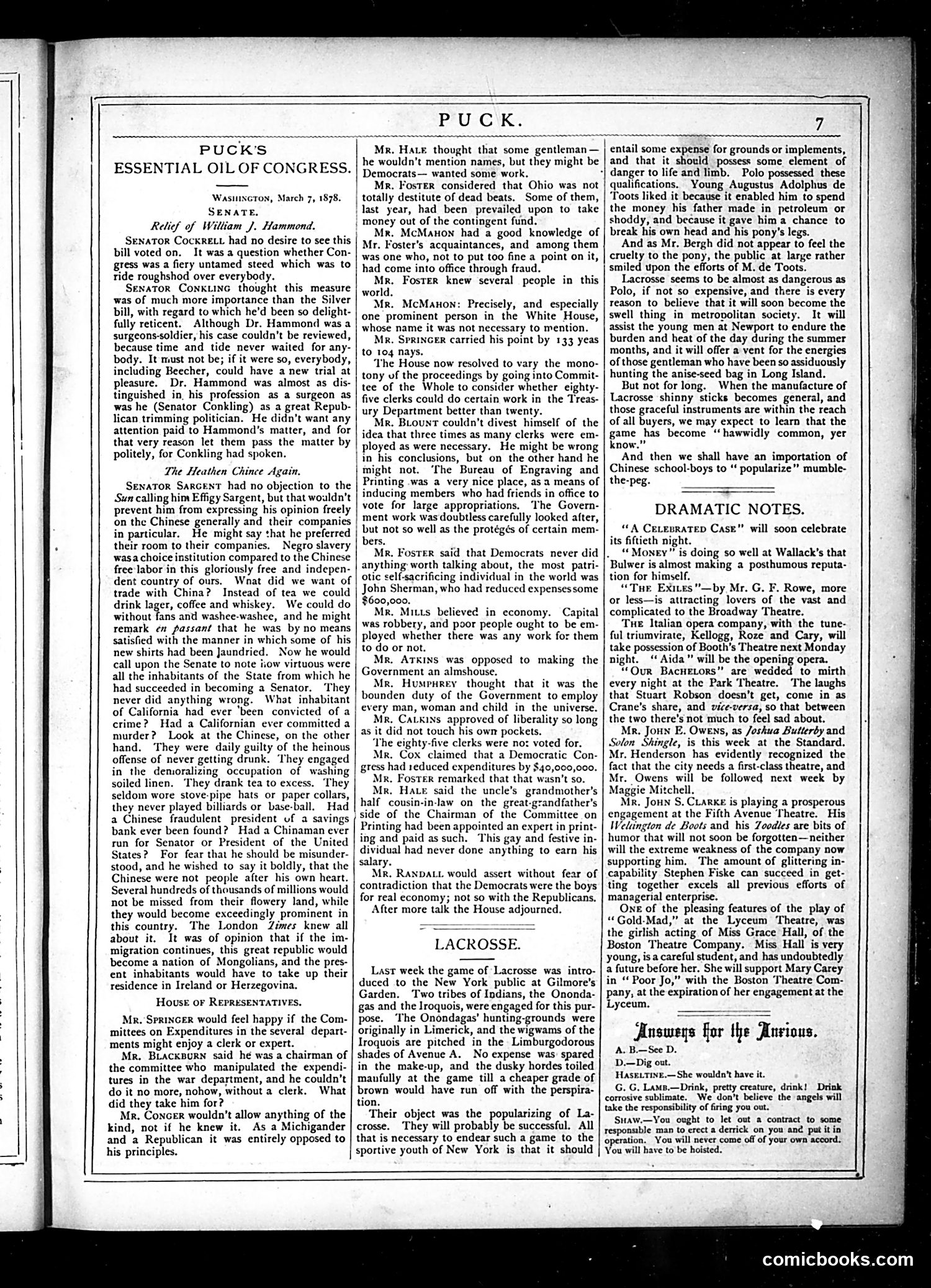
This page from *Puck* (March 7, 1878) contains congressional debate transcripts rather than cartoons. The text discusses Senator Conkling's proposed legislation regarding government expenditures, with various senators debating whether to appropriate funds for clerks and office positions. The satirical commentary mocks the senators' contradictory positions: Democrats claim fiscal responsibility while Democrats like McMahon and Foster advocate hiring additional staff; Republicans defend government efficiency while endorsing similar expenditures. The piece ridicules how politicians selectively invoke economy to justify their preferred spending. References to Chinese laborers and immigration reflect 1870s anti-Chinese sentiment. The brief "Lacrosse" and theatrical notes at page's bottom are unrelated editorial content, typical of *Puck*'s miscellaneous format.
📄 Transcribed text from this page (OCR, searchable)
Machine-transcribed from the original scan — historical spelling and the odd misread are preserved.
PUCK’S ESSENTIAL OIL OF CONGRESS. Wasuixcrox, March 7, 1878. | SENATE, Relief of William J. Hammond, 1 Senator Cocxrete had no desire to see this bill voted on. It was a question whether Con- gress was a fiery untamed steed which was to ride roughshod over everybody. Senator ConkuinG thought this measure was of much more importance than the Silver Dill, with regard to which he'd been so delight- fully reticent. Although Dr. Hammond was a surgeons-soldier, his case couldn't be reviewed, because time and tide never waited for any- body. It must not be; if it were so, everybody, including Beecher, could have a new trial at pleasure. Dr. Hammond was almost as dis- tinguished in, his profession as a surgeon as was he (Senator Conkling) as a great Repub- lican trimming politician. He didn’t want any attention paid to Hammond's matter, and for that very reason let them pass the matter by politely, for Conkling had spoken. The Heathen Chince Again, Senator Sarcent had no objection to the Sun calling him Effigy Sargent, but that wouldn't prevent him from expressing his opinion freely on the Chinese generally and their companies in particular. He might say that he preferred their room to their companies. Negro slavery wasa choice institution compared to the Chinese free labor in this gloriously free and indepen- dent country of ours. What did we want of trade with China? Instead of tea we could drink lager, coffee and whiskey. We could do without ae and washee-washee, and he might remark en passant that he was by no means satisfied with the manner in which some of his new shirts had been Jaundried. Now he would call upon the Senate to note iiow virtuous were all the inhabitants of the State from which he had succeeded in becoming a Senator. They never did anything wrong. What inhabitant of California had ever ‘been convicted of a crime? Had a Californian ever committed a murder? Look at the Chinese, on the other hand. They were daily guilty of the heinous offense of never getting drunk. ‘They engaged in the demoralizing occupation of washing soiled linen. They drank tea to excess. They seldom wore stove-pipe hats or paper collars, they never played billiards or base-ball. Had a Chinese fraudulent president uf a savings bank ever been found? Had a Chinaman ever run for Senator or President of the United States? For fear that he should be misunder- stood, and he wished to say it boldly, that the Chinese were not people after his own heart. Several hundreds of thousands of millions would not be missed from their flowery land, while they would become exceedingly prominent in this country. The London Zimes knew all about it. It was of opinion that if the im- migration continues, this great republic would become a nation of Mongolians, and the pres- ent inhabitants would have to take up their residence in Ireland or Herzegovina. House or REPRESENTATIVES. Mr. SprINGER would feel happy if the Com- mittees on Expenditures in the several depart- ments might enjoy a clerk or expert. Mr. BLackBurn said he was a chairman of the committee who manipulated the expendi- tures in the war department, and he couldn't do it no more, nohow, without a clerk. What did they take him for? Mr. Concer wouldn’t allow anything of the kind, not if he knew it. As a Michigander and a Republican it was entirely opposed to his principles. | last year, had been prevailed upon to take Mr. Hate thought that some gentleman — he wouldn't mention names, but they might be Democrats— wanted some work. Mr. Foster considered that Ohio was not totally destitute of dead beats. Some of them, money out of the contingent fund, Mr. McManon had a good knowledge of Mr. Foster's acquaintances, and among them was one who, not to put too fine a point on it, had come into office through fraud. Mr. Foster knew several people in this world, Mr. McManon: Precisely, and especially one prominent person in the White House, whose name it was not necessary to mention. Mr. Sprincer carried his point by 133 yeas to 104 nays. ‘The House now resolved to vary the mono- tony of the proceedings by going into Commit- tee of the Whole to consider whether eighty- five clerks could do certain work in the Treas- ury Department better than twenty. Mr. Biounrt couldn’t divest himself of the idea that three times as many clerks were em- ployed as were necessary. He might be wrong in his conclusions, but on the other hand he might not. ‘The Bureau of Engraving and Printing .was a very nice place, asa means of inducing members who had friends in office to vote for large appropriations. ‘The Govern- ment work was doubtless carefully looked after, | ut not so well as the protégés of certain mem- ers. anything-worth talking about, the most patri- otic self-sacrificing individual in the world was John Sherman, who had reduced expensessome $600,000. Mr. Mitts believed in economy. Capital was robbery, and poor people ought to be em- ployed whether there was any work for them to do or not. MR. ATKINS was opposed to making the Government an almshouse. Mr. Humpurey thought that it was the bounden duty of the Government to employ | every man, woman and child in the universe. MR. CaLkins approved of liberality so long as it did not touch his own pockets. ‘The eighty-five clerks were no: voted for. Mr. Cox claimed that a Democratic Con- gress had reduced expenditures by $40,000,000. Mr. Foster remarked that that wasn’t so. said the uncle’s grandmother's half cousin-in-law on the great-grandfather’s side of the Chairman of the Committee on Printing had been appointed an expert in print- ing and paid as such. ‘This gay and festive in- dividual had never done anything to earn his salary. Mr. RANDALL would assert without fear of contradiction that the Democrats were the boys for real economy; not so with the Republicans, After more talk the House adjourned. LACROSSE. Last week the game of Lacrosse was intro- duced to the New York public at Gilmore's Garden. Two tribes of Indians, the Ononda- gas and the Iroquois, were engaged for this pur- pose. ‘The Onondagas’ hunting-grounds were originally in Limerick, and the wigwams of the Iroquois are pitched in the Limburgodorous shades of Avenue A. No expense was: spared in the make-up, and the dusky hordes toiled manfully at the game till a cheaper grade of brown would have run off with the perspira- tion. ‘Their object was the popularizing of La- crosse. They will probably be successful. All that is necessary to endear such a game to the sportive youth of New York is that it should Mr. Foster said that Democrats never did |. entail some expense for grounds or implements, and that it should ess some element of -| danger to life and limb. Polo possessed these qualifications. Young Augustus Adolphus de Toots liked it because it enabled him to spend the money his father made in petroleum or shoddy, and because it gave him a chance to break his own head and his pony’s legs. And as Mr. Bergh did not appear to feel the cruelty to the pony, the public at large rather smiled upon the efforts of M. de Toots. Lacrosse seems to be almost as dangerous as Polo, if not so expensive, and there is every reason to believe that it will soon become the swell thing in metropolitan society. It will assist the young men at Newport to endure the burden and heat of the day during the summer months, and it will offer a vent for the energies of those gentleman who have been so assiduously hunting the anise-seed bag in Long Island. But not for long. When the manufacture of Lacrosse shinny sticks becomes general, and those graceful instruments are within the reach of all buyers, we may expect to learn that the game has become ‘‘hawwidly common, yer know.” And then we shall have an importation of Chinese school-boys to “ popularize” mumble- the-peg. DRAMATIC NOTES. “A CeLesraTeD Case” will soon celebrate its fiftieth night. “Money” is doing so well at Wallack’s that Bulwer is almost making a posthumous reputa- tion for himself. “Tue Exites"—by Mr. G. F. Rowe, more or less—is attracting lovers of the vast and complicated to the Broadway Theatre. Tue Italian opera company, with the tune- ful triumvirate, Kellogg, Roze and Cary, will take possession of Booth’s Theatre next Monday night. “ Aida” will be the opening opera. “Our BacHetors” are wedded to mirth every night at the Park ‘Theatre. ‘The laughs that Stuart Robson doesn’t get, come in as Crane's share, and vice-versa, so that between the two there's not much to feel sad about. Mr. Joun E. Owens, as Joshua Butterby and Solon Shingle, is this week at the Standard. Mr. Henderson has evidently recognized the fact that the city needs a first-class theatre, and Mr. Owens will be followed next week by Maggie Mitchell. Mr. Joun S. Crarke is playing a prosperous engagement at the Fifth Avenue Theatre. His Welington de Boots and his Zoodles are bits of humor that will not soon be forgotten—neither will the extreme weakness of the company now supporting him. The amount of glittering in- capability Stephen Fiske can succeed in get- ting together excels all previous efforts of managerial enterprise. One of the pleasing features of the play of **Gold-Mad,” at the Lyceum Theatre, was the girlish acting of Miss Grace Hall, of the Boston Theatre Company. Miss Hall is very young, isa careful student, and has undoubtedly a future before her. She will support Mary Carey in “ Poor Jo,” with the Boston Theatre Com- pany, at the expiration of her engagement at the Lyceum. ‘ Answeys for A. B.—See D. D.—Dig out. Haseutive.—She wouldn’t have it. G. G. Lams.—Drink, pretty creature, drink! Drink corrosive sublimate. We don’t believe the angels will take the responsibility of firing you out. Suaw.—You ought to let out a contract to some responsible man to erect a derrick on you and put it in operation. You will never come off of your own accord. You will have to be hoisted. the Aneious. comicbooks.com