
A complete issue · 20 pages · 1877
Puck — December 19, 1877
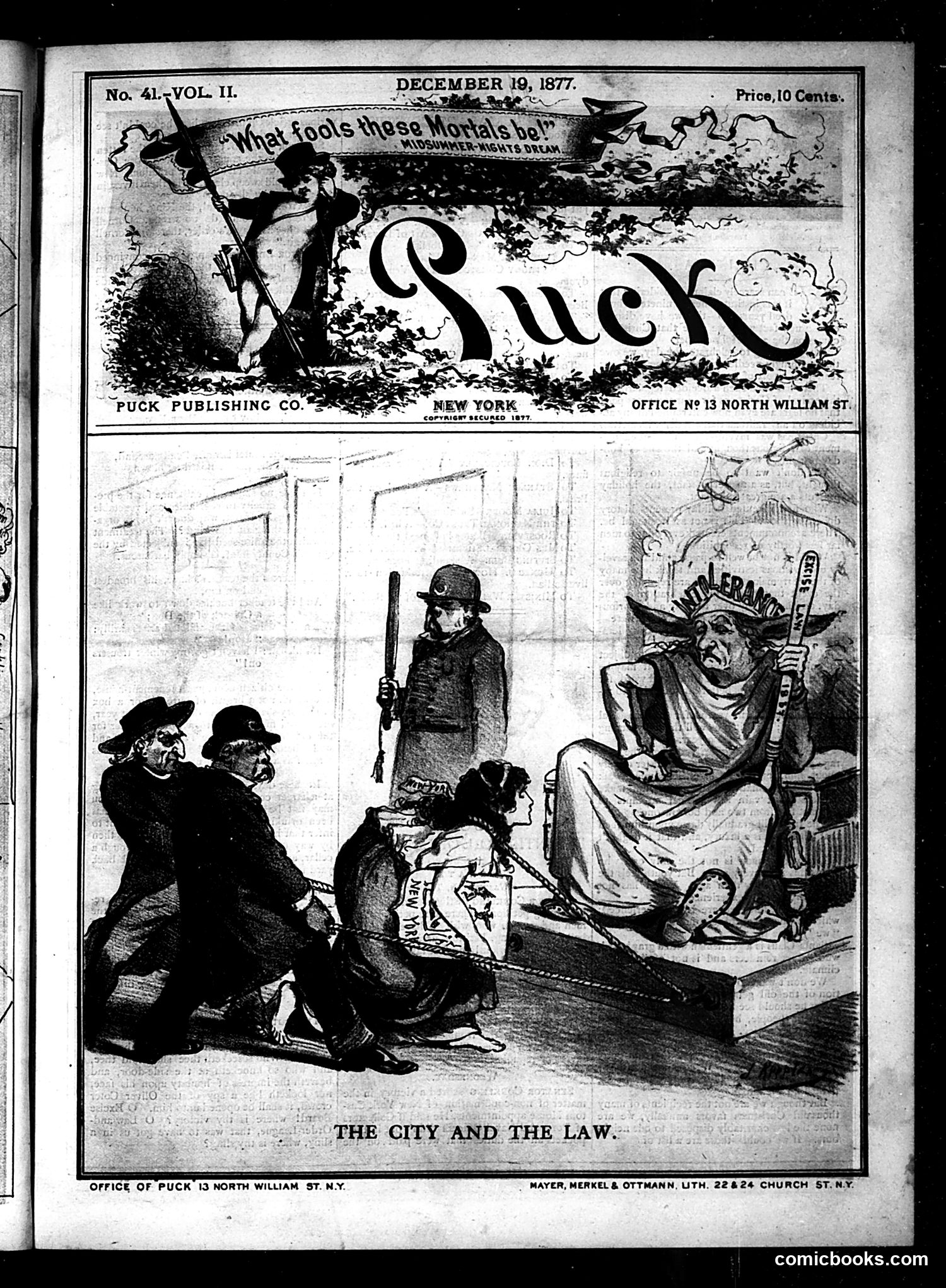
This cartoon depicts the relationship between urban crime and law enforcement in late 19th-century New York. The figure seated on the elevated platform labeled "TAMMANY" appears to represent Tammany Hall, the corrupt Democratic political machine that controlled NYC. Below, various disheveled figures—likely representing criminals, vagrants, or the poor—interact with a police officer holding a club, symbolizing law enforcement's role. The satire suggests that despite the police's authority ("the law"), Tammany Hall's political power and corruption allowed criminal elements to flourish in the city. The cartoon critiques the ineffectiveness or complicity of authorities in addressing urban crime and disorder, a persistent theme in Gilded Age political satire about municipal corruption.
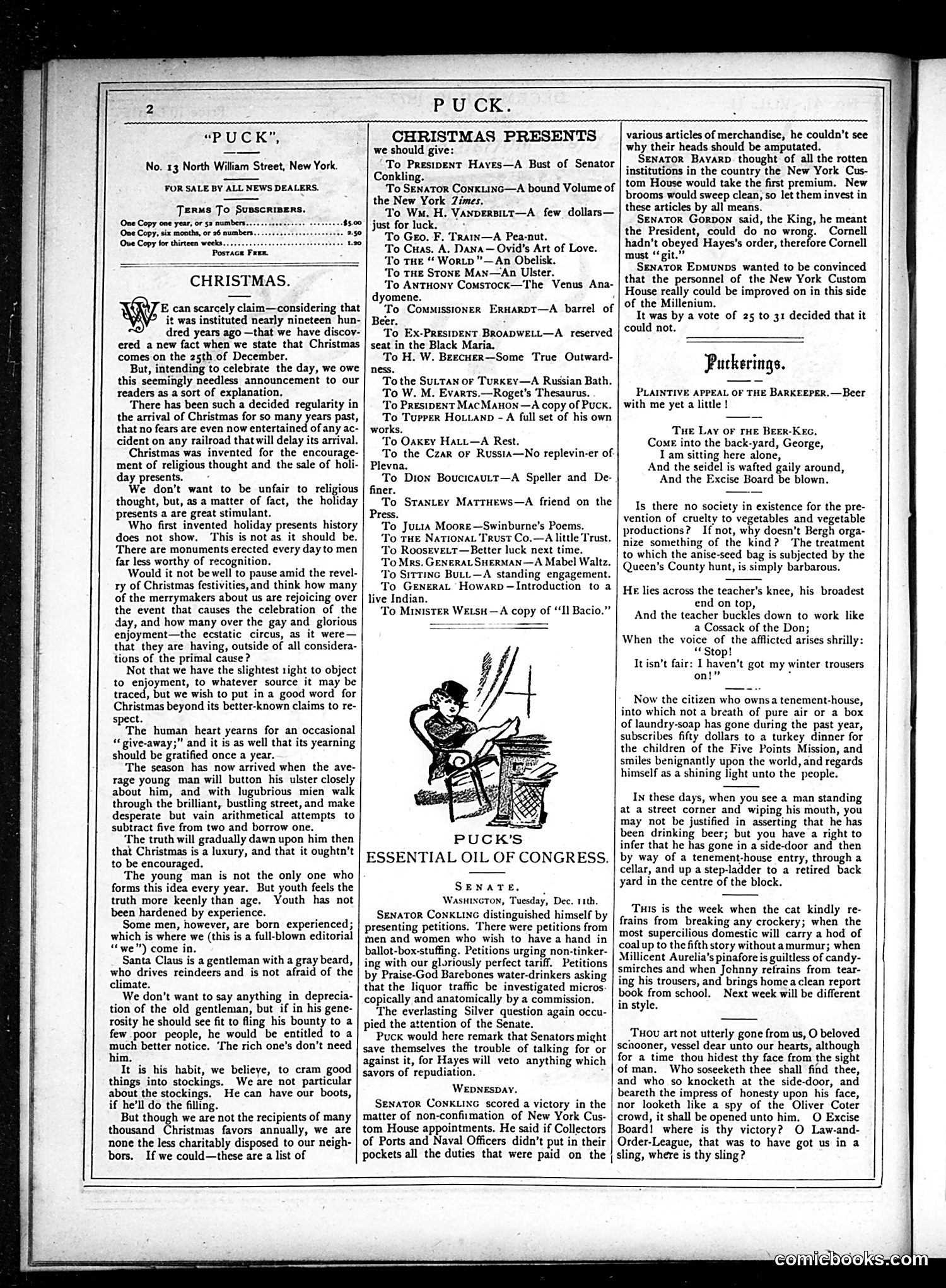
This page satirizes the U.S. Senate under Senator Conkling's leadership. The cartoon depicts a young boy laboriously grinding/processing something—likely representing the distillation of Senate proceedings into usable "essential oil." The text mocks Conkling for celebrating a minor victory regarding New York Custom House appointments while ignoring larger issues. It criticizes senators for ineffectual debate on significant matters like liquor regulation and Silver currency, suggesting their work produces little of substance. The satire suggests Congress is inefficient and self-serving—senators focus on patronage disputes rather than meaningful legislation. The "essential oil" metaphor implies that extracting anything truly valuable from Senate deliberations requires exhausting effort for minimal results.
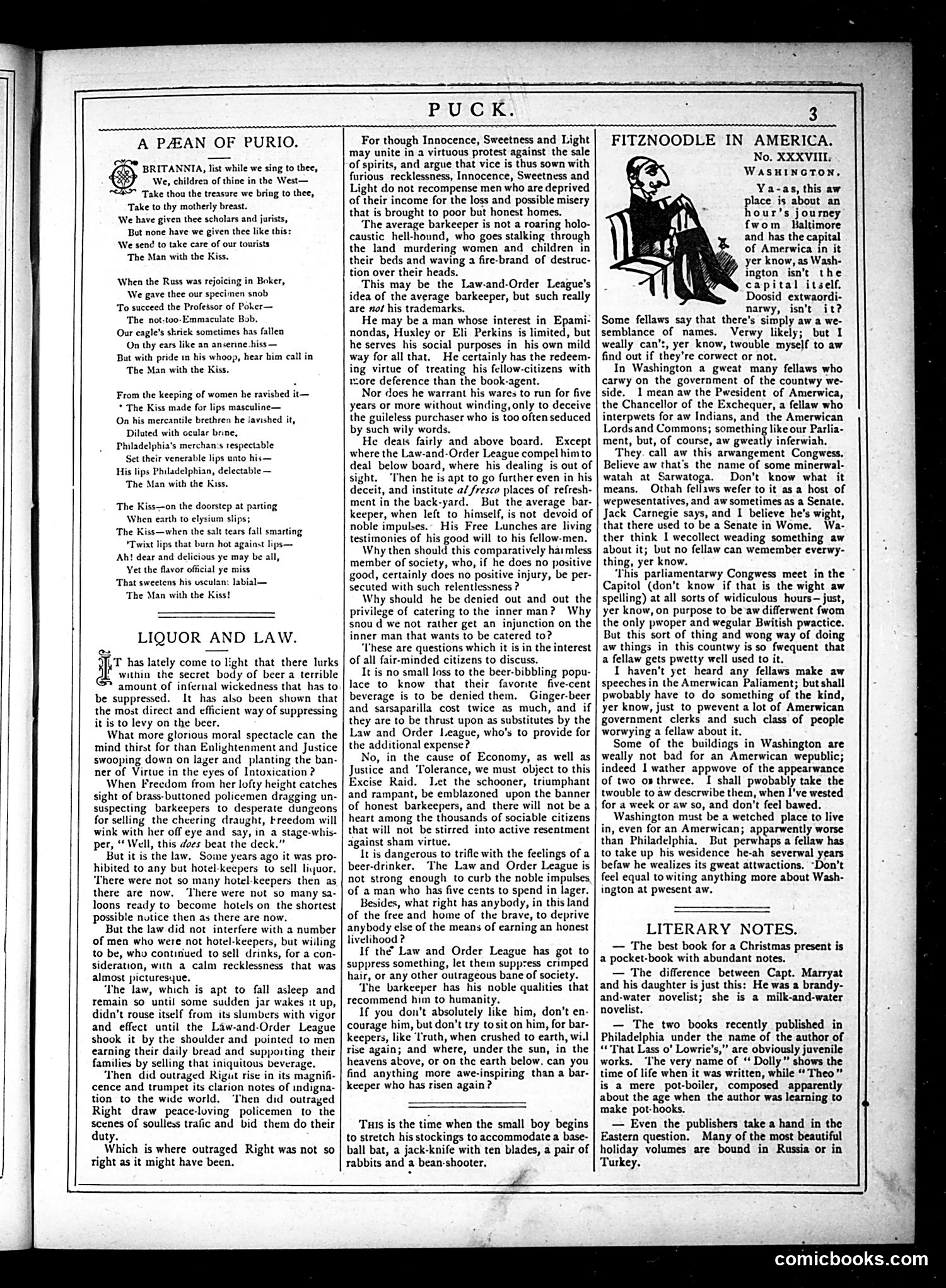
This page contains three distinct pieces: 1. **"A Plean of Purio"** (left column): A poem defending "Innocence, Sweetness and Light" against accusations of naiveté, with repeated refrain "The Man with the Kiss." The meaning and identity of this figure remain unclear from text alone. 2. **"Liquor and Law"** (left-center): Satirizes the "Law-and-Order League" for hypocrisy—they target working-class bar patrons while ignoring wealthy hotel keepers who sell liquor illegally. The piece condemns selective moral enforcement as inconsistent with true reform. 3. **"Fitznoodle in America"** (right): A humorous account of a visitor's observations on American government and customs, appearing to mock both foreign perspectives and American practices through comparative analysis. The page primarily contains political commentary rather than visual cartoons.
This page contains no political cartoon. Instead, it's a literary feature titled "Mythology on the Half-Shell" presenting a humorous mythological tale about Procne and Philomela (figures from classical Greek mythology). The narrative retells their story with satirical embellishments, focusing on domestic complications and marital discord. The right column contains "College Notes"—brief observations about contemporary college life, including commentary on small newspapers at Columbia, young ladies at Vassar, and various academic figures like Professor Lowell of Harvard. This represents Puck's typical mixed content: serialized humor writing alongside social commentary on American institutions. The page demonstrates the magazine's literary rather than purely visual satirical approach.
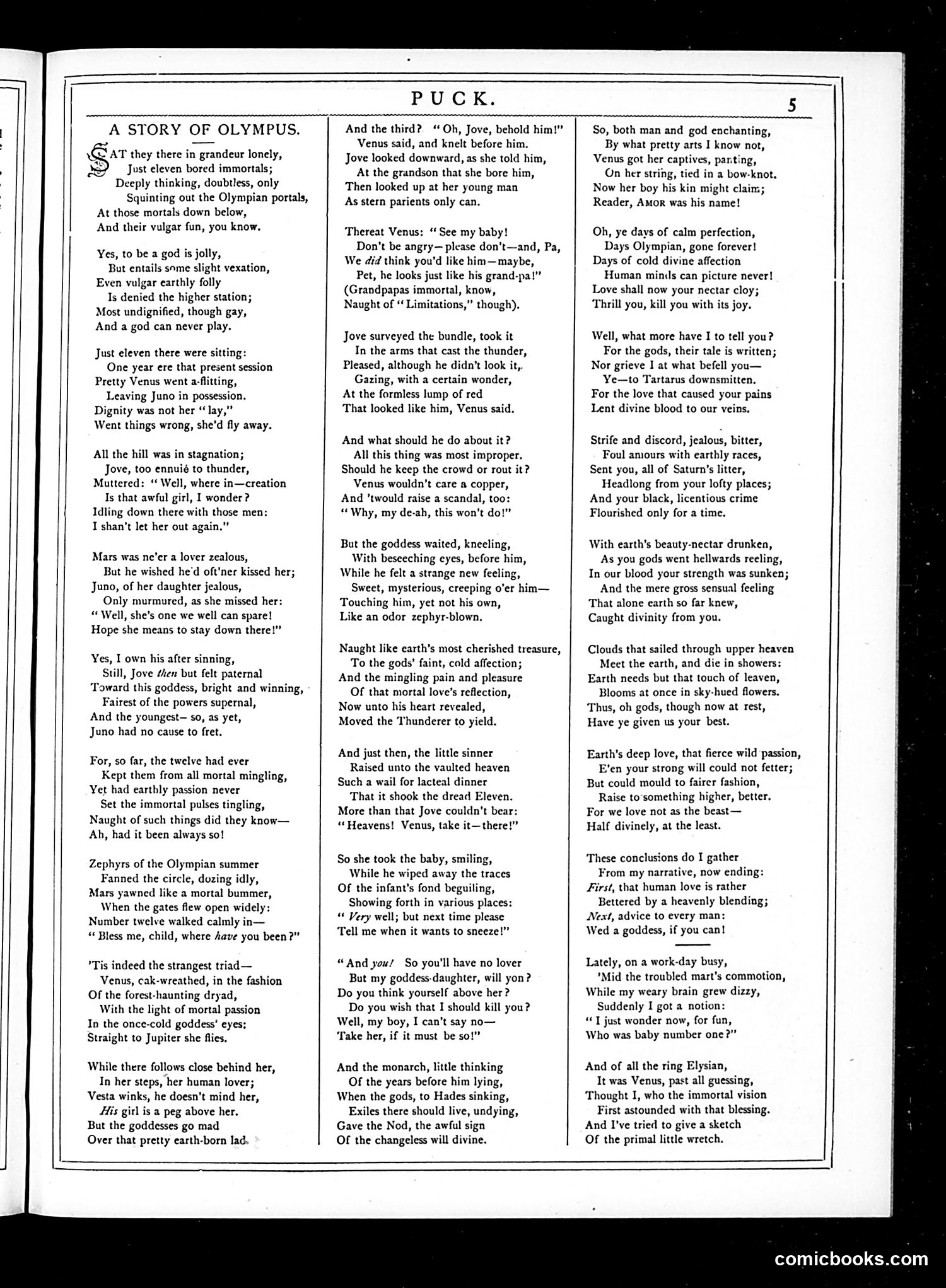
This page contains a poem titled "A Story of Olympus" — a satirical narrative in verse rather than a visual political cartoon. The poem retells the Greek mythological story of Jupiter (Jove) fathering a child with the mortal Juno, exploring themes of divine infidelity and its earthly consequences. The satire appears to use classical mythology as a framework to comment on **human passion, mortality, and the consequences of romantic entanglement across social hierarchies**. References to Juno's jealousy, Venus's intervention, and the "scandal" of a god-mortal union suggest social commentary about class differences and illegitimate relationships — issues relevant to Puck's audience. The poem's conclusion emphasizes the "fierce wild passion" of earthly love versus divine coldness, likely critiquing aristocratic detachment from human suffering.
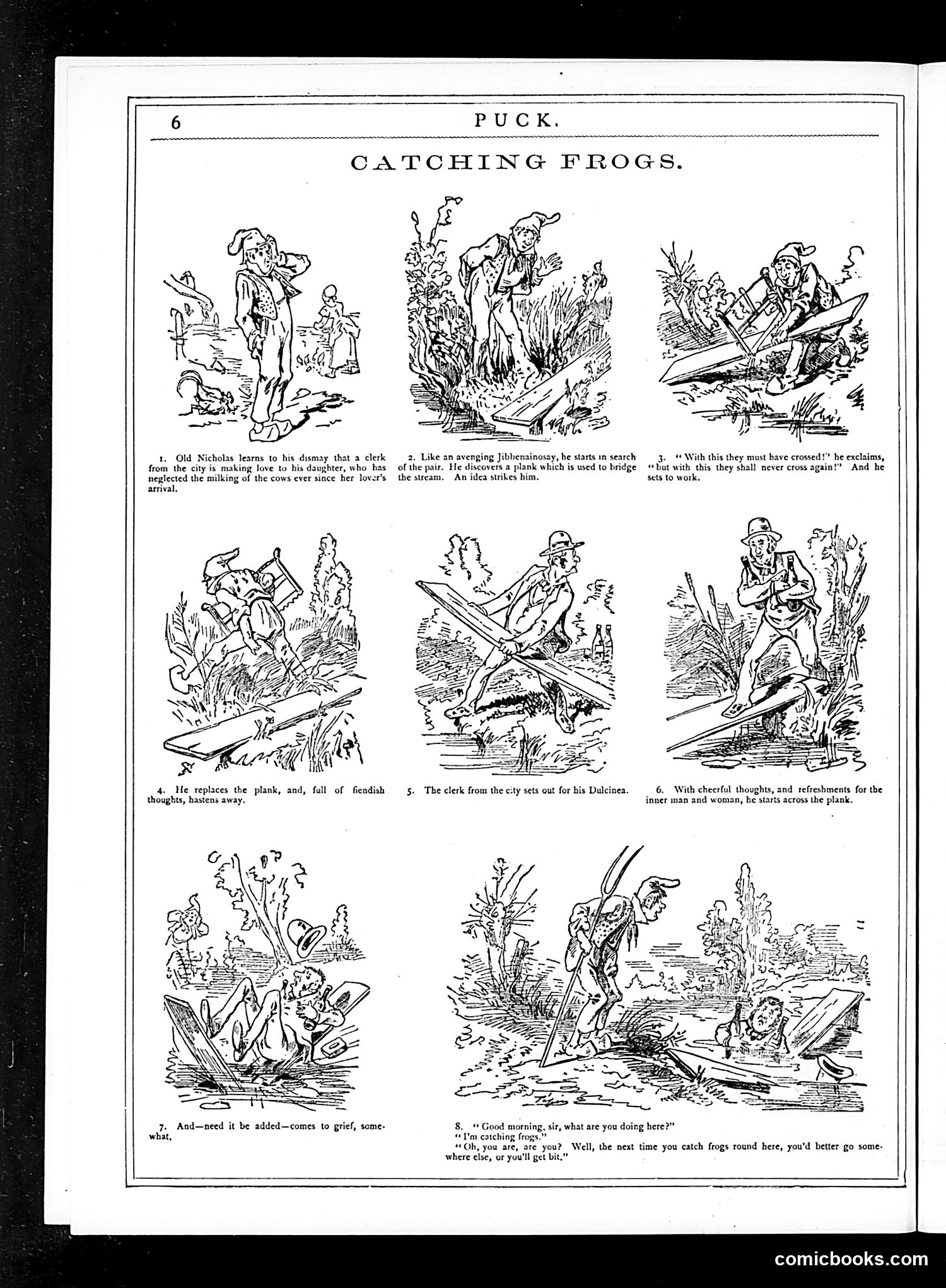
This is a humorous sequential narrative rather than political satire. It tells the story of Old Nicholas (appearing to be a country gentleman), who learns his clerk has been negligent with the household accounts. Nicholas pursues the clerk to a stream, intending to catch him using a plank as a bridge. The eight panels follow their escalating misadventure: Nicholas's repeated failures to cross the plank, the clerk's eventual escape, and Nicholas's final vow never to catch frogs again—a play on words suggesting the "frog-catching" scheme was as futile as actually catching frogs. This appears to be genteel Victorian humor about class conflict and physical comedy, with no apparent political message.
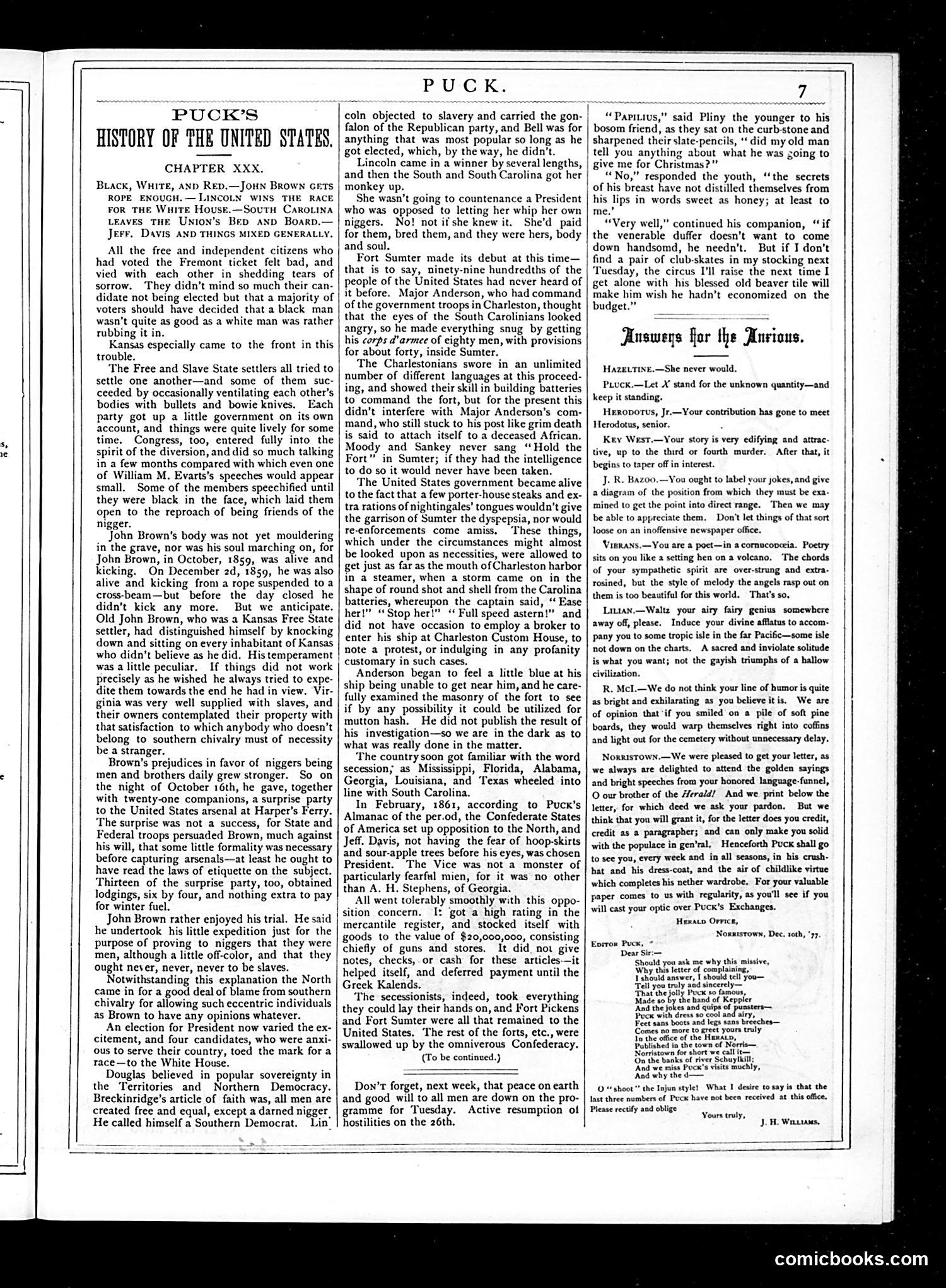
This page contains the continuation of "Puck's History of the United States," Chapter XXX, focusing on pre-Civil War tensions. The satirical text discusses the Free and Slave State settlers' conflicts, John Brown's raid on Harpers Ferry, and Jefferson Davis's military preparations at Fort Sumter. The humor derives from Puck's sardonic commentary on political hypocrisy and sectional conflict. References include Major Anderson (Fort Sumter commander), the Confederacy's military buildup, and disputes over slavery expansion. The "Answers for the Anxious" advice column section provides contemporary satirical commentary on unrelated topics. The page demonstrates Puck's characteristic approach: using historical narrative to critique contemporary political divisions while maintaining a wry, irreverent tone toward all parties involved in the slavery debate.
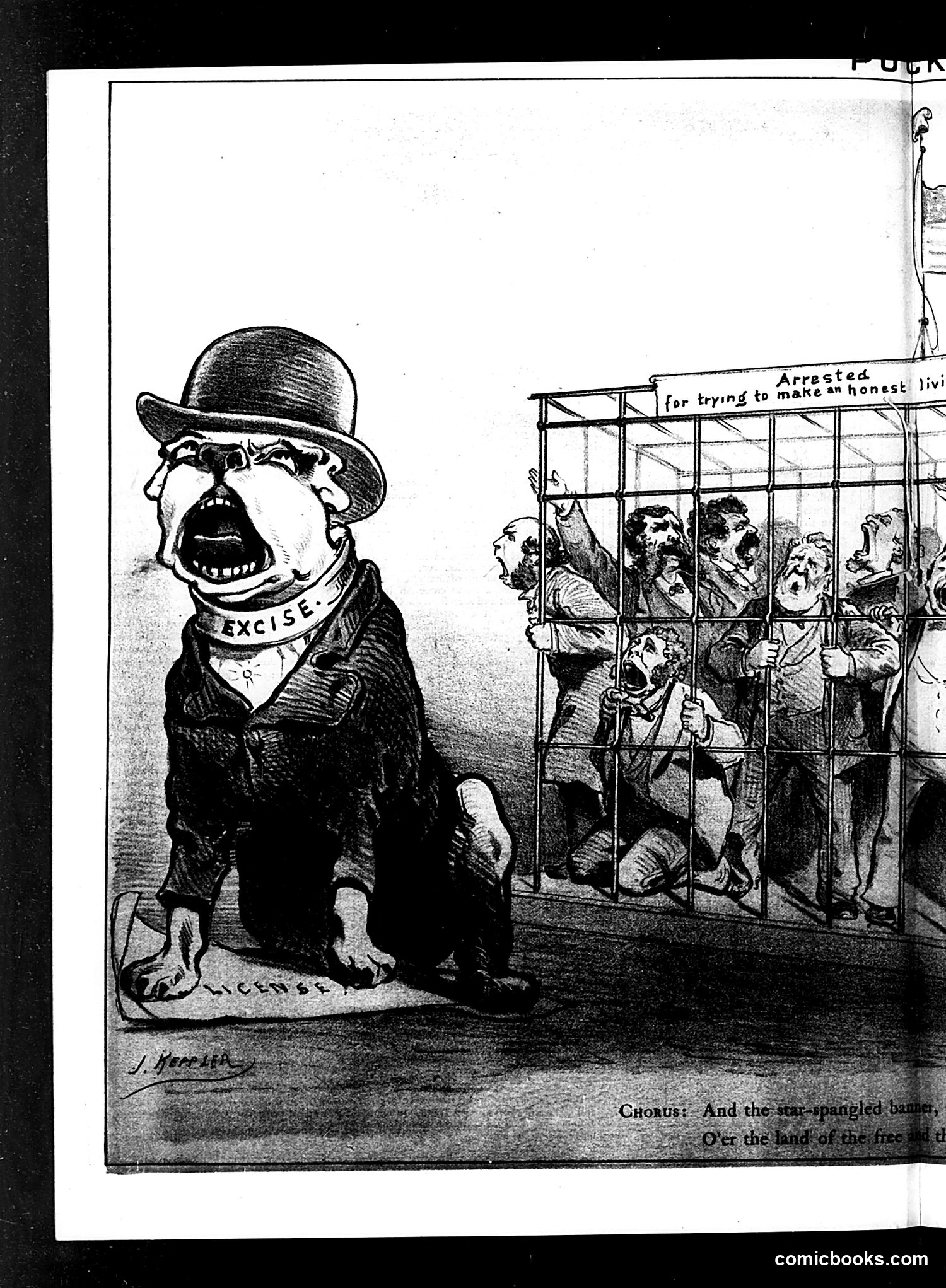
This Puck cartoon satirizes wealth inequality and labor conditions in Gilded Age America. The left figure, labeled "EXCISE," appears to represent a wealthy industrialist or capitalist—depicted as grotesquely fat and comfortable in fine dress with a bowler hat and open mouth (suggesting greed or callousness). On the right, poor workers are caged behind bars, captioned "Arrested for trying to make an honest living." The contrast is stark: the wealthy figure stands free while the impoverished are imprisoned. The satire critiques how economic systems punished the poor for survival while permitting the rich to exploit them without consequence. The "EXCISE" label likely references excessive taxation or exploitation of working people. The cartoon advocates for labor rights and economic justice during an era of severe class tension.
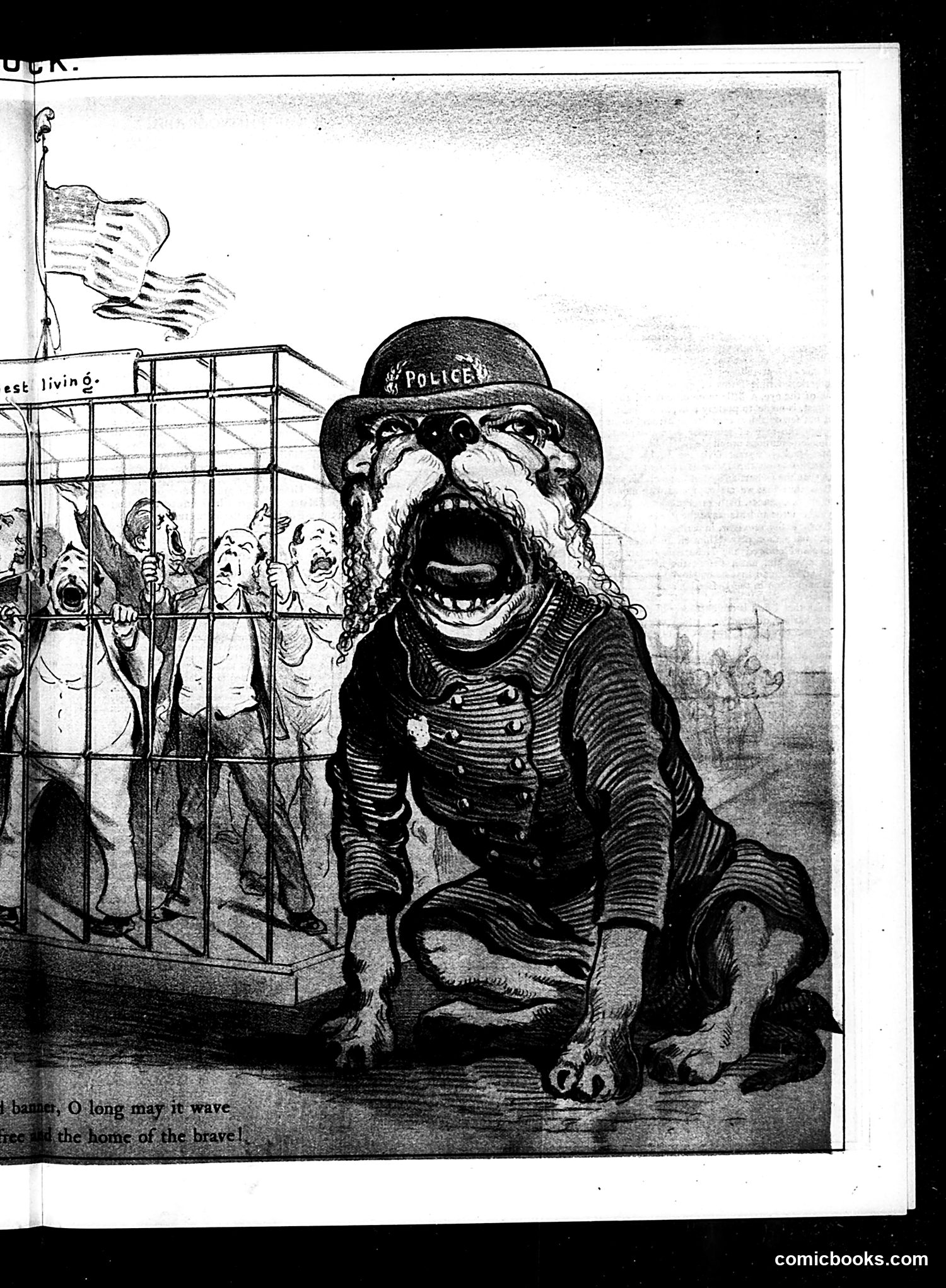
This is a political cartoon satirizing law enforcement, likely from the late 19th or early 20th century. The image shows a grotesque, caricatured police officer wearing a helmet labeled "POLICE" with an exaggerated, threatening expression—mouth wide open as if roaring or yelling. He's depicted as brutish and intimidating, wearing a military-style uniform with buttons. Behind him is a cage containing frightened civilians with distressed expressions. The partial text visible ("banner, O long may it wave / ...the home of the brave") references the American flag and patriotic ideals, creating ironic contrast. The cartoon appears to critique police overreach, abuse of authority, or militaristic policing tactics as contrary to American democratic values. The juxtaposition suggests the cartoon is protesting how law enforcement frightens ordinary citizens rather than protects them.
This page contains theatrical reviews and commentary rather than political cartoons. The main illustration shows a phonograph, accompanying an article titled "THE PHONOGRAPH" that discusses Edison's recording device as a novelty—describing how it captures and reproduces sound. The page also includes "DRAMATIC NOTES" reviewing current Broadway productions, including mentions of plays like "Won at Last," "John Fleming," and "The Man of Success." There's satire of theatrical pretension and criticism of actors' performances. A section titled "A HYPERCRITICASTER" mocks a theater critic (Richard Grant White) for harsh reviews. The content reflects Puck's typical mix: technological novelties presented as curiosities, theater criticism with comedic jabs at actors and playwrights, and satirical commentary on cultural figures and practices of the era.
This page contains two separate pieces: "Mr. Simpkins's Downfall" (a satirical article from the New York Times about a man humiliated by wearing short socks that expose his legs) and "Two Knaves and a Queen," an English short story. The left column's satirical article mocks Victorian social conventions by focusing on Mr. Simpkins's embarrassment over visible ankles—a serious breach of propriety. The humor derives from treating this minor fashion mishap as catastrophic social ruin, satirizing the rigid class consciousness and appearance-obsession of the era. The right column presents a serialized story involving romantic conflict, apparently part of Puck's regular fiction offerings. This is primarily text-based content rather than visual cartooning.
This page contains serialized fiction rather than political satire or editorial cartoons. It appears to be Chapter XXXVIII of a romantic story involving characters named René, Hugh Biron, and Beatrice, with plot elements concerning a duel challenge, honor, and aristocratic intrigue. The text references "M. de Gaillefontaine" and involves theatrical swordplay, suggesting a period drama set in European high society. The narrative concerns questions of propriety, courage, and romantic obligation typical of melodramatic fiction popular in the era. Without identifying specific historical figures, this appears to be serialized entertainment literature rather than political commentary. Puck magazine regularly mixed satirical cartoons with fiction to appeal to diverse readers. This particular page is purely narrative fiction with no apparent satirical or political content visible.
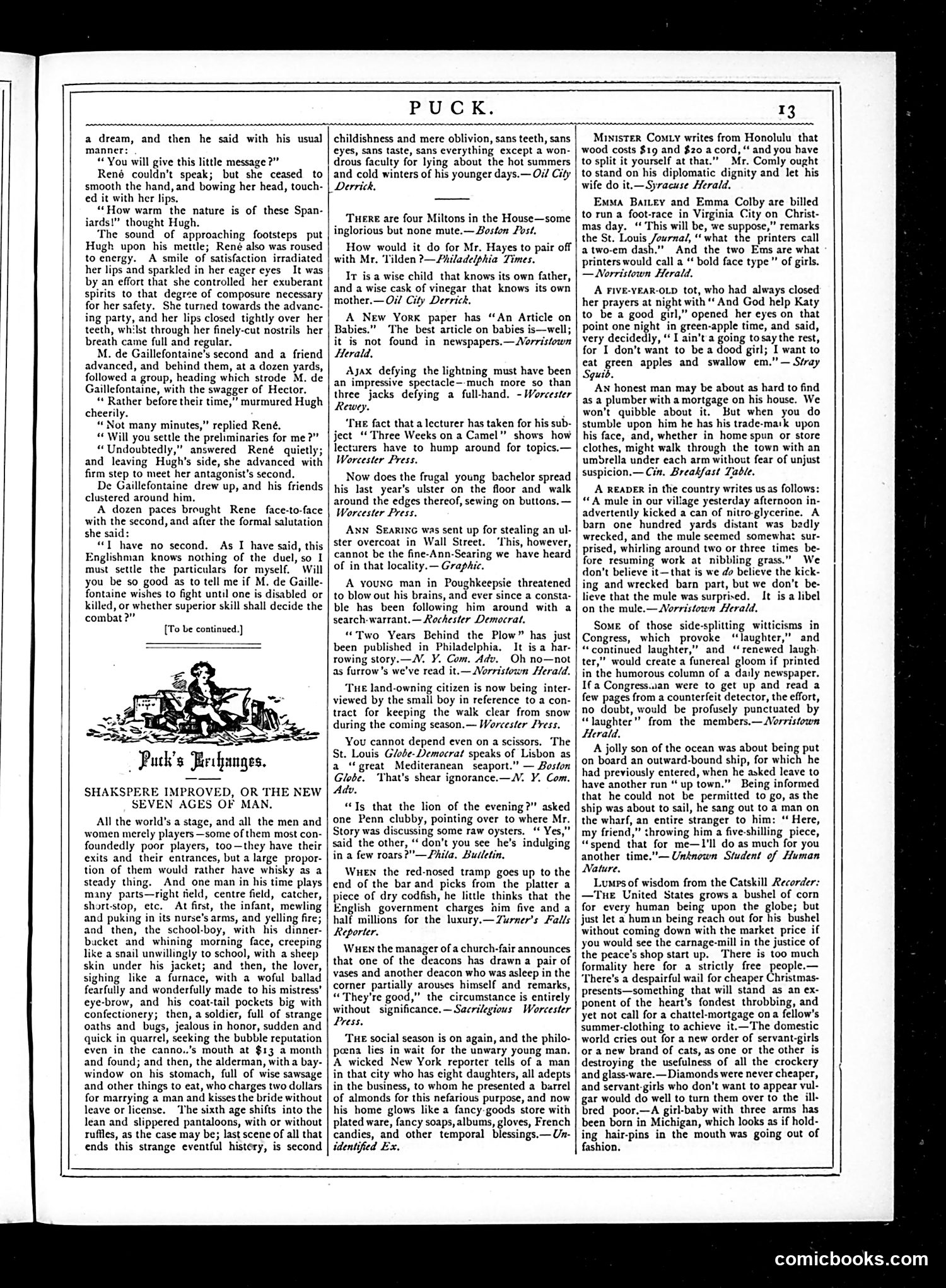
This page contains primarily **text-based satirical commentary** rather than a political cartoon. The content consists of short humor pieces and witty observations on contemporary social issues from the late 19th/early 20th century. Topics include: - **Marital dynamics** and gender relations (wives' behavior, bachelor life) - **Urban observations** (New York City details, street scenes) - **Social commentary** on class and employment (servants, deacons, domestic servants) - **Fashion and consumer culture** (fancy goods, French articles) The small illustration labeled "Puck's Exchanges" at bottom left appears to show a chaotic domestic or commercial scene, typical of Puck's visual humor style. The page functions as a **humor column** rather than political satire, focusing on everyday social absurdities rather than specific political figures or events.
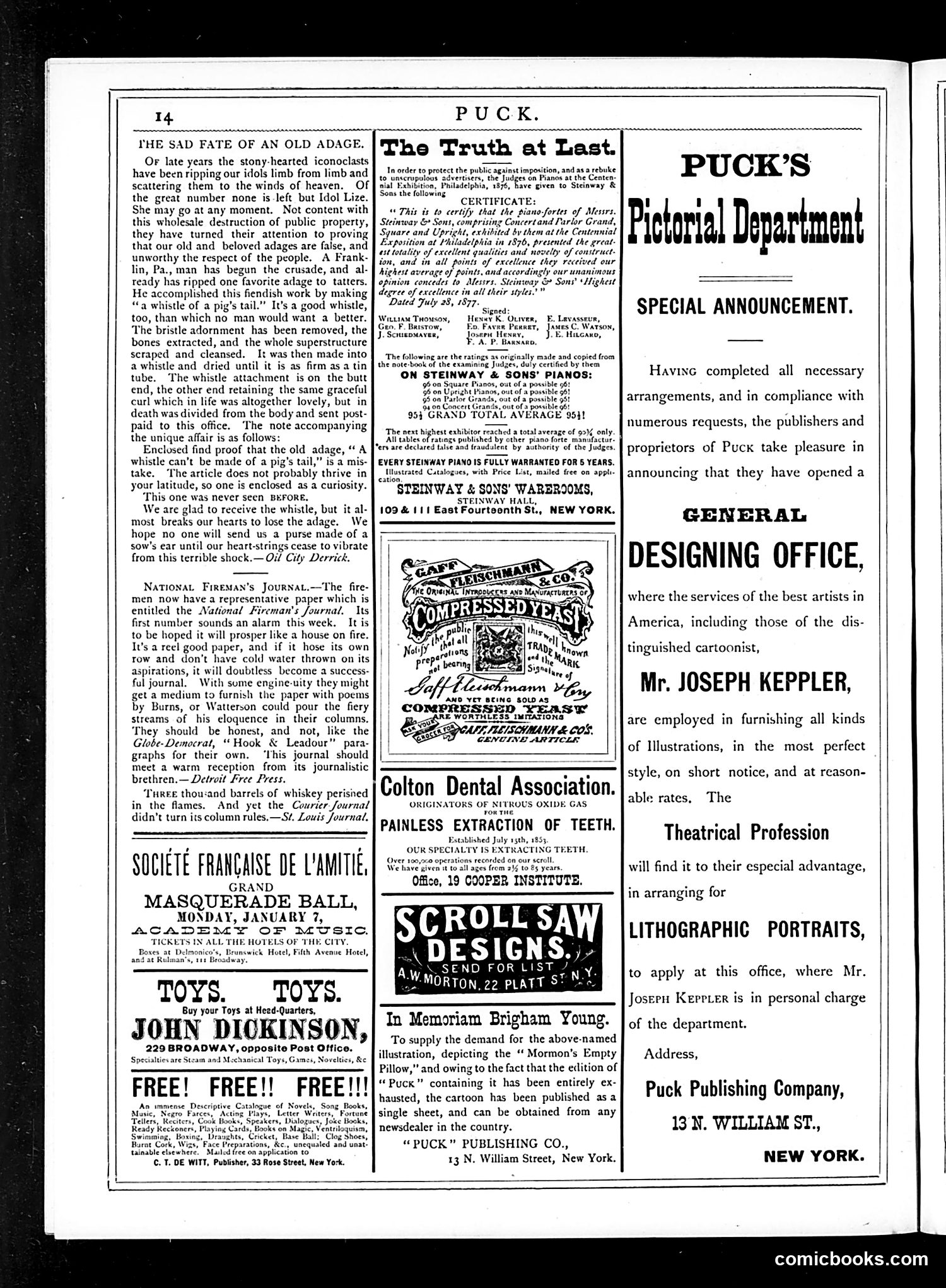
This page is primarily **advertisements and announcements**, not political satire. The main content includes: 1. **Puck's Pictorial Department announcement**: Details about opening a "General Designing Office" employing cartoonist Joseph Keppler to provide illustrations and "lithographic portraits" for theatrical productions and other clients. 2. **Multiple advertisements**: Including pianos, dental services, toys, a masquerade ball, and compressed yeast products. 3. **In Memoriam notice**: References a Brigham Young cartoon depicting "Mormon's Empty Pillow," now available as a single sheet. The page functions as a business/service announcement rather than satirical commentary. The only potentially satirical reference is the Brigham Young memorial, likely commenting on Mormon polygamy practices—a common 19th-century satire target—but specific details aren't visible here.
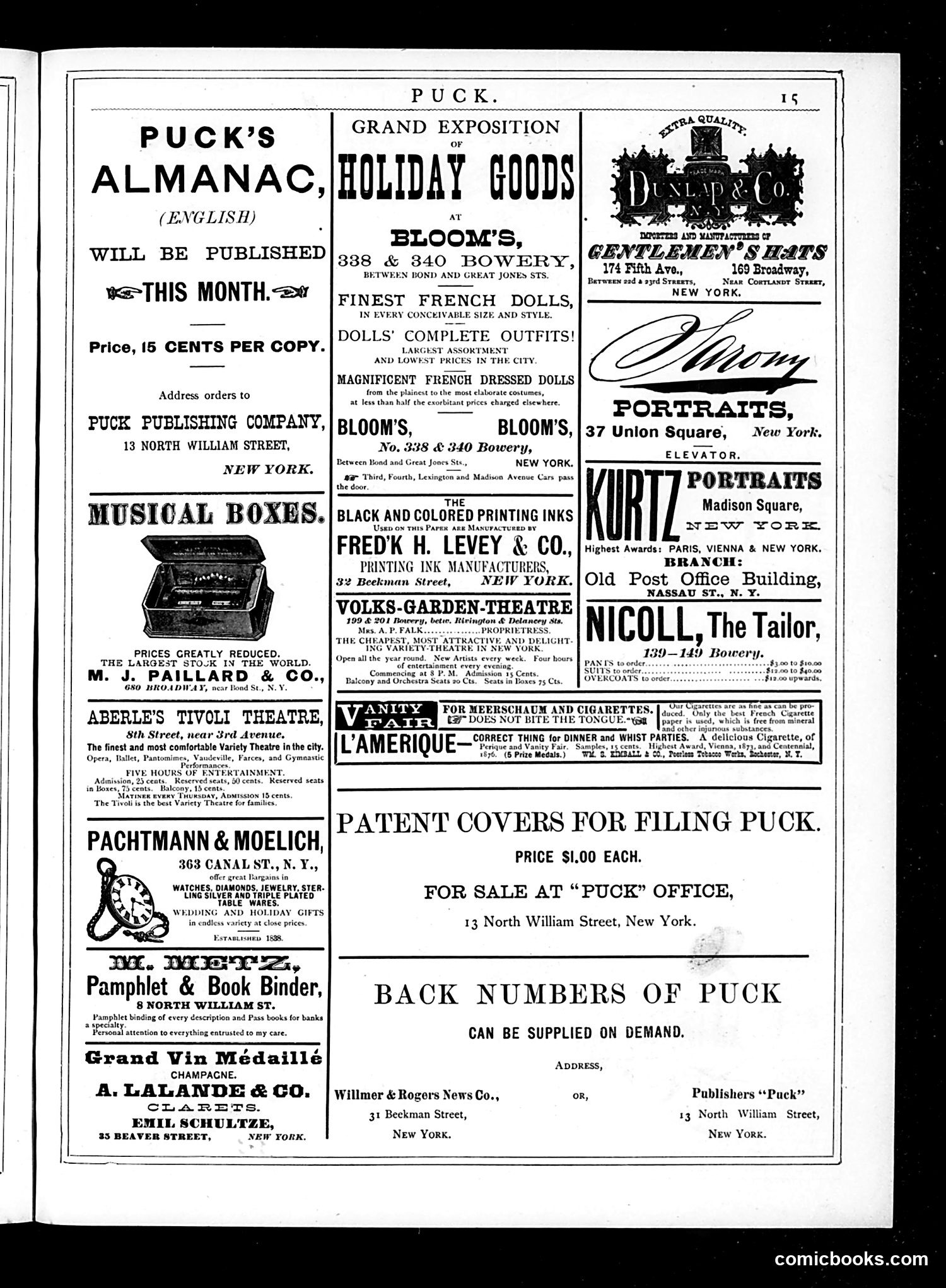
This page is primarily **advertising and announcements** for Puck magazine and related businesses, rather than political cartoons or satirical content. The visible advertisements promote: - Puck's English Almanac (15 cents) - Musical boxes and theatrical venues - Dolls and portrait studios - Clothing and tailoring services - Various New York businesses The only graphic element is a clock illustration for Pachtmann & Moelich (watches and jewelry). At the bottom, there's a notice that **back numbers of Puck can be supplied on demand** through two addresses in New York. This appears to be a standard **back-page or inside-cover advertisement section** from a late 19th-century magazine, showing the commercial ecosystem surrounding Puck's publication rather than editorial content.
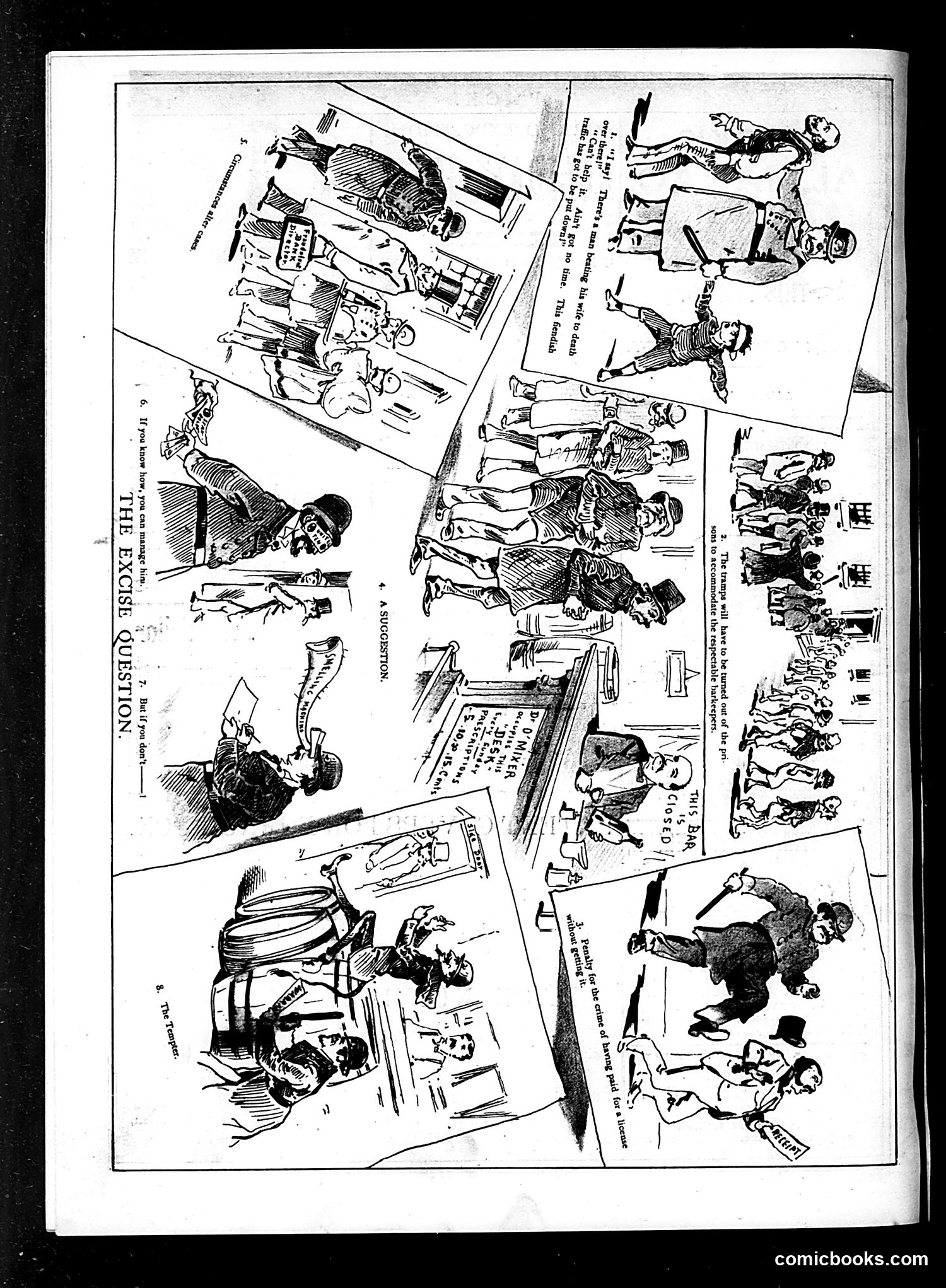
I can see this is a page from Puck magazine containing multiple satirical illustrations arranged at various angles, typical of the magazine's layout style. However, the OCR text provided is essentially blank—it contains no readable content that would help identify the specific figures, political references, or satirical points being made. While I can observe the page contains numerous character sketches and caricatures in what appears to be a narrative or thematic sequence, without legible text labels or captions identifying who these figures represent or what events they reference, I cannot reliably explain the cartoon's meaning to a modern reader. To properly analyze this, I would need either clearer OCR text or visible captions from the image itself.
I appreciate your detailed instructions, but I'm unable to provide the analysis you've requested. The image appears to be almost entirely black or blank, with only a white border visible on the left edge. No cartoon figures, text, or other content is discernible enough for me to identify specific caricatures, political references, or satirical points. To provide accurate historical context about this Puck magazine page, I would need a clearer image where the actual cartoon(s) and text are visible. If you could share a higher-contrast or better-quality version of this page, I'd be happy to analyze it according to your guidelines.
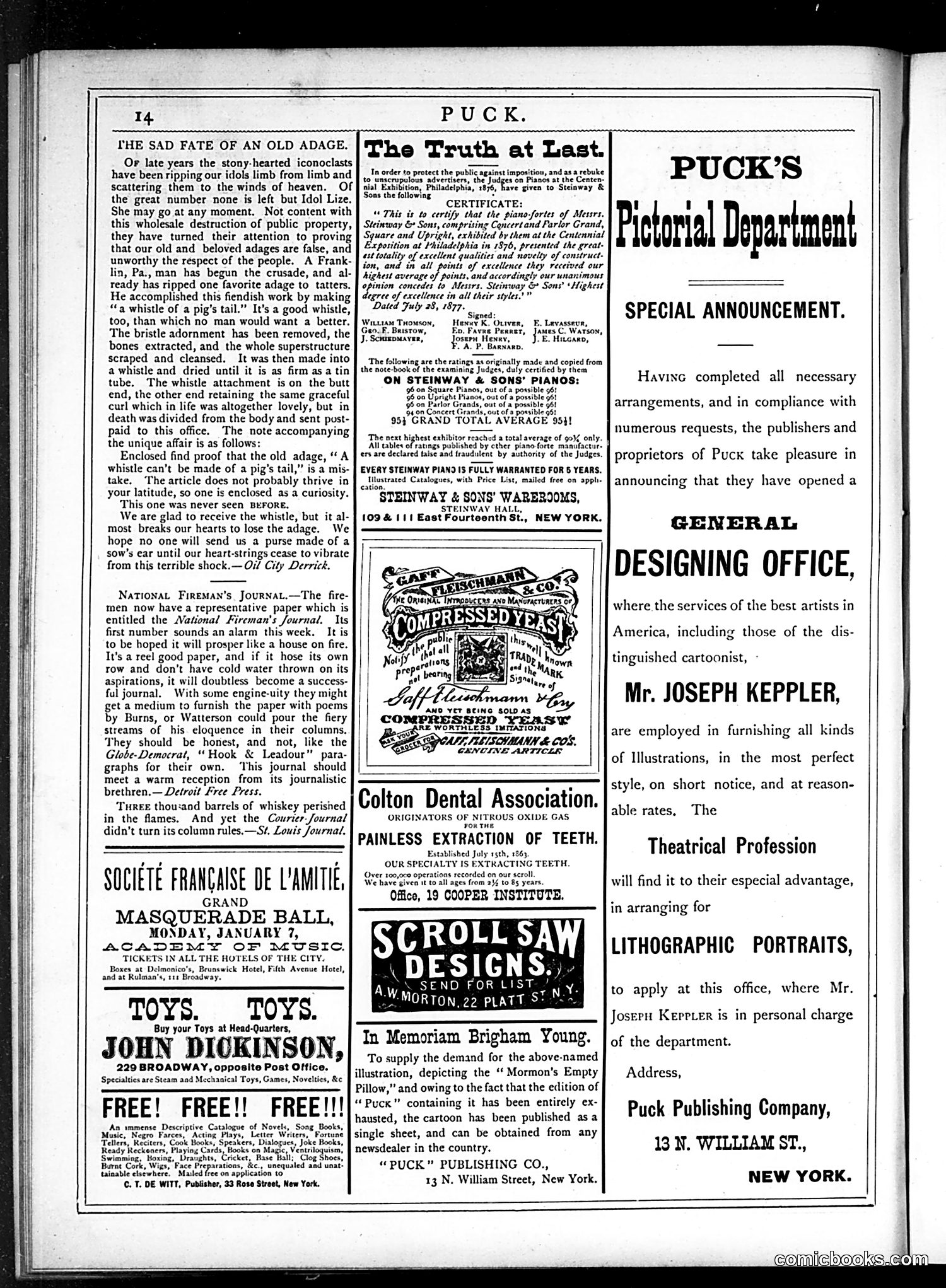
This page is primarily **advertising and announcements** rather than satirical cartoons. The main content includes: - A "Special Announcement" from Puck's publishers about opening a "General Designing Office" employing cartoonist **Joseph Keppler** (likely a prominent illustrator of the era) - Various period advertisements: Steinway pianos, Gaff, Fleischmann & Co. compressed yeast, Colton Dental Association, scroll saw designs, and toys - A small item about Brigham Young, noting a Puck cartoon depicting "Mormon's Empty Pillow" has been exhausted and republished as a single sheet The page lacks the satirical political cartoons typical of Puck's editorial content. Instead, it documents the magazine's business operations and commercial partnerships characteristic of 19th-century publication practices.
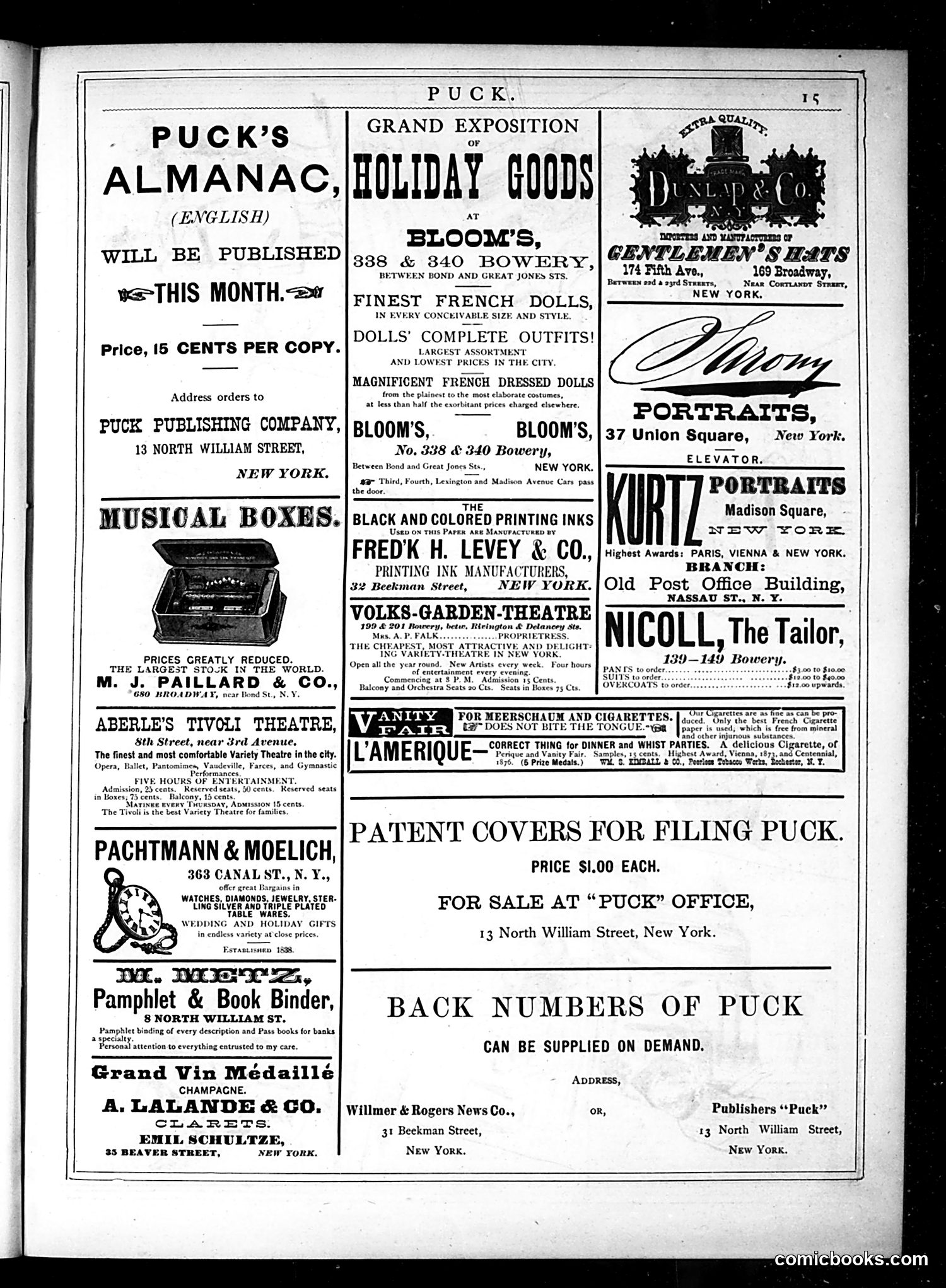
This page is primarily **advertising and announcements**, not a cartoon or satirical content page. The visible elements include: - Puck's English Almanac announcement (15 cents per copy) - Musical boxes advertisement - Theater listings (Aberle's Tivoli Theatre) - Various New York business ads (jewelry, printing inks, tailors, portrait studios) - Patent cover filing information for Puck magazine itself The only potentially humorous visual element is a small illustration of a pocket watch with Pachtmann & Moelich's jewelry advertisement, but this appears to be standard commercial imagery rather than political satire. **This is essentially a classified ads and business directory page** from Puck magazine, likely from the late 19th century, rather than a page featuring the publication's signature satirical cartoons.
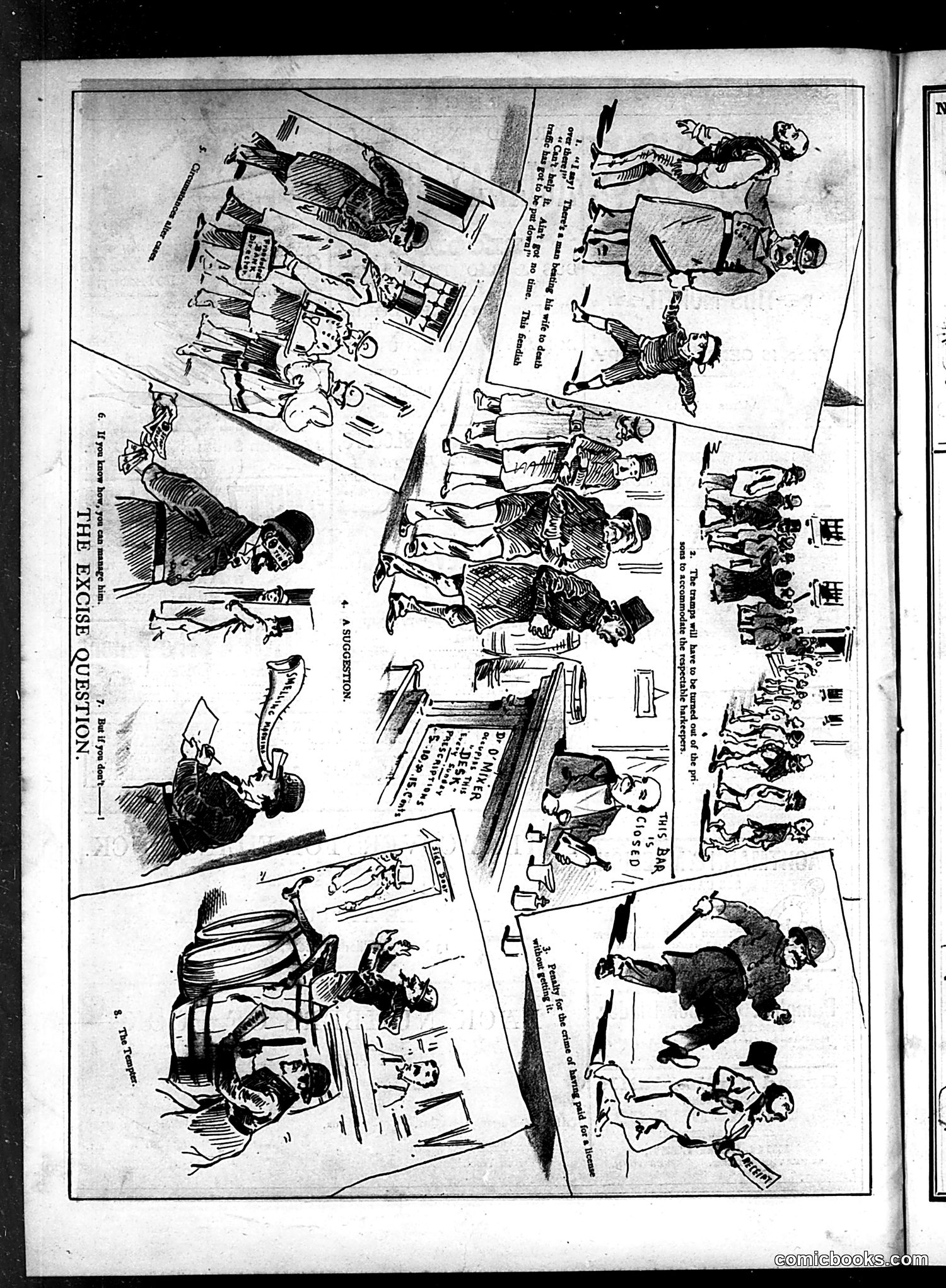
I can see this is a page from Puck magazine containing multiple satirical illustrations and comics arranged in a collage format, but the OCR text provided is blank, making it difficult to identify specific figures, dates, or political references with certainty. From the image alone, I can observe: various caricatured figures in late 19th or early 20th-century dress, multiple comic vignettes depicting social situations, and what appears to be political or social satire typical of Puck's style. However, without readable text labels or captions, I cannot reliably identify which specific politicians, events, or social issues are being satirized. To provide accurate historical context, I would need either clearer OCR text or legible captions from the original page.