
Puck, 1877-12-19 · page 4 of 20
Puck — December 19, 1877 — page 4: what you’re looking at
What you’re looking at
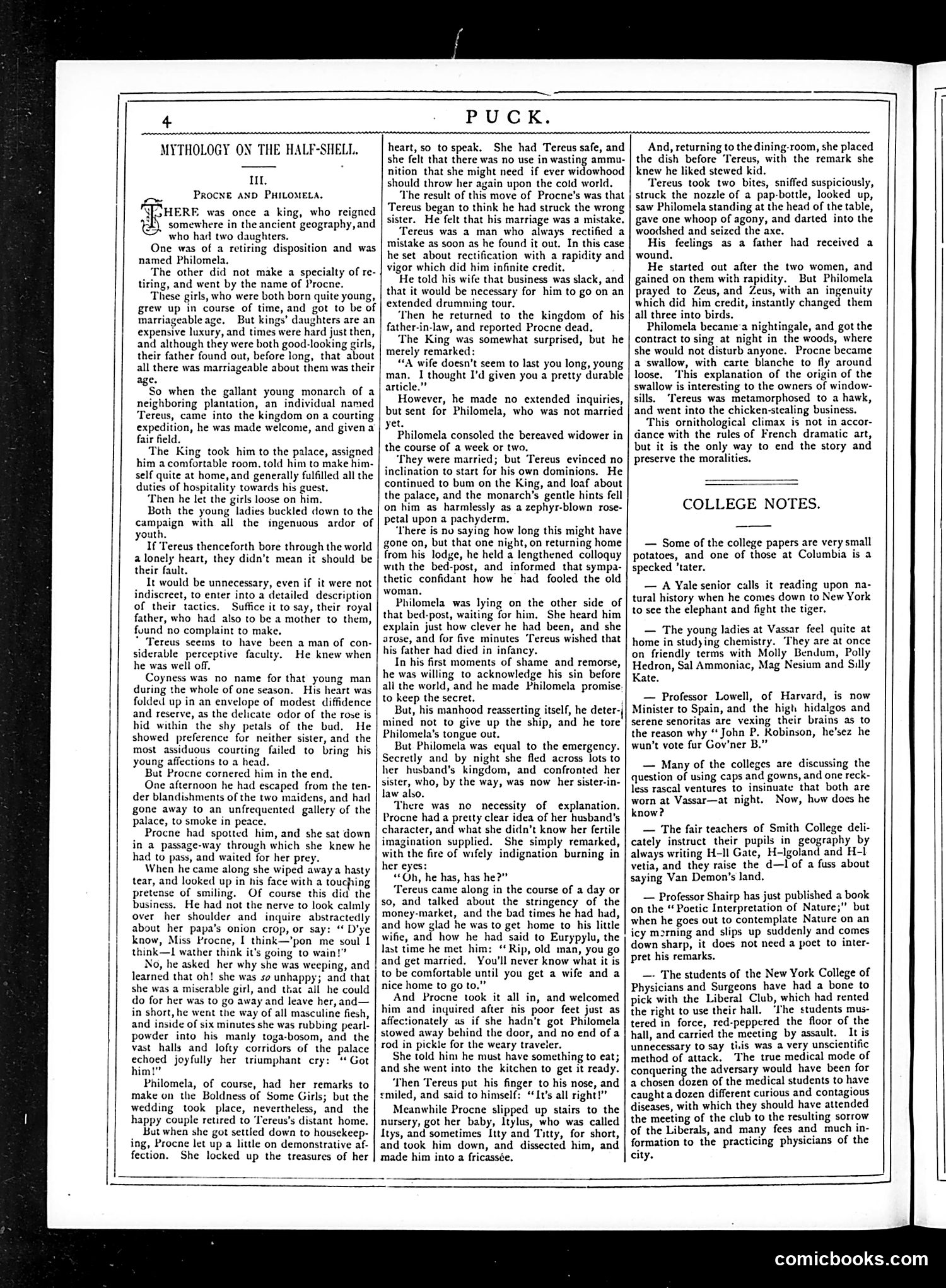
This page contains no political cartoon. Instead, it's a literary feature titled "Mythology on the Half-Shell" presenting a humorous mythological tale about Procne and Philomela (figures from classical Greek mythology). The narrative retells their story with satirical embellishments, focusing on domestic complications and marital discord. The right column contains "College Notes"—brief observations about contemporary college life, including commentary on small newspapers at Columbia, young ladies at Vassar, and various academic figures like Professor Lowell of Harvard. This represents Puck's typical mixed content: serialized humor writing alongside social commentary on American institutions. The page demonstrates the magazine's literary rather than purely visual satirical approach.
📄 Transcribed text from this page (OCR, searchable)
Machine-transcribed from the original scan — historical spelling and the odd misread are preserved.
4 PUCK. MYTHOLOGY ON THE HALF-SHELL. Mt. _— PROCNE AND PHILOMELA. NJGHERE was once a king, who reigned 4D) somewhere in the ancient geography, and who had two daught One was of a retiring named Philomela. The other did not make a specialty of re- tiring, and went by the name of Procne. These girls, who were both born quite young, grew up in course of time, and got to be of marriageable age. But kings’ daughters are an expensive luxury, and times were hard just then, and although they were both good-looking girls, their father found out, before long, that about all there was marriageable about them was their Ce ‘So when the gallant young monarch of a neighboring plantation, an individual named ‘Tereus, came into the kingdom on a courting expedition, he was made welcome, and given a fair field. The King took him to the palace, assigned him acomfortable room. told him to make him- self quite at home, and generally fulfilled all the duties of hospitality towards his guest. Then he let the girls loose on him. Both the young ladies buckled down to the campaign with ail the ingenuous ardor of youth, If Tereus thenceforth bore through the world a lonely heart, they didn’t mean it should be their fault. It would be unnecessary, even if it were not indiscreet, to enter into a detailed description of their tactics. Suffice it to say, their royal father, who had also to be a mother to them, found no complaint to make. Tereus seems to have been a man of con- siderable perceptive faculty. He knew when he was well off, Coyness was no name for that young man during the whole of one season. His heart was folded up in an envelope of modest diffidence and reserve, as the delicate odor of the rose is hid within the shy petals of the bud. He showed preference for neither sister, and the most assiduous courting failed to bring his young affections to a head. But Procne cornered him in the end. One afternoon he had escaped from the ten- der blandishments of the two maidens, and had gone away to an unfrequented gallery of the palace, to smoke in peace. Procne had spotted him, and she sat down in a passage-way through which she knew he had to pass, and waited for her prey. When he came along she wiped away a hasty tear, and looked up in his face with a touching pretense of smiling. Of course this did the business. He had not the nerve to look calmly over her shoulder and inquire abstractedly about her papa’s onion crop, or say: “ D'ye know, Miss Procne, I think—’pon me soul | think—I wather think it’s going to wain!” No, he asked her why she was weeping, and learned that oh! she was so unhappy; and that she was a miserable girl, and that all he could do for her was to go away and leave her, and— in short, he went the way of all masculine fiesh, and inside of six minutes she was rubbing pearl- powder into his manly toga-bosom, and the vast halls and lofty corridors of the palace echoed joyfully her triumphant cry: “Got jim!" Philomela, of course, had her remarks to make on the Boldness of Some Girls; but the wedding took place, nevertheless, and the happy couple retired to ‘Tereus’s distant home. But when she got settled down to housckeep- ing, Procne let up a little on demonstrative af- fection. She locked up the treasures of her isposition and was heart, so to speak. She had Tereus safe, and she felt that there was no use in wasting ammu- nition that she might need if ever widowhood should throw her again upon the cotd world. ‘The result of this move of Procne'’s was that Tereus began to think he had struck the wrong sister. He felt that his marriage was a mistake. ‘Tereus was a man who always rectified a mistake as soon as he found it out. In this case he set about rectification with a rapidity and vigor which did him infinite credit. He told his wife that business was slack, and that it would be necessary for him to go on an extended drumming tour. ‘Then he returned to the kingdom of his father-in-law, and reported Procne dead. ‘The King was somewhat surprised, but he merely remarke “A wife doesn’t seem to last you long, young man. I thought I'd given you a pretty durable article.” However, he made no extended inquiries, but sent for Philomela, who was not married yet. Philomela consoled the bereaved widower in the course of a week or two. ‘They were married; but Tereus evinced no inclination to start for his own dominions. He continued to bum on the King, and loaf about the palace, and the monarch’s gentle hints fell on him as harmlessly as a zephyr-blown rose- petal upon a pachyderm. ‘There is no saying how long this might have gone on, but that one night, on returning home from his lodge, he held a lengthened colloquy with the bed-post, and informed that sympa- thetic confidant how he had fooled the old woman. Philomela was lying on the other side of that bed-post, waiting for him, She heard him explain just how clever he had been, and she arose, and for five minutes ‘Tereus wished that his father had died in infancy. In his first moments of shame and remorse, he was willing to acknowledge his sin before all the world, and he made Philomela promise to keep the secret. But, his manhood reasserting itself, he deter- mined not to give up the ship, and he tore Philomela’s tongue out. But Philomela was equal to the emergency. Secretly and by night she fled across lots to her husband's kingdom, and confronted her sister, who, by the way, was now her sister-in- law also. There was no necessity of explanation. Procne had a pretty clear idea of her husband's character, and what she didn’t know her fertile imagination supplied. She simply remarked, with the fire of wifely indignation burning in her eyes: “Oh, he has, has he?” ‘Tereus came along in the course of a day or so, and talked about the stringency of the money-market, and the bad times he had had, and how glad he was to get home to his little wifie, and how he had said to Eurypylu, the last time he met him: ‘Rip, old man, you go and get married. You'll never know what it is to be comfortable until you get a wife and a nice home to go to.”” And Procne took it all in, and welcomed him and inquired after nis poor feet just as affectionately as if she hadn't got Philomela stowed away behind the door, and no end of a rod in pickle for the weary traveler. She told him he must have something to eat; and she went into the kitchen to get it ready. ‘Then Tereus put his finger to his nose, and smiled, and said to himself: ‘It’s all right!"" Mcanwhile Procne slipped up stairs to the nursery, got her baby, Itylus, who was called tys, and sometimes Itty and Titty, for short, and took him down, and dissected him, and made him into a fricassée. And, returning to the dining-room, she placed the dish before Tereus, with the remark she knew he liked stewed kid. Tereus took two bites, sniffed suspiciously, struck the nozzle of a pap-bottle, looked up, saw Philomela standing at the head of the table, gave one whoop of agony, and darted into the woodshed and seized the axe. His feelings as a father had received a wound, He started out after the two women, and gained on them with rapidity. But Philomela prayed to Zeus, and Zeus, with an ingenuity which did him credit, instantly changed them all three into birds. Philomela became‘a nightingale, and got the contract to sing at night in the woods, where she would not disturb anyone. Procne became a swallow, with carte blanche to fly around loose. ‘This explanation of the origin of the swallow is interesting to the owners of window- sills, ‘Tereus was metamorphosed to a hawk, and went into the chicken-stealing business. This ornithological climax is not in accor- dance with the rules of French dramatic art, but it is the only way to end the story and preserve the moralities. COLLEGE NOTES. — Some of the college papers are very small potatoes, and one of those at Columbia is a specked ‘tater. — A Yale senior calls it reading upon na- tural history when he comes down to New York to see the elephant and fight the tiger. — The young ladies at Vassar feel quite at home in studying chemistry. They are at once on friendly terms with Molly Bendum, Polly Hedron, Sal Ammoniac, Mag Nesium and Silly Kate. — Professor Lowell, of Harvard, is now Minister to Spain, and the high hidalgos and serene senoritas are vexing their brains as to the reason why ‘John P. Robinson, he'sez he wun’t vote fur Gov'ner B.” — Many of the colleges are discussing the question of using caps and gowns, and one reck- less rascal ventures to insinuate that both are worn at Vassar—at night. Now, how does he know? — The fair teachers of Smith College deli- cately instruct their pupils in geography by always writing H-Il Gate, H-lgoland and H-I vetia, and they raise the d—I of a fuss about saying Van Demon’s land. — Professor Shairp has just published a book on the “Poetic Interpretation of Nature;” but when he goes out to contemplate Nature on an icy morning and slips up suddenly and comes down sharp, it does not need a poet to inter- pret his remarks. ‘The students of the New York College of Physicians and Surgeons have had a bone to pick with the Liberal Club, which had rented the right to use their hall. ‘Ihe students mus- tered in force, red-peppered the floor of the hall, and carried the meeting by assault. It is unnecessary to say tiis was a very unscientific method of attack. The true medical mode of conquering the adversary would have been for a chosen dozen of the medical students to have caught a dozen different curious and contagious diseases, with which they should have attended the meeting of the club to the resulting sorrow of the Liberals, and many fees and much in- formation to the practicing physicians of the city. comicbooks.com