
Puck, 1877-12-19 · page 3 of 20
Puck — December 19, 1877 — page 3: what you’re looking at
What you’re looking at
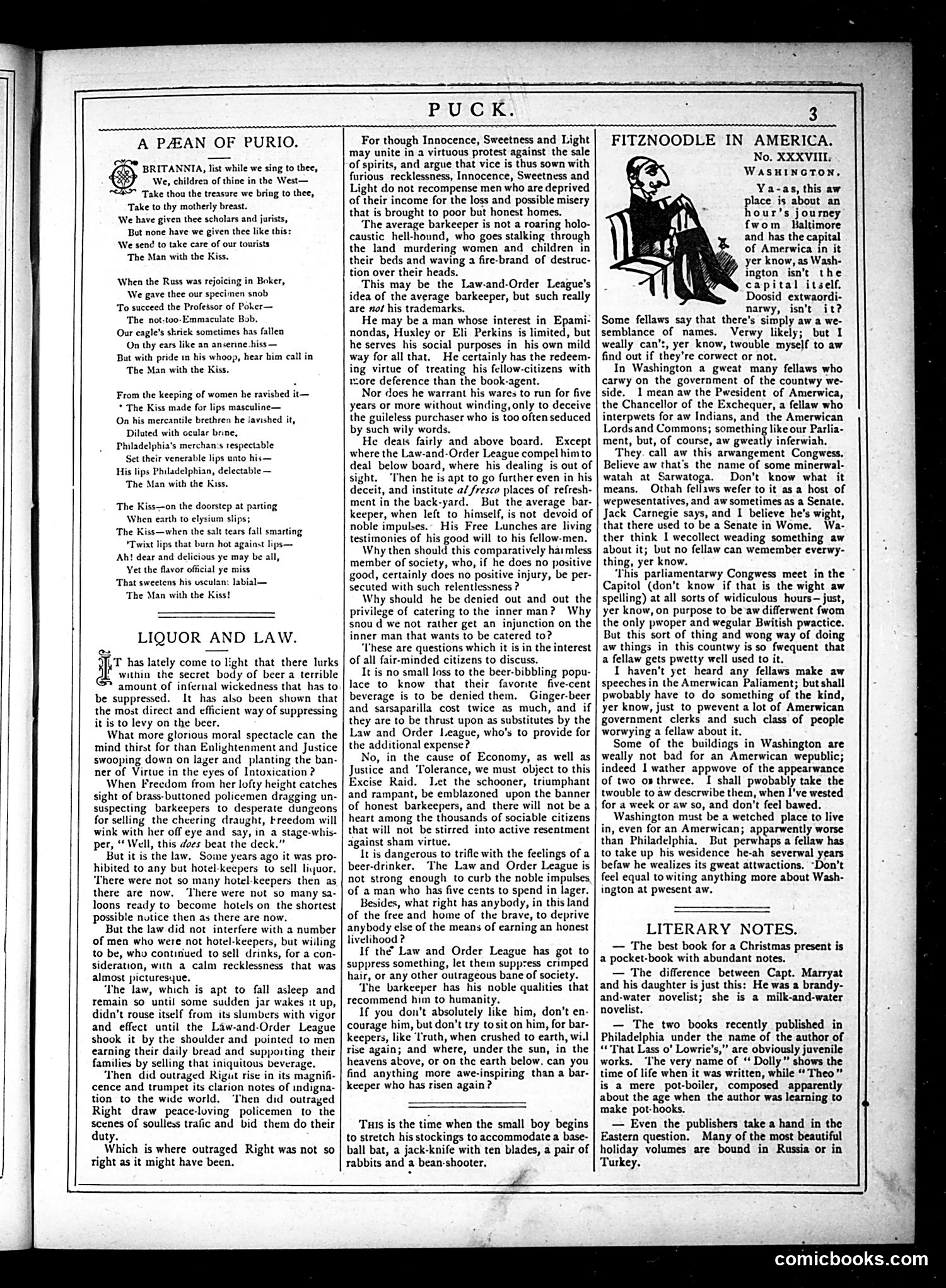
This page contains three distinct pieces: 1. **"A Plean of Purio"** (left column): A poem defending "Innocence, Sweetness and Light" against accusations of naiveté, with repeated refrain "The Man with the Kiss." The meaning and identity of this figure remain unclear from text alone. 2. **"Liquor and Law"** (left-center): Satirizes the "Law-and-Order League" for hypocrisy—they target working-class bar patrons while ignoring wealthy hotel keepers who sell liquor illegally. The piece condemns selective moral enforcement as inconsistent with true reform. 3. **"Fitznoodle in America"** (right): A humorous account of a visitor's observations on American government and customs, appearing to mock both foreign perspectives and American practices through comparative analysis. The page primarily contains political commentary rather than visual cartoons.
📄 Transcribed text from this page (OCR, searchable)
Machine-transcribed from the original scan — historical spelling and the odd misread are preserved.
PUCK. A PAEAN OF PURIO. FAX BRITANNTA, list while we sing to thee, We, childrea of thine in the West— Take thou the treasare we bring to thee, Take to thy motherly breast. We have given thee scholars and jurists, But none have we given thee like this: We send to take care of our tourists ‘The Man with the Kiss. When the Russ was rejoicing in Boker, We gave thee our specimen snob To succeed the Professor of Poker— ‘The not:too-Emmaculate Bob. Our eagle's shriek sometimes has fallen On thy ears like an anserine.hiss— But with pride in his whoop, hear him call in The Man with the Kiss. From the keeping of women he ravished it— * The Kiss made for lips masculine— On his mercantile brethren he lavished it, Diluted with ocular bune, Philadelphia’s merchan:s respectable Set their venerable lips unto his— His lips Philadelphian, delectable — The Man with the Kiss. The Kiss—on the doorstep at parting ‘When earth to elysium slips; The Kiss—when the salt tears fall smarting "Twiat lips that burn hot against lips— Ah! dear and delicious ye may be all, Yet the flavor official ye miss ‘That sweetens his usculan: labial— The Man with the Kiss! LIQUOR AND LAW. 6s ale sp, has lately come to light that there lurks within the secret body of beer a terrible amount of infernal wickedness that has to be suppressed. It has also been shown that the most direct and efficient way of suppressing it is to levy on the beer. What more glorious moral spectacle can the mind thirst for than Enlightenment and Justice swooping down on lager and planting the ban- ner of Virtue in the eyes of Intoxication ? When Freedom from her lofty height catches sight of brass-buttoned policemen dragging un- suspecting barkeepers to desperate dungeons for selling the cheering draught, Freedom will wink with her off eye and say, in a stage-whis- per, “Well, this does beat the deck.” But it is the law. Some years ago it was pro- hibited to any but hotel-keepers to sell liquor. ‘There were not so many hotel-keepers then as there are now. ‘Ihere were not so many sa- loons ready to become hotels on the shortest possible notice then as there are now. But the law did not interfere with a number of men who were not hotel-keepers, but wiiling to be, who continued to sell drinks, for a con- sideration, with a calm recklessness that was almost picturesque, ‘The law, which is apt to fall asleep and remain so until some sudden jar wakes 1t up, didn’t rouse itself from its slumbers with vigor and effect until the Law-and-Order League shook it by the shoulder and pointed to men earning their daily bread and suppoiting their families by selling that iniquitous beverage. ‘Then did outraged Rigut rise in its magnifi- cence and trumpet its clarion notes of indigna- tion to the wide world. ‘hen did outraged Right draw peace-loving policemen to the scenes of soulless trafic and bid them do their duty. Which is where outraged Right was not so right as it might have been. For though Innocence, Sweetness and Light may unite in a virtuous protest against the sale of spirits, and argue that vice is thus sown with furious recklessness, Innocence, Sweetness and Light do not recompense men who are deprived of their income for the loss and possible misery that is brought to poor but honest homes. ‘The average barkeeper is not a roaring holo- caustic hell-hound, who goes stalking through the land murdering women and children in their beds and waving a fire-brand of destruc- tion over their heads. This may be the Law-and-Order League's idea of the average barkeeper, but such really are not his trademarks. He may be a man whose interest in Epami- nondas, Huxley or Eli Perkins is limited, but he serves his social purposes in his own mild way for all that. He certainly has the redeem- ing virtue of treating his fellow-citizens with tore deference than the book-agent. Nor does he warrant his wares to run for five years or more without winding, only to deceive the guileless purchaser who is too often seduced by such wily words. He deats fairly and above board. Except where the Law-and-Order League compel himto deal below board, where his dealing is out of sight. ‘Then he is apt to go further even in his deceit, and institute a/ fresco places of refresh- ment in the back-yard. But the average bar- keeper, when left to himself, is not devoid of noble impulses. His Free Lunches are living testimonies of his good will to his fellow-men. Why then should this comparatively harmless member of society, who, if he does no positive good, certainly does no positive injury, be per- secuted with such relentlessness ? Why should he be denied out and out the privilege of catering to the inner man? Why snou d we not rather get an injunction on the inner man that wants to be catered to? ‘These are questions which it is in the interest of all fair-minded citizens to discuss. It is no small loss to the beer-bibbling popu- lace to know that their favorite five-cent beverage is to be denied them. Ginger-beer and sarsaparilla cost twice as much, and if they are to be thrust upon as substitutes by the Law and Order League, who’s to provide for the additional expense? No, in the cause of Economy, as well as Justice and ‘Tolerance, we must object to this Excise Raid. Let the schooner, triumphant and rampant, be emblazoned upon the banner of honest barkeepers, and there will not be a heart among the thousands of sociable citizens that will not be stirred into active resentment against sham virtue. It is dangerous to trifle with the feelings of a beer-drinker. The Law and Order League is not strong enough to curb the noble impulses, of a man who has five cents to spend in lager. Besides, what right has anybody, in this land of the free and home of the brave, to deprive anybody else of the means of earning an honest livelihood ? If the Law and Order League has got to suppress something, let them suppzess crimped hair, or any other outrageous bane of society. ‘The barkeeper has his noble qualities that recommend him to humanity. If you don't absolutely like him, don’t en- courage him, but don’t try tosit on him, for bar- keepers, like ‘'ruth, when crushed to earth, wi.l rise again; and where, under the sun, in the heavens above, or on the earth below. can you find anything more awe-inspiring than a bar- keeper who has risen again? Tuts is the time when the small boy begins to stretch his stockings to accommodate a base- ball bat, a jack-knife with ten blades, a pair of rabbits and a bean-shooter, x FITZNOODLE IN AMERICA. No. XXXVIII. WASHINGTON, Ya-as, this aw lace is about an our’s journey fwom Baltimore and has the capital of Amerwica in it yer know, as Wash- ington isn’t the capital itself. Doosid extwaordi- narwy, isn’t it? Some fellaws say that there’s simply aw a we- semblance of names. Verwy likely; but I weally can’t, yer know, twouble myself to aw find out if they're corwect or not. In Washington a gweat many fellaws who carwy on the government of the countwy we- side. 1 mean aw the Pwesident of Amerwica, the Chancellor of the Exchequer, a fellaw who interpwets for aw Indians, and the Amerwican. Lords and Commons; something like our Parlia- ment, but, of course, aw gweatly inferwiah, They. call aw this arwangement Congwess, Believe aw that’s the name of some minerwal- watah at Sarwatoga. Don’t know what it means. Othah fellaws wefer to it as a host of wepwesentatives, and aw sometimes as a Senate. Jack Carnegie says, and I believe he's wight, that there used to be a Senate in Wome. Wa- ther think 1 wecollect weading something aw about it; but no fellaw can wemember everwy- thing, yer know. ‘This parliamentarwy Congwess meet in the © Capitol (don't know if that is the wight aw spelling) at all sorts of widiculous hours— just, yer know, on purpose to be-aw differwent fwom the only pwoper and wegular Bwitish pwactice. But this sort of thing and wong way of doing aw things in this countwy is so fwequent that a fellaw gets pwetty well used to it. I haven't yet heard any fellaws make aw speeches in the Amerwican Paliament; but shall pwobably have to do something of the kind, yer know, just to pwevent a lot of Amerwican government clerks and such class of people worwying a fellaw about it. Some of the buildings in Washington are weally not bad for an Amerwican wepublic; indeed 1 wather appwove of the appearwance of two osthrwee. I shall pwobably take the twouble to aw descrwibe them, when I've wested for a week or aw so, and don't feel bawed. Washington must be a wetched place to live in, even for an Amerwican; apparwently worse than Philadelphia, But perwhaps a fellaw has to take up his wesidence he-ah severwal years befaw he wealizes its gweat attwactions. “Don’t feel equal to witing anything more about Wash- ington at pwesent aw. LITERARY NOTES. — The best book for a Christmas present is a pocket-book with abundant notes. — The difference between Capt. Marryat and his daughter is just this: He was a brandy- and-water novelist; she is a milk-and-water novelist. — The two books recently published in iladelphia under the name of the author of Phat Lass o’ Lowrie’s,”” are obviously juvenile works. ‘The very name of “ Dolly” shows the time of life when it was written, while “Theo” is a mere pot-boiler, composed apparently about the age when the author was learning to make pot-hooks. — Even the publishers take a hand in the Eastern question, Many of the most beautiful holiday volumes are bound in Russia or in Turkey. ae comicbooks.com