
Puck, 1877-12-19 · page 5 of 20
Puck — December 19, 1877 — page 5: what you’re looking at
What you’re looking at
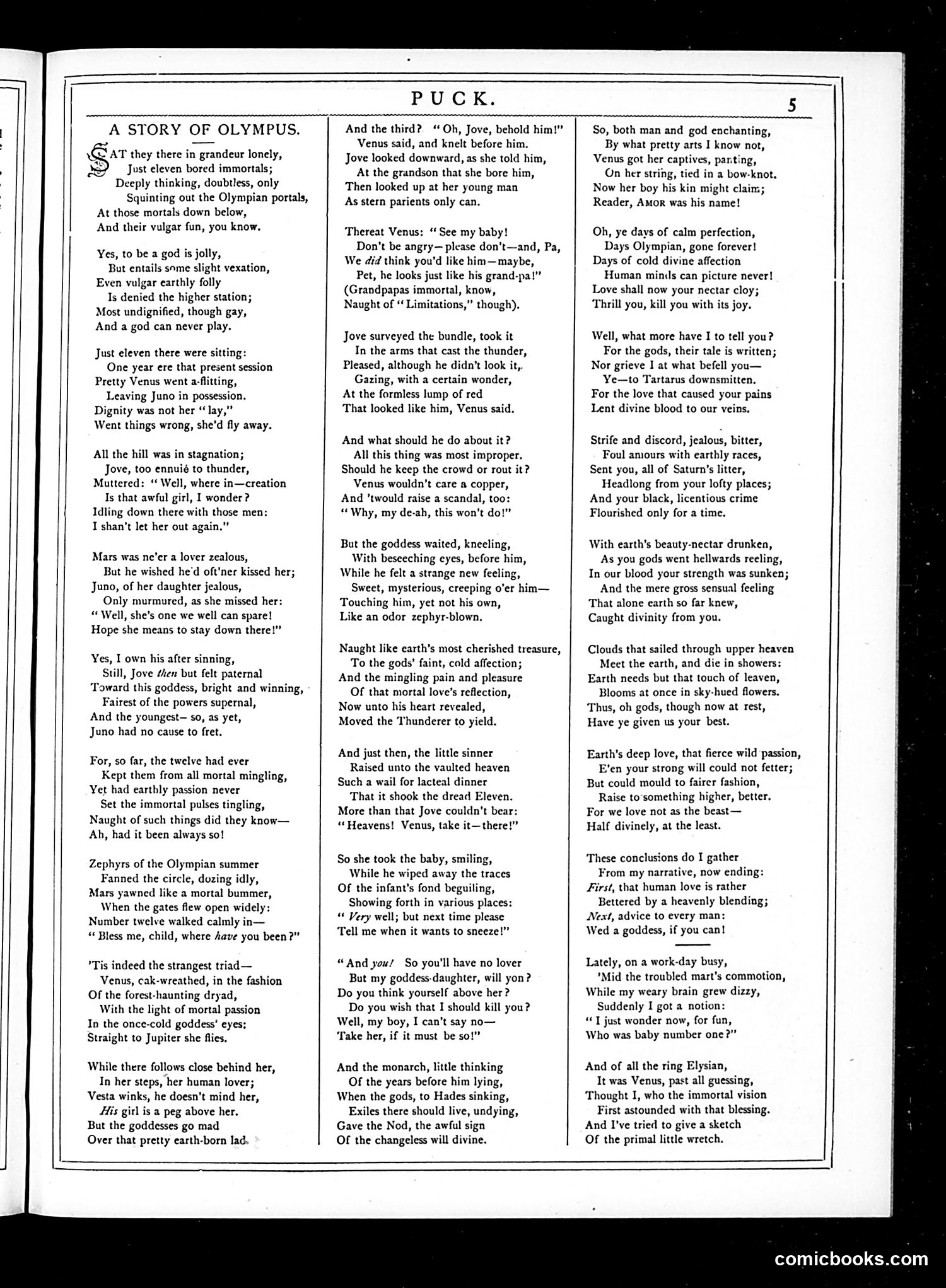
This page contains a poem titled "A Story of Olympus" — a satirical narrative in verse rather than a visual political cartoon. The poem retells the Greek mythological story of Jupiter (Jove) fathering a child with the mortal Juno, exploring themes of divine infidelity and its earthly consequences. The satire appears to use classical mythology as a framework to comment on **human passion, mortality, and the consequences of romantic entanglement across social hierarchies**. References to Juno's jealousy, Venus's intervention, and the "scandal" of a god-mortal union suggest social commentary about class differences and illegitimate relationships — issues relevant to Puck's audience. The poem's conclusion emphasizes the "fierce wild passion" of earthly love versus divine coldness, likely critiquing aristocratic detachment from human suffering.
📄 Transcribed text from this page (OCR, searchable)
Machine-transcribed from the original scan — historical spelling and the odd misread are preserved.
PUCK. A STORY OF OLYMPUS. Se they there in grandeur lonely, =) — Just eleven bored immortals; Deeply thinking, doubtless, only Squinting out the Olympian portals, At those mortals down below, And their vulgar fun, you know. Yes, to be a god is jolly, But entails some slight vexation, Even vulgar earthly folly Is denied the higher station; Most undignified, though gay, And a god can never play. Just eleven there were sitting: One year ere that present session Pretty Venus went a-flitting, Leaving Juno in possession. Dignity was not her “lay,” Went things wrong, she'd fly away. All the hill was in stagnation; Jove, too ennuié to thunder, Muttered: “ Well, where in—creation Is that awful girl, I wonder? Idling down there with those men: I shan’t let her out again.” Mars was ne'er a lover zealous, But he wished he'd oft'ner kissed her; Juno, of her daughter jealous, Only murmured, as she missed her: “Well, she’s one we well can spare! Hope she means to stay down there!” Yes, I own his after sinning, Still, Jove shen but felt paternal Toward this goddess, bright and winning, Fairest of the powers supernal, And the youngest— so, as yet, Juno had no cause to fret. For, so far, the twelve had ever Kept them from all mortal mingling, Yet had earthly passion never Set the immortal pulses tingling, Naught of such things did they know— Ah, had it been always so! Zephyrs of the Olympian summer Fanned the circle, dozing idly, Mars yawned like a mortal bummer, When the gates flew open widely: Number twelve walked calmly in— « Bless me, child, where have you been?” ’Tis indeed the strangest triad— Venus, cak-wreathed, in the fashion Of the forest-haunting dryad, With the light of mortal passion In the once-cold goddess’ eyes; Straight to Jupiter she flies. While there follows close behind her, In her steps, her human lover; Vesta winks, he doesn’t mind her, His girl is a peg above her. But the goddesses go mad Over that pretty earth-born lad. And the monarch, little thinking And the third? Oh, Jove, behold him!” Venus said, and knelt before him. Jove looked downward, as she told him, At the grandson that she bore him, Then looked up at her young man As stern parients only can. Thereat Venus: “See my baby! Don't be angry— please don’t—and, Pa, We did think you'd like him—maybe, Pet, he looks just like his grand-pa!”” (Grandpapas immortal, know, Naught of “ Limitations,” though). Jove surveyed the bundle, took it In the arms that cast the thunder, Pleased, although he didn’t look it,. Gazing, with a certain wonder, At the formless lump of red That looked like him, Venus said. And what should he do about it? All this thing was most improper. Should he keep the crowd or rout it? Venus wouldn't care a copper, And ‘twould raise a scandal, too: “Why, my de-ah, this won't do!” But the goddess waited, kneeling, With beseeching eyes, before him, While he felt a strange new feeling, Sweet, mysterious, creeping o’er him— Touching him, yet not his own, Like an odor zephyr-blown. Naught like carth’s most cherished treasure, To the gods’ faint, cold affection; And the mingling pain and pleasure Of that mortal love's reflection, Now unto his heart revealed, Moved the Thunderer to yield. And just then, the little sinner Raised unto the vaulted heaven Such a wail for lacteal dinner That it shook the dread Eleven. More than that Jove couldn't bear: “Heavens! Venus, take it—there!” So she took the baby, smiling, While he wiped away the traces Of the infant's fond beguiling, Showing forth in various places: “ Very well; but next time please Tell me when it wants to sneeze!” “And you! So you'll have no lover But my goddess-daughter, will yon? Do you think yourself above her? Do you wish that I should kill you? Well, my boy, I can’t say no— ‘Take her, if it must be so!” Of the years before him lying, When the gods, to Hades sinking, Exiles there should live, undying, Gave the Nod, the awful sign Of the changeless will divine. So, both man and god enchanting, By what pretty arts I know not, Venus got her captives, panting, On her string, tied in a bow-knot. Now her boy his kin might claim; Reader, Amor was his name! Oh, ye days of calm perfection, Days Olympian, gone forever! Days of cold divine affection Human minils can picture never! Love shall now your nectar cloy; ‘Thrill you, kill you with its joy. Well, what more have I to tell you? For the gods, their tale is written; Nor grieve I at what befell you— Ye—to Tartarus downsmitten, For the love that caused your pains Lent divine blood to our veins. Strife and discord, jealous, bitter, Foul aniours with earthly races, Sent you, all of Saturn's litter, Headlong from your lofty places; And your black, licentious crime Flourished only for a time. With earth's beauty-nectar drunken, As you gods went hellwards reeling, In our blood your strength was sunken; And the mere gross sensual feeling ‘That alone earth so far knew, Caught divinity from you. Clouds that sailed through upper heaven Meet the earth, and die in showers: Earth needs but that touch of leaven, Blooms at once in sky-hued flowers. Thus, oh gods, though now at rest, Have ye given us your best. Earth's deep love, that fierce wild passion, E’en your strong will could not fetter; But could mould to fairer fashion, Raise to’something higher, better. For we love not as the beast— Half divinely, at the least. ‘These conclusions do I gather From my narrative, now ending: First, that human love is rather Bettered by a heavenly blending; Next, advice to every man: Wed a goddess, if you can! Lately, on a work-day busy, 'Mid the troubled mart’s commotion, While my weary brain grew dizzy, Suddenly I got a notion: “1 just wonder now, for fun, Who was baby number one?” And of all the ring Elysian, It was Venus, past all guessing, Thought I, who the immortal vision First astounded with that blessing. And I've tried to give a sketch Of the primal little wretch. comicbooks.com