
Puck, 1877-12-19 · page 10 of 20
Puck — December 19, 1877 — page 10: what you’re looking at
What you’re looking at
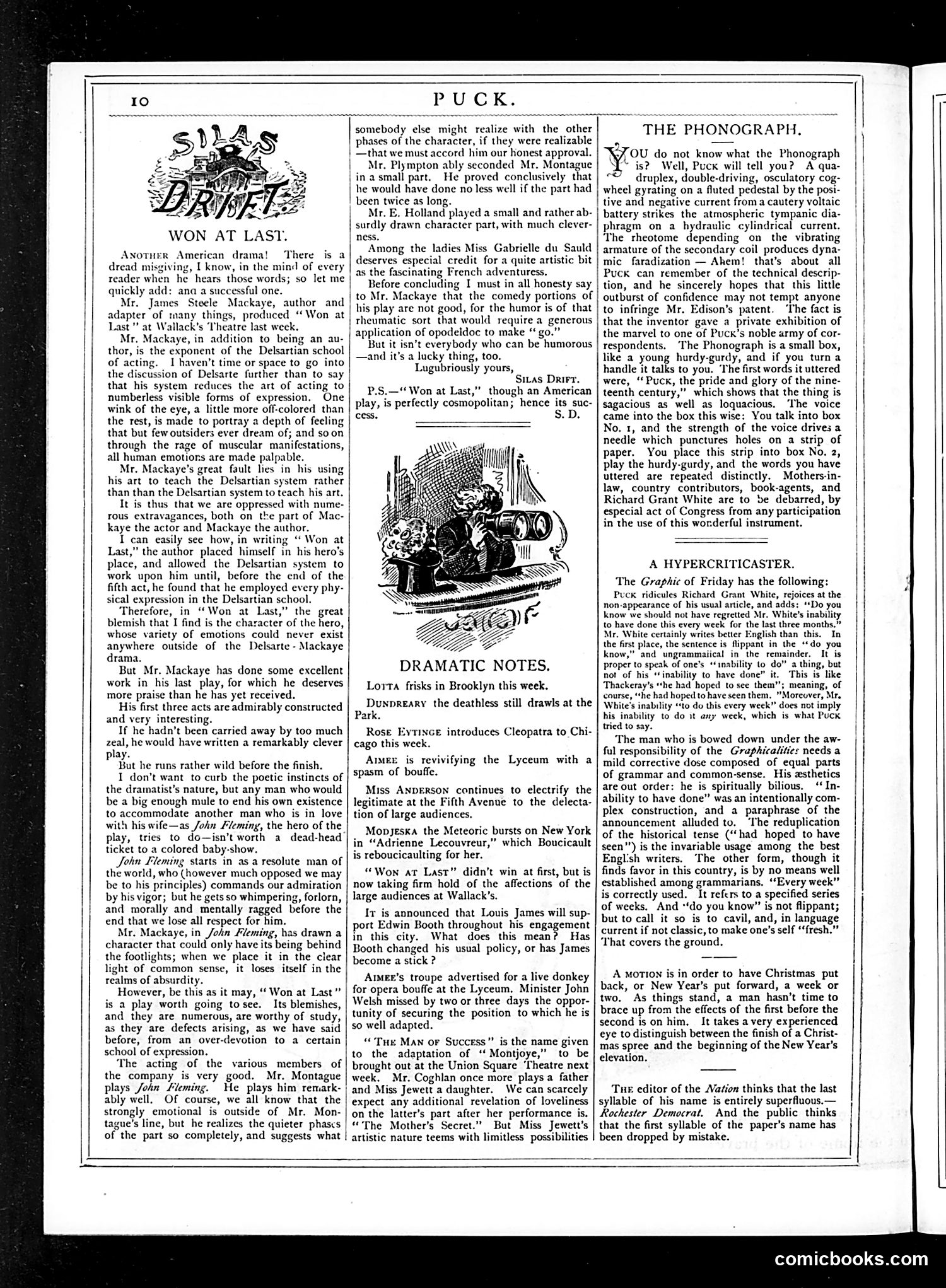
This page contains theatrical reviews and commentary rather than political cartoons. The main illustration shows a phonograph, accompanying an article titled "THE PHONOGRAPH" that discusses Edison's recording device as a novelty—describing how it captures and reproduces sound. The page also includes "DRAMATIC NOTES" reviewing current Broadway productions, including mentions of plays like "Won at Last," "John Fleming," and "The Man of Success." There's satire of theatrical pretension and criticism of actors' performances. A section titled "A HYPERCRITICASTER" mocks a theater critic (Richard Grant White) for harsh reviews. The content reflects Puck's typical mix: technological novelties presented as curiosities, theater criticism with comedic jabs at actors and playwrights, and satirical commentary on cultural figures and practices of the era.
📄 Transcribed text from this page (OCR, searchable)
Machine-transcribed from the original scan — historical spelling and the odd misread are preserved.
WON AT LAST. Avotuer American drama! There is a dread misgiving, I know, in the mind of every reader when he hears those words; so let me quickly add: ana a successful one. Mr. James Steele Mackaye, author and adapter of many things, produced “Won a Last" at Wallac! heatre last week. Mr. Mackaye, in addition to being an au- thor, is the exponent of the Delsartian school of acting. I haven’t time or space to go into the discussion of Delsarte further than to say that his system reduces the art of acting to numberless visible forms of expression. One wink of the eye, a little more off-colored than the rest, is made to portray a depth of feeling that but few outsiders ever dream of; and soon through the rage of muscular manifestations, all human emotions are made palpable. Mr. Mackaye’s great fault lies in his using his art to teach the Delsartian system rather than than the Delsartian system to teach his art. It is thus that we are oppressed with nume- rous extravagances, both on the part of Mac- kaye the actor and Mackaye the author. I can easily see how, in writing “ Won at Last,” the author placed himself in his hero's place, and allowed the Delsartian system to work upon him until, before the end of the fifth act, he found that he employed every phy- sical expression in the Delsartian school. Therefore, in ‘Won at Last,” the great blemish that I find is the character of the hero, whose variety of emotions could never exist anywhere outside of the Delsarte - Mackaye drama. But Mr. Mackaye has done some excellent work in his last play, for which he deserves more praise than he has yet received. His first three acts are admirably constructed and very interesting. If he hadn’t been carried away by too much zeal, he would have written a remarkably clever lay. But he runs rather wild before the finish. I don’t want to curb the poetic instincts of the dramatist’s nature, but any man who would. be a big enough mule to end his own existence to accommodate another man who is in love with his wife—as John Fleming, the hero of the play, tries to do—isn’t worth a dead-head ticket to a colored baby-show. John Fleming starts in as a resolute man of the world, who (however much opposed we may be to his principles) commands our admiration by his vigor; but he gets so whimpering, forlorn, and morally and mentally ragged before the end that we lose all respect for him. Mr. Mackaye, in John Fleming, has drawn a character that could only have its being behind the footlights; when we place it in the clear light of common sense, it loses itself in the realms of absurdi However, be this as it may, “‘ Won at Last” is a play worth going tosee. Its blemishes, and they are numerous, are worthy of study, as they are defects arising, as we have said before, from an over-devotion to a certain school of expression. ‘The acting of the various members of the company is very good. Mr. Montague plays John Fleming. He plays him remark- ably well. Of course, we all know that the strongly emotional is outside of Mr. Mon- tague's line, but he realizes the quieter phascs of the part so completely, and suggests what | somebody else might realize with the other phases of the character, if they were realizable | —that we must accord him our honest approval. Mr. Plympton ably seconded Mr. Montague in a small part. He proved conclusively that | he would have done no less well if the part had been twice as long. Mr. E. Holland played a small and rather ab- | surdly drawn character part, with much clever- ness. Among the ladies Miss Gabrielle du Sauld deserves especial credit for a quite artistic bit as the fascinating French adventuress. Before concluding I must in all honesty say to Mr. Mackaye that the comedy portions of his play are not good, for the humor is of that heumatic sort that would require a generous application of opodeldoc to make “ go.” But it isn’t everybody who can be humorous —and it’s a lucky thing, too. Lugubriously yours, Sitas Drirr. 5.—‘ Won at Last,” though an American is perfectly cosmopolitan; hence its suc- S.D. > DRAMATIC NOTES. Lorta frisks in Brooklyn this week. Dunpreary the deathless still drawls at the Park. Rose Eyt cago this week Ainec. is revivifying the Lyceum with a spasm of bouffe. £ introduces Cleopatra to Chi- Miss ANDERSON continues to electrify the legitimate at the Fifth Avenue to the delecta- tion of large audiences. Mopjeska the Meteoric bursts on New York in “Adrienne Lecouvreur,” which Boucicault is reboucicaulting for her. “Won at Last” didn’t win at first, but is now taking firm hold of the affections of the large audiences at Wallack’s. Ir is announced that Louis James will sup- port Edwin Booth throughout his engagement in this city. What does this mean? Has Booth changed his usual policy, or has James become a stick ? Aimee’s troupe advertised for a live donkey for opera bouffe at the Lyceum, Minister John Welsh missed by two or three days the oppor- tunity of securing the position to which he is so well adapted. “Tue Man oF Success” is the name given to the adaptation of ‘ Montjoye,” to be brought out at the Union Square ‘Theatre next week. Mr. Coghlan once more plays a father and Miss Jewett a daughter. We can scarcely | expect any additional revelation of loveliness on the latter’s part after her performance is. “The Mother's Secret.” But Miss Jewett's artistic nature teems with limitless possibilities THE PHONOGRAPH, DU do not know what the Phonograph is? Well, Puck will tell you? A qua- druplex, double-driving, osculatory cog- wheel gyrating on a fluted pedestal by the posi- tive and negative current from a cautery voltaic battery strikes the atmospheric tympanic dia- phragm on a hydraulic cylindrical current. ‘The theotome depending on the vibrating armature of the secondary coil produces dyna- mic faradization — Ahem! that’s about all Puck can remember of the technical descrip- tion, and he sincerely hopes that this little outburst of confidence may not tempt anyone to infringe Mr. Edison's patent. ‘The fact is that the inventor gave a private exhibition of the marvel to one of Puck’s noble army of cor- respondents. ‘The Phonograph is a small box, like a young hurdy-gurdy, and if you turna handle it talks to you. ‘The first words it uttered were, “Puck, the pride and glory of the nine- teenth century,” which shows that the thing is sagacious as well as loquacious. ‘The voice came into the box this wise: You talk into box No. 1, and the strength of the voice drives a needle which punctures holes on a strip of paper. You place this strip into box No. 2, play the hurdy-gurdy, and the words you have uttered are repeated distinctly. Mothers-in- law, country contributors, book-agents, and Richard Grant White are to be debarred, by especial act of Congress from any participation in the use of this wonderful instrument. A HYPERCRITICASTER. ‘The Graphic of Friday has the following: Puck ridicules Richard Grant White, rejoices at the non-appearance of his usual article, and adds: “Do you know we should not have regretted Mr. White’s inability to have done this every week for the last three months.” Mr. White certainly writes better English than this. In the first place, the sentence is flippant in the “do you know,” and ungrammaiical in the remainder. It is proper to speak of one’s ‘inability to do” a thing, but inability to have done” it. This is like he had hoped to see them”; meaning, of course, ‘the had hoped to have seen them. "Moreover, Mr. White's inability “to do this every week” does not imply his inability to do it any week, which is what Puck tried to say. ‘The man who is bowed down under the aw- ful responsibility of the Graphicalities needs a mild corrective dose composed of equal parts of grammar and common-sense. His xsthetics are out order: he is spiritually bilious, “ In- ability to have done” was an intentionally com- plex construction, and a paraphrase of the announcement alluded to. ‘Ihe reduplication of the historical tense (“had hoped to have seen”) is the invariable usage among the best Engl'sh writers. The other form, though it finds favor in this country, is by no means well established among grammarians. ‘Every week” is correctly used. It refers to a specified series of weeks, And “do you know” is not flippant; but to call it so is to cavil, and, in language current if not classic, to make one’s self ‘‘fresh.”” ‘That covers the ground. A motion is in order to have Christmas put back, or New Year’s put forward, a week or two. As things stand, a man hasn’t time to brace up from the effects of the first before the second is on him. It takes a very experienced eye to distinguish between the finish of a Christ- mas spree and the beginning of the New Year's elevation. Tue editor of the ation thinks that the last syllable of his name is entirely superfluous.— Rochester Democrat. And the public thinks that the first syllable of the paper’s name has been dropped by mistake. comicbooks.com