
Puck, 1877-12-19 · page 7 of 20
Puck — December 19, 1877 — page 7: what you’re looking at
What you’re looking at
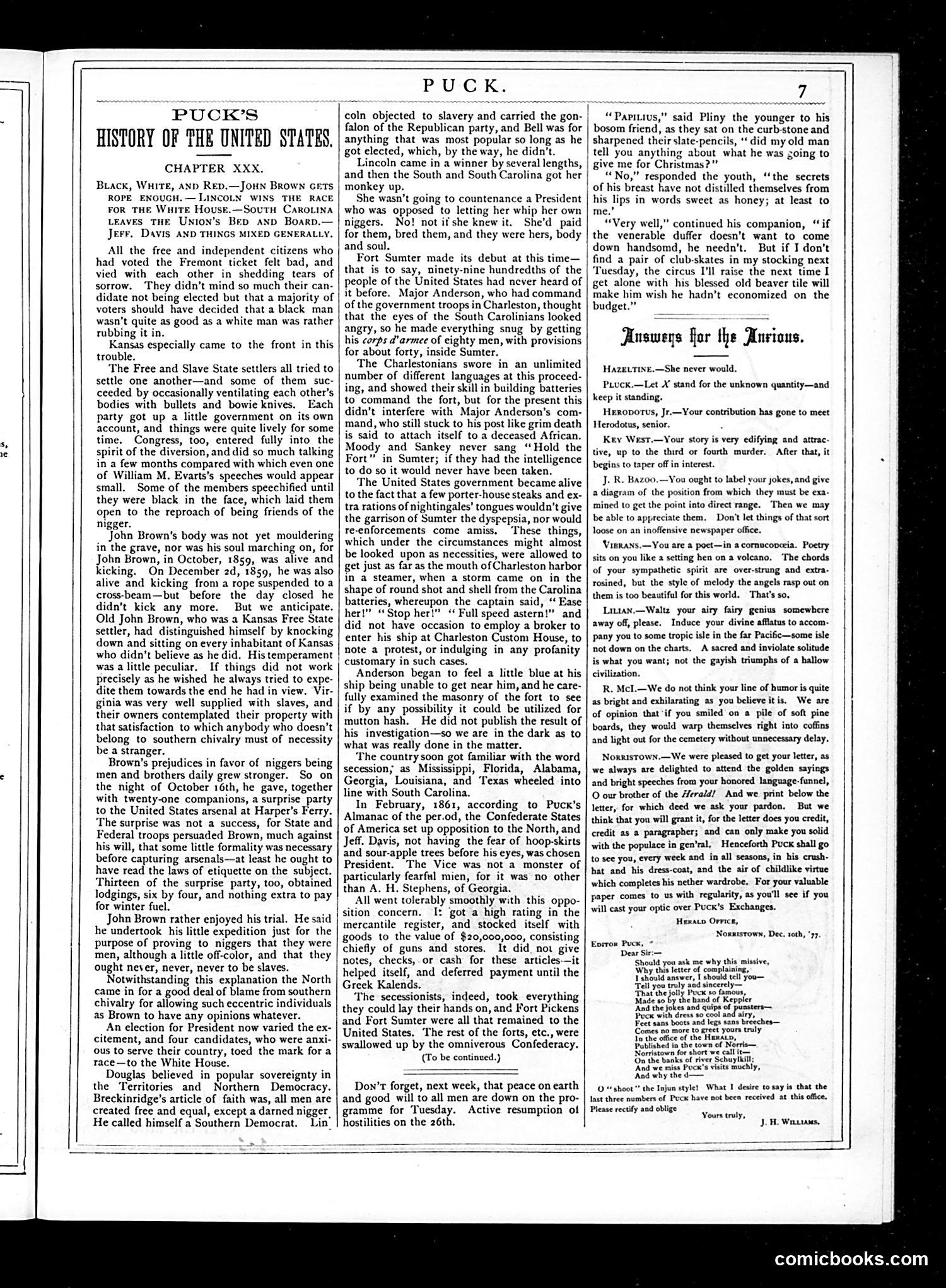
This page contains the continuation of "Puck's History of the United States," Chapter XXX, focusing on pre-Civil War tensions. The satirical text discusses the Free and Slave State settlers' conflicts, John Brown's raid on Harpers Ferry, and Jefferson Davis's military preparations at Fort Sumter. The humor derives from Puck's sardonic commentary on political hypocrisy and sectional conflict. References include Major Anderson (Fort Sumter commander), the Confederacy's military buildup, and disputes over slavery expansion. The "Answers for the Anxious" advice column section provides contemporary satirical commentary on unrelated topics. The page demonstrates Puck's characteristic approach: using historical narrative to critique contemporary political divisions while maintaining a wry, irreverent tone toward all parties involved in the slavery debate.
📄 Transcribed text from this page (OCR, searchable)
Machine-transcribed from the original scan — historical spelling and the odd misread are preserved.
PUCK’S HISTORY OF THE UNITED STATES. CHAPTER XXX. Brack, Wuite, anp Rep.—Joun Brown Gets ROPE ENOUGH. — Lin FoR THE WuiTe House. LEAvES THE Union’s Bep AND Boarp.— Jerr. Davis AND THINGS MIXED GENERALLY. All the free and independent citizens who had voted the Fremont ticket felt bad, and vied with each other in shedding tears of sorrow. They didn’t mind so much their can- didate not being elected but that a majority of voters should have decided that a black man wasn’t quite as good as a white man was rather rubbing it in. Kansas especially came to the front in this trouble. The Free and Slave State settlers all tried to settle one another—and some of them suc- ceeded by occasionally ventilating each other’s bodies with bullets and bowie knives. Each party got up a little government on its own account, and things were quite lively for some time. Congress, too, entered fully into the spirit of the diversion, and did so much talking in a few months compared with which even one of William M. Evarts’s speeches would appear small. Some of the members speechified until they were black in the face, which laid them open to the reproach of being friends of the nigger. John Brown's body was not yet mouldering in the grave, nor was his soul marching on, for John Brown, in October, 1859, was alive and kicking. On December 2d, 1859, he was also alive and kicking from a rope suspended toa cross-beam—but before the day closed he didn’t kick any more. But we anticipate. Old John Brown, who was a Kansas Free State settler, had distinguished himself by knocking down and sitting on every inhabitant of Kansas who didn’t believe as he did. His temperament was a little peculiar. If things did not work precisely as he wished he always tried to expe- dite them towards the end he had in view. Vir- ginia was very well supplied with slaves, and their owners contemplated their property with that satisfaction to which anybody who doesn’t belong to southern chivalry must of necessity be a stranger. Brown's prejudices in favor of niggers being men and brothers daily grew stronger. So on the night of October 16th, he gave, together with twenty-one companions, a surprise party to the United States arsenal at Harper’s Ferry. The surprise was not a success, for State and Federal troops persuaded Brown, much against his will, that some little formality was necessary before capturing arsenals—at least he ought to have read the laws of etiquette on the subject. Thirteen of the surprise party, too, obtained lodgings, six by four, and nothing extra to pay | for winter fuel. John Brown rather enjoyed his trial. He said he undertook his little expedition just for the purpose of proving to niggers that they were men, although a little off-color, and that they ought never, never, never to be slaves. Notwithstanding this explanation the North came in for a good deal of blame from southern chivalry for allowing such eccentric individuals as Brown to have any opinions whatever. An election for President now varied the ex- citement, and four candidates, who were anxi- ous to serve their country, toed the mark for a race—to the White House. Douglas believed in popular sovereignty in the Territories and Northern Democracy. Breckinridge’s article of faith was, all men are created free and equal, except a darned nigger, He called himself a Southern Democrat. Lin™ | sition concern. PUCK, coln objected to slavery and carried the gon- | falon of the Republican party, and Bell was for anything that was most popular so long as he got elected, which, by the way, he didn’t. Lincoln came in a winner by several lengths, and then the South and South Carolina got her monkey up. She wasn’t going to countenance a President who was opposed to letting her whip her own niggers. No! not if she knew it. She'd paid for them, bred them, and they were hers, body and soul. Fort Sumter made its debut at this time— that is to say, ninety-nine hundredths of the people of the United States had never heard of it before. Major Anderson, who had command of the government troops in Charleston, thought that the eyes of the South Carolinians looked angry, so he made everything snug by getting his corps d'armee of eighty men, with provisions for about forty, inside Sumter. The Charlestonians swore in an unlimited number of different languages at this proceed- ing, and showed their skill in building batteries to command the fort, but for the present this didn’t interfere with Major Anderson's com- mand, who still stuck to his post like grim death is said to attach itself to a deceased African. Moody and Sankey never sang “Hold the Fort” in Sumter; if they had the intelligence to do so it would never have been taken. The United States government became alive to the fact that a few porter-house steaks and ex- tra rations of nightingales’ tongues wouldn’t give the garrison of Sumter the dyspepsia, nor would re-enforcements come amiss. These things, which under the circumstances might almost be looked upon as necessities, were allowed to get just as far as the mouth of Charleston harbor in a steamer, when a storm came on in the shape of round shot and shell from the Carolina batteries, whereupon the captain said, “ Ease her!” “Stop her!” “Full speed astern!” and did not have occasion to employ a broker to enter his ship at Charleston Custom House, to note a protest, or indulging in any profanity customary in such cases. Anderson began to feel a little blue at his ship being unable to get near him, and he care- fully examined the masonry of the fort to see if by any possibility it could be utilized for mutton hash. He did not publish the result of his investigation—so we are in the dark as to what was really done in the matter. ‘The country soon got familiar with the word secession; as Mississippi, Florida, Alabama, Georgia, Louisiana, and Texas wheeled into line with South Carolina. In February, 1861, according to Puck's Almanac of the per.od, the Confederate States of America set up opposition to the North, and Jeff. Davis, not having the fear of hoop-skirts and sour-apple trees before his eyes, was chosen President. The Vice was not a monster of particularly fearful mien, for it was no other than A. H. Stephens, of Georgia. All went tolerably smoothly with this oppo- I: got a high rating in the mercantile register, and stocked itself with goods to the value of $20,000,000, consisting Chiefly of guns and stores. It did, now give notes, checks, or cash for these articles—it helped itself, and deferred payment until the Greek Kalends. The secessionists, indeed, took everything they could lay their hands on, and Fort Pickens and Fort Sumter were all that remained to the United States. The rest of the forts, etc., were swallowed up by the omniverous Confederacy. (To be continved.) Don’t forget, next week, that peace on earth and good will to all men are down on the pro- gramme for Tuesday. Active resumption of hostilities on the 26th. “Papitius,” said Pliny the younger to his bosom friend, as they sat on the curb-stone and sharpened their slate-pencils, “did my old man tell you anything about what he was going to give me for Christmas?” “No,” responded the youth, “the secrets of his breast have not distilled themselves from his lips in words sweet as honey; at least to me.’ “Very well,” continued his companion, “if the venerable duffer doesn’t want to come down handsomd, he needn’t. But if I don’t | find a pair of club-skates in my stocking next Tuesday, the circus I'll raise the next time I get alone with his blessed old beaver tile will make him wish he hadn't economized on the budget. Answers for the vious. Hazevtine.—She never would, Puvck.—Let X stand for the unknown quantity—and keep it standing. Heroporvs, Jr. Herodotus, senior. Your contribution has gone to meet Key West.—Your story is very edifying and attrac- tive, up to the third or fourth murder. After that, it begins to taper off in interest. J. R. Bazoo.—You ought to label your jokes, and give a diagram of the position from which they must be exa- mined to get the point into direct range, ‘Then we may be able to appreciate them. Don't let things of that sort loose on an inofiensive newspaper office. ‘Vinrans.—You are a poct—in a cornucopwia. Poetry sits on you like a setting hen on a volcano, The chords of your sympathetic spirit are over-strung and extra- rosined, but the style of melody the angels rasp out on them is too beautiful for this world. That's so, Lrian.—Waltz your airy fairy genius somewhere away off, please, Induce your divine afflatus to accom- pany you to some tropic isle in the far Pacific—some isle not down on the charts, A sacred and inviolate solitude is what you want; not the gayish triumphs of a hallow civilization. R. McI.—We do not think your line of humor is quite as bright and exhilarating as you believe it is. We are of opinion that if you smiled on a pile of soft pine boards, they would warp themselves right into coffins and light out for the cemetery without unnecessary delay, Noxnisrown.—We were pleased to get your letter, as we always are delighted to attend the golden sayings and bright speeches from your honored language-funnel, our brother of the Herald! And we print below the letter, for which deed we ask your pardon, But we think that you will grant it, for the letter does you credit, credit as a paragrapher; and can only make you solid with the populace in gen’ral, Henceforth Puck shall go to see you, every week and in all seasons, in his crush- hat and his dress-coat, and the air of childlike virtue which completes his nether wardrobe. For your valuable paper comes to us with regularity, as you'll see if you will cast your optic over Puck’s Exchanges. Hexatp Ornce, Nonarstown, Dec. roth, °77. Eorron Puc, * Dear Sie:— ‘Should you ask me why this missive, Why this letter of complai Tshould answer, 1 shoald ‘Tell you truly aed sincerely — ‘har Ge Joly Poe famous ade oo by the hand of Repo ‘And the jokes and quips Peck with dress s0 cool Feet sans boots and legs ‘Comes no more to greet yours truly. To the office of the HERALD, Published ia the town of Nerris— Norristown for short we call t= Savthe banks of river Schuylil: ‘Rod we mise Puck's visits muchly, ‘And why the d— ©“ shoot" the Injun style! What I desire to say is that the last three numbers of Puck have not been received at this office, Please rectify and oblige fer asters ‘Yours truly, YH, Wana, J comic! books.com