
A complete issue · 16 pages · 1877
Puck — October 31, 1877
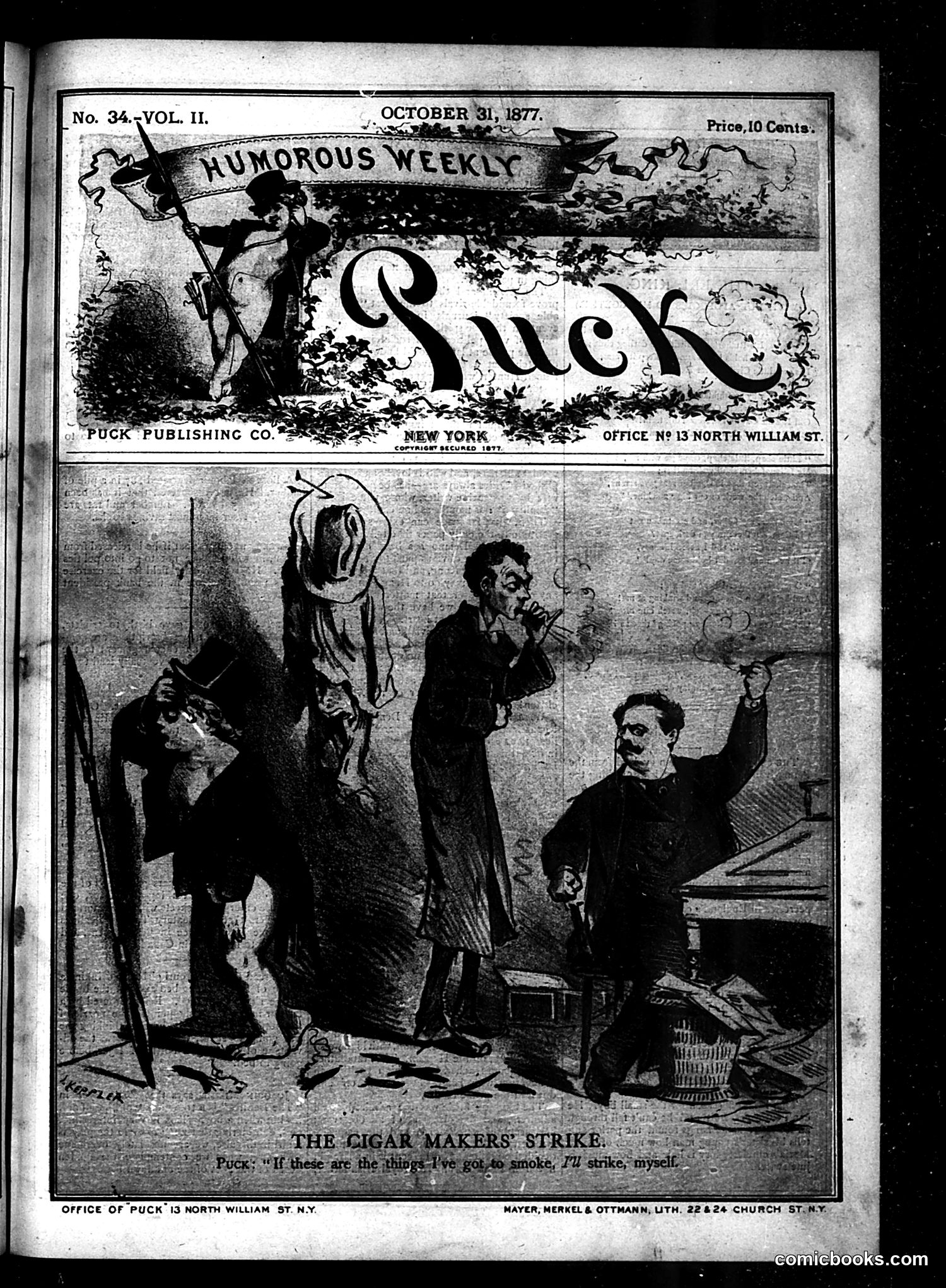
This 1877 cartoon satirizes a labor dispute involving cigar manufacturers. The caption quotes Puck (the magazine's mascot): "If these are the things I've got to smoke, I'll strike, myself." The cartoon depicts cigar makers in what appears to be a workshop, with one figure holding up a poorly made cigar as evidence of the strike's impact. The joke plays on dual meanings of "strike"—both the labor action and the act of striking/hitting. The satire criticizes either the quality of strike-replacement cigars or suggests that even the magazine's mascot would protest working conditions by refusing inferior products. This reflects late-19th-century labor tensions and consumer concerns about product quality during labor disputes.
This page consists primarily of **text articles and commentary** rather than political cartoons. The main content includes: 1. **"Jenkins Again"** — satire mocking sensational newspaper coverage of a young woman (apparently named Jenkins or Delaware) and her romantic entanglements, critiquing how society papers obsess over trivial society gossip. 2. **"The Earl King"** — a humorous poem parodying Goethe, likely satirizing romantic or melodramatic literary conventions. 3. **"Simon Cameron"** — commentary on a Pennsylvania politician, calling him a "chicken" and referencing his unpopularity, with criticism of his Civil Service record. 4. **"Ash-Cart Bells in Baxter Street"** — an anecdote about street sweeper Bill Buggins. The page emphasizes **satirical social commentary** over visual cartoons, typical of Puck's editorial approach to American politics and society.
This page from Puck magazine contains two distinct sections: the left column features "Memoirs of a Suicide," a dark satirical narrative about a man's repeated failed suicide attempts using increasingly absurd methods (hot frog soup, indigestion, hanging, immersion). The piece satirizes both the desperation of poverty and the incompetence of the suicidal protagonist. The right column, "Answers for the Curious," presents reader responses to various submitted queries about social etiquette and personal matters. These brief advice-style responses offer humorous commentary on contemporary social conventions and personal problems. Without visible illustrations on this page, the satire relies entirely on written content—typical of Puck's mix of humor targeting 19th-century American social conditions and personal foibles. The suicide narrative particularly satirizes economic hardship and despair.
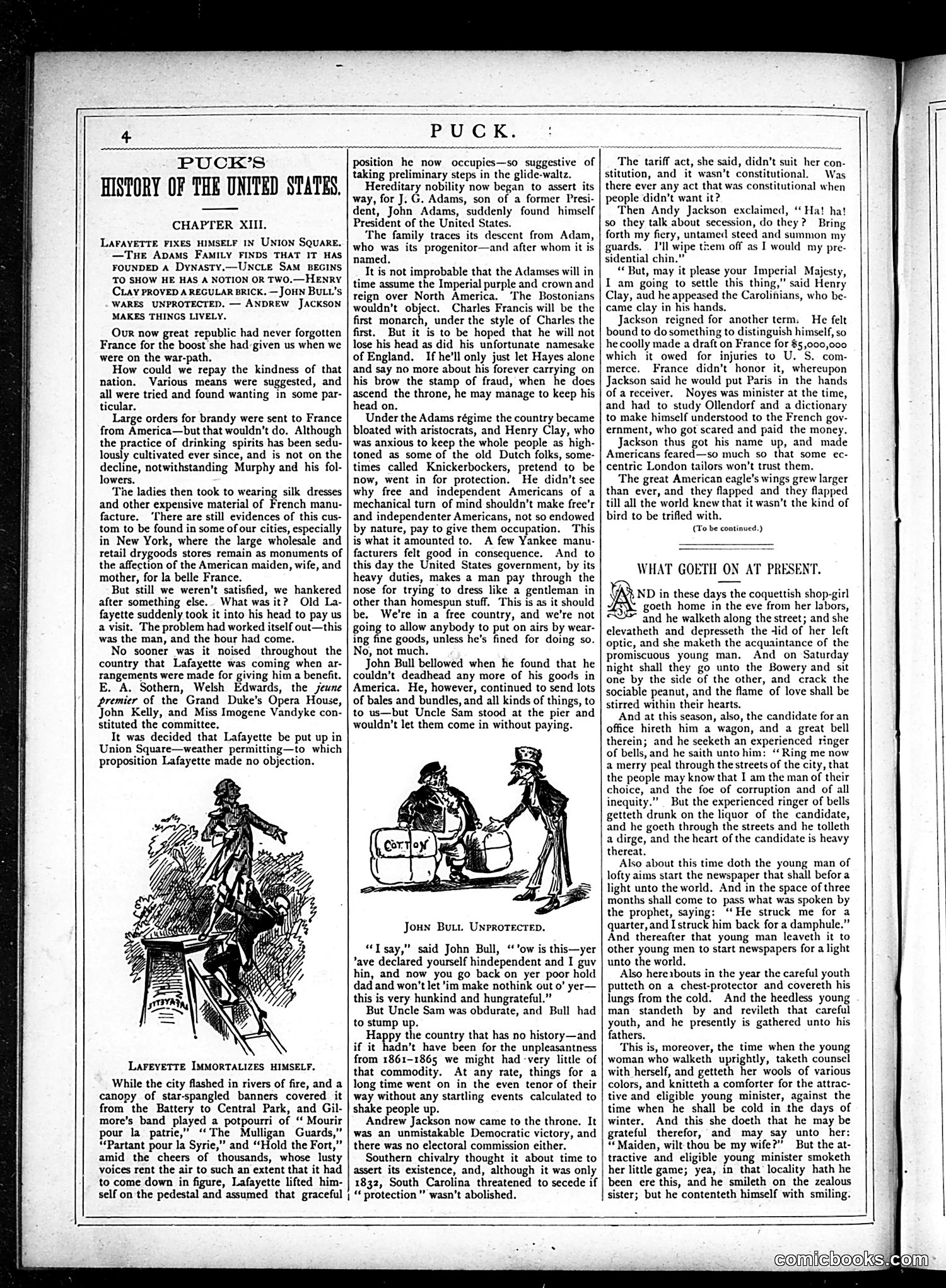
This page contains a serialized history of the United States focusing on Lafayette and the Adams family. The two political cartoons illustrate historical anecdotes: **"John Bull Unprotected"** (left) depicts Britain's vulnerability, with the figure of John Bull (personification of Britain) exposed and defenseless—likely commenting on American independence and Britain's loss of colonial protection. **"Lafayette Immortalizes Himself"** (right) shows Lafayette on a pedestal amid cheering crowds, celebrating his heroic status in American Revolutionary history. The text discusses Lafayette's fame, American tariffs, and Andrew Jackson's political rise. The "What Goeth On at Present" section satirizes contemporary (1830s-era) social conditions: corrupt politicians, drunken campaigning, and the selling of public offices—criticizing democratic politics as degraded and transactional.
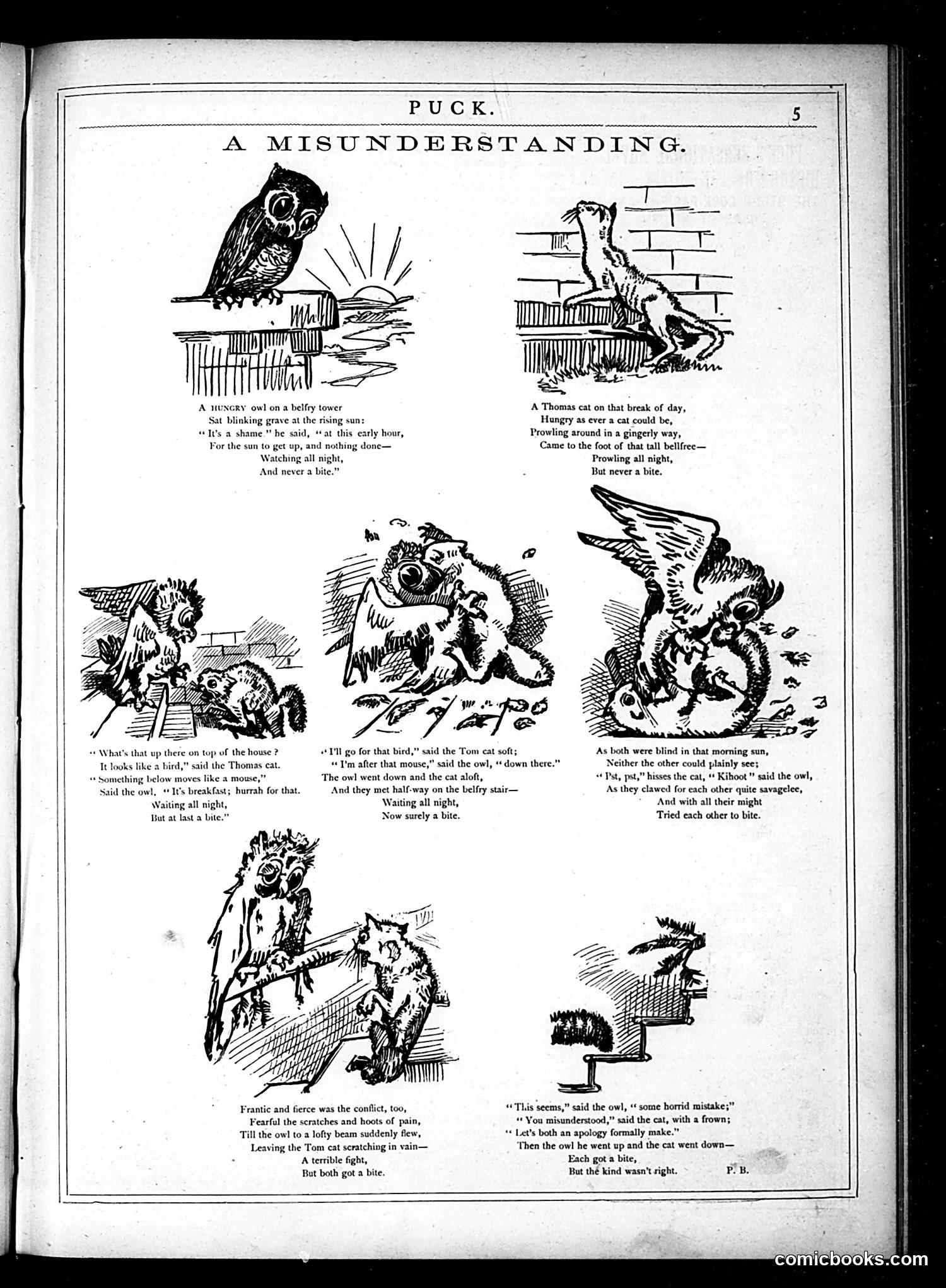
This page presents a humorous narrative about miscommunication between an owl, a cat, and a mouse. The owl mistakes a cat for a mouse, the cat mistakes a bird for a mouse, and both predators end up fighting each other instead of catching their intended prey. The satire appears to be social commentary on mutual misunderstanding and mistaken identity leading to conflict. The animals' dialogue emphasizes how each creature operates from false assumptions—the owl says "I'll go for that bird," the cat responds "I'm after that mouse," and their fight ensues. The final panel suggests that such misunderstandings, while resolving nothing ("the kind wan't right"), at least exhaust everyone equally. This likely critiques how human conflicts often stem from similar failures of perception and communication.
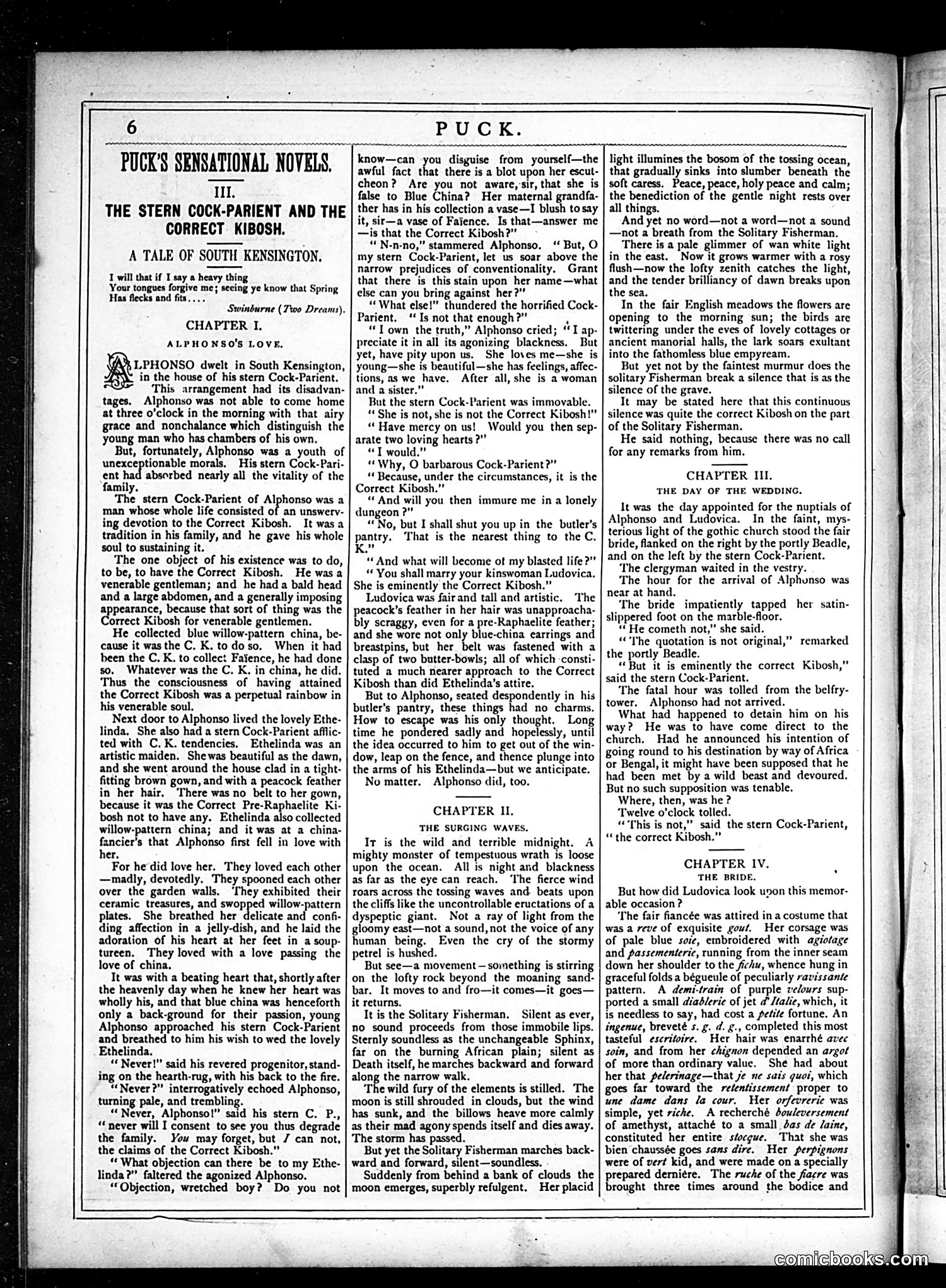
This page contains **serialized fiction**, not political cartoons. The heading "PUCK'S SENSATIONAL NOVELS" indicates this is a literary feature rather than satirical commentary. The text presents "The Stern Cock-Parient and the Correct Kibosh: A Tale of South Kensington"—an apparent melodramatic serial story featuring characters named Alphonso, Ethelinda, and Ludovica. The narrative involves romantic entanglement, social class tensions, and domestic conflict typical of Victorian-era sensational fiction. While Puck magazine was primarily known for political satire, this page demonstrates that it also published serialized adventure and romance stories to engage readers and drive subscriptions—common practice for American magazines of this period.
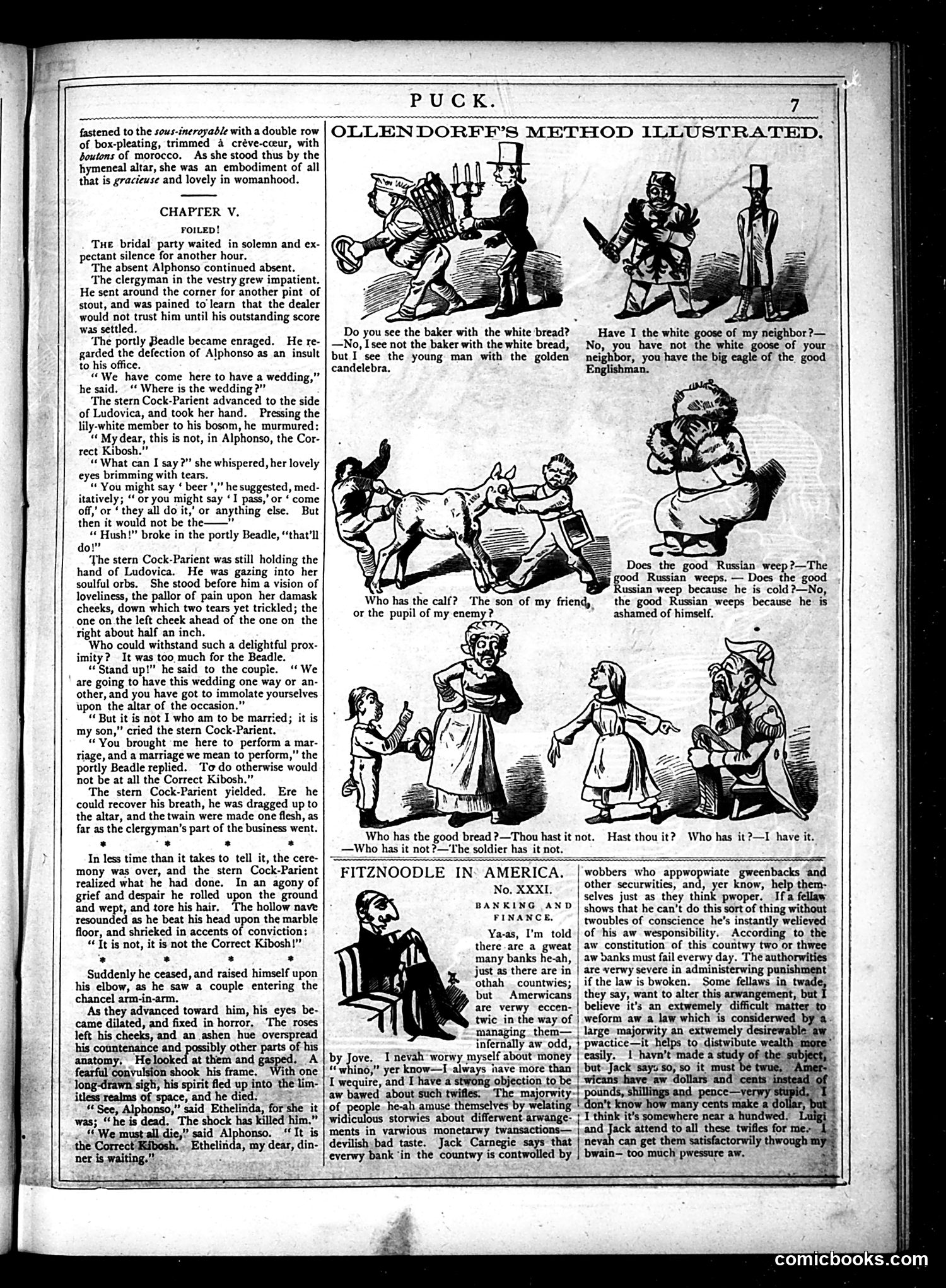
This page contains multiple sections: Chapter V of a serialized story about a wedding, "Ollendorff's Method Illustrated" (language-lesson cartoons), and "Fitznoodle in America" about banking and finance. **Ollendorff's Method** uses exaggerated character types—a gentleman in a top hat, soldiers, and Russians—to mock language instruction through absurd dialogues. The jokes rely on stereotypes: Russians depicted as simple or crude ("good Russian weeps because he is cold"). **Fitznoodle in America** satirizes American banking practices and financial regulation. The text criticizes banks' control over currency and suggests reform is needed, with Jack Carnegie apparently representing wealthy financiers who resist oversight ("too much pressure on my brain"). The cartoons employ period racial and ethnic caricature typical of 1870s-80s satire.
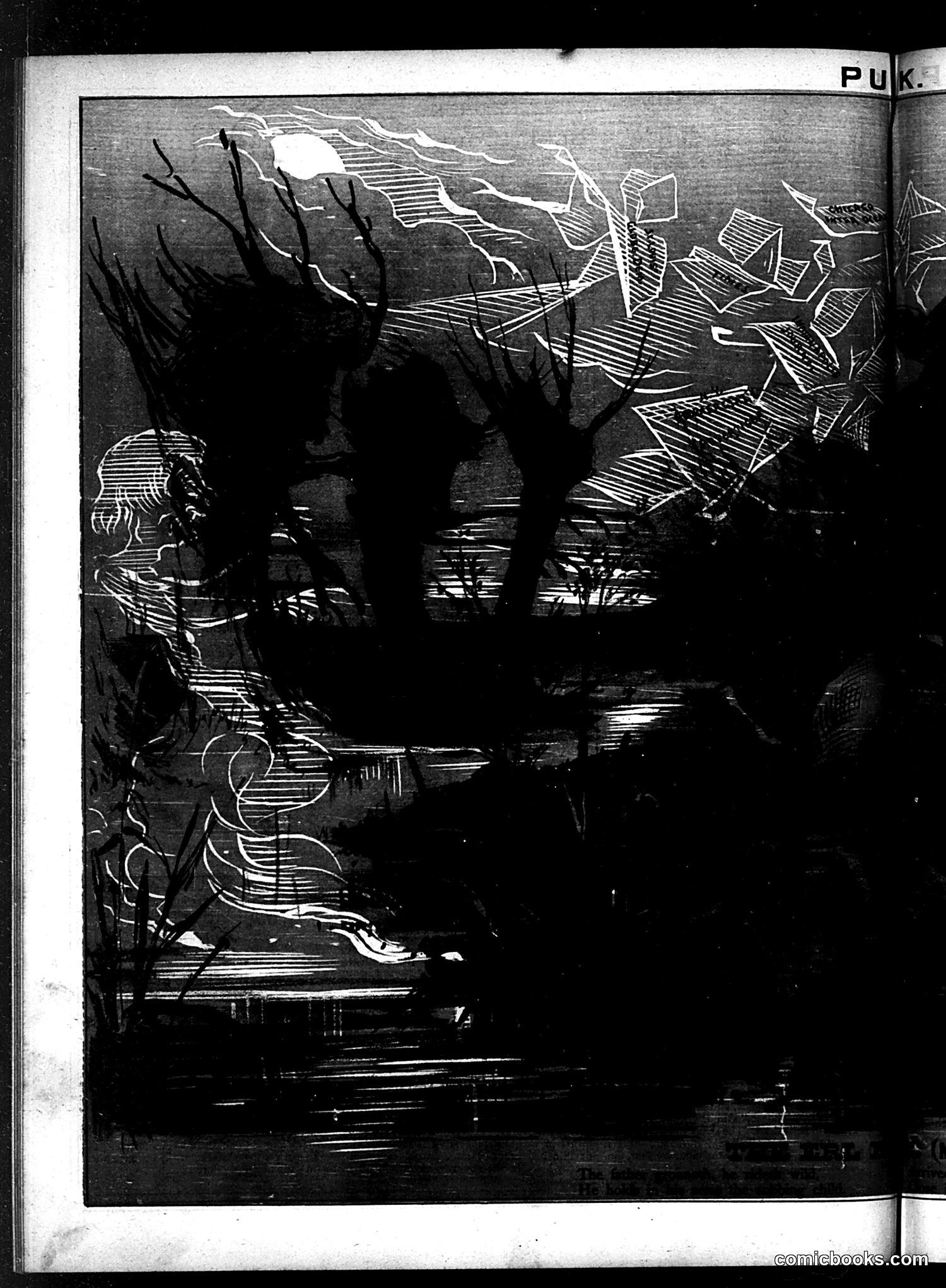
I can see this is a woodcut or engraving-style illustration from Puck magazine, but the image quality and contrast make it difficult to read specific details with certainty. The composition shows silhouetted figures in what appears to be a dramatic scene with bare trees and dynamic line work characteristic of late 19th/early 20th-century satirical illustration. However, without clearer visibility of facial features, text labels, or readable OCR content from this specific page, I cannot confidently identify the figures being caricatured or explain the political/social satire intended. To accurately explain this cartoon's meaning to a modern reader, I would need either higher image resolution or additional context about the publication date and article titles on this page.
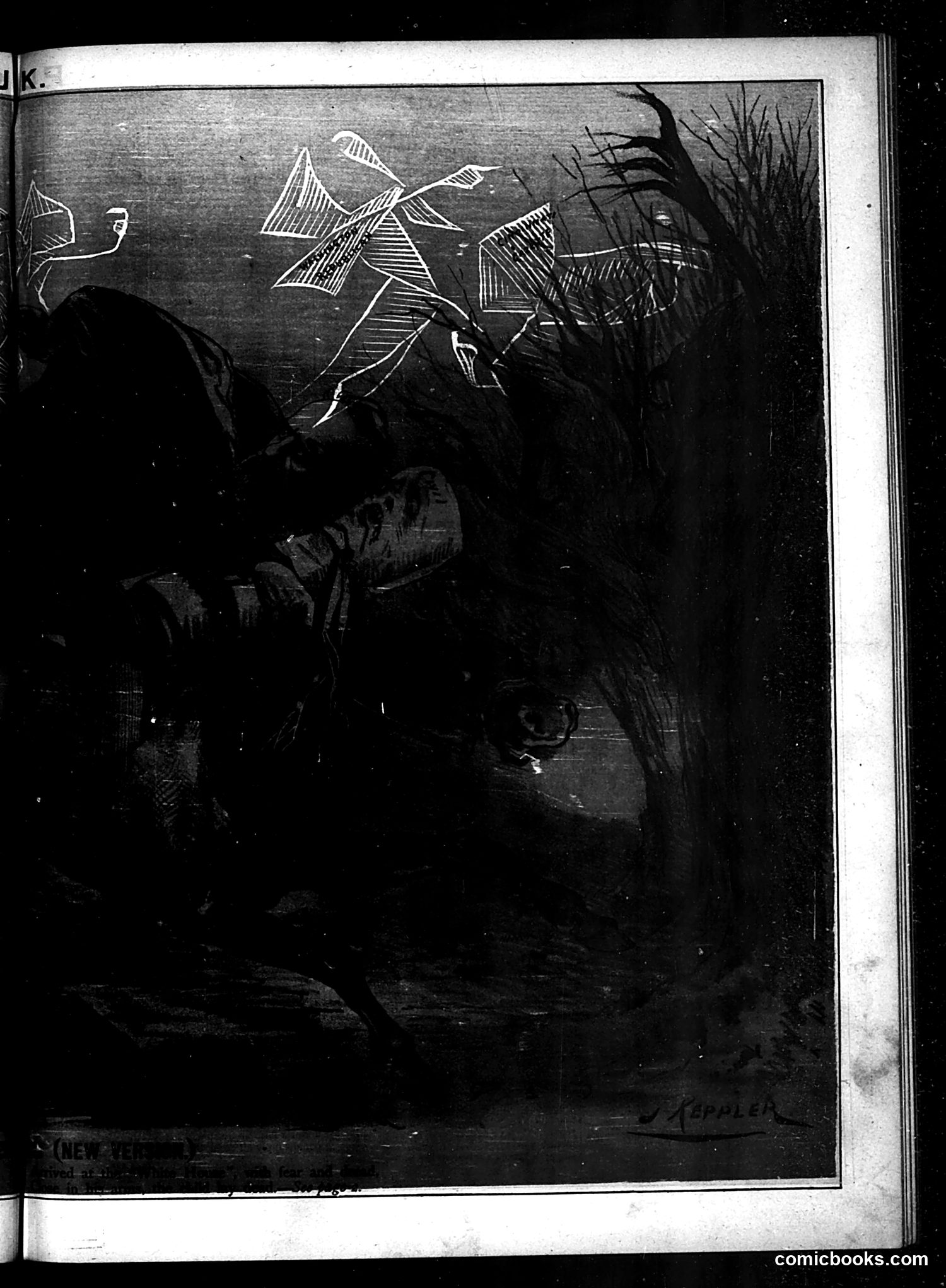
I can see this is a black and white illustration from Puck magazine showing a silhouetted figure in the foreground viewing what appears to be a dramatic scene depicted on a wall or screen above. The upper image contains figures rendered in white line work against a dark background, appearing to show some kind of action or conflict scene with geometric, angular forms suggesting movement or struggle. However, the OCR text appears blank or illegible in the provided transcription, making it difficult to identify the specific political figures, events, or satirical references intended. Without readable caption text or title, I cannot confidently identify which historical event, political conflict, or social commentary this cartoon addresses. The artistic style and composition suggest social or political satire typical of Puck's editorial content, but determining the precise subject would require clearer text or additional context.
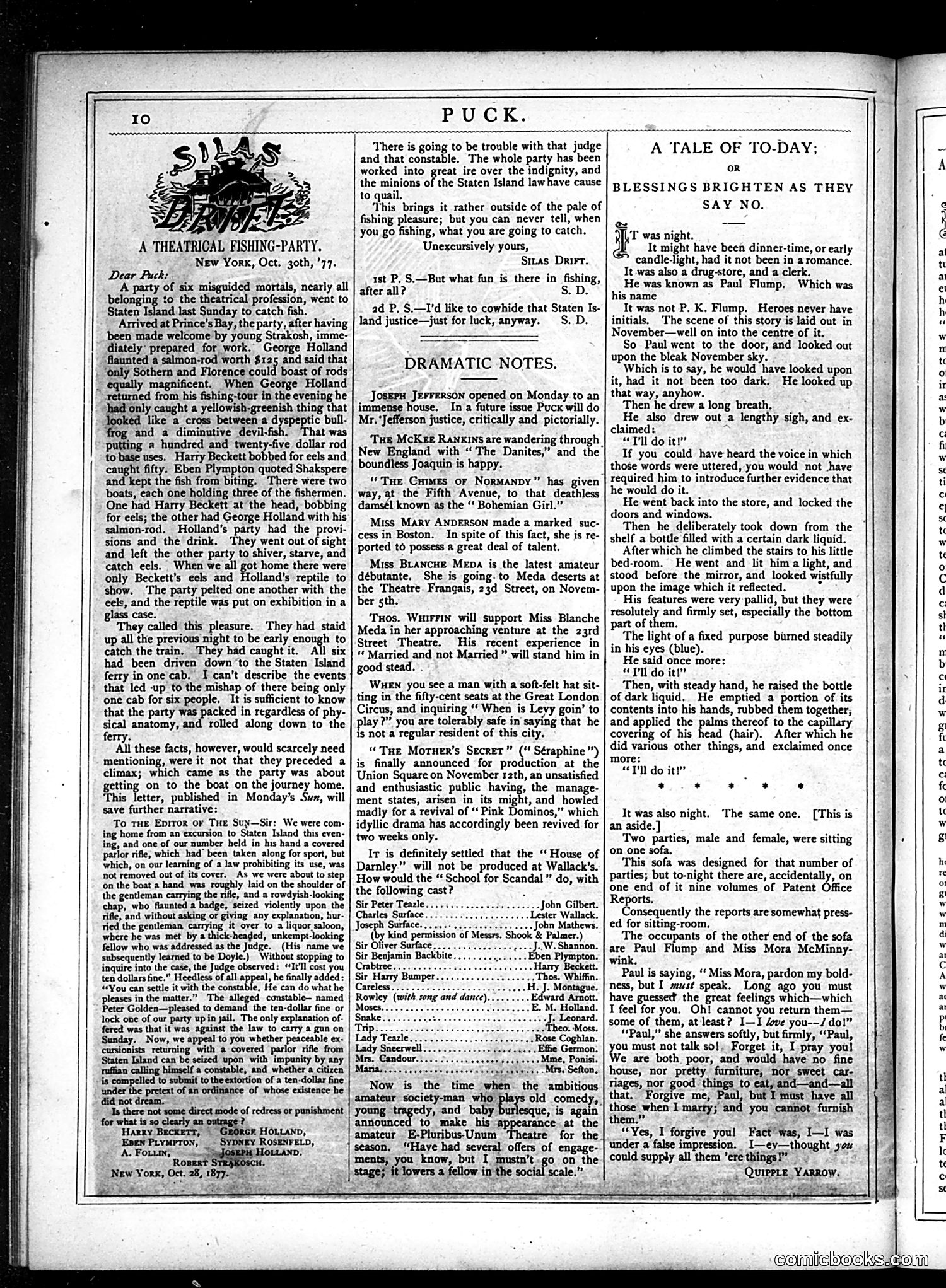
This page contains theatrical commentary and a fictional story rather than political cartoons. The main illustration shows "A Theatrical Fishing-Party" with six figures attempting to catch fish—likely satirizing theatrical professionals pursuing roles or success. The accompanying letter humorously describes mishaps during a fishing trip that mirror stage disasters (bobbed corks, tangled lines, lost catches). The "Dramatic Notes" section reviews recent New York theater productions and performers, while "A Tale of To-Day" presents a domestic romance about a character named Paul Plump and his romantic misadventures. This reflects Puck's dual nature: while primarily known for political satire, it also featured entertainment criticism and humorous fiction for a general audience interested in theater and society gossip of the 1870s.
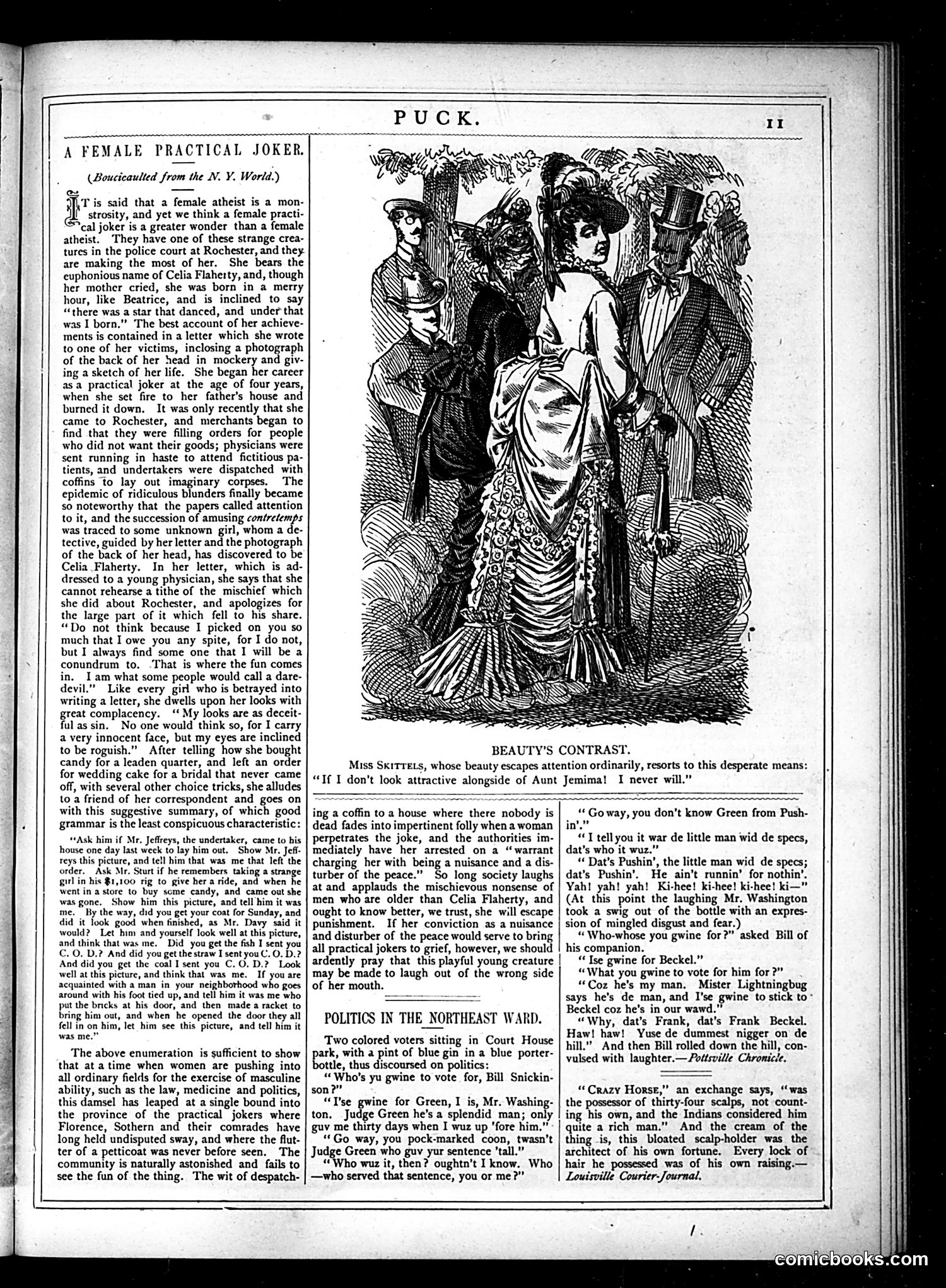
This article satirizes a woman named Celia Flaherty who, the text claims, is a female atheist conducting elaborate practical jokes in Rochester. The piece mocks the contradiction of a "female practical joker" as unusual—suggesting women were expected to be passive rather than mischievous. The accompanying illustration shows a woman in fashionable dress among other figures, apparently depicting one of her pranks. The satire targets both her atheism (presented as outrageous) and her gender-nonconforming behavior of actively initiating pranks rather than being their victim. The sidebar "Beauty's Contrast" further mocks Miss Skittles, a woman who allegedly uses deceptive appearance to perpetrate social tricks. The overall tone reflects late-19th-century assumptions about proper feminine behavior while satirizing women who transgressed these expectations.
This page contains **text only**—specifically Chapter XXX of a serialized short story titled "Two Knaves and a Queen" by Frank Barrett. The narrative describes a dramatic rescue scene involving characters named M. de Gaillefontaine, Mr. Fox, and others in what appears to be a quarry. There are **no political cartoons or satirical illustrations** visible on this page. It is purely literary content, typical of Puck's serialized fiction offerings alongside its better-known satirical imagery. Without seeing accompanying illustrations or having broader story context, the political or social commentary—if any—cannot be determined from this text excerpt alone. The page represents Puck's mixed content format of humor, satire, and serialized entertainment.
This page contains **"Puck's Beginnings,"** a column of brief satirical items rather than a single cartoon. The illustration shows a cherub or putto figure amid clouds—Puck's traditional mascot. The items mock various contemporary issues: a Republican paper's hypocrisy about "300 jackasses," a boy asking about the legislature's "spell," Chief Joseph's unannounced lecture, Stanley Matthews losing his boxing match, turkey shortages, and a New York obeisk project. Other jokes target gun ownership, Indian removal, newspaper accuracy, women's suffrage debates, theological seminaries, and British naval power. The satire is typical of Puck's format: brief, topical jabs at politics, social customs, and public figures of the era. Without specific dates or context clues, precise identification of most references remains unclear.
This page is primarily **advertising and announcements** rather than satirical cartoons. The main content announces Puck magazine's new "General Designing Office" featuring artist **Joseph Keppler**, offering illustration services and lithographic portraits to the theatrical profession. The page includes period advertisements for **Friedrichshall Bitterwater** (a digestive beverage), **Volks-Garden Theatre**, **Aberle's Tivoli Theatre**, and **Saff Liebermann & Co.'s Compressed Yeast**. The left column contains humorous anecdotes and social commentary typical of Puck's satirical style—brief jokes about church attendance, poverty, military service, and domestic life—but these are **standalone humor pieces rather than illustrated political cartoons**. The overall page functions as a **business announcement with period advertising**.
This page is primarily **advertising and business notices** from Puck magazine (page 15), not satirical content. The advertisements include: - **Puck's Illustrated Almanac** (German edition) - Portrait studios and photography services - Wine and spirits importers - Printing ink manufacturers - Carpet and furniture retailers - Clothing merchants The only potentially satirical element is a **Hungarian wines advertisement** featuring a classical engraving of a rider on horseback with a heraldic seal, stating it "Received the First Prize at the Centennial Exhibition, Philadelphia, 1876." The page reflects late-19th-century New York commerce and contains no identifiable political figures or commentary—it's primarily a revenue-generating advertisements section typical of period magazines.
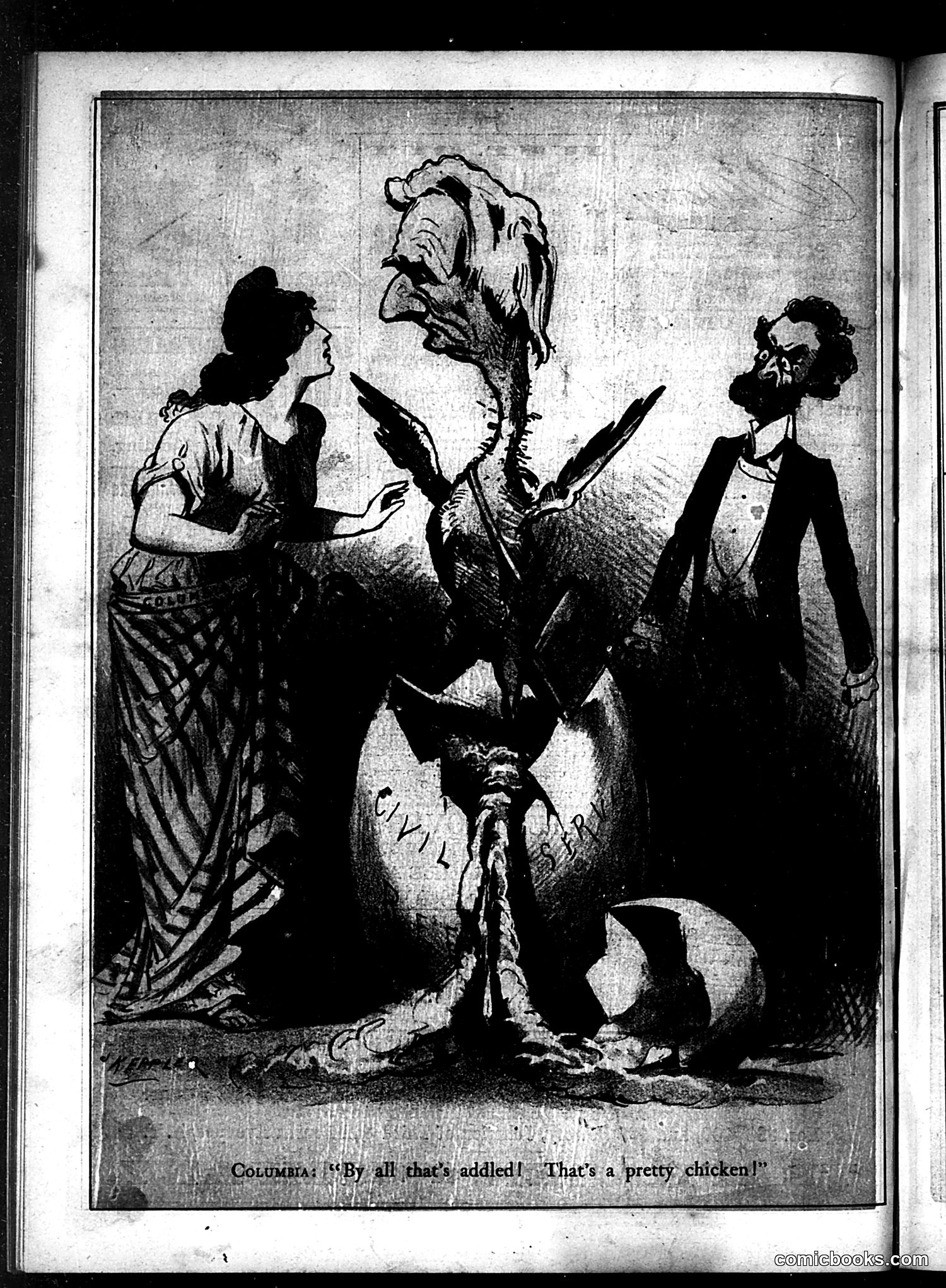
This satirical cartoon depicts three figures examining a grotesque, plant-like creature. The caption reads: "By all that's addled! That's a pretty chicken!" The central figure appears to be a caricatured man with exaggerated features, drawn in Puck's characteristic grotesque style. He's flanked by a woman on the left and a bearded man on the right, both reacting with apparent surprise or dismay. The humor operates on absurdity: the "chicken" is clearly no chicken at all—it's a bizarre, monstrous hybrid creature. The joke likely satirizes either fraudulent dealings (selling something misrepresented as something else) or foolish gullibility (the characters accepting an obvious fake as genuine). Without knowing the specific historical context or publication date, the exact political or social target remains unclear, though Puck typically lampooned corruption, hypocrisy, or public folly.