
Puck, 1877-10-31 · page 6 of 16
Puck — October 31, 1877 — page 6: what you’re looking at
What you’re looking at
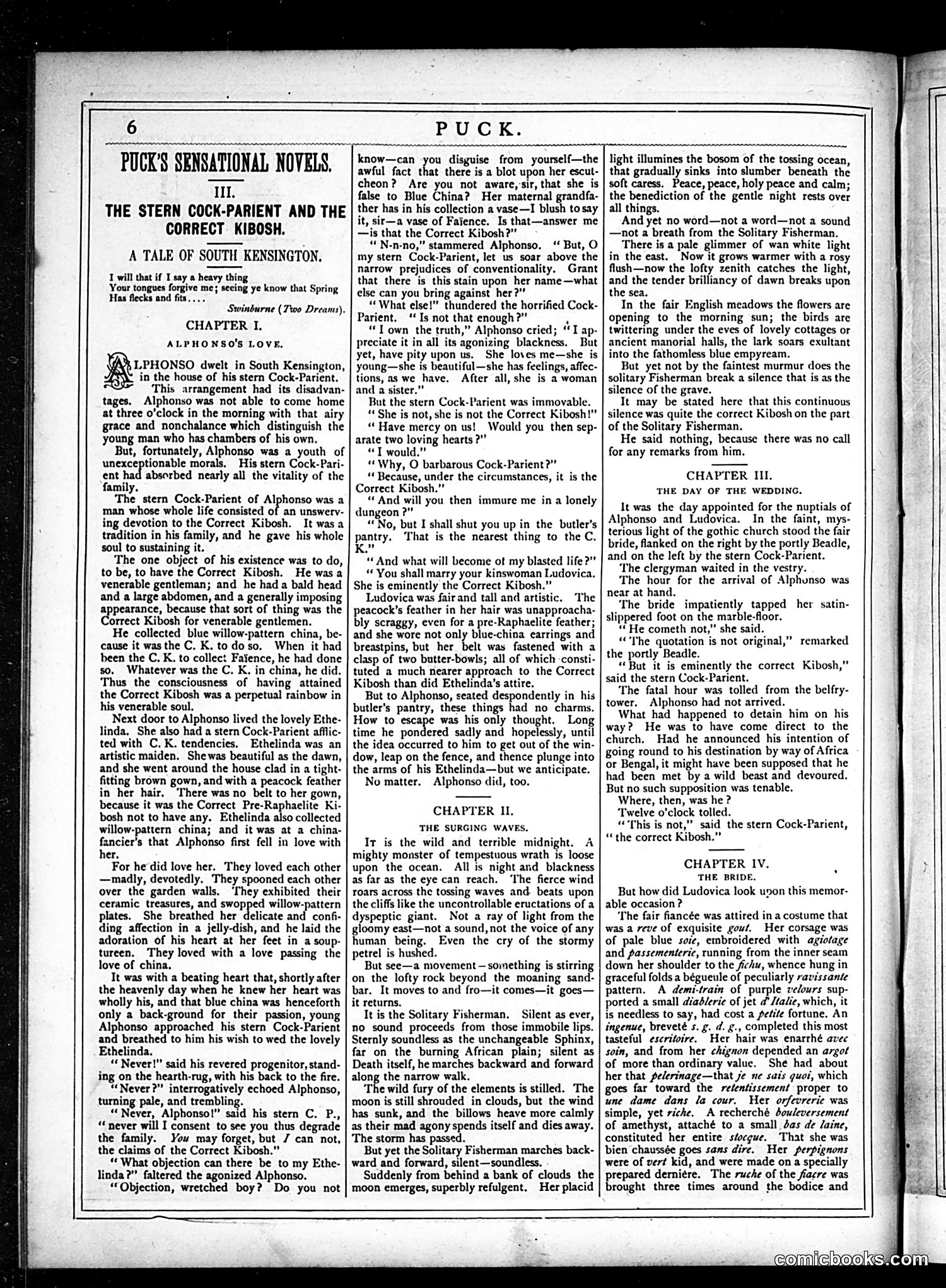
This page contains **serialized fiction**, not political cartoons. The heading "PUCK'S SENSATIONAL NOVELS" indicates this is a literary feature rather than satirical commentary. The text presents "The Stern Cock-Parient and the Correct Kibosh: A Tale of South Kensington"—an apparent melodramatic serial story featuring characters named Alphonso, Ethelinda, and Ludovica. The narrative involves romantic entanglement, social class tensions, and domestic conflict typical of Victorian-era sensational fiction. While Puck magazine was primarily known for political satire, this page demonstrates that it also published serialized adventure and romance stories to engage readers and drive subscriptions—common practice for American magazines of this period.
📄 Transcribed text from this page (OCR, searchable)
Machine-transcribed from the original scan — historical spelling and the odd misread are preserved.
PUCK. PUCK'S SENSATIONAL NOVELS. Ill. THE STERN COCK-PARIENT AND THE CORRECT KIBOSH. A TALE OF SOUTH KENSINGTON, I will that if say a heavy thing ‘Your tongues forgive me; seeing ye know that Spring Has flecks and fits... Swinburne (Tro Dreams). CHAPTER I, ALPHONSO'S LOVE. LPHONSO dwelt in South Kensington, in the house of his stern Cock-Parient. This arrangement had its disadvan- tages. Alphonso was not able to come home at three o'clock in the morning with that airy grace and nonchalance which distinguish the young man who has chambers of his own. But, fortunately, Alphonso was a youth of unexceptionable morals, His stern Cock-Pari- ent had absorbed nearly all the vitality of the family, The stern Cock-Parient of Alphonso was a man whose whole life consisted of an unswery- ing devotion to the Correct Kibosh. It was a tradition in his family, and he gave his whole soul to sustaining it. The one object of his existence was to do, to be, to have the Correct Kibosh. He was a venerable gentleman; and he had a bald head and a large abdomen, and a generally imposing appearances because that sort of thing was the orrect Kibosh for venerable gentlemen. He collected blue willow-pattern china, be- cause it was the C. K. todo so, When it had been the C. K. to collect Faience, he had done so. Whatever was the C. K. in china, he did. Thus the consciousness of having attained the Correct Kibosh was a perpetual rainbow in his venerable soul. Next door to Alphonso lived the lovely Ethe- linda, She also had a stern Cock-Parient afflic- ted with C.K. tendencies. Ethelinda was an artistic maiden. Shewas beautiful as the dawn, and she went around the house clad in a tight- fitting brown gown, and with a peacock feather in her hair. ‘There was no belt to her gown, because it was the Correct Pre-Raphaelite Ki- bosh not to have any. Ethelinda also collected willow-pattern china; and it was at a china- fancier’s that Alphonso first fell in love with er. For he did love her. They loved each other —madly, devotedly. They spooned each other over the garden walls. ‘They exhibited their ceramic treasures, and swopped willow-pattern plates. She breathed her delicate and confi- ding affection in a jelly-dish, and he laid the adoration of his heart at her feet in a soup- tureen, They loved with a love passing the love of china, It was with a beating heart that, shortly after the heavenly day when he knew her heart was wholly his, and that blue china was henceforth only a back-ground for their passion, young Alphonso approached his stern Cock-Parient and breathed to him his wish to wed the lovely Ethelinda. “ Never!" said his revered progenitor, stand- ing on the hearth-rug, with his back to the fire. “Never?” interrogatively echoed Alphonso, turning pale, and trembling. “Never, Alphonso!” said his stern C. P., “never will I consent to see you thus degrade the family. You may forget, but / can not, the claims of the Correct Kibosh.”” “What objection can there be to my Ethe- linda?” faltered the agonized Alphonso. “Objection, wretched boy? Do you not know—can you disguise from yourself—the awful fact that there is a blot upon her escut- cheon? Are you not aware,sir, that she is false to Blue China? Her maternal ganda. ther has in his collection a vase—I blush tosay it, sir—a vase of Faience. Is that—answer me —is that the Correct Kibosh?” “(N-n-no,” stammered Alphonso. ‘ But, O my stern Cock-Parient, let us soar above the narrow prejudices of conventionality. Grant that there is this stain upon her name—what else can you bring against her?” “What else!" thundered the horrified Cock- Parient. ‘Is not that enough?” “T own the truth,” Alphonso cried; ‘I ap- preciate it in all its agonizing blackness. But yet, have pity upon us. She loves me—she is young—she is beautiful—she has feelings, affec- tions, as we have. After all, she is a woman and a sister.” But the stern Cock-Parient was immovable. “She is not, she is not the Correct Kibosh!" “ Have mercy on us! Would you then sep- arate two loving hearts ?” “T would.” “Why, O barbarous Cock-Parient?” “ Because, under the circumstances, it is the Correct Kibosh.” “ And will you then immure me in a lonely dungeon ?” “No, but I shall shut you up in the butler’s pantry. That is the nearest thing to the C. ** And what will become ot my blasted life?” “ You shall marry your kinswoman Ludovica. She is eminently the Correct Kibosh.” Ludovica was fairand tall and artistic. The peacock’s feather in her hair was unapproacha- bly scraggy, even for a pre-Raphaelite feather; and she wore not only blue-china earrings and breastpins, but her belt was fastened with a clasp of two butter-bowls; all of which -consti- tuted a much nearer approach to the Correct Kibosh than did Ethelinda’s attire. But to Alphonso, seated despondently in his butler’s pantry, these things had no charms, How to escape was his only thought. Long time he pondered sadly and hopelessly, until the idea occurred to him to get out of the win- dow, leap on the fence, and thence plunge into the arms of his Ethelinda—but we anticipate. No matter. Alphonso did, too. CHAPTER II, THE SURGING WAVES. Ir is the wild and terrible midnight. A mighty monster of tempestuous wrath is loose upon the ocean. All is night and blackness as far as the eye can reach. ‘The fierce wind roars across the tossing waves and beats upon the cliffs like the uncontrollable eructations of a dyspeptic giant. Not a ray of light from the gloomy east—not a sound, not the voice of any human being. Even the cry of the stormy petrel is hushed. But see—a movement — something is stirring on the lofty rock beyond the moaning sand- bar. It moves to and fro—it comes—it goes— it returns, It is the Solitary Fisherman. Silent as ever, no sound proceeds from those immobile lips. Sternly soundless as the unchangeable Sphinx, far on the burning African plain; silent as Death itself, he marches backward and forward along the narrow walk. The wild fury of the elements is stilled. The moon is still shrouded in clouds, but the wind has sunk, and the billows heave more calmly as their mad agony spends itself and dies away. The storm has passed. But yet the Solitary Fisherman marches back- ward and forward, silent—soundless. Suddenly from behind a bank of clouds the moon emerges, superbly refulgent. Her placid light illumines the bosom of the tossing ocean, that gradually sinks into slumber beneath the soft caress. Peace, peace, holy peace and calm; the benediction of the gentle night rests over all things. And yet no word—not a word—not a sound —not a breath from the Solitary Fisherman. There is a pale glimmer of wan white light in the east. Now it grows warmer with a rosy flush—now the lofty zenith catches the light, and the tender brilliancy of dawn breaks upon the sea. In the fair English meadows the flowers are opening to the morning sun; the birds are twittering under the eves of lovely cottages or ancient manorial halls, the lark soars exultant into the fathomless blue empyream. But yet not by the faintest murmur does the solitary Fisherman break a silence that is as the silence of the grave. It may be stated here that this continuous silence was quite the correct Kibosh on the part of the Solitary Fisherman, He said nothing, because there was no call for any remarks from him, CHAPTER III. THE DAY OF THE WEDDING. It was the day appointed for the nuptials of Alphonso and Ludovica. In the faint, mys- terious light of the gothic church stood the fair bride, flanked on the right by the portly Beadle, and on the left by the stern Cock-Parient. ‘The clergyman waited in the vestry. The hour for the arrival of Alphonso was near at hand. The bride impatiently tapped her satin- slippered foot on the marble-floor. “He cometh not,” she said. “The quotation is not original,” remarked the portly Beadle. “But it is eminently the correct Kibosh,” said the stern Cock-Parient. ‘The fatal hour was tolled from the belfry- tower. Alphonso had not arrived. What had happened to detain him on his way? He was to have come direct to the church. Had he announced his intention of going round to his destination by way of Africa or Bengal, it might have been supposed that he had been met by a wild beast and devoured. But no such supposition was tenable. Where, then, was he ? ‘Twelve o'clock tolled. “This is not,” said the stern Cock-Parient, “ the correct Kibosh.”” CHAPTER IV. THE BRIDE. But how did Ludovica look upon this memor- able occasion ? ‘The fair fiancée was attired in a costume that was a reve of exquisite gout. Her corsage was of pale blue soie, embroidered with agiotage and passementerie, running from the inner seam down her shoulder to the fichu, whence hung in graceful folds a bégueule of peculiarly ravissante pattern. A demi-train of purple velours sup- ported a small diad/erie of jet a’ Italie, which, it is needless to say, had cost a petite fortune. An ingenue, breveté s. g. d. g., completed this most tasteful escrifoire. Her hair was enarrhé avec soin, and from her chignon depended an argot of more than ordinary value. She had about her that pelerinage—that je ne sais quoi, which goes far toward the reéentissement proper to une dame dans la cour, Her orfevrerie was simple, yet riche. A recherché bouleversement of amethyst, attaché to a small das de /aine, constituted her entire stocgue. That she was bien chaussée goes sans dire, Her perpignons were of vert kid, and were made ona specially prepared derni¢re. The ruche of the fiacre was brought three times around the bodice and