
Puck, 1877-10-31 · page 11 of 16
Puck — October 31, 1877 — page 11: what you’re looking at
What you’re looking at
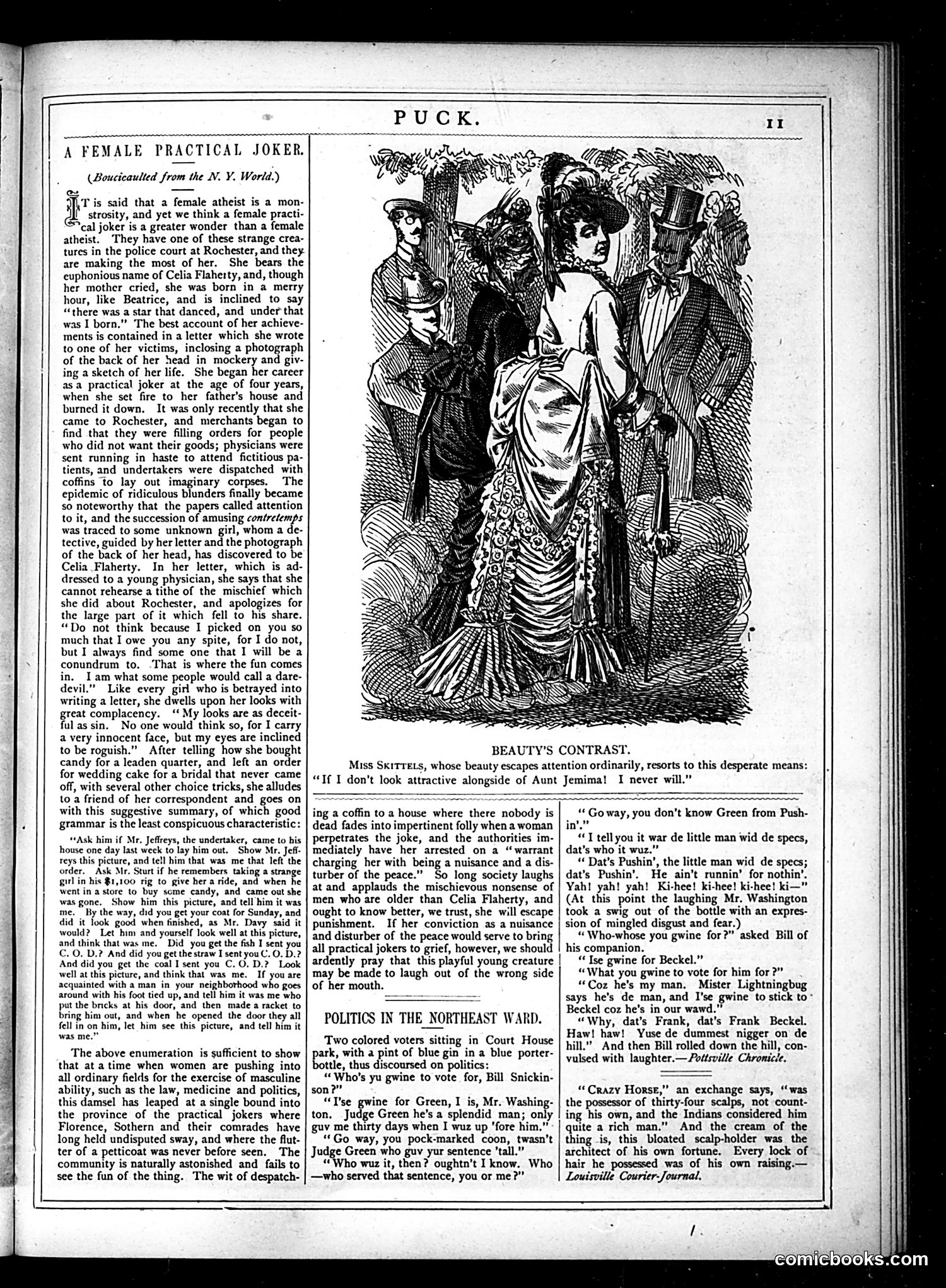
This article satirizes a woman named Celia Flaherty who, the text claims, is a female atheist conducting elaborate practical jokes in Rochester. The piece mocks the contradiction of a "female practical joker" as unusual—suggesting women were expected to be passive rather than mischievous. The accompanying illustration shows a woman in fashionable dress among other figures, apparently depicting one of her pranks. The satire targets both her atheism (presented as outrageous) and her gender-nonconforming behavior of actively initiating pranks rather than being their victim. The sidebar "Beauty's Contrast" further mocks Miss Skittles, a woman who allegedly uses deceptive appearance to perpetrate social tricks. The overall tone reflects late-19th-century assumptions about proper feminine behavior while satirizing women who transgressed these expectations.
📄 Transcribed text from this page (OCR, searchable)
Machine-transcribed from the original scan — historical spelling and the odd misread are preserved.
A FEMALE PRACTICAL JOKER (Boucicaulted from the N.Y. World.) T is said that a female atheist is a mon- I strosity, and yet we think a female practi- cal joker is a greater wonder than a female atheist. ‘They have one of these strange crea- tures in the police court at Rochester, and they are making the most of her. She bears the cuphonious name of Celia Flaherty, and, though her mother cried, she was born in a merry hour, like Beatrice, and is inclined to say “there was a star that danced, and under that was I born.” The best account of her achieve- ments is contained in a letter which she wrote to one of her victims, inclosing a photograph of the back of her head in mockery and giv- ing a sketch of her life. She began her career asa practical joker at the age of four years, when she set fire to her father’s house and burned it down. It was only recently that she came to Rochester, and merchants began to find that they were filling orders for people who did not want their goods; physicians were sent running in haste to attend fictitious pa- tients, and undertakers were dispatched with coffins to lay out imaginary corpses. The epidemic of ridiculous blunders finally became so noteworthy that the papers called attention to it, and the succession of amusing contrelomps was traced to some unknown girl, whom a de- tective, guided by her letter and the photograph of the back of her head, has discovered to be Celia Flaherty. In her letter, which is ad- dressed to a young physician, she says that she cannot rehearse a tithe of the mischief which she did about Rochester, and apologizes for the large part of it which fell to his share. “Do not think because I picked on you so much that I owe you any spite, for I do not, but I always find some one that I will be a conundrum to. .That is where the fun comes in. I am what some people would call a dare- devil.” Like every girl who is betrayed into writing a letter, she dwells upon her looks with great complacency. ‘‘ My looks are as deceit- ful as sin. No one would think so, for I carry a very innocent face, but my eyes are inclined to be roguish.” After telling how she bought candy for a leaden quarter, and left an order for wedding cake for a bridal that never came off, with several other choice tricks, she alludes to a friend of her correspondent and goes on with this suggestive summary, of which good grammar is the least conspicuous characteristic: “Ask him if Mr. Jeffreys, the undertaker, came to his house one day last week to lay him out. Show Mr. Jef reys this picture, and tell him that was me that left the order. Ask Mr. Sturt if he remembers taking a strange gill in his $1,100 rig to give hera ride, and when he went ina store to buy scme candy, and came out she was gone. Show him this picture, and tell him it was me. By the way, did you get your coat for Sunday, and did it look good when finished, as Mr. Davy said it would? Let him and yourself look well at this picture, and think that was me. Did you get the fish I sent you C. 0. D.? And did you get the straw I sent you C. O. D.? And did you get the coal I sent you C. 0. D.? Look well at this picture, and think that was me. If you are acquainted with a man in your neighbothood who goes around with his foot tied up, and tell him it was me who put the bricks at his door, and then made a racket to bring him out, and when he opened the door they all fell in on him, let him see this picture, and tell him it was me.” The above enumeration is sufficient to show that at a time when women are pushing into all ordinary fields for the exercise of masculine ability, such as the law, medicine and politics, this damsel has leaped at a single bound into the province of the practical jokers where Florence, Sothern and their comrades have long held undisputed sway, and where the flut- ter of a petticoat was never before seen. The community is naturally astonished and fails to see the fun of the thing. The wit of despatch- Oh hp | “G wy Uf BEAUTY'S CONTRAST. Miss SkiTTELs, whose beauty escapes attention ordinarily, resorts to this desperate means: “If I don’t look attractive alongside of Aunt Jemima! I never will.” ing a coffin to a house where there nobody is dead fades into impertinent folly when a woman perpetrates the joke, and the authorities im- mediately have her arrested on a “warrant charging her with being a nuisance and a dis- turber of the peace.” So long society laughs at and applauds the mischievous nonsense of men who are older than Celia Flaherty, and ought to know better, we trust, she will escape punishment. If her conviction as a nuisance and disturber of the peace would serve to bring all practical jokers to grief, however, we should ardently pray that this playful young creature may be made to laugh out of the wrong side of her mouth. Two colored voters sitting in Court House ark, with a pint of blue gin in a blue porter- ttle, thus discoursed on politics: “Who's yu gwine to vote for, Bill Snickin- son?” “T’se gwine for Green, I is, Mr. Washing- ton, Judge Green he’s a splendid man; only guv me thirty days when I wuz up ‘fore him.” “©Go way, you pock-marked coon, twasn’t Judge Green who guv yur sentence 'tall.” «Who wuz it, then? oughtn’t I know. Who —who served that sentence, you or me?” “Go way, you don’t know Green from Push- “T tellyou it war de little man wid de specs, dat’s who it wuz.”” “ Dat’s Pushin’, the little man wid de specs; dat’s Pushin’. He ain’t runnin’ for nothin’. Yah! yah! yah! Ki-hee! ki-hee! ki-hee! k (At this point the laughing Mr. Washington took a swig out of the bottle with an expres- sion of mingled disgust and fear.) “ Who-whose you gwine for?” asked Bill of his companion. “ Ise gwine for Beckel.” “What you gwine to vote for him for ?” “Coz he's my man. Mister Lightningbug says he’s de man, and Ise gwine to stick to* Beckel coz he's in our wawd." “Why, dat’s Frank, dat’s Frank Beckel. Haw! haw! Yuse de dummest nigger on de hill.” And then Bill rolled down the hill, con- vulsed with laughter.— Pottsville Chronicle. “Crazy Bors an Sxchanee says, ‘was the possessor of thirty-four Ips, not count- ing his own, and the. Indians considered him quite a rich man.” And the cream of the thing -is, this bloated scalp-holder was the architect of his own fortune. Every lock of hair he possessed was of his own raising.— Louisville Courier-Journal, EOMICDOO