
Puck, 1877-10-31 · page 3 of 16
Puck — October 31, 1877 — page 3: what you’re looking at
What you’re looking at
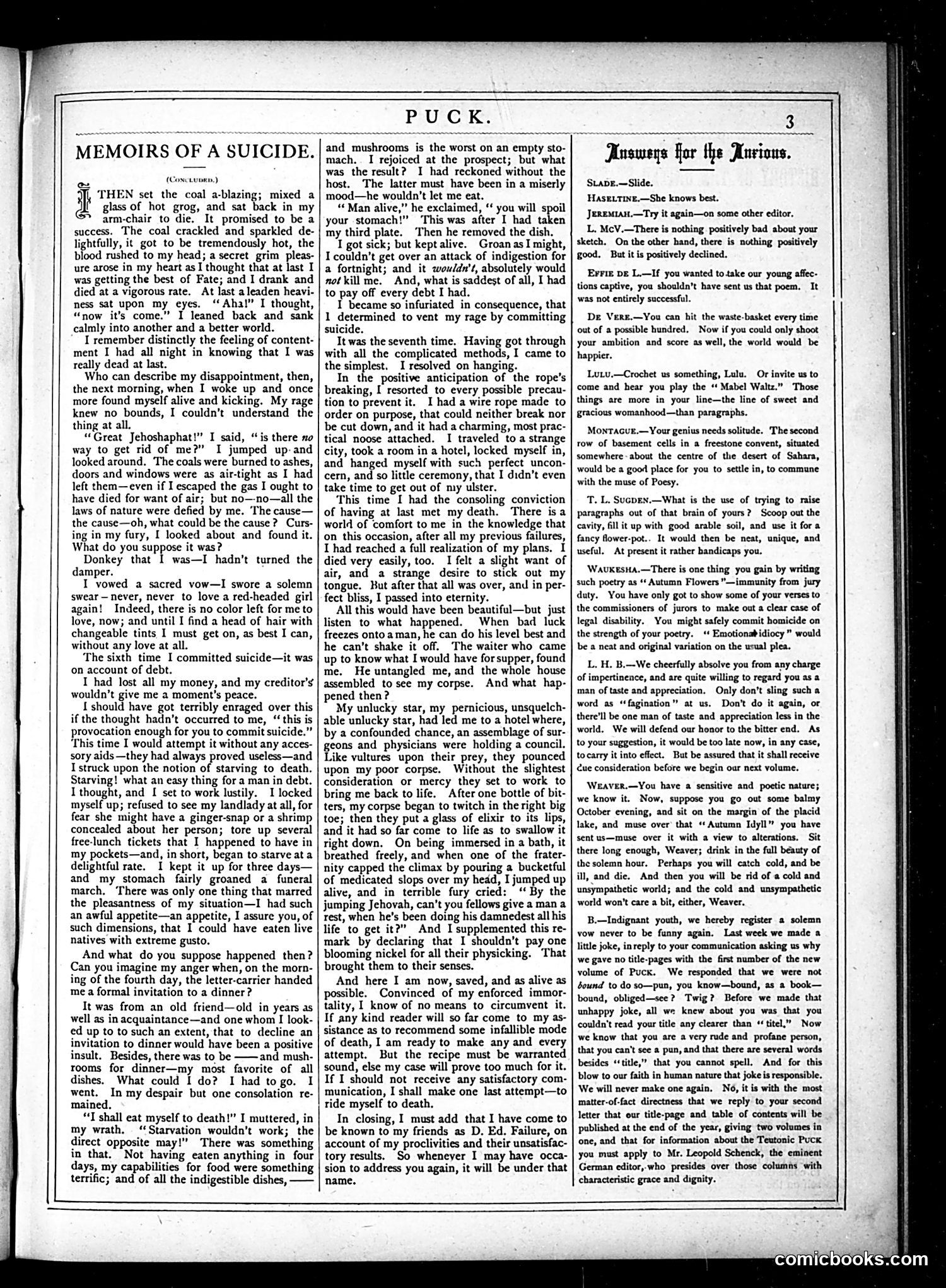
This page from Puck magazine contains two distinct sections: the left column features "Memoirs of a Suicide," a dark satirical narrative about a man's repeated failed suicide attempts using increasingly absurd methods (hot frog soup, indigestion, hanging, immersion). The piece satirizes both the desperation of poverty and the incompetence of the suicidal protagonist. The right column, "Answers for the Curious," presents reader responses to various submitted queries about social etiquette and personal matters. These brief advice-style responses offer humorous commentary on contemporary social conventions and personal problems. Without visible illustrations on this page, the satire relies entirely on written content—typical of Puck's mix of humor targeting 19th-century American social conditions and personal foibles. The suicide narrative particularly satirizes economic hardship and despair.
📄 Transcribed text from this page (OCR, searchable)
Machine-transcribed from the original scan — historical spelling and the odd misread are preserved.
MEMOIRS OF A SUICIDE. a (Coxcivoen,) f THEN set the coal a-blazing; mixed a glass of hot grog, and sat back in my arm-chair to die. It promised to be a success. The coal crackled and sparkled de- lightfully, it got to be tremendously hot, the blood rushed to my head; a secret grim pleas- ure arose in my heart as I thought that at last I was getting the best of Fate; and I drank and died at a vigorous rate. At last a leaden heavi- ness sat upon my eyes. ‘Ahal” I thought, “now it’s come.” I leaned back and sank calmly into another and a better world. I remember distinctly the feeling of content- ment I had all night in knowing that I was really dead at last. Who can describe my disappointment, then, the next morning, when I woke up and once more found myself alive and kicking. My rage knew no bounds, I couldn't understand the thing at all. “Great Jehoshaphat!” I said, “is there no way to get rid of me?” I jumped up-and looked around. The coals were burned to ashes, doors and windows were as air-tight as I had left them—even if I escaped the gas I ought to have died for want of air; but no—no—all the laws of nature were defied by me. The cause— the cause—oh, what could be the cause? Curs- ing in my fury, I looked about and found it. What do you suppose it was? Donkey that I was—I hadn't turned the damper. I vowed a sacred vow—I swore a solemn swear — never, never to love a red-headed girl again! Indeed, there is no color left for me to love, now; and until I find a head of hair with changeable tints I must get on, as best I can, without any love at all. The sixth time I committed suicide—it was on account of debt. I had lost all my money, and my creditor's wouldn’t give me a moment's peace. I should have got terribly enraged over this if the thought hadn’t occurred to me, “this is provocation enough for you to commit suicide.” This time I would attempt it without any acces- sory aids—they had always proved useless—and I struck upon the notion of starving to death. Starving! what an easy thing for a man in debt. I thought, and [ set to work lustily. I locked myself up; refused to see my landlady at all, for fear she might have a ginger-snap or a shrimp concealed about her person; tore up several free-lunch tickets that I happened to have in my pockets—and, in short, began to starve ata delightful rate. I kept it up for three days— and my stomach fairly groaned a funeral march, ‘There was only one thing that marred the pleasantness of my situation—I had such an awful appetite—an appetite, I assure you, of such dimensions, that I could have eaten live natives with extreme gusto. And what do you suppose happened then? Can you imagine my anger when, on the morn- ing of the fourth day, the letter-carrier handed mea formal invitation to a dinner? It was from an old friend—old in years as well as in acquaintance—and one whom I look- ed up to to such an extent, that to decline an invitation to dinner would have been a positive insult. Besides, there was to be ——and mush- rooms for dinner—my most favorite of all dishes. What could I do? I had togo. I went. In my despair but one consolation re- mained. “I shall eat myself to death!” I muttered, in my wrath. “Starvation wouldn't work; the direct opposite may!” There was something in that. Not having eaten anything in four days, my capabilities for food were something |. ee and of all the indigestible dishes, —— and mushrooms is the worst on an empty sto- mach. I rejoiced at the prospect; but what was the result? I had reckoned without the host. The latter must have been in a miserly mood—he wouldn’t let me eat. “Man alive,” he exclaimed, ‘ you will spoil your stomach!” ‘This was after I had taken my third plate. Then he removed the dish, I got sick; but keptalive. GroanasI might, Icouldn’t get over an attack of indigestion for a fortnight; and it wouldn't, absolutely would notkill me. And, what is saddest of all, I had to pay off every debt I had. I became so infuriated in consequence, that 1 determined to vent my rage by committing suicide. It was the seventh time. Having got through with all the complicated methods, I came to the simplest. I resolved on hanging. In the positive anticipation of the rope’s breaking, I resorted to every possible precau- tion to prevent it. I had a wire rope made to order on purpose, that could neither break nor be cut down, and it had a charming, most prac- tical noose attached. I traveled to a strange city, took a room in a hotel, locked myself in, and hanged myself with such perfect uncon- cern, and so little ceremony, that I didn’t even take time to get out of my ulster. This time I had the consoling conviction of having at last met my death. There isa world of comfort to me in the knowledge that on this occasion, after all my previous failures, Thad reached a full realization of my plans. I died very easily, too. I felt a slight want of air, and a strange desire to stick out my tongue. But after that all was over, and in per- fect bliss, I passed into eternity. All this would have been beautiful—but just listen to what happened. When bad luck freezes onto aman, he can do his level best and he can’t shake it off. The waiter who came up to know what I would have for supper, found me. He untangled me, and the whole house assembled to see my corpse. And what hap- pened then? My unlucky star, my pernicious, unsquelch- able unlucky star, had led me to a hotel where, by a confounded chance, an assemblage of sur- geons and physicians were holding a council. Like vultures upon their prey, they pounced upon my poor corpse. Without the slightest consideration or mercy they set to work to bring me back to life. After one bottle of bit- ters, my corpse began to twitch in the right big toe; then they put a glass of elixir to its lips, and it had so far come to life as to swallow it right down. On being immersed in a bath, it breathed freely, and when one of the frater- nity capped the climax by pouring a bucketful of medicated slops over my hedd, I jumped up alive, and in terrible fury cried: ‘By the jumping Jehovah, can’t you fellows give a man a rest, when he's been doing his damnedest all his life to get it?” And I supplemented this re- mark by declaring that I shouldn’t pay one blooming nickel for all their physicking. That brought them to their senses. And here I am now, saved, and as alive as possible. Convinced of my enforced immor- tality, I know of no means to circumvent it. If any kind reader will so far come to my as- sistance as to recommend some infallible mode of death, I am ready to make any and every attempt. But the recipe must be warranted sound, else my case will prove too much for it. If I should not receive any satisfactory com- munication, I shall make one last attempt—to ride myself to death. In closing, I must add that I have come to be known to my friends as D. Ed. Failure, on account of my proclivities and their unsatisfac- tory results. So wheneyer I may have occa- sion to address you again, it will be under that name. 3 Jnsueys for the Tune SLADE.—Slide. Hasztive.—She knows best. JeREMIAH.—Try it again—on some other editor. L. McV.—There is nothing positively bad about your sketch. On the other hand, there is nothing positively good. But it is positively declined. Erriz DE L.—If you wanted totake our young affec- tions captive, you shouldn’t have sent us that poem. It was not entirely successful. De Vere.—You can hit the waste-basket every time out of a possible hundred. Now if you could only shoot your ambition and score as well, the world would be happier. LvLu.—Crochet us something, Lulu. Or invite us to come and hear you play the “ Mabel Waltz.” Those things are more in your line—the line of sweet and gracious womanhood—than paragraphs. Mowtacus.—Your genius needs solitude. The second row of basement cells in a freestone convent, situated somewhere-about the centre of the desert of Sahara, would be a good place for you to settle in, to commune with the muse of Poesy. T. L, SucDEN.—What is the use of trying to raise paragraphs out of that brain of yours? Scoop out the cavity, fill it up with good arable soil, and use it for a fancy flower-pot.. It would then be neat, unique, and useful. At present it rather handicaps you. Wauxesita.—There is one thing you gain by writing such poetry as “ Autumn Flowers "—immunity from jury duty. You have only got to show some of your verses to the commissioners of jurors to make out a clear case of legal disability. You might safely commit homicide on the strength of your poetry.“ Emotionabidiocy ” would be a neat and original variation on the usual plea. L. H. B,—We cheerfully absolve you from any charge of impertinence, and are quite willing to regard you as a man of taste and appreciation. Only don’t sling such a word as “fagination” at us. Don’t do it again, or there'll be one man of taste and appreciation less in the world. We will defend our honor to the bitter end. As to your suggestion, it would be too late now, in any case, tocarry it into effect. But be assured that it shall receive cue consideration before we begin oar next volume. Weaver.—You have a sensitive and poetic nature; we know it. Now, suppose you go out some balmy October evening, and sit on the margin of the placid lake, and muse over’ that “Autumn Idyll” you have sent us—muse over it with a view to alterations. Sit there long enough, Weaver; drink in the full beauty of the solemn hour. Perhaps you will catch cold, and be ill, and die. And then you will be rid of a cold and unsympathetic world; and the cold and unsympathetic world won't care a bit, either, Weaver. B.—Indignant youth, we hereby register a solemn vow never to be fanny again, Last week we made a little joke, in reply to your communication asking us why we gave no title-pages with the first number of the new volume of Puck. We responded that we were not bound to do so—pun, you know—bound, as a book— bound, obliged—see? Twig? Before we made that unhappy joke, all we knew about you was that you couldn't read your title any clearer than ‘ titel,” Now we know that you are a very rude and profane person, that you can’t see a pun, and that there are several words besides “title,” that you cannot spell. And for this blow to our faith in human nature that joke is responsible. ‘We will never make one again. N6, it is with the most matter-of-fact directness that we reply to your second letter that our title-page and table of contents will be published at the end of the year, giving two volumes in one, and that for information about the Teutonic Puck you must apply to Mr. Leopold Schenck, the eminent German editor,-who presides over those columns with characteristic grace and dignity.