
Puck, 1877-10-31 · page 4 of 16
Puck — October 31, 1877 — page 4: what you’re looking at
What you’re looking at
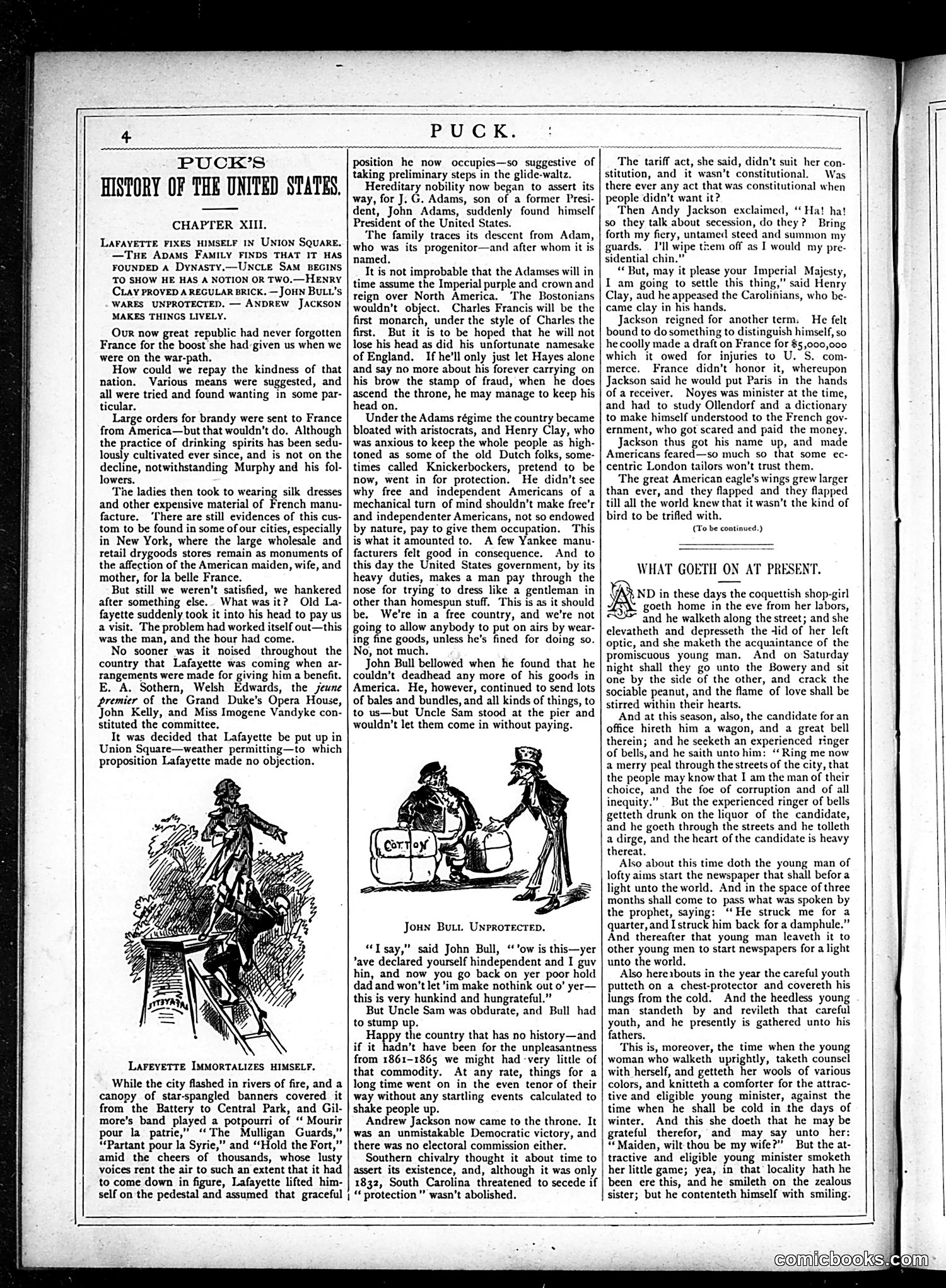
This page contains a serialized history of the United States focusing on Lafayette and the Adams family. The two political cartoons illustrate historical anecdotes: **"John Bull Unprotected"** (left) depicts Britain's vulnerability, with the figure of John Bull (personification of Britain) exposed and defenseless—likely commenting on American independence and Britain's loss of colonial protection. **"Lafayette Immortalizes Himself"** (right) shows Lafayette on a pedestal amid cheering crowds, celebrating his heroic status in American Revolutionary history. The text discusses Lafayette's fame, American tariffs, and Andrew Jackson's political rise. The "What Goeth On at Present" section satirizes contemporary (1830s-era) social conditions: corrupt politicians, drunken campaigning, and the selling of public offices—criticizing democratic politics as degraded and transactional.
📄 Transcribed text from this page (OCR, searchable)
Machine-transcribed from the original scan — historical spelling and the odd misread are preserved.
4 PUCK’S HISTORY OF THE UNITED STATES. CHAPTER XIII. LAFAYETTE FIXES HIMSELF IN UNION SQUARE. —Tue ADAMS FAMILY FINDS THAT IT HAS FouNDED A Dynasty.—UNCLE SAM BEGINS TO SHOW HE HAS A NOTION OR TWO.—HENRY CLAY PROVED A REGULAR BRICK. — JOHN BULL's WARES UNPROTECTED. — ANDREW JACKSON MAKES THINGS LIVELY. Our now great republic had never forgotten France for the boost she had-given us when we were on the war-path. How could we repay the kindness of that nation. Various means were suggested, and all were tried and found wanting in some par- ticular. Large orders for brandy were sent to France from America—but that wouldn't do. Although the practice of drinking spirits has been sedu- lously cultivated ever since, and is not on the decline, notwithstanding Murphy and his fol- lowers. ‘The ladies then took to wearing silk dresses and other expensive material of French manu- facture. ‘There are still evidences of this cus- tom to be found in some of our cities, especially in New York, where the large wholesale and retail drygoods stores remain as monuments of the affection of the American maiden, wife, and mother, for la belle France. But still we weren't satisfied, we hankered after something else. What was it? Old La- fayette suddenly took it into his head to pay us a visit. The problem had worked itself out—this was the man, and the hour had come. No sooner was it noised throughout the country that Lafayette was coming when ar- rangements were made for giving him a benefit. E. A. Sothern, Welsh Edwards, the jeune premier of the Grand Duke’s Opera House, John Kelly, and Miss Imogene Vandyke con- stituted the committee. It was decided that Lafayette be put up in Union Square—weather permitting—to which proposition Lafayette made no objection. LAFEYETTE IMMORTALIZES HIMSELF. While the city flashed in rivers of fire, and a canopy of star-spangled banners covered it from the Battery to Central Park, and Gil- more’s band played a potpourri of ‘ Mourir pour la patrie,” ‘The Mulligan Guards,” “Partant pour la Syrie,” and ‘Hold the Fort,” amid the cheers of thousands, whose lusty voices rent the air to such an extent that it had to come down in figure, Lafayette lifted him- position he now occupics—so suggestive of taking preliminary steps in the glide-waltz. Hereditary nobility now began to assert its way, for J. G. Adams, son of a former Presi- dent, John Adams, ‘suddenly found himself President of the United States. The family traces its descent from Adam, who was its progenitor—and after whom it is named. It is not improbable that the Adamses will in time assume the Imperial purple and crown and reign over North America. The Bostonians wouldn’t object. Charles Francis will be the first monarch, under the style of Charles the first. But it is to be hoped that he will not lose his head as did his unfortunate namesake of England. If he'll only just let Hayes alone and say no more about his forever carrying on his brow the stamp of fraud, when he does ascend the throne, he may manage to keep his head on. Under the Adams régime the country became bloated with aristocrats, and Henry Clay, who was anxious to keep the whole people as high- toned as some of the old Dutch folks, some- times called Knickerbockers, pretend to be now, went in for protection. He didn’t see why free and independent Americans of a mechanical turn of mind shouldn’t make free'r and independenter Americans, not so endowed by nature, pay to give them occupation. This is what it amounted to, A few Yankee manu- facturers felt good in consequence. And to this day the United States government, by its heavy duties, makes a man pay through the nose for trying to dress like a gentleman in other than homespun stuff. This is as it should be. We're in a free country, and we're not going to allow anybody to put on airs by wear- ing fine goods, unless he’s fined for doing so. No, not much. John Bull bellowed when he found that he couldn’t deadhead any more of his goods in America. He, however, continued to send lots of bales and bundles, and all kinds of things, to to us—but Uncle Sam stood at the pier and wouldn’t let them come in without paying. Joun Butt. Unprotecten. “Tsay,” said John Bull, ‘’ow is this—yer ’ave declared yourself hindependent and I guv hin, and now you go back on yer poor hold dad and won't let im make nothink out 0’ yer— this is very hunkind and hungrateful.” But Uncle Sam was obdurate, and Bull had to stump up. Happy the country that has no history—and if it hadn’t have been for the unpleasantness from 1861-1865 we might had -very little of that commodity. At any rate, things for a long time went on in the even tenor of their way without any startling events calculated to shake people up. Andrew Jackson now came to the throne. It was an unmistakable Democratic victory, and there was no electoral commission either. Southern chivalry thought it about time to assert its existence, and, although it was only 1832, South Carolina threatened to secede if self on the pedestal and assumed that graceful | “ protection” wasn’t abolished. The tariff act, she said, didn’t suit her con- stitution, and it wasn’t constitutional. Was there ever any act that was constitutional when people didn’t want it? Then Andy Jackson exclaimed, “Ha! ha! so they talk about secession, do they? Bring forth my fiery, untamed steed and summon my guards. I'll wipe them off as I would my pre- sidential chin.” «But, may it please your Imperial Majesty, I am going to settle this thing,” said Henry Clay, aud he appeased the Carolinians, who be- came clay in his hands. Jackson reigned for another term. He felt bound to do something to distinguish himself, so he coolly made a draft on France for $5,000,000 which it owed for injuries to U. S. com- merce. France didn’t honor it, whereupon Jackson said he would put Paris in the hands ofa receiver. Noyes was minister at the time, and had to study Ollendorf and a dictionary to make himself understood to the French gov- ernment, who got scared and paid the money. Jackson thus got his name up, and made Americans feared—so much so that some ec- centric London tailors won't trust them. The great American cagle’s wings grew larger than ever, and they flapped and they flapped till all the world knew that it wasn’t the kind of bird to be trifled with. (To be continued.) WHAT GOETH ON AT PRESENT. xo in these days the coquettish shop-girl ZAX goeth home in the eve from her labors, “** and he walketh along the street; and she elevatheth and depresseth the did of her left optic, and she maketh the acquaintance of the promiscuous young man. And on Saturday night shall they go unto the Bowery and sit one by the side of the other, and crack the sociable peanut, and the flame of love shall be stirred within their hearts. And at this season, also, the candidate for an office hireth him a wagon, and a great bell therein; and he seeketh an experienced ringer of bells, and he saith unto him: “Ring me now a merry peal through the streets of the city, that the people may know that I am the man of their choice, and the foe of corruption and of all inequity.” But the experienced ringer of bells getteth drunk on the liquor of the candidate, and he goeth through the streets and he tolleth a dirge, and the heart of the candidate is heavy thereat. Also about this time doth the young man of lofty aims start the newspaper that shail befor a light unto the world. And in the space of three months shall come to pass what was spoken by the prophet, saying: “He struck me for a quarter, and I struck him back for a damphule.” And thereafter that young man leaveth it to other young men to start newspapers for a light unto the world. Also hereabouts in the year the careful youth putteth on a chest-protector and covereth his lungs from the cold. And the heedless young man standeth by and revileth that careful youth, and he presently is gathered unto his fathers. ‘This is, moreover, the time when the young woman who walketh uprightly, taketh counsel with herself, and getteth her wools of various colors, and knitteth a comforter for the attrac- tive and eligible young minister, against the time when he shall be cold in the days of winter, And this she doeth that he may be grateful therefor, and may say unto her: “Maiden, wilt thou be my wife?” But the at- tractive and eligible young minister smoketh her little game; yea, in that locality hath he been ere this, and he smileth on the zealous sister; but he contenteth himself with smiling.