
A complete issue · 16 pages · 1877
Puck — October 17, 1877
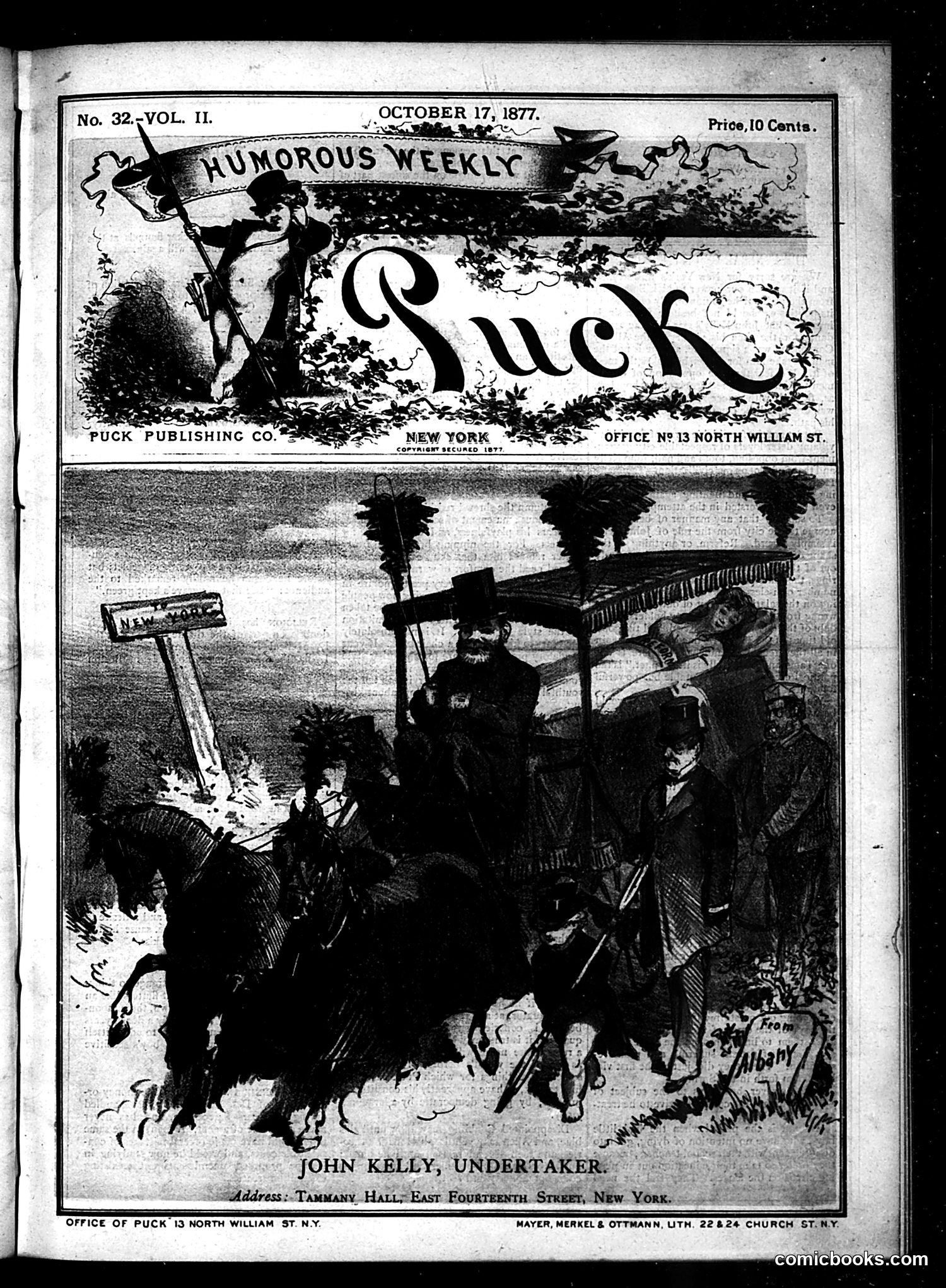
This satirical cartoon depicts **John Kelly, Undertaker**, addressing what appears to be a funeral gathering at Tammany Hall in New York. The setup is a visual pun: Kelly, a prominent Tammany Hall political figure, is shown as a literal undertaker presiding over a coffin beneath a wooden structure. The satire likely comments on the political "death" or decline of Tammany Hall's power or a specific faction within it during the 1870s. The coffin and funeral imagery serve as dark political commentary on corruption or failure within New York City politics. The text identifies his address as Tammany Hall, East Fourteenth Street, New York—the headquarters of the notorious Democratic political machine.
This page is primarily **text-based editorial content** rather than illustrated political cartoons. The main sections include: 1. **"The Funeral of City Reform"** — satirizing New York's failed reform efforts under John Kelly, suggesting reform movements lack staying power without strong leadership. 2. **"Autumn"** — a seasonal essay reflecting on autumn as a transitional period, using it metaphorically to discuss social decline and educational neglect. 3. **"Hayes Weathers the Storm"** — commentary on President Hayes navigating political turbulence, praising his steadfastness amid Democratic opposition. The **"Puckerings"** column offers brief satirical observations on contemporary topics including influenza, hunting, and social customs. No major political figures are prominently caricatured here; instead, Puck employs written satire targeting institutional failures and political personalities through argumentative prose rather than visual commentary.
This page contains three separate prose articles rather than political cartoons: 1. **"What Goeth On at Present"** - A satirical commentary on urban winter life, mocking a fashionable barber's pretentious behavior and the shallow vanities of city society. 2. **"Rural Pleasures"** - A humorous account of the author's country boarding experience, contrasting idealized rural life with its actual hardships (poor water, meager meals, uncomfortable accommodations). The satire targets romantic notions of pastoral life. 3. **"Bercher"** and brief notes on Vassar College and Deadwood City society - Short miscellaneous items about social issues. The page's satire focuses on **class distinctions and lifestyle illusions**—both urban affectation and rural romanticism are debunked as equally foolish. The humor derives from exposing gaps between expectation and reality.
This page from *Puck* contains primarily **literary content rather than political cartoons**. The main pieces are: - **"Lines to Bess"** — a poem by a law student, appearing to be romantic verse addressing someone named Bess, with playful legal references - **"A Tale of Troy"** — a narrative story about a deacon's family and their domestic troubles, featuring their sons and various household misadventures The page includes **no identifiable political caricatures or satirical cartoon imagery** visible in the reproduction. It represents *Puck*'s literary/humor content rather than its signature political satire. The humor appears social and domestic rather than topical or political in nature.
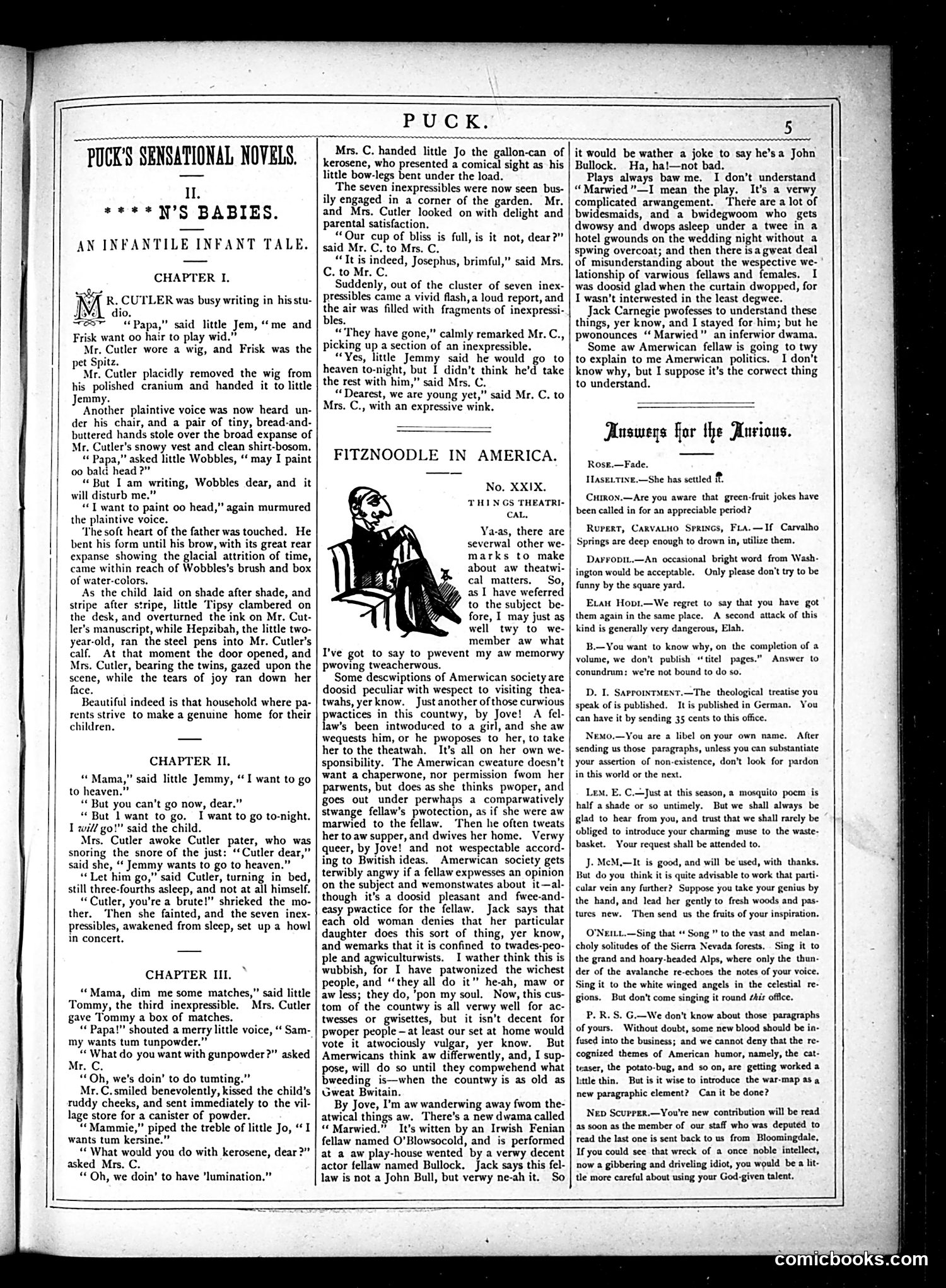
This page contains serialized fiction rather than political satire. The main content includes: **"Puck's Babies"** — a humorous serial story about Mr. Cutler, whose children cause domestic chaos. The narrative depicts Victorian-era parenting challenges: children demanding matches, kerosene, and other dangerous items; a father removing wigs from his head; children's mischief disrupting household order. **"Fitznoodle in America"** — a theatrical column discussing American society and theater practices, with commentary on how Americans treat visiting performers and their attitudes toward entertainment. The page functions as entertainment literature rather than political commentary. The humor derives from domestic situations and social observations typical of 1880s-90s American magazine content, aimed at middle-class family readership.
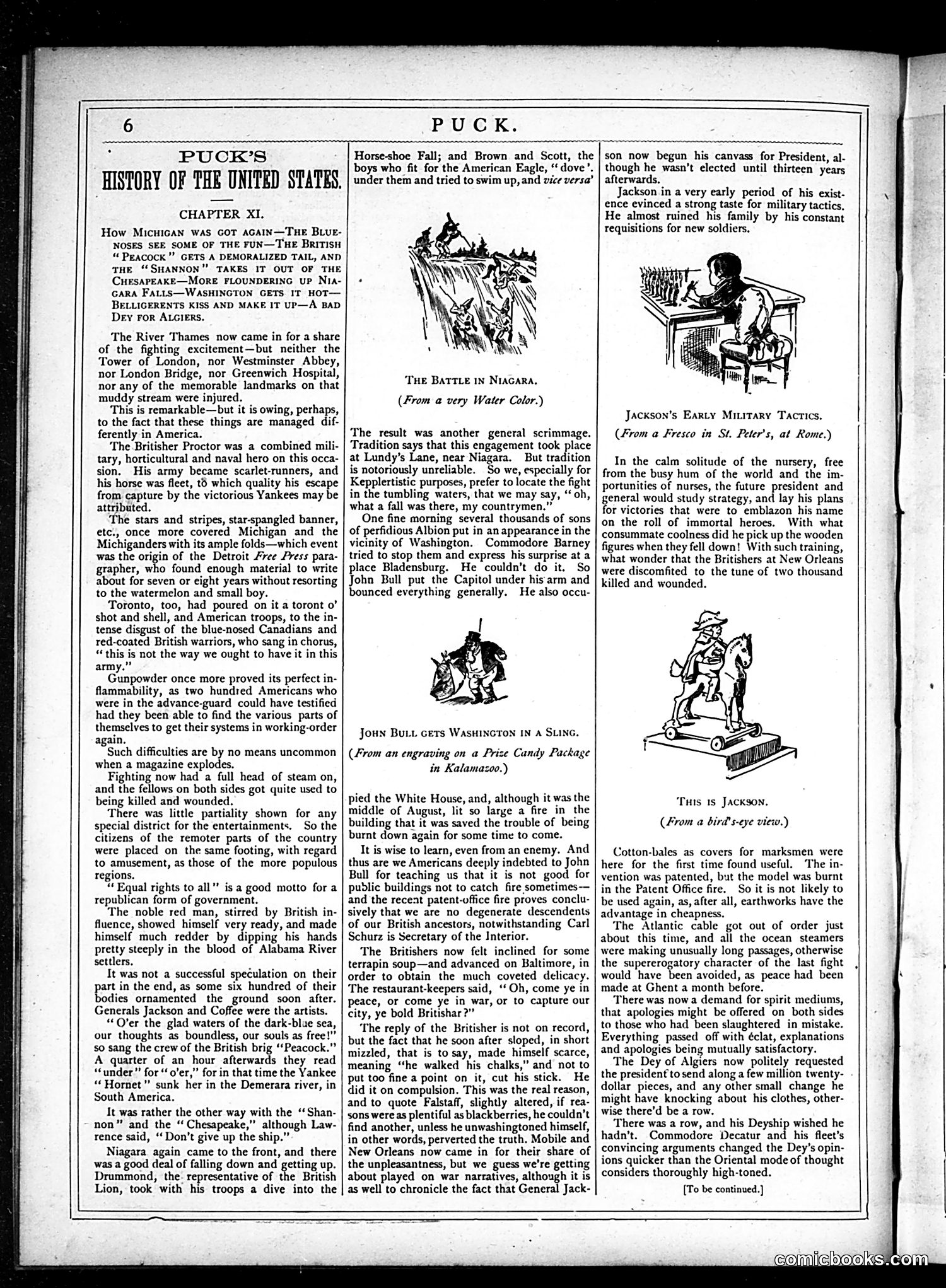
This page is primarily **text-based historical content**, not satirical cartoons. It's Chapter XI of "Puck's History of the United States," covering the War of 1812, specifically battles around Michigan and Niagara. The few illustrations are **historical vignettes** rather than political satire: - "The Battle in Niagara" (a water-color sketch) - "John Bull gets Washington in a Sling" (depicting British military action) - "This is Jackson" (showing Andrew Jackson) The text discusses American military engagements, with satirical commentary embedded in the narrative—mocking British confidence, praising American resilience, and using humorous anecdotes about military figures. The page represents Puck's approach of combining historical education with comedic nationalist perspective rather than pure editorial cartooning.
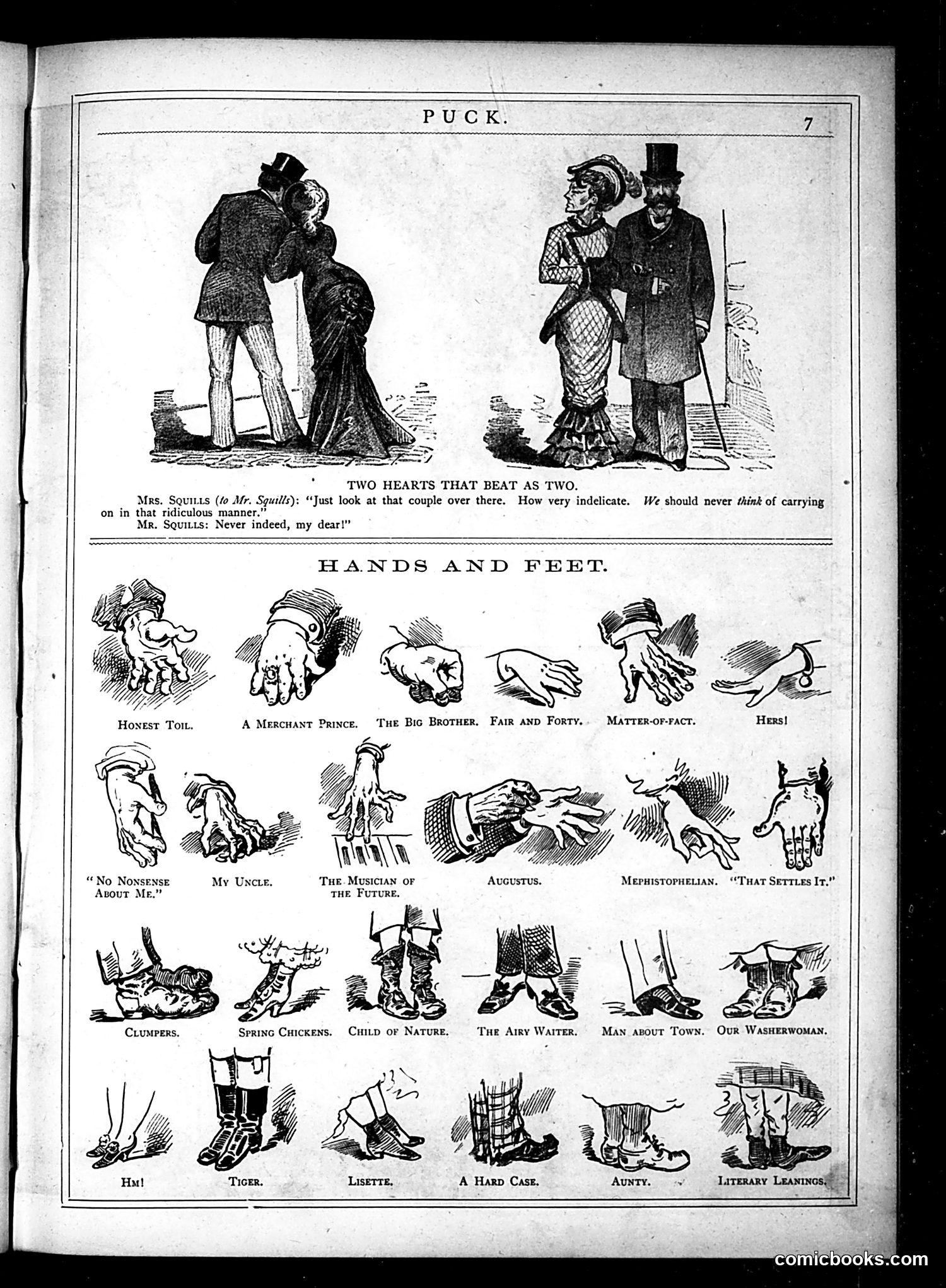
The upper cartoon mocks excessive public displays of affection. Mrs. Soulis criticizes a couple's intimate behavior as "ridiculous" and "indelicate," while Mr. Soulis agrees they shouldn't display such conduct openly—reflecting Victorian-era anxieties about propriety in public spaces. The lower section, "Hands and Feet," presents a series of visual puns depicting hands and feet in various poses, each captioned with witty labels like "Honest Toil," "A Merchant Prince," "The Big Brother," and "Augustus." These appear to be character or social-type commentary through exaggerated gesture, typical of Puck's satirical approach to class and social behavior. The overall page satirizes contemporary manners and social pretension.
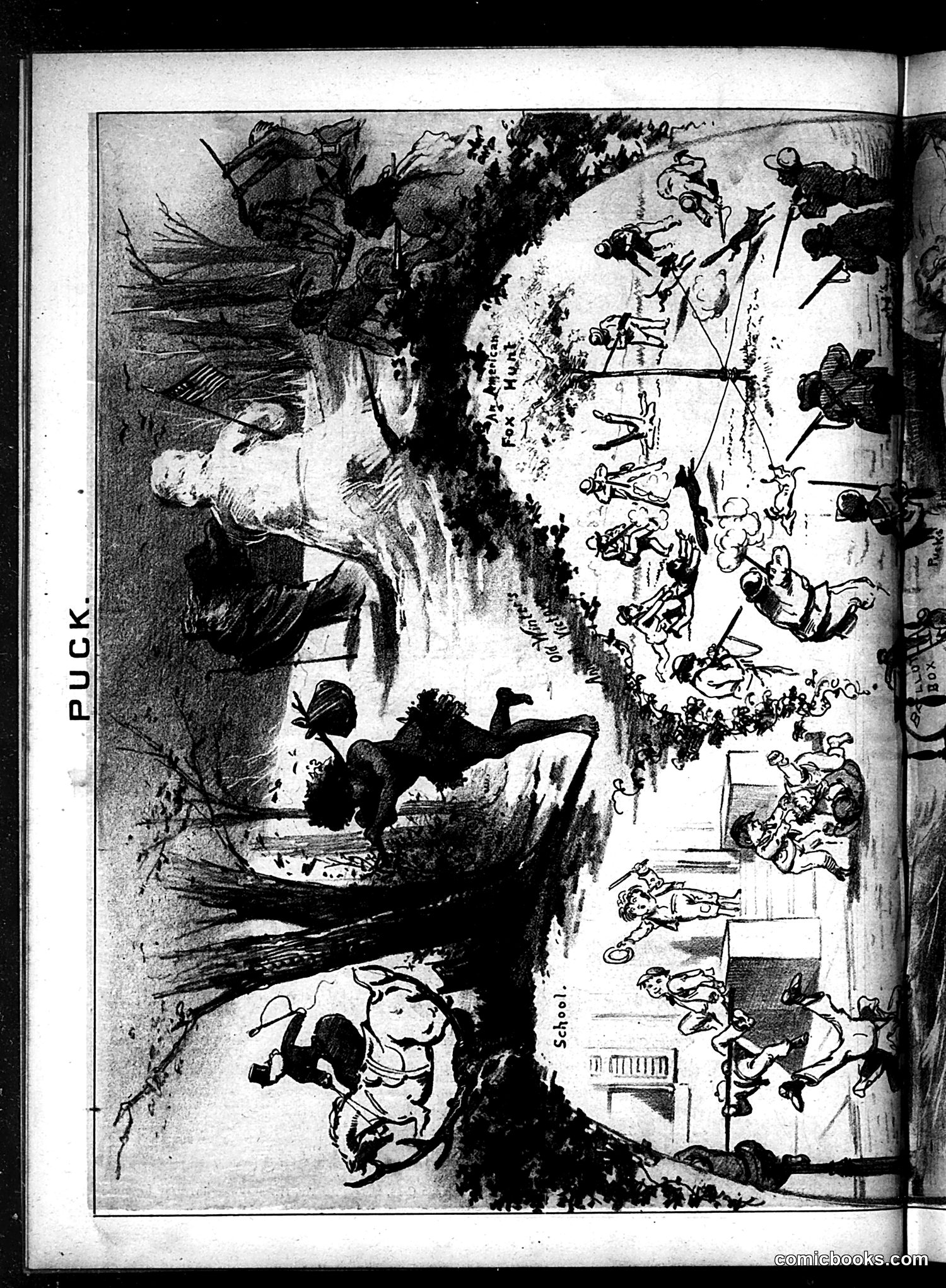
This page from *Puck* magazine appears to be rotated 90 degrees. When viewed correctly, it shows a satirical scene labeled "PUCK" on the left margin and what seems to be "School" noted on the right. The central image depicts what appears to be a chaotic schoolroom scene with numerous child figures in exaggerated poses, suggesting disorder or misbehavior. An adult figure (likely a teacher) looms large on the left side, apparently overwhelmed by the pandemonium. The satire likely critiques either school discipline problems, teaching challenges, or possibly educational policies of the era. The cartoonist exaggerates the children's wild behavior to mock either incompetent schooling or unruly student conduct, though the specific historical reference remains unclear without additional context or clearer OCR text.
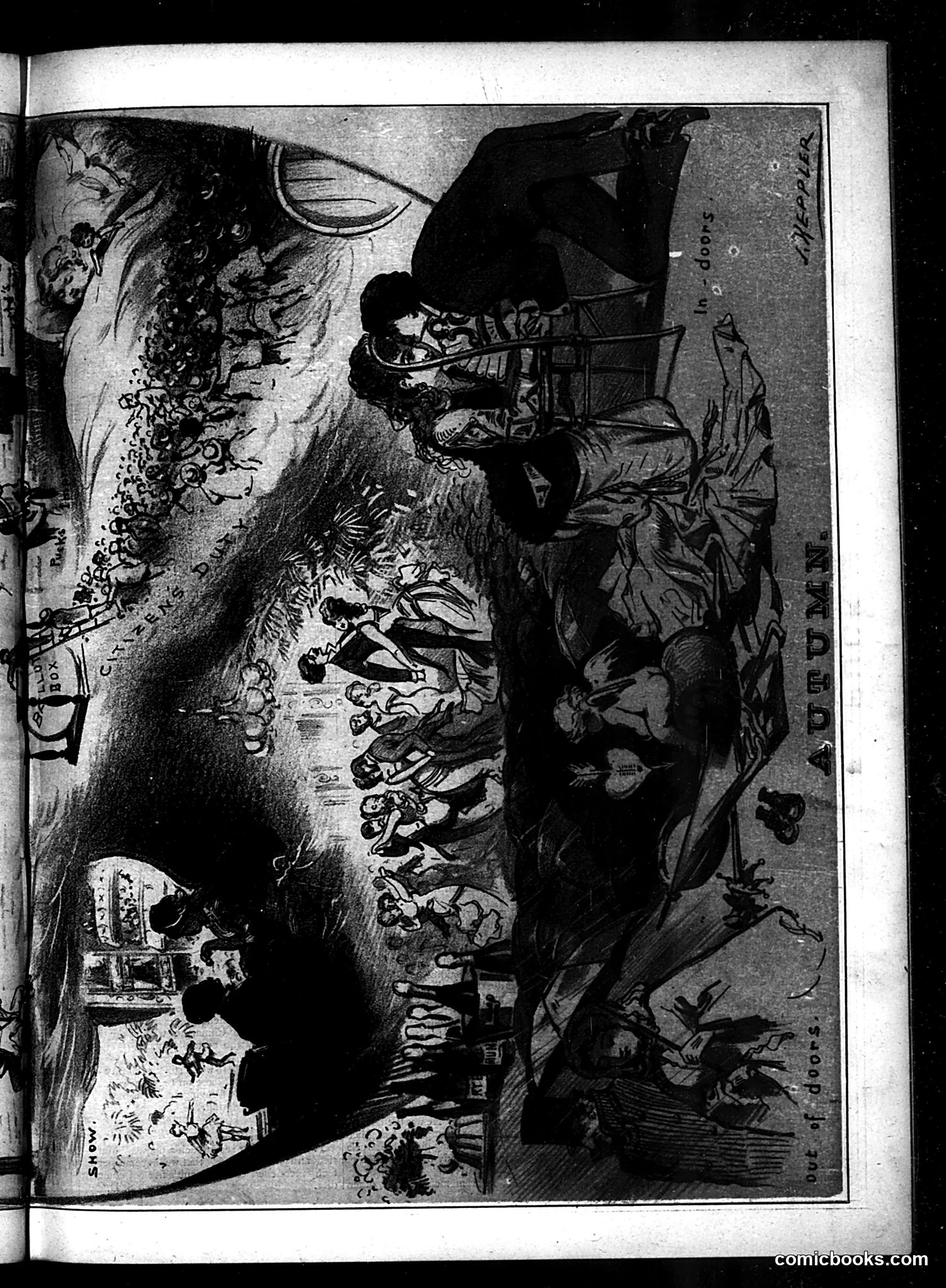
I can see this is a page from *Puck* magazine, but the image quality and rotation make it difficult to read the OCR text clearly or identify specific figures with certainty. The illustration appears to be a satirical scene with multiple characters in what looks like a crowded, chaotic setting, rendered in the typical black-and-white engraving style of *Puck*. Without being able to reliably read the accompanying text or caption, I cannot confidently identify which historical or political figures are being caricatured, what specific event is being referenced, or what the intended satirical message is. To provide accurate historical context rather than speculation, I would need a clearer image or legible text identifying the cartoon's subject and date.
This page is primarily **text content** — a letter to the editor titled "That Ideal Drama Again," dated New York, October 17th, 1877, signed by Silas Drift. The letter **critiques a new theatrical production** called "Atlantis," a comedy-drama in four acts. The writer discusses its structural flaws: excessive length, unclear plot development, and an implausible finale involving Joseph's birth. He praises the cast (particularly Miss Imogene Vandyke) but notes the dog received more applause than the actors. The cartoon illustration at top-left shows a theatrical mask or demon face, likely symbolizing **dramatic criticism or theatrical satire**. This is **theater criticism disguised as satire** — typical of Puck's role commenting on contemporary New York cultural institutions, with humor aimed at both the play's quality and audience reactions.
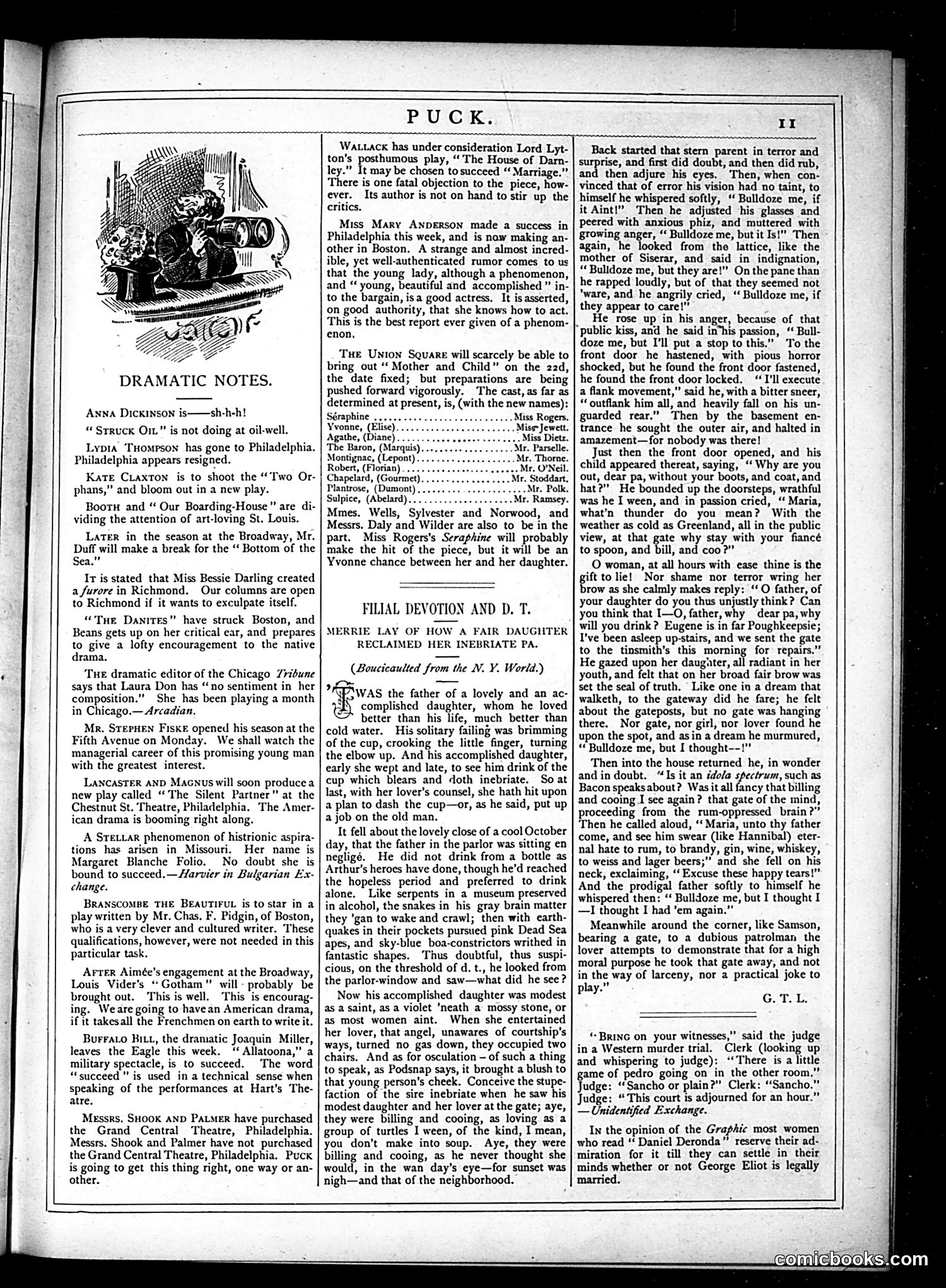
This page contains theatrical notes and reviews rather than political satire. The illustration shows a caricatured figure with exaggerated features in period dress, but the accompanying text focuses on stage performances and actors of the era. The "Dramatic Notes" section discusses various theatrical productions and performers, including Anna Dickinson, Kate Clayton, and others. There's particular emphasis on a story titled "Filial Devotion and D.T." about a father who abstains from drinking to impress his accomplished daughter, but later struggles with temptation. The content reflects Puck's theatrical criticism and gossip rather than political commentary. Without clearer identification of the figure in the illustration, its specific satirical target remains unclear, though it appears to reference stage personalities of the period.
This page contains **Chapter XVIII of "Two Knaves and a Queen," a serialized English story by Frank Barrett** — not a political cartoon. The text is narrative fiction about M. de Gaillefontaine, a French character, and his interactions with an English woman named Renée. The passage describes Gaillefontaine's attempts to win Renée's affection through various schemes involving her home and social position. It includes dialogue about transforming her English country estate into a more fashionable French-style palace, with references to theatrical scenery and artistic improvements. This is **literary content rather than political satire**—a serialized novel typical of Puck's editorial mix, alongside its more famous satirical cartoons and commentary.
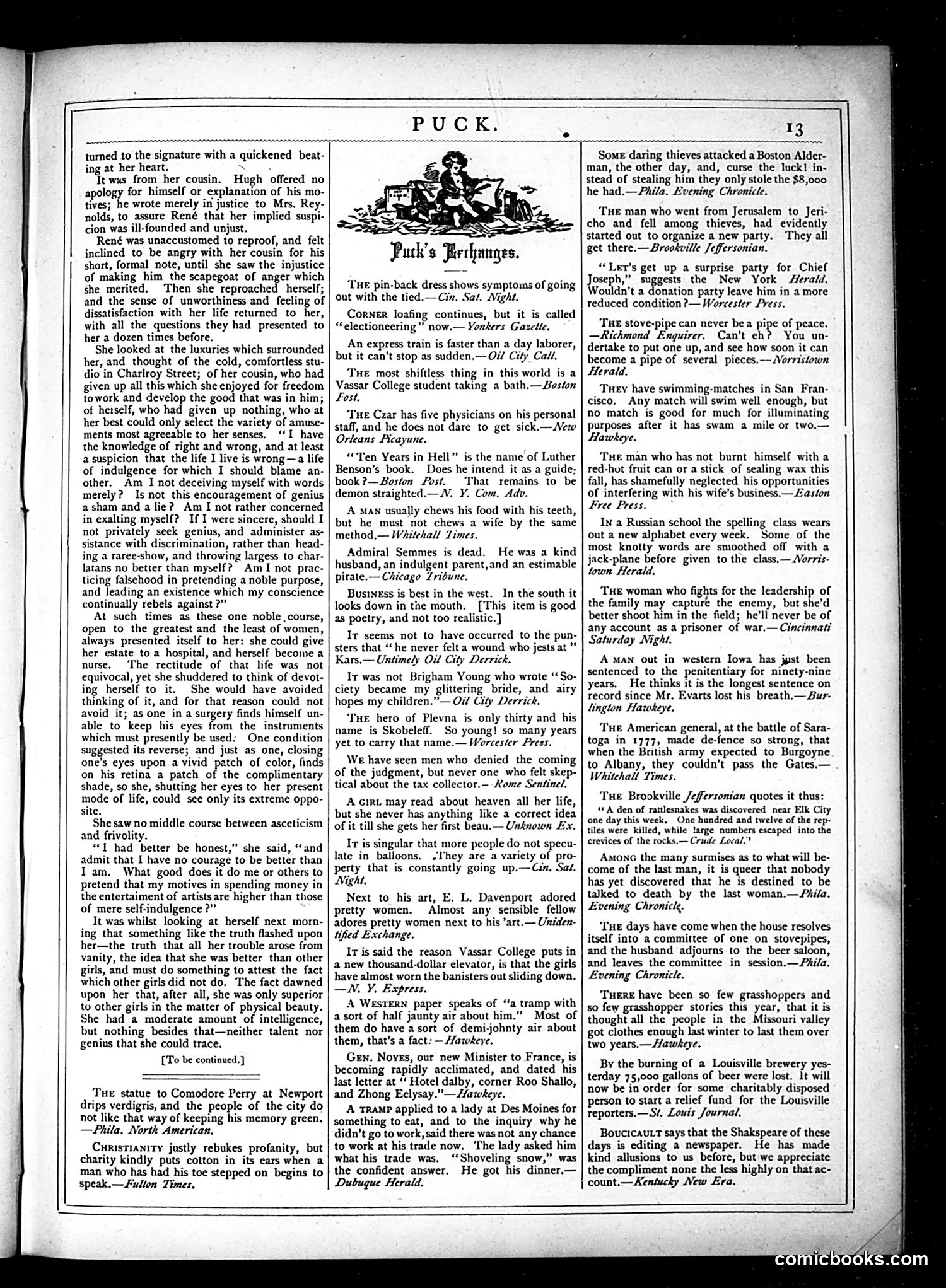
This page contains **no political cartoon**, but rather a humor column titled "Puck's Persiflage" — a collection of brief satirical quips and witticisms about contemporary American life. The jokes target various subjects: medical pretension (a doctor with five physicians on staff), college student bathing habits, marriage dynamics, business practices, and social hypocrisy. Several items mock specific publications like the *Boston Herald* and *Chicago Tribune*. The column's tone is lighthearted social satire rather than political commentary — poking fun at universal human foibles: vanity, laziness, contradictions between professed values and actual behavior. The humor relies on wordplay and ironic observations about everyday American society circa the magazine's publication era.
This page consists primarily of **text columns with satirical commentary** rather than political cartoons. The content includes brief humorous anecdotes and social observations on various topics: twine-making processes, wood-wine production, selecting young horses, ice strength in Russia, weight-scaling issues, and elevator exhibitions at a fair. The pieces target specific groups through mild ridicule—incompetent officials, farmers, newspaper editors, and wealthy individuals. One section mocks Americans' "unlimited voracity," while another satirizes pretentious editorial practices. The **tone is light social satire** rather than hard political commentary. A period advertisement for Gaste Fleischmann & Co. appears at bottom. Without identifying specific contemporary figures or events referenced, the page demonstrates Puck's characteristic approach: witty cultural observation aimed at middle-class readers.
This is primarily an **advertising page** from Puck magazine, not a political cartoon page. The content consists entirely of commercial advertisements for various New York businesses and services from the late 19th century. Notable ads include: - **D. Kelly's Carpet & Furniture Warerooms** (major display ad) - **Traphagen & Company** (men's and children's clothing) - **Kurtz Portraits** (photography) - **D'Amayer Hungarian Wines** (beverages) - Various other services (printing inks, champagne, bookbinding, etc.) The page includes a memorial notice for Brigham Young and promotes Puck's own publications (Illustrated Almanac, back numbers available). There are no satirical cartoons or political commentary visible—this represents the magazine's revenue-generating advertising section rather than editorial content.
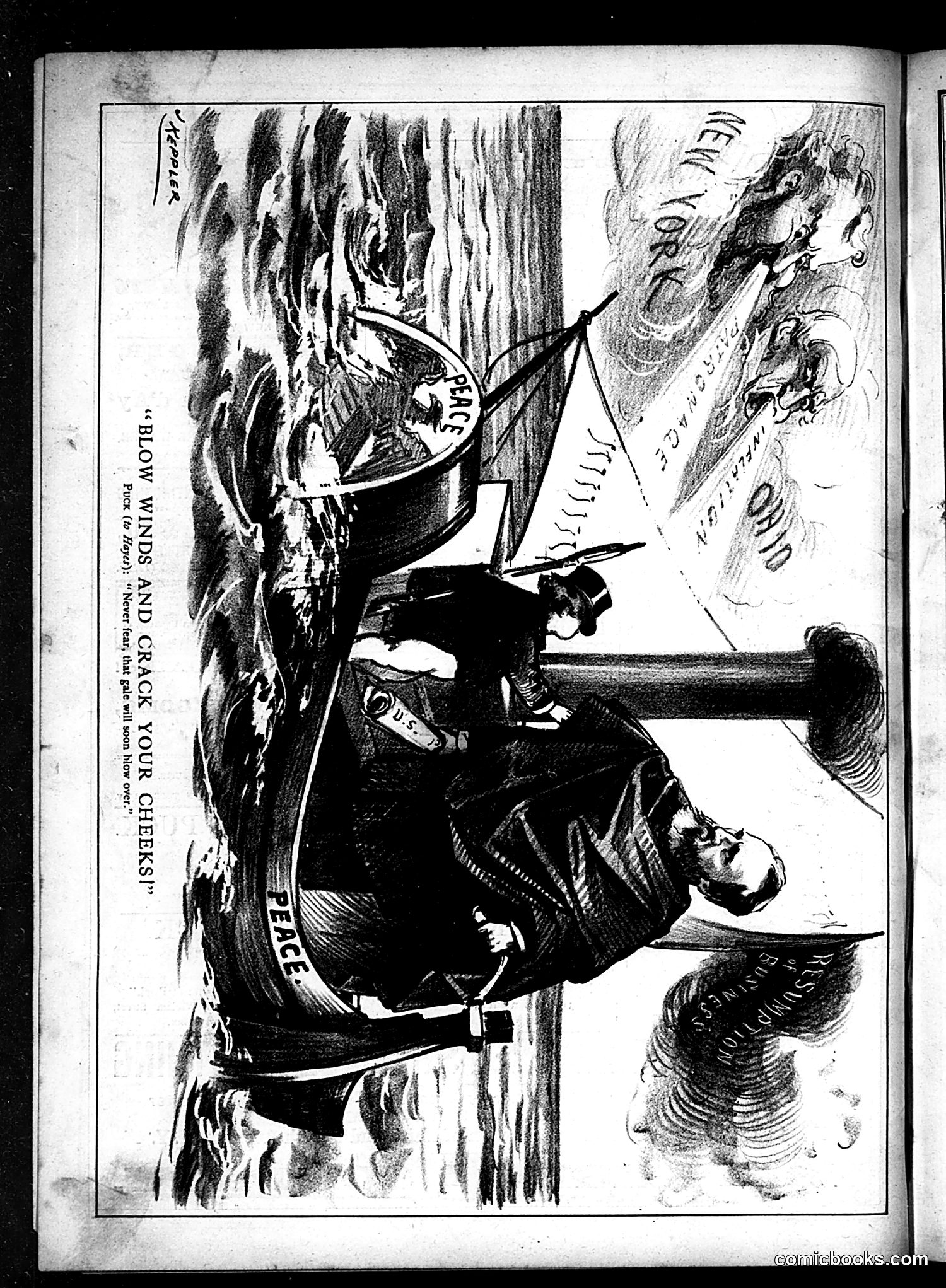
This Puck cartoon depicts a sailor labeled "PEACE" being blown off course by winds labeled "BLOW WINDS AND CRACK YOUR CHEEKS!" The figure appears to be struggling to maintain control of his vessel during a storm. The text on the left reads "BLOW WINDS AND CRACK YOUR CHEEKS! YOUR CHERISH?" (likely a Shakespeare reference). The cartoon satirizes efforts to maintain peace during a period of international turbulence—likely referencing early 20th-century geopolitical tensions. The sailor represents peaceful intentions being overwhelmed by powerful forces beyond individual control. The dramatic storm imagery suggests the satirist's skepticism about whether peaceful resolutions could withstand the mounting pressures of global conflict. The exact historical moment remains unclear without publication date confirmation.