
Puck, 1877-10-17 · page 13 of 16
Puck — October 17, 1877 — page 13: what you’re looking at
What you’re looking at
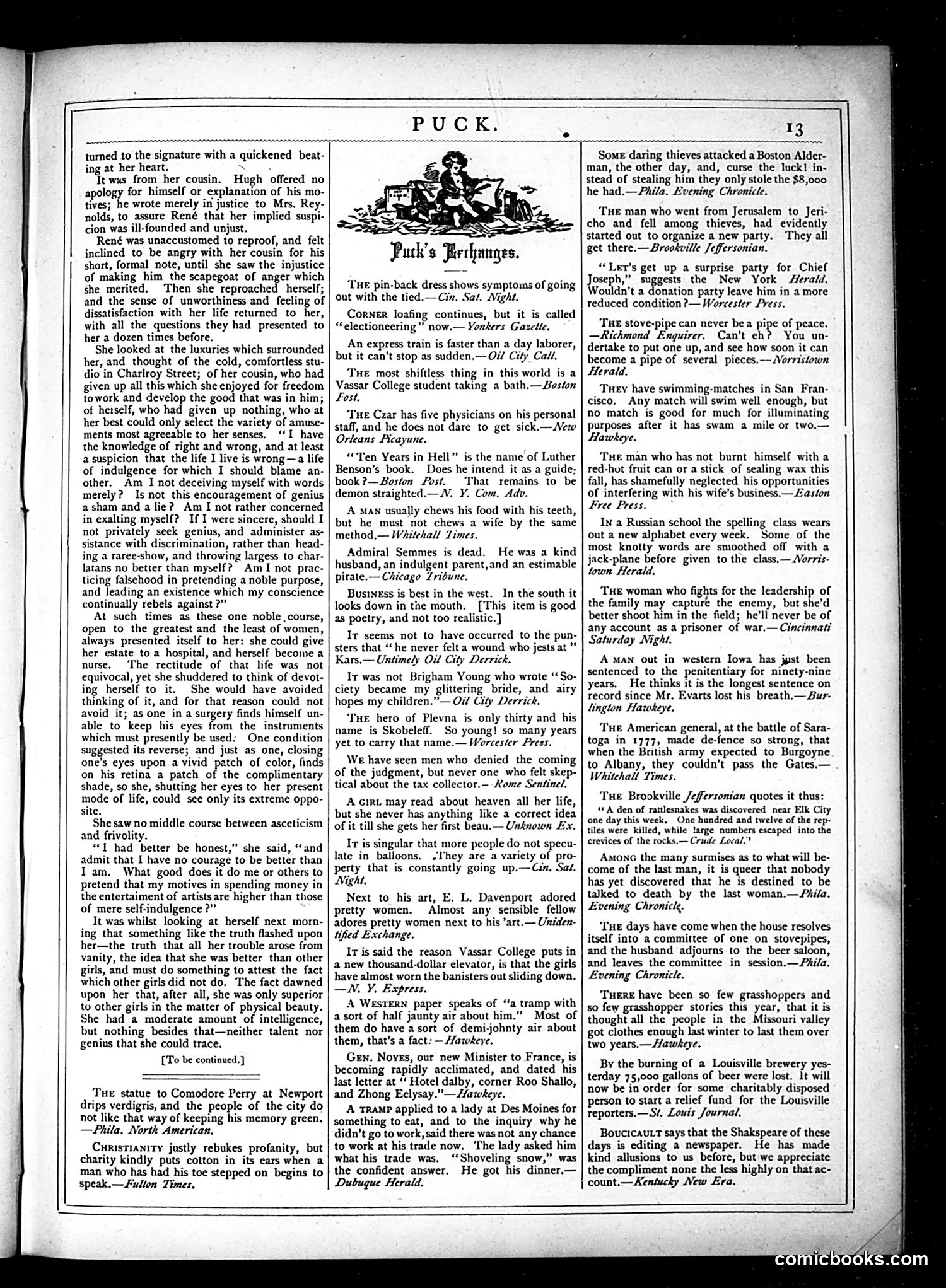
This page contains **no political cartoon**, but rather a humor column titled "Puck's Persiflage" — a collection of brief satirical quips and witticisms about contemporary American life. The jokes target various subjects: medical pretension (a doctor with five physicians on staff), college student bathing habits, marriage dynamics, business practices, and social hypocrisy. Several items mock specific publications like the *Boston Herald* and *Chicago Tribune*. The column's tone is lighthearted social satire rather than political commentary — poking fun at universal human foibles: vanity, laziness, contradictions between professed values and actual behavior. The humor relies on wordplay and ironic observations about everyday American society circa the magazine's publication era.
📄 Transcribed text from this page (OCR, searchable)
Machine-transcribed from the original scan — historical spelling and the odd misread are preserved.
turned to the signature with a quickened_beat- ing at her heart. \ fe was from her cousin. Hugh offered no apology for himself or explanation of his mo- tives; he wrote merely in justice to Mrs. Rey- nolds, to assure René that her implied suspi- cion was ill-founded and unjust. René was unaccustomed to reproof, and felt inclined to be angry with her cousin for his short, formal note, until she saw the injustice of making him the scapegoat of anger which she merited. Then she reproached herself; and the sense of unworthiness and feeling of dissatisfaction with her life returned to her, with all the questions they had presented to her a dozen times before. She looked at the luxuries which surrounded her, and thought of the cold, comfortless stu- dio in Charlroy Street; of her cousin, who had given up all this which she enjoyed for freedom towork and develop the good that was in him; of herself, who had given up nothing, who at her best could only select the variety of amuse- ments most agreeable to her senses. ‘I have the knowledge of right and wrong, and at least asuspicion that the life I live is wrong—a life of indulgence for which I should blame an- other. Am I not deceiving myself with words merely? Is not this encouragement of genius asham and a lie? Am I not rather concerned in exalting myself? If I were sincere, should I not privately seek genius, and administer as- sistance with discrimination, rather than head- ing a raree-show, and throwing largess to char- latans no better than myself? Am I not prac- ticing falsehood in pretending a noble purpose, and eading an existence which my conscience continually rebels against ?” At such times as these one noble course, open to the greatest and the least of women, always presented itself to her: she could give her estate to a hospital, and herself become a nurse. The rectitude of that life was not equivocal, yet she shuddered to think of devot- ing herself to it. She would have avoided thinking of it, and for that reason could not avoid it; as one in a surgery finds himself un- able to keep his eyes from the instruments which must presently be used: One condition suggested its reverse; and just as one, closing one’s eyes upon a vivid patch of color, finds on his retina a patch of the complimentary shade, so she, shutting her eyes to her present mode of life, could see only its extreme oppo- site, She saw no middle course between asceticism and frivolity. “IT had better be honest,” she said, “and admit that I have no courage to be better than I am. What good does it do me or others to pretend that my motives in spending money in the entertaiment of artists are higher than those of mere self-indulgence ?” It was whilst looking at herself next morn- ing that something like the truth flashed upon her—the truth that all her trouble arose from vanity, the idea that she was better than other girls, and must do something to attest the fact which other girls did not do. The fact dawned upon her that, after all, she was only superior to other girls in the matter of physical beauty. She had a moderate amount of intelligence, but nothing besides that—neither talent nor genius that she could trace. [To be continued] Tue statue to Comodore Perry at Newport drips verdigris, and the people of the city do not like that way of keeping his memory green. —Phila, North American. Curistianity justly rebukes profanity, but charity kindly puts cotton in its ears when a man who has had his toe stepped on begins to speak.—Fulton Times. anges. ‘Tue pin-back dress shows symptoms of going out with the tied.— Cin. Sat. Night. Corner loafing continues, but it is called “electioneering” now.— Yonkers Gazelle. An express train is faster than a day laborer, but it can’t stop as sudden.— Oi? City Call. Tue most shiftless thing in this world is a Vassar College student taking a bath.—Boston Fost. ‘Tue Czar has five physicians on his personal staff, and he does not dare to get sick.—New Orleans Picayune. “Ten Years in Hell” is the name of Luther Benson’s book. Does he intend it as a guide: book?— Boston Fost, That remains to be demon straighted.—V. Y. Com. Adv. A MAN usually chews his food with his teeth, but he must not chews a wife by the same method.— Whitehall Times. Admiral Semmes is dead. He was a kind husband, an indulgent parent, and an estimable pirate.— Chicago Tribune. Business is best in the west. In the south it looks down in the mouth. [This item is good as poetry, und not too realistic.) Ir seems not to have occurred to the pun- sters that “he never felt a wound who jests at Kars.— Untimely Oil City Derrick. Ir was not Brigham Young who wrote ‘‘So- ciety became my glittering bride, and airy hopes my children.”— Ov City Derrick. ‘Tue hero of Plevna is only thirty and his name is Skobeleff. So young! so many years yet to carry that name.— Worcester Press. We have seen men who denied the coming of the judgment, but never one who felt skep- tical about the tax collector.— Home Sentinel. A GiRL may read about heaven all her life, but she never has anything like a correct idea of it till she gets her first beau.— Unknown Ex, It is singular that more people do not specu- late in balloons. .'‘They are a variety of pro- perty that is constantly going up.—Cin. Sat. Night. Next to his art, E. L. Davenport adored pretty women. Almost any sensible fellow adores pretty women next to his ’art.— Uniden- tified Exchange. Ivis said the reason Vassar College puts in a new thousand-dollar elevator, is that the girls have almost worn the banisters out sliding down. —N. Y. Express. A WesTERN paper speaks of ‘a tramp with a sort of half jaunty air about him.” Most of them do have a sort of demi-johnty air about them, that’s a fact: — Hawkeye. Gen. Noyes, our new Minister to France, is becoming rapidly acclimated, and dated his last letter at “‘ Hotel dalby, corner Roo Shallo, and Zhong Eelysay."— Hawkeye. A tramp applied to a lady at Des Moines for something to eat, and to the inquiry why he didn’t go to work, said there was not any chance to work at his trade now. The lady asked him what his trade was. ‘‘Shoveling snow,” was the confident answer. He got his dinner.— Dubuque Herald. 13 Some daring thieves attacked a Boston Alder- man, the other day, and, curse the luck! it stead of stealing him they only stole the $8,000 he had.— Phila. Evening Chronicle. ‘Tue man who went from Jerusalem to Jeri- cho and fell among thieves, had evidently started out to organize a new party. They all get there.— Brookville Jeffersonian. “Ler's get up a surprise party for Chief Joseph,” suggests the New York Herald. Wouldn't a donation party leave him in a more reduced condition ?— Worcester Press. ‘Tue stove-pipe can never bea pipe of peace. —Richmond Enquirer. Can't eh? You un- dertake to put one up, and see how soon it can become a pipe of several pieces.— Norristown Herald. Tuey have swimming-matches in San Fran- cisco. Any match will swim well enough, but no match is good for much for illuminating purposes after it has swam a mile or two.— Hawkeye. ‘Te man who has not burnt himself with a red-hot fruit can or a stick of sealing wax this fall, has shamefully neglected his opportunities of interfering with his wife's business.— aston Free Press. In a Russian school the spelling class wears out a new alphabet every week. Some of the most knotty words are smoothed off with a jack-plane before given to the class.—Norris- town Herald. ‘Tue woman who fights for the leadership of the family may capture the enemy, but she’d better shoot him in the field; he'll never be of any account as a prisoner of war.— Cincinnati Saturday Night. A MAN out in western Iowa has jgst been sentenced to the penitentiary for ninety-nine years. He thinks it is the longest sentence on record since Mr. Evarts lost his breath.— Bur- lington Hawkeye. ‘Tue American general, at the battle of Sara- toga in 1777, made de-fence so strong, that when the British army expected to Burgoyne to Albany, they couldn’t pass the Gates.— Whitehall Times. Tue Brookville Jefersonian quotes it thus: “A den of rattlesnakes was discovered near Elk City one day this week. One hundred and twelve of the rep- tiles were killed, while large numbers escaped into the crevices of the rocks.— Crude Local. AMoncG the many surmises as to what will be- come of the last man, it is queer that nobody has yet discovered that he is destined to be talked to death by the last woman.—/iila. Evening Chronicle, ‘wz days have come when the house resolves itself into a committee of one on stovepipes, and the husband adjourns to the beer saloon, and leaves the committee in session.— Phila. Evening Chronicle. ‘Tuere have been so few grasshoppers and so few grasshopper stories this year, that it is thought all the people in the Missouri valley got clothes enough last winter to last them over two years.— Hawkeye. By the burning of a Louisville brewery yes- terday 75,000 gallons of beer were lost. It will now be in order for some charitably disposed person to start a relief fund for the Louisville reporters.—St, Louis Journal, Boucicavtt says that the Shakspeare of these days is editing a newspaper. He has made kind allusions to us before, but we appreciate the compliment none the less highly on that ac- count.— Kentucky New Era. Comicbooks.com