
Puck, 1877-10-17 · page 14 of 16
Puck — October 17, 1877 — page 14: what you’re looking at
What you’re looking at
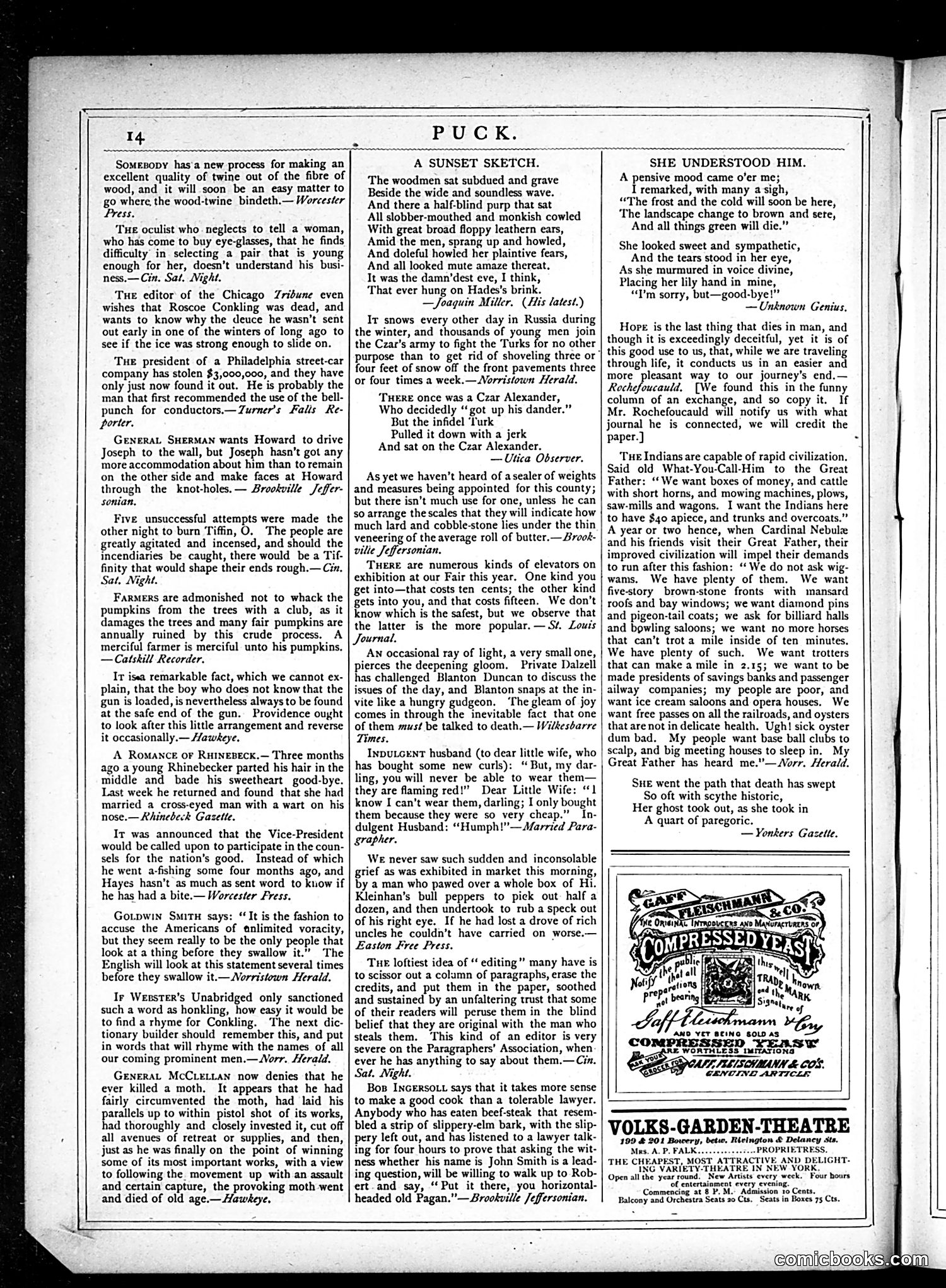
This page consists primarily of **text columns with satirical commentary** rather than political cartoons. The content includes brief humorous anecdotes and social observations on various topics: twine-making processes, wood-wine production, selecting young horses, ice strength in Russia, weight-scaling issues, and elevator exhibitions at a fair. The pieces target specific groups through mild ridicule—incompetent officials, farmers, newspaper editors, and wealthy individuals. One section mocks Americans' "unlimited voracity," while another satirizes pretentious editorial practices. The **tone is light social satire** rather than hard political commentary. A period advertisement for Gaste Fleischmann & Co. appears at bottom. Without identifying specific contemporary figures or events referenced, the page demonstrates Puck's characteristic approach: witty cultural observation aimed at middle-class readers.
📄 Transcribed text from this page (OCR, searchable)
Machine-transcribed from the original scan — historical spelling and the odd misread are preserved.
14 Somesopy has’a new process for making an excellent quality of twine out of the fibre of wood, and it will soon be an easy matter to go where, the wood-twine bindeth.— Worcester Press. ‘Tue oculist who. neglects to tell a woman, who has come to buy eye-glasses, that he finds difficulty’ in selecting a pair that is young enough for her, doesn’t understand his busi- ness.— Cin. Sat, Night. Tue editor of the Chicago Zridune even wishes that Roscoe Conkling was dead, and wants to know why the deuce he wasn’t sent out early in one of the winters of long ago to see if the ice was strong enough to slide on. Tue president of a Philadelphia street-car company has stolen $3,000,000, and they have only just now found it out. He is probably the man that first recommended the use of the bell- punch for conductors.—Zurner’s Falis Re- porter. GENERAL SHERMAN wants Howard to drive Joseph to the wall, but Joseph hasn’t got any more accommodation about him than to remain on the other side and make faces at Howard through the knot-holes.— Brookville Jeffer- sonian. Five unsuccessful attempts were made the other night to burn Tiffin, O. The people are greatly agitated and incensed, and should the incendiaries be caught, there would be a Tif- finity that would shape their ends rough.— Cin. Sat. Night. Farmers are admonished not to whack the pumpkins from the trees with a club, as it damages the trees and many fair pumpkins are annually ruined by this crude process. A merciful farmer is merciful unto his pumpkins. —Calskill Recorder. Ir isea remarkable fact, which we cannot ex- plain, that the boy who does not know that the gun is loaded, is nevertheless always to be found at the safe end of the gun. Providence ought to look after this little arrangement and reverse it occasionally.— Hawkeye. A Romance or Rutnepeck.— Three months ago a young Rhinebecker parted his hair in the middle and bade his sweetheart good-bye. Last week he returned and found that she had married a cross-eyed man with a wart on his nose.— Khinebeck Gazette, It was announced that the Vice-President would be called upon to participate in the coun- sels for the nation’s good. Instead of which he went a-fishing some four months ago, and Hayes hasn't as much as sent word to know if he has had a bite.— Worcester Fress. Gotpwin SsitH says: ‘It is the fashion to accuse the Americans of anlimited voracity, but they seem really to be the only people that look at a thing before they swallow it.” The English will look at this statement several times before they swallow it.— Norristown Herald. Ir Wesster’s Unabridged only sanctioned such a word as honkling, how easy it would be to find a rhyme for Conkling. The next dic- tionary builder should remember this, and put in words that will rhyme with the names of all our coming prominent men.—Norr. Herald. GeNneERAL MCCLELLAN now denies that he ever killed a moth. It appears that he had fairly circumvented the moth, had laid his parallels up to within pistol shot of its works, had thoroughly and closely invested it, cut off all avenues of retreat or supplies, and then, just as he was finally on the point of winning some of its most important works, with a view to following the. movement up with an assault and certain capture, the provoking moth went and died of old age.— Hawkeye, A SUNSET SKETCH. The woodmen sat subdued and grave Beside the wide and soundless wave. And there a half-blind purp that sat All slobber-mouthed and monkish cowled With great broad floppy leathern ears, Amid the men, sprang up and howled, And doleful howled her plaintive fears, And all looked mute amaze thereat, It was the damn’dest eve, I think, That ever hung on Hades'’s brink. —Joaquin Miller, (His latest.) Ir snows every other day in Russia during the winter, and thousands of young men join the Czar's army to fight the Turks for no other purpose than to get rid of shoveling three or | four feet of snow off the front pavements three or four times a week.— Norristown Herald. ‘THERE once was a Czar Alexander, Who decidedly “got up his dander.” But the infidel ‘Turk Pulled it down with a jerk And sat on the Czar Alexander. — Utica Observer. As yet we haven’t heard of asealer of weights and measures being appointed for this county; but there isn’t much use for one, unless he can so arrange the scales that they will indicate how much lard and cobble-stone lies under the thin veneering of the average roll of butter.—Brook- vilie Jeffersonian, ‘THERE are numerous kinds of elevators on exhibition at our Fair this year. One kind you get into—that costs ten cents; the other kind gets into you, and that costs fifteen. We don’t know which is the safest, but we observe that the latter is the more popular. —S¢. Louis Journal. An occasional ray of light, a very small one, pierces the deepening gloom. Private Dalzell has challenged Blanton Duncan to discuss the issues of the day, and Blanton snaps at the in- vite like a hungry gudgeon. ‘The gleam of joy comes in through the inevitable fact that one of them must be talked to death.— Wilkesbarre Times. Inputcent husband (to dear little wife, who has bought some new curls): “But, my dar- ling, you will never be able to wear them— they are flaming red!” Dear Little Wife: “1 know I can't wear them, darling; I only bought them because they were so very cheap.” In- dulgent Husband: “Humph!"—Married Para- grapher. WE never saw such sudden and inconsolable grief as was exhibited in market this morning, by a man who pawed over a whole box of Hi. Kleinhan’s bull peppers to pick out: half a dozen, and then undertook to rub a speck out of his right eye. If he had lost a drove of rich uncles he couldn’t have carried on worse.— Easton Free Press. Tue loftiest idea of “ editing” many have is to scissor out a column of paragraphs, erase the credits, and put them in the paper, soothed and sustained by an unfaltering trust that some of their readers will peruse them in the blind belief that they are original with the man who steals them. ‘This kind of an editor is very severe on the Paragraphers’ Association, when ever he has anything to say about them.—Cin. Sat, Night. Bos INGERSOLL says that it takes more sense to make a good cook than a tolerable lawyer. Anybody who has eaten beef-steak that resem- bled a strip of slippery-elm bark, with the slip- pery left out, and has listened to a lawyer talk- ing for four hours to prove that asking the wit- ness whether his name is John Smith is a lead- ing question, will be willing to walk up to Rob- ert. and say, ‘Put it there, you horizontal- headed old Pagan.”— Brookville Jeffersonian. SHE UNDERSTOOD HIM. A pensive mood came o’er me; I remarked, with many a sigh, “The frost and the cold will soon be here, ‘The landscape change to brown and sere, And all things green will die.” She looked sweet and sympathetic, And the tears stood in her eye, As she murmured in voice divine, Placing her lily hand in mine, “I’m sorry, but—good-bye!”” — Unknown Genius, Hore is the last thing that dies in man, and though it is exceedingly deceitful, yet it is of this good use to us, that, while we are traveling through life, it conducts us in an easier and more pleasant way to our journey’s end.— Rochepoucauld. [We found this in the funny column of an exchange, and so copy it. If Mr. Rochefoucauld will notify us with what journal he is connected, we will credit the paper.] ‘THe Indians are capable of rapid civilization. Said old What-You-Call-Him to the Great Father: “We want boxes of money, and cattle with short horns, and mowing machines, plows, saw-mills and wagons. I want the Indians here to have $40 apiece, and trunks and overcoats.” A year or two hence, when Cardinal Nebulz and his friends visit their Great Father, their improved civilization will impel their demands to run after this fashion: ‘‘ We do not ask wig- wams. We have plenty of them. We want five-story brown-stone fronts with mansard roofs and bay windows; we want diamond pins and pigeon-tail coats; we ask for billiard halls and bowling saloons; we want no more horses that can’t trot a mile inside of ten minutes, We have plenty of such. We want trotters that can make a mile in 2.15; we want to be made presidents of savings banks and passenger ailway companies; my people are poor, and want ice cream saloons and opera houses. We want free passes on all the railroads, and oysters that are not in delicate health. Ugh! sick oyster dum bad. My people want base ball clubs to scalp, and big meeting houses to sleep in. My Great Father has heard me."—worr. Herald. Sue went the path that death has swept So oft with scythe historic, Her ghost took out, as she took in A quart of paregoric. — Yonkers Gasetle. 10 YET BEING GOLD AS COMPRES. su 2D XE. WORTHLESS IMITATIONS (AIL, FELIS CHMANN & COS. CENCIND ARTICLE VOLKS-GARDEN-THEATRE 199 & 201 Bowery, betie, Rivington & Delancy sts. Open all the year round. ‘of entertainment eve Commencing at 8 P.M. Balcony and Orchestra Seats 20 Cts.