
Puck, 1877-10-17 · page 10 of 16
Puck — October 17, 1877 — page 10: what you’re looking at
What you’re looking at
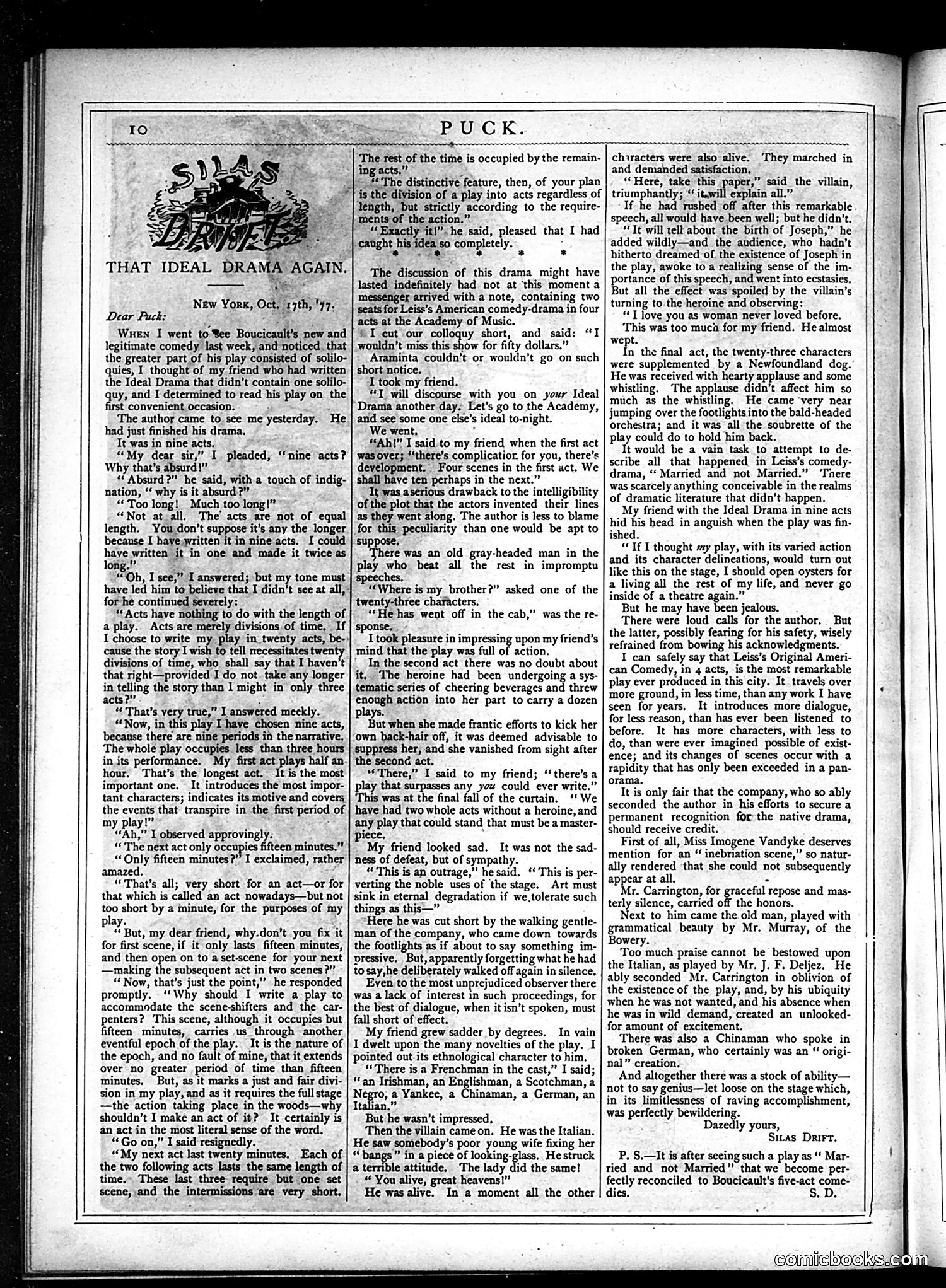
This page is primarily **text content** — a letter to the editor titled "That Ideal Drama Again," dated New York, October 17th, 1877, signed by Silas Drift. The letter **critiques a new theatrical production** called "Atlantis," a comedy-drama in four acts. The writer discusses its structural flaws: excessive length, unclear plot development, and an implausible finale involving Joseph's birth. He praises the cast (particularly Miss Imogene Vandyke) but notes the dog received more applause than the actors. The cartoon illustration at top-left shows a theatrical mask or demon face, likely symbolizing **dramatic criticism or theatrical satire**. This is **theater criticism disguised as satire** — typical of Puck's role commenting on contemporary New York cultural institutions, with humor aimed at both the play's quality and audience reactions.
📄 Transcribed text from this page (OCR, searchable)
Machine-transcribed from the original scan — historical spelling and the odd misread are preserved.
mS Pp uUcK. ‘The rest of the time is occupied by the remain- ing acts.”” © # The distinctive feature, then, of your plan Dear Puck: Wuen I went toSee Boucicault’s new and legitimate comedy last week, and noticed. that the greater part of his play consisted of solilo- uies, I thought of my. friend who had written the Ideal Drama that didn’t contain one solilo- quy, and I determined to read his play on the first convenient occasion. P s The author came to. see me yesterday. He had just finished his drama. Tt was in nine acts. “My dear sir,” I pleaded, ‘nine acts? Why that’s absurd!” “Absurd?” he said, witha touch of indig- nation, ‘‘ why is it absurd?” “Too long! Much too long!” “Not atvall. The’ acts are not of equal length. Youdon’t suppose it’s any the longer because I have.written it in nine acts. I could have written it in one and made it twice as long.” A “Oh, I see,” I answered; but my tone must haye led him to believe that I didn’t see at all, for-he continued severely: “* Acts have nothing to do with the length of a play. Acts are merely divisions of time, If I choose to write m: cause the story I wish to tell necessitates twenty divisions of time, who shall say that I haven't that right—provided I do not. take any longer in telling the story than I might in’ only three acts?” . : “That's very true,” I answered meekly. “Now, in this play [have chosen nine acts, because there are nine periods in the narrative, The whole play occupies less than three hours in.its performance. My first act plays half an. hour. That's the longest act. It is the most important one. It introduces the most impor- tant characters; indicates its motive and covers the events that transpire in the: first period of my play!” “Ah,” I observed approvingly. “The next act only occupies fiteen minutes.” “Only fifteen minutes?’ I exclaimed, rather amazed. “That's all; very short for an act—or for that which is called an act nowadays—but not 0 short by a minute, for the purposes of my lay. R 2 But, my dear friend, why.don’t you fix it for first scene, if it only lasts fifteen minutes, and then open on to aset-scene for your next —making the subsequent act in two scenes?” ‘Now, that’s just the point,” he responded promptly. “Why should I write a play to accommodate the scene-shifters and the car- penters? This scene, although it occupies but fifteen minutes, carries us through another eventful epoch of the play.. It is the nature of the epoch, and no fault of mine, that it extends over no greater period of time than fifteen minutes. But, as it marks a just and fair divi- sion in my play, and as it requires the full stage —the ‘action taking place in the woods—why shouldn't I make an act of it? It certainly is an act in the most literal sense of the word. “Go on,” I said resignedly. - «My next act last twenty minutes, Each of the two following acts lasts the same length of time.~ These last three- require but one set scene, and the intermissions are very short. -play in twenty acts, be-) ‘is. the division of a play into acts regardless of length, but strictly according to the require- ments of the action.” “Exactly it!”. he said, pleased that I had catght his idea'so completely. e208 * 2 * The discussion of this drama might have lasted indefinitely had not at ‘this moment a messenger arrived with a note, containing two seats for Leiss’s American comedy-drama in four acts at the Academy of Music. © I cut our colloquy short, and said: “I wouldn’t miss this show for fifty dollars.” Araminta couldn’t or wouldn’t go on such short notice. I took my friend. “T_will discourse with you on your Ideal Drama another day. Let's go to the Academy, and see some one else's ideal to-night. ‘We went, : *AhI" I said to my friend when the first act was over; ‘‘there’s complicatior. for you, there’s development. Four scenes in the first act. We shall have ten perhaps in the next.” Tt was aserious drawback to the intelligibility ofthe plot that the actors invented their lines as they went along. The author is less to blame for this peculiarity than one would be apt to su x § ere was an old gray-headed man in the play who beat all the rest in impromptu speeches. ‘Where is my brother?” asked one of the twenty-three chafacters. “*He has went off in the cab,” was the re- sponse, I took pleasure in impressing upon my friend’s mind that the play was full of action. ‘In the second act there was no doubt about it, The heroine had been undergoing a sys- tematic series of cheering beverages and threw enough action into her part to carry a dozen plays. But when she made frantic efforts to kick her ‘own back-hair off, it was deemed advisable to suppress her, and she vanished from sight after the second act. “There,” I said to my friend; ‘there's a play that surpasses any you could ever write.” ‘was at the final fall of the curtain. ‘We have had two whole acts without a heroine, and any play that could stand that must be a master- piece. “ My friend looked sad. It was not the sad- ness of defeat, but of sympathy. “This is an outrage,” he said. “This is per- verting the noble uses of ‘the stage. Art must sink in eternal degradation if we.tolerate such things as this—”” ‘Here he was cut short by the walking gentle- man of the company, who came down towards the footlights as if about to say something im- pressive. But, apparently forgetting what he had to say,he deliberately walked off again in silence, Even to the most unprejudiced observer there was a lack of interest in such proceedings, for the best of dialogue, when it isn’t spoken, must fall short of effect. My friend grew sadder by degrees. In vain I dwelt upon the many novelties of the play. I pointed out.its ethnological character to him. “There is a Frenchman in the cast,” I said; ‘an Irishman, an Englishman, a Scotchman, a N 4 ‘0, a Yankee, a Chinaman, a German, an But he wasn’t impressed, ‘Then the villain cameon. He was the Italian. ‘He saw somebody’s poor young wife fixing her “bangs” in a piece of Tooking glass, Hestruck a terrible attitude. ‘The lady did the same! “ You alive, great heavens!” He was alive. In a moment all the other characters were also alive. ‘They marched in and demanded satisfaction. “Here, take this paper,” said_the villain, triumphantly; “‘ it.will explain all.” If he had rushed off after this remarkable speech, all would have.been well; but he didn’t. “It will telt about the birth of Joseph,” he added wildly—and the audience, who hadn’t hitherto dreamed of. the existence of Joseph in the play, awoke to a realizing sense of the im- portance of this speech, and went into ecstasies, But all the effect was spoiled by the villain’s turning to.the heroine and observing: “I love you as woman never loved before. This was too muca for my friend. He almost wept. In the final act, the twenty-three characters were supplemented by a Newfoundland dog. He was received with hearty applause and some whistling. The applause didn’t affect him so much as the whistling. He came ‘very near jumping over the footlights into the bald-headed orchestra; and it was all the soubrette of the play could do to hold him back. It would be a vain task to attempt to de- scribe all that happened in Leiss’s comedy- drama, ‘‘ Married and not Married.” ‘There was scarcely anything conceivable in the realms of dramatic literature that didn’t happen. My friend with the Ideal Drama in nine acts hid his head in anguish when the play was fin- ished. “If I thought my play, with its varied action and its character delineations, would turn out like this on the stage, I should open oysters for a living all the rest of my life, and never go inside of a theatre again.” But he may have been jealous. There were loud calls for the author. But the latter, possibly fearing for his safety, wisely refrained from bowing his acknowledgments. I can safely say that Leiss’s Original Ameri- can Comedy, in 4 acts, is the most remarkable play ever produced in this city. It travels over more ground, in less time, than any work I have seen for years. It introduces more dialogue, for less reason, than has ever been listened to before. It has more characters, with less to do, than were ever imagined possible of exist- ence; and its changes of scenes occur with a rapidity that has only been exceeded in a pan- orama. It is only fair that the company, who so ably seconded the author in his efforts to secure a permanent recognition forthe native drama, should receive credit. First of all, Miss Imogene Vandyke deserves mention for an “ inebriation scene,” so natur- ally rendered that she could not subsequently appear at all. 2 Mr, Cazrington, for graceful repose and mas- terly silence, carried off the honors. Next to him came the old man, played with grammatical beauty by Mr. Murray, of the Bowery. Too much praise cannot be bestowed upon the Italian, as played by Mr. J. F. Deljez. He ably seconded Mr. Carrington in oblivion of the existence of the play, and, by his ubiquity when he was not wanted, and his absence when he was in wild demand, created an unlooked- for amount of excitement. There was also a Chinaman who spoke in broken German, who certainly was an “ origi- nal” creation. And altogether there was a stock of ability— not to say genius—let loose on the stage which, in its limitlessness of raving accomplishment, was perfectly bewildering. Dazedly yours, Sitas Drirt. P. S.—It is after seeing such a play as “ Mar- tied and not Married” that we become per- fectly reconciled to Boucicault’s five-act come- dies. S. D. comichooks.cemm