
Puck, 1877-10-17 · page 6 of 16
Puck — October 17, 1877 — page 6: what you’re looking at
What you’re looking at
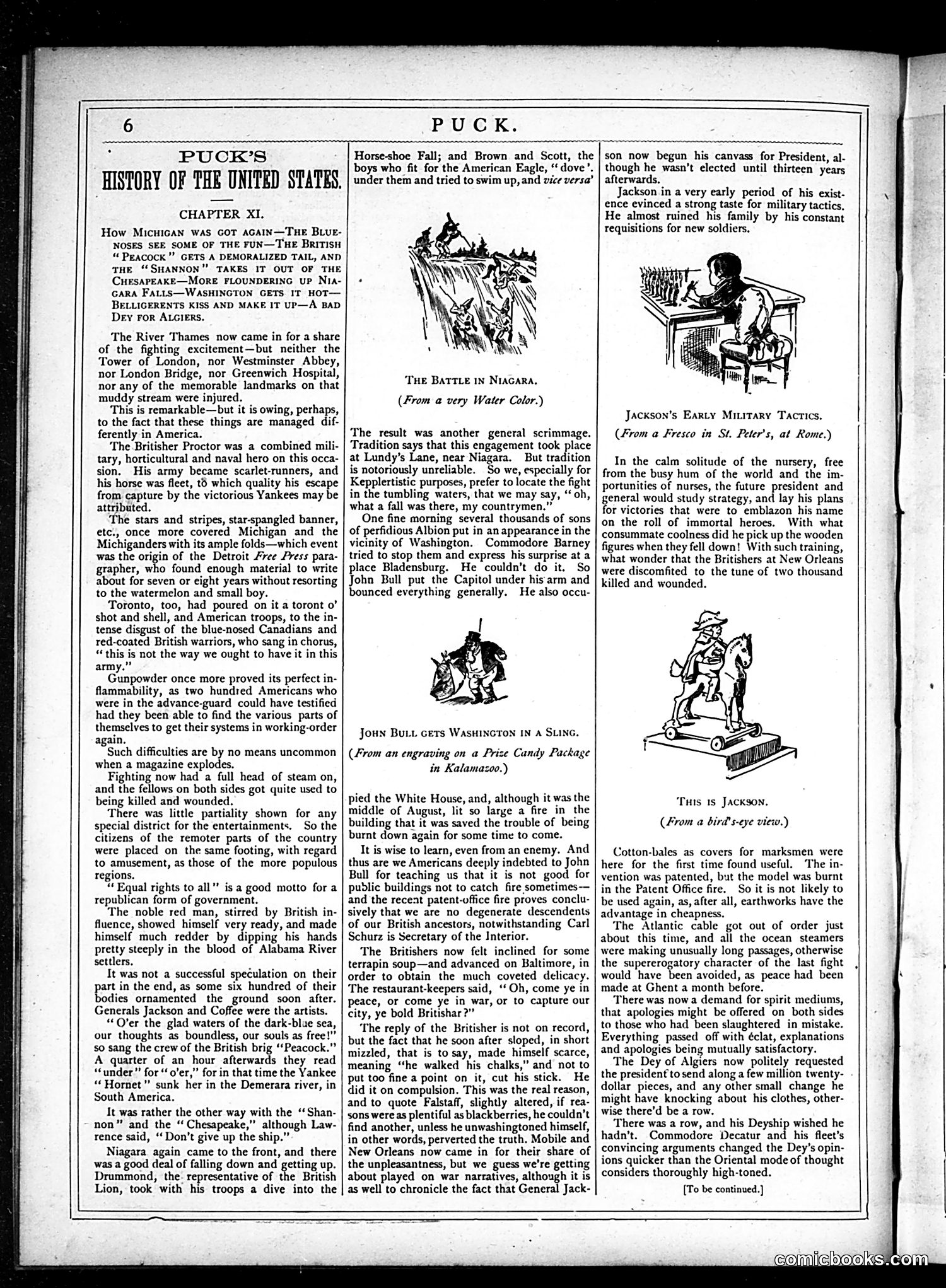
This page is primarily **text-based historical content**, not satirical cartoons. It's Chapter XI of "Puck's History of the United States," covering the War of 1812, specifically battles around Michigan and Niagara. The few illustrations are **historical vignettes** rather than political satire: - "The Battle in Niagara" (a water-color sketch) - "John Bull gets Washington in a Sling" (depicting British military action) - "This is Jackson" (showing Andrew Jackson) The text discusses American military engagements, with satirical commentary embedded in the narrative—mocking British confidence, praising American resilience, and using humorous anecdotes about military figures. The page represents Puck's approach of combining historical education with comedic nationalist perspective rather than pure editorial cartooning.
📄 Transcribed text from this page (OCR, searchable)
Machine-transcribed from the original scan — historical spelling and the odd misread are preserved.
6 PUCK. ; PUCK’S HISTORY OF THE UNITED STATES. CHAPTER XI. How MICHIGAN WAS GOT AGAIN—THE BLUE- NOSES SEE SOME OF THE FUN—THE Britis “ PEACOCK” GETS A DEMORALIZED TAIL, AND THE “SHANNON” TAKES IT OUT OF THE CHESAPEAKE—MORE FLOUNDERING UP NiA- GARA FALLS—WASHINGTON GETS IT HOT— BELLIGERENTS KISS AND MAKE IT UP—A BAD Dey FoR ALGIERS. The River Thames now came in for a share of the fighting excitement—but neither the Tower of London, nor Westminster Abbey, nor London Bridge, nor Greenwich Hospital, nor any of the memorable landmarks on that muddy stream were injured. This is remarkable—but it is owing, perhaps, to the fact that these things are managed dif- ferently in America. ‘The Britisher Proctor was a combined mili- tary, horticultural and naval hero on this occa- sion. His army became scarlet-runners, and his horse was fleet, t6 which quality his escape from capture by the victorious Yankees may be attributed. The stars and stripes, star-spangled banner, etc., once more covered Michigan and the Michiganders with its ample folds—which event was the origin of the Detroit Free Press para- grapher, who found enough material to write about for seven or eight years without resorting to the watermelon and small boy. Toronto, too, had poured on it a toront 0’ shot and shell, and American troops, to the in- tense disgust of the blue-nosed Canadians and red-coated British warriors, who sang in chorus, “this is not the way we ought to have it in this army.” Gunpowder once more proved its perfect in- flammability, as two hundred Americans who were in the advance-guard could have testified had they been able to find the various parts of themselves to get their systems in working-order again. Such difficulties are by no means uncommon when a magazine explodes. Fighting now had a full head of steam on, and the fellows on both sides got quite used to being killed and wounded. There was little partiality shown for any special district for the entertainments. So the citizens of the remoter parts of the country were placed on the same footing, with regard to amusement, as those of the more populous regions. “« Equal rights to all” is a good motto for a republican form of government. The noble red man, stirred by British in- fluence, showed himself very ready, and made himself much redder by dipping his hands pretty steeply in the blood of Alabama River settlers. It was not a successful speculation on their part in the end, as some six hundred of their dies ornamented the ground soon after. Generals Jackson and Coffee were the artists. “Over the glad waters of the dark-blue sea, our thoughts as boundless, our souls as free!” so sang the crew of the British brig “Peacock.” A quarter of an hour afterwards they read “under” for “o'er,” for in that time the Yankee “Hornet” sunk her in the Demerara river, in South America. It was rather the other way with the ‘Shan- non” and the “Chesapeake,” although Law- rence said, “Don’t give up the ship.” Niagara again came to the front, and there was a good deal of falling down and getting up. Drummond, the- representative of the British Lion, took with his troops a dive into the Horse-shoe Fall; and Brown and Scott, the boys who fit for the American Eagle, ‘dove’. under them and tried to swim up, and vice versa’ ‘THE BaTTLe IN NIAGARA, (From a very Water Color.) ‘The result was another general scrimmage. Tradition says that this engagement took place at Lundy’s Lane, near Niagara. But tradition is notoriously unreliable. we, especially for Kepplertistic purposes, prefer to locate the fight in the tumbling waters, that we may say, “oh, what a fall was there, my countrymen.” One fine morning ‘several thousands of sons of perfidious Albion put in an appearance in the vicinity of Washington. Commodore Barney tried to stop them and express his surprise at a place Bladensburg. He couldn't do it. So John Bull put the Capitol under his'arm and bounced everything generally. He also occu- I Joun But Gets WASHINGTON IN A SLING. (From an engraving on a Prize Candy Package in Kalamazoo.) pied the White House, and, although it was the middle of August, lit so large a fire in the building that it was saved the trouble of being burnt down again for some time to come. It is wise to learn, even from an enemy. And thus are we Americans deeply indebted to John Bull for teaching us that it is not good for public buildings not to catch fire sometimes— and the recent patent-office fire proves conclu- sively that we are no degenerate descendents of our British ancestors, notwithstanding Carl Schurz is Secretary of the Interior. The Britishers now felt inclined for some terrapin soup—and advanced on Baltimore, in order to obtain the much coveted delicacy. ‘The restaurant-keepers said, “Oh, come ye in peace, or come ye in war, or to capture our city, ye bold Britishar ?” ‘The reply of the Britisher is not on record, but the fact that he soon after sloped, in short mizzled, that is to say, made himself scarce, meaning ‘the walked his chalks,” and not to put too fine a point on it, cut his stick. He did it on compulsion. This was the real reason, and to quote Falstaff, slightly altered, if rea- sons were as plentiful as blackberries, he couldn’t find another, unless he unwashingtoned himself, in other words, perverted the truth. Mobile and New Orleans now came in for their share of the unpleasantness, but we guess we're getting about played on war narratives, although it is as well to chronicle the fact that General Jack- son now begun his canvass for President, al- though he wasn’t elected until thirteen years afterwards. Jackson in a very early period of his exist- ence evinced a strong taste for military tactics, He almost ruined his family by his constant requisitions for new soldiers. Jacxson’s Earty Minitary Tactics. (From a Fresco in St. Peter's, at Rome.) In the calm solitude of the nursery, free from the busy hum of the world and the im- portunities of nurses, the future president and eneral would study strategy, and lay his plans for victories that were to emblazon his name on the roll of immortal heroes. With what consummate coolness did he pick up the wooden figures when they fell down! With such training, what wonder that the Britishers at New Orleans were discomfited to the tune of two thousand killed and wounded. ‘THis 1s JACKSON. (From a bird's-eye view.) Cotton-bales as covers for marksmen were here for the first time found useful. ‘he in- vention was patented, but the model was burnt in the Patent Office fire. So it is not likely to be used again, as, after all, earthworks have the advantage in cheapness. The Atlantic cable got out of order just about this time, and all the ocean steamers were making unusually long passages, otherwise the supererogatory character of the last fight would have been avoided, as peace had been made at Ghent a month before. ‘There was now a demand for spirit mediums, that apologies might be offered on both sides to those who had been slaughtered in mistake. Everything passed off with éclat, explanations and apologies being mutually satisfactory. The Dey of Algiers now politely requested the president to send along a few million twenty- dollar pieces, and any other small change he might have knocking about his clothes, other- wise there'd be a row. ‘There was a row, and his Deyship wished he hadn't. Commodore Decatur and his fleet's convincing arguments changed the Dey’s opin- ions quicker than the Oriental mode of thought considers thoroughly high-toned. [To be continued.]