
Puck, 1877-10-17 · page 5 of 16
Puck — October 17, 1877 — page 5: what you’re looking at
What you’re looking at
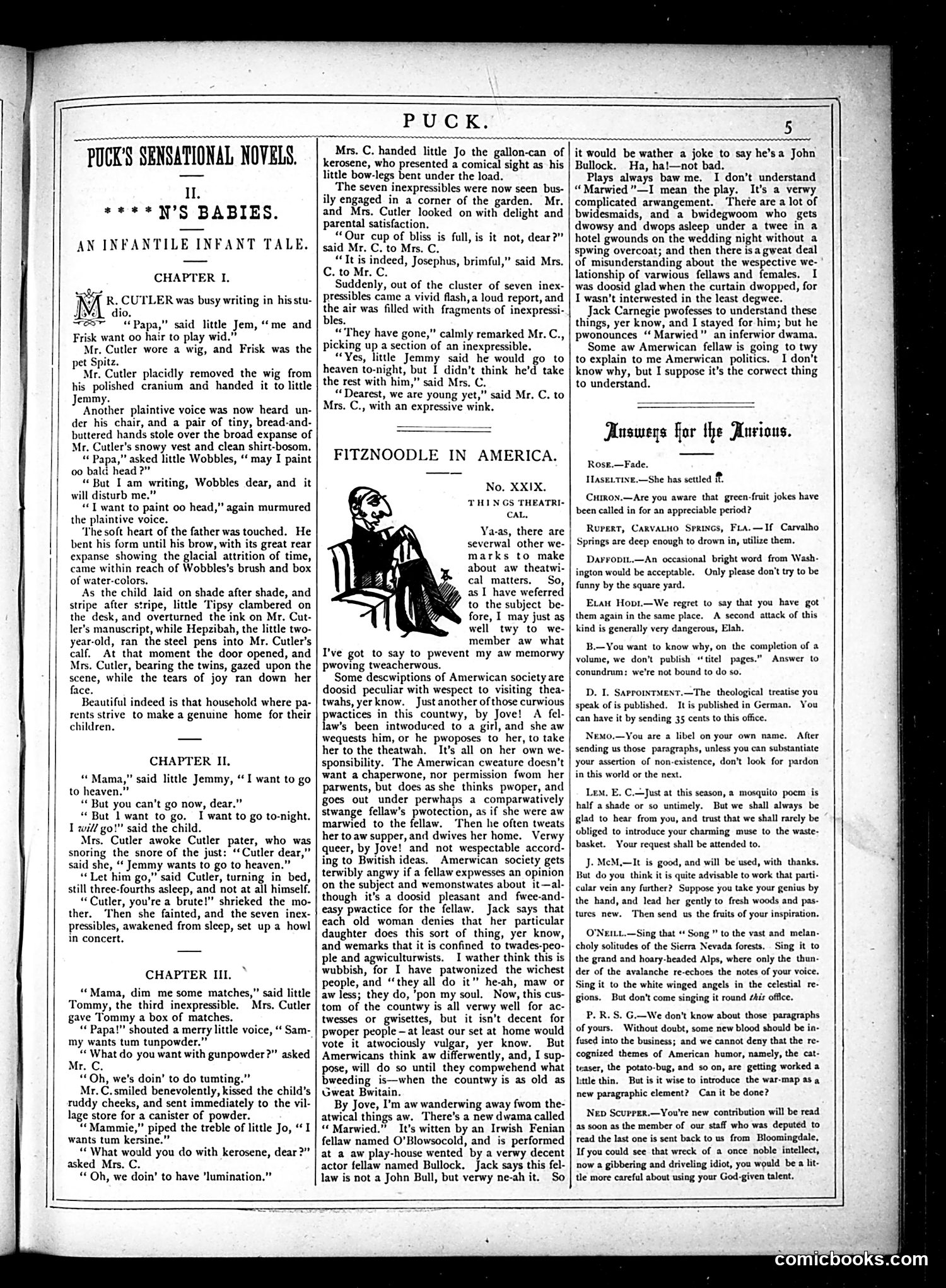
This page contains serialized fiction rather than political satire. The main content includes: **"Puck's Babies"** — a humorous serial story about Mr. Cutler, whose children cause domestic chaos. The narrative depicts Victorian-era parenting challenges: children demanding matches, kerosene, and other dangerous items; a father removing wigs from his head; children's mischief disrupting household order. **"Fitznoodle in America"** — a theatrical column discussing American society and theater practices, with commentary on how Americans treat visiting performers and their attitudes toward entertainment. The page functions as entertainment literature rather than political commentary. The humor derives from domestic situations and social observations typical of 1880s-90s American magazine content, aimed at middle-class family readership.
📄 Transcribed text from this page (OCR, searchable)
Machine-transcribed from the original scan — historical spelling and the odd misread are preserved.
POCK'S SENSATIONAL NOVELS. II. ****N’S BABIES. AN INFANTILE INF CHAPTER I. R. CUTLER was busy writing in his stu- dio. “Papa,” said little Jem, ‘‘me and Frisk want 00 hair to play wid Mr. Cutler wore a wig, and Frisk was the pet Spitz. Mr. Cutler placidly removed the wig from his polished cranium and handed it to little Jemmy. Another plaintive voice was now heard un- der his chair, and a pair of tiny, bread-and- buttered hands stole over the broad expanse of Mr. Cutler’s snowy vest and clean shirt-bosom, “ Papa,” asked little Wobbles, “ may I paint oo bald head ?” “ But I am writing, Wobbles dear, and it will disturb mi “«T want to paint oo head,” again murmured the plaintive voice. ‘The soft heart of the father was touched. He bent his form until his brow, with its great rear expanse showing the glacial attrition of time, came within reach of Wobbles’s brush and box of water-colors. As the child laid on shade after shade, and stripe after stripe, little Tipsy clambered on the desk, and overturned the ink on Mr. Cut- ler's manuscript, while Hepzibah, the little two- year-old, ran the steel pens into Mr. Cutler’s calf. At that moment the door opened, and Mrs. Cutler, bearing the twins, gazed upon the scene, while the tears of joy ran down her face. Beautiful indeed is that household where pa- rents strive to make a genuine home for their children. ANT TALE, CHAPTER II, “Mama,” said little Jemmy, “I want to go to heaven.” “« But you can't go now, dear.” “ But 1 want to go. I want to go to-night. I will go!” said the child. Mrs. Cutler awoke Cutler pater, who was snoring the snore of the just: ‘Cutler dear,” said she, ‘‘ Jemmy wants to go to heaven.” “Let him go,” said Cutler, turning in bed, still three-fourths asleep, and not at all himself. “Cutler, you're a brute!” shrieked the mo- ther. Then she fainted, and the seven inex- pressibles, awakened from sleep, set up a howl in concert. CHAPTER III. “Mama, dim me some matches,” said little Tommy, the third inexpressible. Mrs. Cutler gave Tommy a box of matches. “Papa!” shouted a merry little voice, “ Sam- my wants tum tunpowder.” un Weat do you want with gunpowder?” asked “Oh, we's doin’ to do tumting.”” Mr.C. smiled benevolently, kissed the child’s ruddy cheeks, and sent immediately to the vil- lage store for a canister of powder. “Mammie,” piped the treble of little Jo, “1 wants tum kersine.”” “What would you do with kerosene, dear?” asked Mrs. C. “Oh, we doin’ to have ‘lumination.” 5 Mrs. C. handed little Jo the gallon-can of kerosene, who presented a comical sight as his little bow-legs bent under the load. The seven inexpressibles were now seen bus- ily engaged in a corner of the garden. Mr. and Mrs. Cutler looked on with delight and parental satisfaction. “Our cup of bliss is full, is it not, dear?” said Mr. C. to Mrs. C. “Tt is indeed, Josephus, brimful,” said Mrs. C. to Mr. C. Suddenly, out of the cluster of seven inex- pressibles came a vivid flash,a loud report, and the air was filled with fragments of inexpressi- es. _“They have gone,” calmly remarked Mr. C., picking up a section of an inexpressible. “Yes, little Jemmy said he would go to heaven to-night, but I didn’t think he'd take the rest with him,” said Mrs, C. “Dearest, we are young yet,” said Mr. C. to Mrs. C., with an expressive wink. FITZNOODLE IN AMERICA. No. XXIX. THINGS THEATRI- CAL. Ya-as, there are severwal other we- marks to make about aw theatwi- cal matters. So, as I have weferred to the subject be- fore, I may just as well twy to we- member aw what I've got to say to pwevent my aw memorwy Pwoving tweacherwous. Some descwiptions of Amerwican society are doosid peculiar with wespect to visiting thea- twahs, yerknow. Just another of those curwious practices in this countwy, by Jove! A fel- law’s been intwoduced to a girl, and she aw wequests him, or he pwoposes to her, to take her to the theatwah, It’s all on her own we- sponsibility. The Amerwican cweature doesn’t want a chaperwone, nor permission fwom her parwents, but does as she thinks pwoper, and goes out under perwhaps a comparwatively stwange fellaw’s pwotection, as if she were aw marwied to the fellaw. Then he often tweats her to aw supper, and dwives her home. Verwy queer, by Jove! and not wespectable accord- ing to Bwitish ideas, Amerwican society gets terwibly angwy if a fellaw expwesses an opinion on the subject and wemonstwates about it—al- though it’s a doosid pleasant and fwee-and- easy pwactice for the fellaw. Jack says that each old woman denies that her particular daughter does this sort of thing, yer know, and wemarks that it is confined to twades-peo- ple and agwiculturwists. 1 wather think this is wubbish, for I have patwonized the wichest people, and “they all do it” he-ah, maw or aw less; they do, ‘pon my soul. Now, this cus- tom of the countwy is all verwy well for ac- twesses or gwisettes, but it isn’t decent for pwoper people —at least our set at home would vote it atwociously vulgar, yer know. But Amerwicans think aw differwently, and, I sup- pose, will do so until they compwehend what bweeding is—when the countwy is as old as Gweat Bwitain. By Jove, I’m aw wanderwing away fwom the- atwical things aw. There’s a new dwama called “ Marwied.” It’s witten by an Irwish Fenian fellaw named O'Blowsocold, and is performed at a aw play-house wented by a verwy decent actor fellaw named Bullock. Jack says this fel- law is not a John Bull, but verwy ne-ah it. So it would be wather a joke to say he’sa John Bullock. Ha, ha!—not bad. Plays always baw me. I don’t understand “Marwied”"—I mean the play. It’s a verwy complicated arwangement. There are a lot of bwidesmaids, and a bwidegwoom who gets dwowsy and dwops asleep under a twee in a hotel gwounds on the wedding night without a spwing overcoat; and then there isa gweat deal of misunderstanding about the wespective we- lationship of varwious fellaws and females. I was doosid glad when the curtain dwopped, for I wasn’t interwested in the least degwee. Jack Carnegie pwofesses to understand these things, yer know, and I stayed for him; but he pwonounces “ Marwied" an inferwior dwama. Some aw Amerwican fellaw is going to twy to explain to me Amerwican politics. I don’t know why, but I suppose it’s the corwect thing to understand. Ausweys for the Anrious. Rost.—Fade. Iasentive.—She has settled ff. Citrox.—Are you aware that green-fruit jokes have been called in for an appreciable period? Rourert, CARVALHO Srrines, FLA.—If Carvalho Springs are deep enough to drown in, utilize them. DarropiL.—An occasional bright word from Wash- ington would be acceptable. Unly please don't try to be funny by the square yard. Etat Hopt—We regret to say that you have got them again in the same place. A. second attack of this kind is generally very dangerous, Elah. B.—You want to know why, on the completion of a volume, we don’t publish “titel pages.” Answer to conundrum: we're not bound to do so. D. I. SarrontMeNt.—The theological treatise you speak of is published. It is published in German. You can have it by sending 35 cents to this office. Nemo.—You are a libel on your own name. After sending us those paragraphs, unless you can substantiate your assertion of non-existence, don’t look for pardon in this world or the next. Lem, E. C.Just at this season, a mosquito poem is half a shade or so untimely. But we shall always be glad to hear from you, and trust that we shall rarely be obliged to introduce your charming muse to the waste- basket. Your request shall be attended to. J. McM,—It is good, and will be used, with thanks. But do you think it is quite advisable to work that parti- cular vein any further? Suppose you take your genius by the hand, and lead her gently to fresh woods and pas- tures new. ‘Then send us the fruits of your inspiration. O'NEILL.—Sing that « Song "to the vast and melan- choly solitudes of the Sierra Nevada forests. Sing it to the grand and hoary-headed Alps, where only the thun- der of the avalanche re-echoes the notes of your voice. Sing it to the white winged angels in the celestial re- gions. But don't come singing it round ¢his office. P. R. S. G.—We don’t know about those paragraphs of yours. Without doubt, some new blood should be in- fused into the business; and we cannot deny that the re- cognized themes of American humor, namely, the cat- teaser, the potato-bug, and so on, are getting worked a Little thin. But is it wise to introduce the war-map as q new paragraphic element? Can it be done? Nep Scurrer.—You're new contribution will be read as soon as the member of our staff who was deputed to read the last one is sent back to us from Bloomingdale, If you could see that wreck of a once noble intellect, now a gibbering and driveling idiot, you would be a lit- tle more careful about using your God-given talent.