
Puck, 1877-10-17 · page 4 of 16
Puck — October 17, 1877 — page 4: what you’re looking at
What you’re looking at
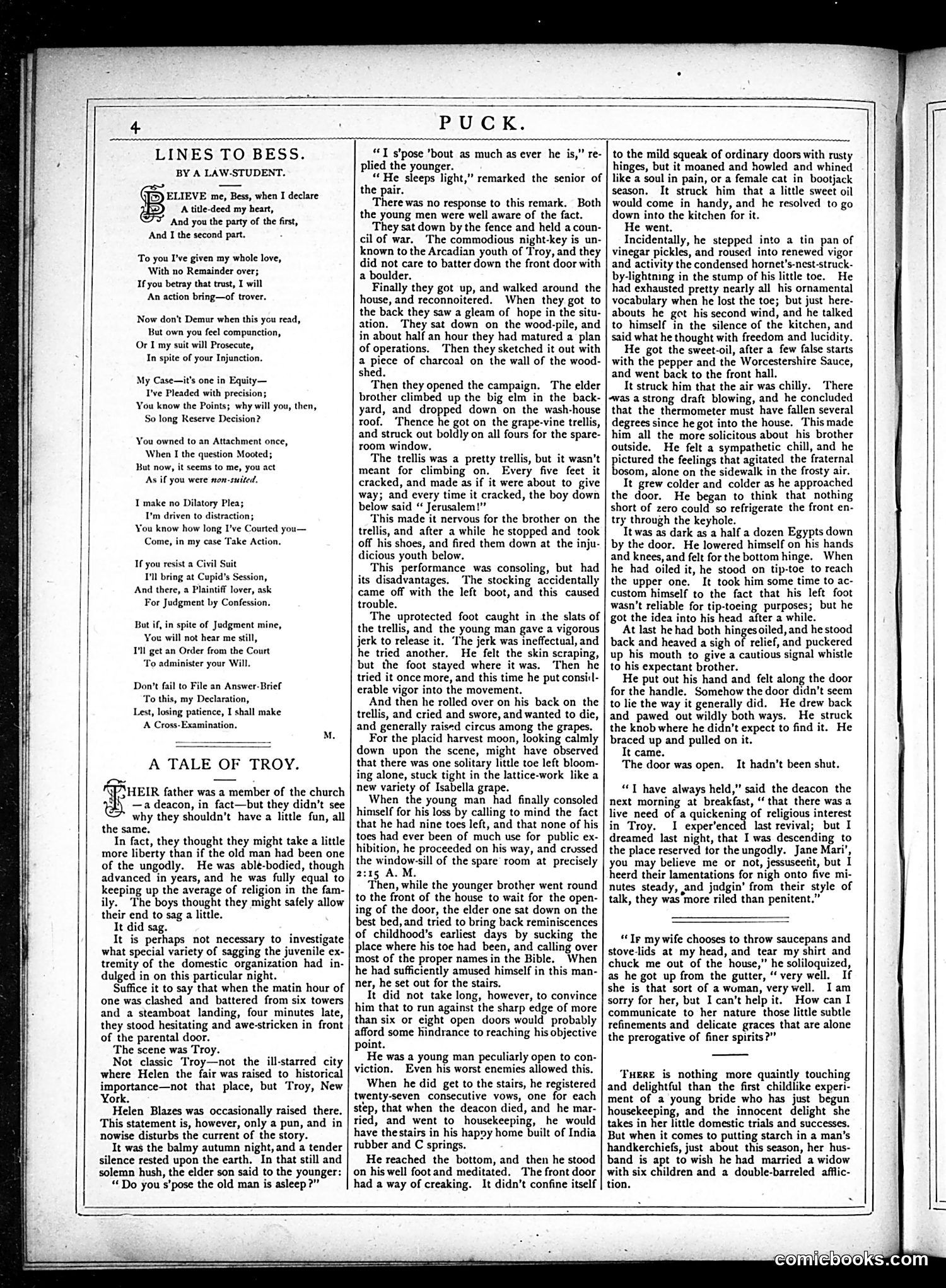
This page from *Puck* contains primarily **literary content rather than political cartoons**. The main pieces are: - **"Lines to Bess"** — a poem by a law student, appearing to be romantic verse addressing someone named Bess, with playful legal references - **"A Tale of Troy"** — a narrative story about a deacon's family and their domestic troubles, featuring their sons and various household misadventures The page includes **no identifiable political caricatures or satirical cartoon imagery** visible in the reproduction. It represents *Puck*'s literary/humor content rather than its signature political satire. The humor appears social and domestic rather than topical or political in nature.
📄 Transcribed text from this page (OCR, searchable)
Machine-transcribed from the original scan — historical spelling and the odd misread are preserved.
PUCK. LINES TO BESS. BY A LAW-STUDENT. LIEVE me, Bess, when I declare A title-deed my heart, And you the party of the first, And I the second part. To you I've given my whole love, With no Remainder ov: Ifyou betray that trust, I will ‘An action bring—of trover. Now don't Demur when this you read, But own you feel compunction, Or I my suit will Prosecute, In spite of your Injunction. My Case—it's one in Equity— I've Pleaded with precision; You know the Points; why will you, then, So long Reserve Decision? You owned to an Attachment once, When I the question Mooted; But now, it seems to me, you act ‘As if you were non-suited. I make no Dilatory Plea; I'm driven to distraction; You know how long I've Courted you— Come, in my case Take Action. If you resist a Civil Suit I'll bring at Cupid’s Session, And there, a Plaintiff lover, ask For Judgment by Confession. But if, in spite of Judgment mine, You will not hear me still, I'll get an Order from the Court ‘To administer your Will. Don’t fail to File an Answer-Brief To this, my Declaration, Lest, losing patience, I shall make A Cross-Examination. A TALE OF TROY. y 7SHEIR father was a member of the church —a deacon, in fact—but they didn’t see why they shouldn't have a little fun, all the same. In fact, they thought they might take a little more liberty than if the old man had been one of the ungodly. He was ablé-bodied, though advanced in years, and he was fully equal to keeping up the average of religion in the fam- ily. The boys thought they might safely allow their end to sag a little. It did sag. It is perhaps not necessary to investigate what special variety of sagging the juvenile ex- tremity of the domestic organization had in- dulged in on this particular night. Suffice it to say that when the matin hour of one was clashed and battered from six towers and a steamboat landing, four minutes late, they stood hesitating and awe-stricken in front of the parental door. The scene was Troy. Not classic Troy—not the ill-starred city where Helen the fair was raised to historical importance—not that place, but Troy, New York. Helen Blazes was occasionally raised there. This statement is, however, only a pun, and in nowise disturbs the current of the story. It was the balmy autumn night, and a tender silence rested upon the earth. In that still and solemn hush, the elder son said to the younger: “Do you s*pose the old man is asleep?” “T s'pose bout as much as ever he is,’ re- plied the younger. “He sleeps light,” remarked the senior of the pair. There was no response to this remark. Both the young men were well aware of the fact. They sat down by the fence and held acoun- cil of war. The commodious night-key is un- known to the Arcadian youth of Troy, and they did not care to batter down the front door with a boulder. Finally they got up, and walked around the house, and reconnoitered. When they got to the back they saw a gleam of hope in the situ- ation. They sat down on the wood-pile, and in about half an hour they had matured a plan of operations. Then they sketched it out with a piece of charcoal on the wall of the wood- shed. ‘Then they opened the campaign. The elder brother climbed up the big elm in the back- yard, and dropped down on the wash-house roof. Thence he got on the grape-vine trellis, and struck out boldly on all fours for the spare- room window, The trellis was a pretty trellis, but it wasn’t meant for climbing on. Every five feet it cracked, and made as if it were about to give way; and every time it cracked, the boy down below said “ Jerusalem!”” This made it nervous for the brother on the trellis, and after a while he stopped and took off his shoes, and fired them down at the inju- dicious youth below. This ‘performance was consoling, but had its disadvantages. ‘The stocking accidentally came off with the left boot, and this caused trouble. The uprotected foot caught in the slats of the trellis, and the young man gave a vigorous jerk to release it. ‘The jerk was ineffectual, and he tried another. He felt the skin scraping, but the foot stayed where it was. Then he tried it once more, and this time he put consi«l- erable vigor into the movement. And then he rolled over on his back on the trellis, and cried and swore, and wanted to die, and generally raised circus among the grapes. For the placid harvest moon, looking calmly down upon the scene, might have observed that there was one solitary little toe left bloom- ing alone, stuck tight in the lattice-work like a new variety of Isabella grape. When the young man had finally consoled himself for his loss by calling to mind the fact that he had nine toes left, and that none of his toes had ever been of much use for public ex- hibition, he proceeded on his way, and crossed indow-sill of the spare room at precisely 5 A.M. Then, while the younger brother went round to the front of the house to wait for the open- ing of the door, the elder one sat down on the best bed, and tried to bring back reminiscences of childhood’s earliest days by sucking the place where his toe had been, and calling over most of the proper names in the Bible. When he had sufficiently amused himself in this man- ner, he set out for the stairs. It did not take long, however, to convince him that to run against the sharp edge of more than six or eight open doors would’ probably afford some hindrance to reaching his objective point. He was a young man peculiarly open to con- viction. Even his worst enemies allowed this. When he did get to the stairs, he registered twenty-seven consecutive vows, one for each step, that when the deacon died, and he mar- ried, and went to housekeeping, he would have thestairs in his hapoy home built of India rubber and C springs. He reached the bottom, and then he stood on his well foot and meditated. The front door had a way of creaking. It didn’t confine itself to the mild squeak of ordinary doors with rusty hinges, but it moaned and howled and whined like a soul in pain, or a female cat in bootjack season. It struck him that a little sweet oil would come in handy, and he resolved to go down into the kitchen for it. He went. Incidentally, he stepped into a tin pan of vinegar pickles, and roused into renewed vigor and activity the condensed hornet's-nest-struck- by-lightning in the stump of his little toe. He had exhausted pretty nearly all his ornamental vocabulary when he lost the toe; but just here- abouts he got his second wind, and he talked to himself in the silence of the kitchen, and said what he thought with freedom and lucidity. He got the sweet-oil, after a few false starts with the pepper and the Worcestershire Sauce, and went back to the front hall. It struck him that the air was chilly. There vas a strong draft blowing, and he concluded that the thermometer must have fallen several degrees since he got into the house. This made him all the more solicitous about his brother outside. He felt a sympathetic chill, and he pictured the feelings that agitated the fraternal osom, alone on the sidewalk in the frosty air. It grew colder and colder as he approached the door. He began to think that nothing short of zero could so refrigerate the front en- try through the keyhole. Tt was as dark as a half a dozen Egypts down by the door. He lowered himself on his hands and knees, and felt for the bottom hinge. When he had oiled it, he stood on tip-toe to reach the upper one. It took him some time to ac- custom himself to the fact that his left foot wasn't reliable for tip-toeing purposes; but he got the idea into his head after a while. At last he had both hinges oiled, and he stood back and heaved a sigh of relief, and puckered up his mouth to give a cautious signal whistle to his expectant brother. He put out his hand and felt along the door for the handle. Somehow the door didn’t seem to lie the way it generally did. He drew back and pawed out wildly both ways. He struck the knob where he didn’t expect to find it. He braced up and pulled on it. Tt came. ‘The door was open. It hadn't been shut. “1 have always held,” said the deacon the next morning at breakfast, “that there was a live need of a quickening of religious interest in Troy. I exper'enced last revival; but I dreamed last night, that I was descending to the place reserved tor the ungodly. Jane Mari’, you may believe me or not, jessuseetit, but I heerd their lamentations for nigh onto five mi- nutes steady, ,and jadgin’ from their style of talk, they was more riled than penitent.” “Ip my wife chooses to throw saucepans and stove-lids at my head, and tear my shirt and chuck me out of the house,” he soliloquized, as he got up from the gutter, “ very well. she is that sort of a woman, very well. Iam sorry for her, but I can’t help it. How can I communicate to her nature those little subtle refinements and delicate graces that are alone the prerogative of finer spirits?” ‘Tuere is nothing more quaintly touching and delightful than the first childlike experi- ment of a young bride who has just begun housekeeping, and the innocent delight she takes in her little domestic trials and successes. But when it comes to putting starch in a man’s handkerchiefs, just about this season, her hus- band is apt to wish he had married a widow with six children and a double-barreled afflic- tion.