
Puck, 1877-10-17 · page 3 of 16
Puck — October 17, 1877 — page 3: what you’re looking at
What you’re looking at
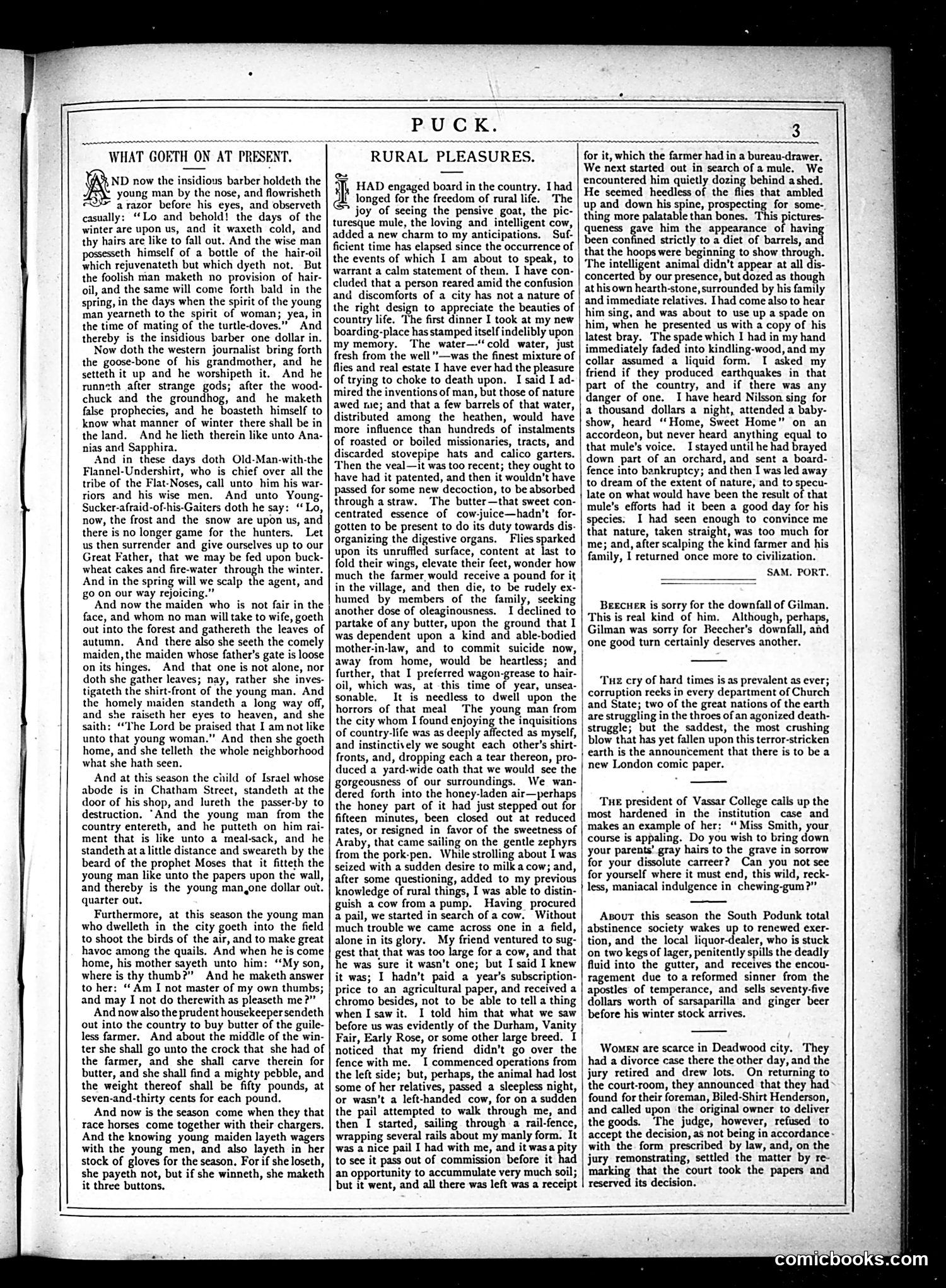
This page contains three separate prose articles rather than political cartoons: 1. **"What Goeth On at Present"** - A satirical commentary on urban winter life, mocking a fashionable barber's pretentious behavior and the shallow vanities of city society. 2. **"Rural Pleasures"** - A humorous account of the author's country boarding experience, contrasting idealized rural life with its actual hardships (poor water, meager meals, uncomfortable accommodations). The satire targets romantic notions of pastoral life. 3. **"Bercher"** and brief notes on Vassar College and Deadwood City society - Short miscellaneous items about social issues. The page's satire focuses on **class distinctions and lifestyle illusions**—both urban affectation and rural romanticism are debunked as equally foolish. The humor derives from exposing gaps between expectation and reality.
📄 Transcribed text from this page (OCR, searchable)
Machine-transcribed from the original scan — historical spelling and the odd misread are preserved.
WHAT GOETH ON AT PRESENT. ND now the insidious barber holdeth the young man by the nose, and flowrisheth OS a razor before his eyes, and observeth casually: ‘‘Lo and behold! the days of the winter are upon us, and it waxeth cold, and thy hairs are like to fall out. And the wise man jesseth himself of a bottle of the hair-oil which rejuvenateth but which dyeth not. But the foolish man maketh no provision of hair- oil, and the same will come forth bald in the spring, in the days when the spirit of the young man yearneth to the spirit of woman; yea, in the time of mating of the turtle-doves.” And thereby is the insidious barber one dollar in. Now doth the western journalist bring forth the goose-bone of his grandmother, and he setteth it up and he worshipeth it. And he runneth after strange gods; after the wood- chuck and the groundhog, and he maketh false prophecies, and he boasteth himself to know what manner of winter there shall be in the land. And he lieth therein like unto Ana- nias and Sapphira. And in these days doth Old-Man-with-the Flannel-Undershirt, who is chief over all the tribe of the Flat-Noses, call unto him his war- riors and his wise men. And unto Young- Sucker-afraid-of-his-Gaiters doth he say: ‘Lo, now, the frost and the snow are upon us, and there is no longer game for the hunters. Let us then surrender and give ourselves up to our Great Father, that we may be fed upon buck- wheat cakes and fire-water through the winter. And in the spring will we scalp the agent, and go on our way rejoicing.” And now the maiden who is not fair in the face, and whom no man will take to wife, goeth out into the forest and gathereth the leaves of autumn, And there also she seeth the comely maiden, the maiden whose father’s gate is loose on its hinges. And that one is not alone, nor doth she gather leaves; nay, rather she inves- tigateth the shirt-front of the young man. And the homely maiden standeth’ a long way off, and she raiseth her eyes to heaven, and she saith: ‘The Lord be praised that I am not like unto that young woman.” And then she gocth home, and she telleth the whole neighborhood what she hath seen. And at this season the child of Israel whose abode is in Chatham Street, standeth at the door of his shop, and lureth the passer-by to destruction, “And the young man from the country entereth, and he putteth on him rai- ment that is like unto a meal-sack, and he standeth at alittle distance and sweareth by the beard of the prophet Moses that it fitteth the young man like unto the papers upon the wall, and thereby is the young man,one dollar out. quarter out. Furthermore, at this season the young man who dwelleth in the city goeth into the field to shoot the birds of the air, and to make great havoc among the quails. And when he is come home, his mother sayeth unto him: ‘My son, where is thy thumb?” And he maketh answer to her: ‘Am I not master of my own thumbs; and may I not do therewith as pleaseth me?” And now also the prudent housekeeper sendeth out into the country to buy butter of the guile- less farmer. And about the middle of the win- ter she shall go unto the crock that she had of the farmer, and she shall carve therein for butter, and she shall find a mighty pebble, and the weight thereof shall be fifty pounds, at seven-and-thirty cents for each pound. And now is the season come when they that race horses come together with their chargers. And the knowing young maiden layeth wagers with the young men, and also layeth in her stock of gloves for the season, For if she loseth, she payeth not, but if she winneth, she maketh it three buttons. PUCK. RURAL PLEASURES. oe i HAD engaged board in the country. [had longed for the freedom of rural life. The joy of secing the pensive goat, the pic- turesque mule, the loving and intelligent cow, added a new charm to my anticipations. Suf- ficient time has elapsed since the occurrence of the events of which I am about to speak, to warrant a calm statement of them. I have con- cluded that a person reared amid the confusion and discomforts of a city has not a nature of the right design to appreciate the beauties of country life. The first dinner I took at my new boarding-place has stamped itself indelibly upon my memory. The water—‘cold water, just fresh from the well "—was the finest mixture of flies and real estate I have ever had the pleasure of trying to choke to death upon. I said I ad- mired the inventions of man, but those of nature awed me; and that a few barrels of that water, distributed among the heathen, would have more influence than hundreds of instalments of roasted or boiled missionaries, tracts, and discarded stovepipe hats and calico garters. ‘Then the veal—it was too recent; they ought to have had it patented, and then it wouldn't have passed for some new decoction, to be absorbed through a straw. The butter—that sweet con- centrated essence of cow-juice—hadn’t for- gotten to be present to do its duty towards dis- organizing the digestive organs. Flies sparked upon its unruffied surface, content at last to fold their wings, elevate their feet, wonder how much the farmer, would receive a pound for it in the village, and then die, to be rudely ex- humed by members of the family, seeking another dose of oleaginousness. I declined to partake of any butter, upon the ground that I was dependent upon a kind and able-bodied away from home, would be heartless; and further, that I preferred wagon-grease to hair- oil, which was, at this time of year, unsea- sonable, It is needless to dwell upon the horrors of that meal The young man from the city whom I found enjoying the inquisitions of country-life was as deeply affected as myself, and instinctively we sought each other’s shirt- fronts, and, dropping each a tear thereon, pro- duced a yard-wide oath that we would see the gorgeousness of our surroundings. We wan- ered forth into the honey-laden air—perhaps the honey part of it had just stepped out for fifteen minutes, been closed out at reduced rates, or resigned in favor of the sweetness of Araby, that came sailing on the gentle zephyrs from the pork-pen. While strolling about I was seized with a sudden desire to milk a cow; and, after some questioning, added to my previous knowledge of rural things, I was able to distin- guish a cow from a pump. Having procured a pail, we started in search of a cow. Without much trouble we came across one in a field, alone in its glory. My friend ventured to sug- gest that, that was too large for a cow, and that he was sure it wasn’t one; but I said I knew it was; I hadn’t paid a year’s subscription- price to an agricultural paper, and received a chromo besides, not to be able to tell a thing when I saw it. I told him that what we saw before us was evidently of the Durham, Vanity Fair, Early Rose, or some other large breed. I noticed that my friend didn’t go over the fence with me. I commenced operations from the left side; but, perhaps, the animal had lost some of her relatives, passed a sleepless night, or wasn’t a left-handed cow, for on a sudden the pail attempted to walk through me, and then I started, sailing through a rail-fence, wrapping several rails about my manly form. It was a nice pail I had with me, and it wasa pity to see it pass out of commission before it had an opportunity to accummulate very much soil; but it went, and all there was left was a receipt 3 for it, which the farmer had in a bureau-drawer. We next started out in search of a mule. We encountered him quietly dozing behind ashed, He seemed heedless of the flies that ambled up and down his spine, prospecting for some-. thing more palatable than bones. This pictures- queness gave him the appearance of havin, been confined strictly to a diet of barrels, and that the hoops were beginning to show through. ‘The intelligent animal didn't appear at all dis- concerted by our presence, but dozed as though at his own hearth-stone, surrounded by his family and immediate relatives. [had come also to hear him sing, and was about to use up a spade on him, when he presented us with a copy of his latest bray. The spade which I had in my hand immediately faded into kindling-wood, and my collar assumed a liquid form. I asked my friend if they produced earthquakes in that part of the country, and if there was any danger of one. I have heard Nilsson sing for a thousand dollars a night, attended a baby- show, heard “Home, Sweet Home” on an accordeon, but never heard anything equal to that mule’s voice. I stayed until he had brayed down part of an orchard, and sent a board- fence into bankruptcy; and then I was led away to dream of the extent of nature, and to specu- late on what would have been the result of that mule’s efforts had it been a good day for his species. I had seen enough to convince me that nature, taken straight, was too much for me; and, after scalping the kind farmer and his family, I returned once more to civilization. SAM. PORT. Beecuer is sorry for the downfall of Gilman. This is real kind of him. Although, perhaps, Gilman was sorry for Reccher’s downfall, and mother-in-law, and to commit suicide now, | °"® good turn certainly deserves another. ‘Tue cry of hard times is as prevalent as ever; corruption reeks in every department of Church and State; two of the great nations of the earth are struggling in the throes of an agonized death- struggle; but the saddest, the most crushing blow that has yet fallen upon this terror-stricken earth is the announcement that there is to be a new London comic paper. Tue president of Vassar College calls up the most hardened in the institution case and makes an example of her: “Miss Smith, your course is appaling. Do you wish to bring down your parents’ gray hairs to the grave in sorrow for your dissolute carreer? Can you not see for yourself where it must end, this wild, reck- less, maniacal indulgence in chewing-gum?” AsouT this season the South Podunk total abstinence society wakes up to renewed exer- tion, and the local liquor-dealer, who is stuck on two kegs of lager, penitently spills the deadly fluid into the gutter, and receives the encou- ragement due to a reformed sinner from the apostles of temperance, and sells seventy-five dollars worth of sarsaparilla and ginger beer before his winter stock arrives. Women are scarce in Deadwood city. They had a divorce case there the other day, and the jury retired and drew lots. On returning to the court-room, they announced that they found for their foreman, Biled-Shirt Henderson, and called upon the original owner to deliver the goods. The judge, however, refused to accept the decision, as not being in accordance ~ with the form prescribed by law, and, on the jury remonstrating, settled the matter by re- marking that the court took the papers and reserved its decision.