
A complete issue · 16 pages · 1877
Puck — July 18, 1877
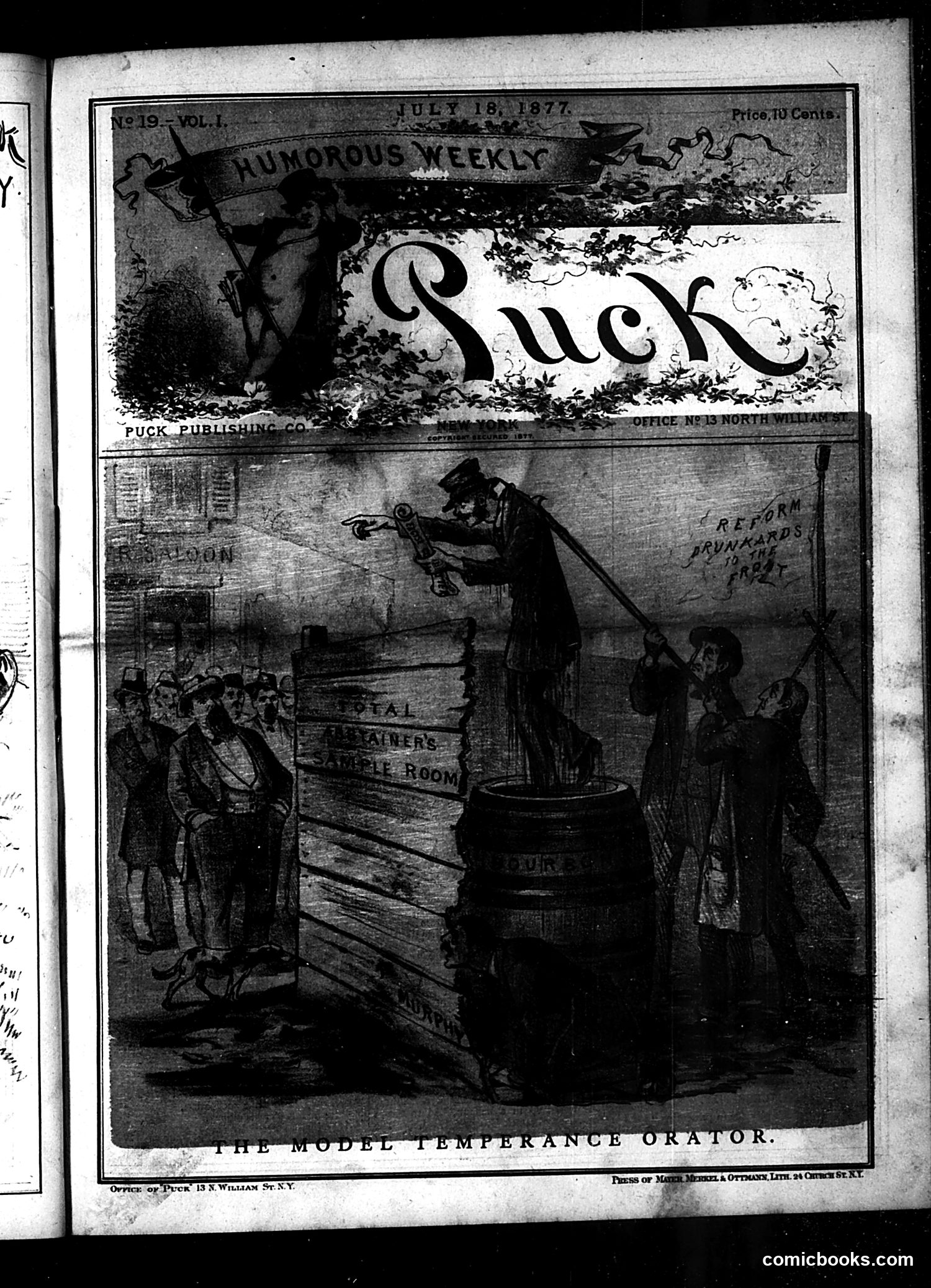
This July 1877 *Puck* cartoon satirizes temperance movement hypocrisy. The image shows a tall, skeletal figure labeled "The Model Temperance Orator" standing atop a large barrel (presumably of alcohol) while gesturing dramatically to an audience below. Signs visible in the background reference "Reform," "Drunkards," and "Crazy." The satire is clear: the temperance advocate preaches against alcohol while literally standing on a barrel of it—suggesting moral corruption or that temperance leaders profited from or secretly participated in the very vice they publicly condemned. The skeletal appearance emphasizes the cartoon's mockery of self-righteous reformers. This reflects 1870s skepticism toward temperance campaigners' sincerity, a recurring theme in period satire.
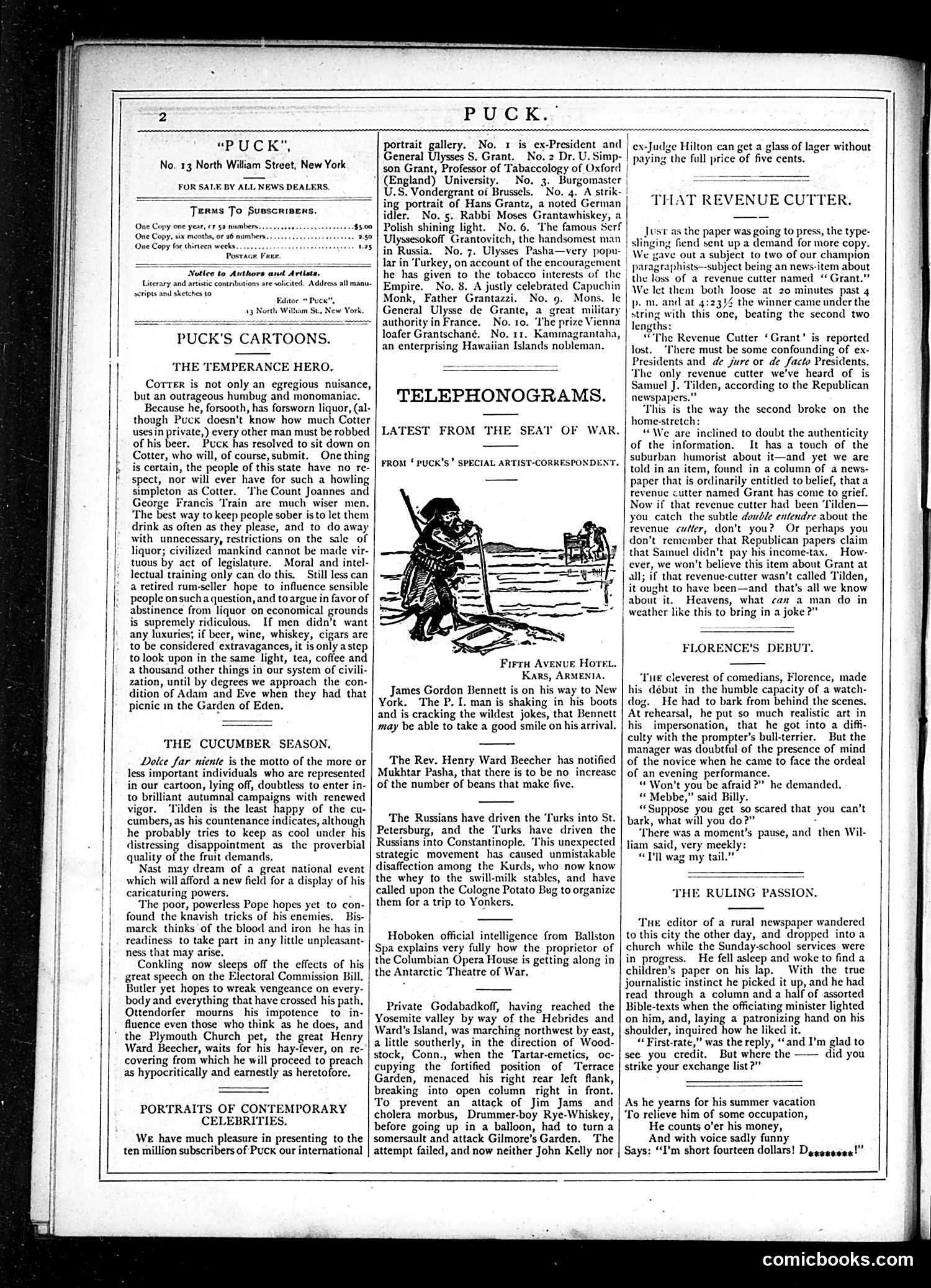
This page's main cartoon satirizes the hypocrisy of temperance advocates. The text explains that while "Puck doesn't know how much Coffee Cotter preaches," the character himself is an "outrageous humbug and monomaniac" who drinks heavily. The satire targets selective moralism: Cotter crusades against alcohol while being a secret drinker—a common Victorian-era criticism of temperance campaigners. The cartoon suggests such reformers were self-righteous frauds whose preaching contradicted their private behavior. The page also includes war dispatches and celebrity portraits, but the temperance piece is the primary satirical content, mocking the gap between public virtue-signaling and private vice among reform-minded figures of the period.
This page contains humor columns and reader responses rather than political cartoons. The "Puckerings" section offers satirical social commentary—mocking a young man's elaborate maple sugar party, commenting on smell's power over animals, and joking about a chess match involving "Hope deferred" and heart sickness. The "Answers for the Curious" section addresses reader letters with tongue-in-cheek responses about topics like newspaper quality, rural life, and social etiquette. There's humor about chess rules, Billy White (described as Georgia's strong negro), and various domestic situations. Without identifying specific political figures in accompanying illustrations (which aren't clearly visible in this OCR'd text), the page represents typical Puck content: general social satire rather than focused political commentary.
This page contains three distinct pieces of satirical content: 1. **"Lines to My Beautiful Bamboozler"** — A poem mocking a woman who is deceptive or manipulative in romance, using flowery language to describe her dishonesty. 2. **"His Voice"** — A narrative story satirizing Mr. Bibbleton, a man with no singing talent whom his friend Jones pressures into performing. The satire ridicules both Bibbleton's lack of ability and the social pressure to participate in amateur entertainment despite obvious incompetence. 3. **"Bootmaking Extraordinary"** and related advertisements — These appear to be humorous advice columns and product advertisements typical of Puck's mixed editorial-advertising format. The overall tone targets Victorian-era social pretensions and the embarrassments of polite society gatherings where untalented individuals are coerced into public performances.
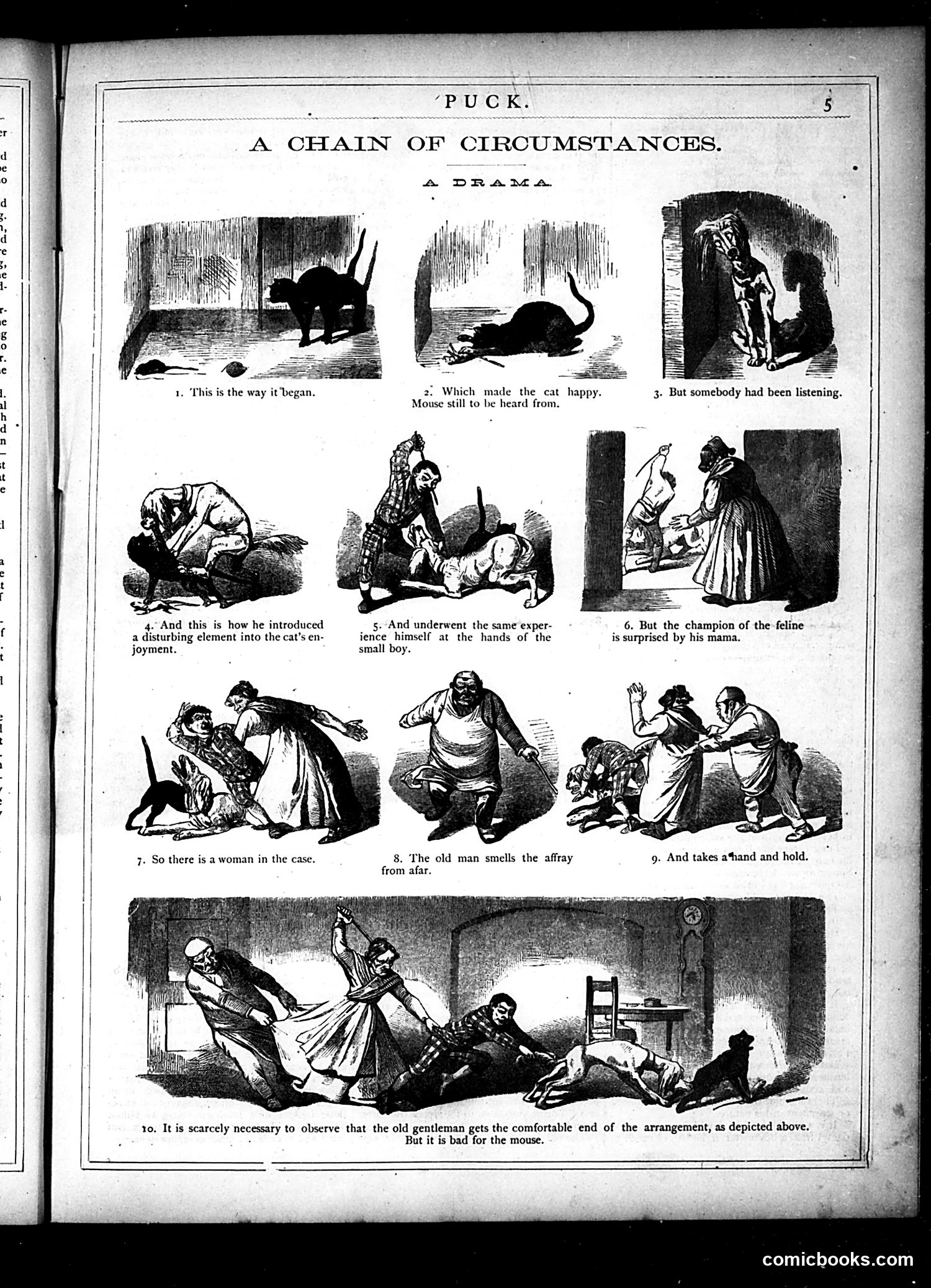
This is a sequential comic strip showing how a cat's fate becomes intertwined with human misfortune. The narrative progresses from a cat eating a mouse (panels 1-2), to someone witnessing this and reporting it (panel 3). This triggers a chain of consequences: a man is introduced to the cat's owner and experiences injury (panels 4-5), his mother learns of his condition (panel 6), a woman becomes involved in the case (panel 7), an elderly man detects deception (panel 8), and the situation escalates into violent conflict (panels 9-10). The final panel's caption—noting the old gentleman "gets the comfortable end of the arrangement" while "it is bad for the mouse"—suggests dark irony about how innocent parties suffer while manipulators benefit from chaos. The work satirizes how small events cascade into disproportionate human drama.
This satirical story mocks a practical, unromantic suitor named Spriggins who pursues a farmer's daughter named Ophelia. The humor lies in contrasting his prosaic, business-minded nature with her romantic expectations. When Spriggins attempts to impress her with sentimental poetry, her father dismissively calls it "the worst trash I ever read," while a friend warns Spriggins that poetry suggests impracticality—a dangerous quality in a potential son-in-law. The satire targets both rural attitudes (valuing practicality over sentiment) and urban pretensions. The story suggests that Spriggins's materialism and lack of genuine feeling make him ridiculous as a suitor, while also mocking Ophelia's romantic idealism as unsuited to farmer's life.
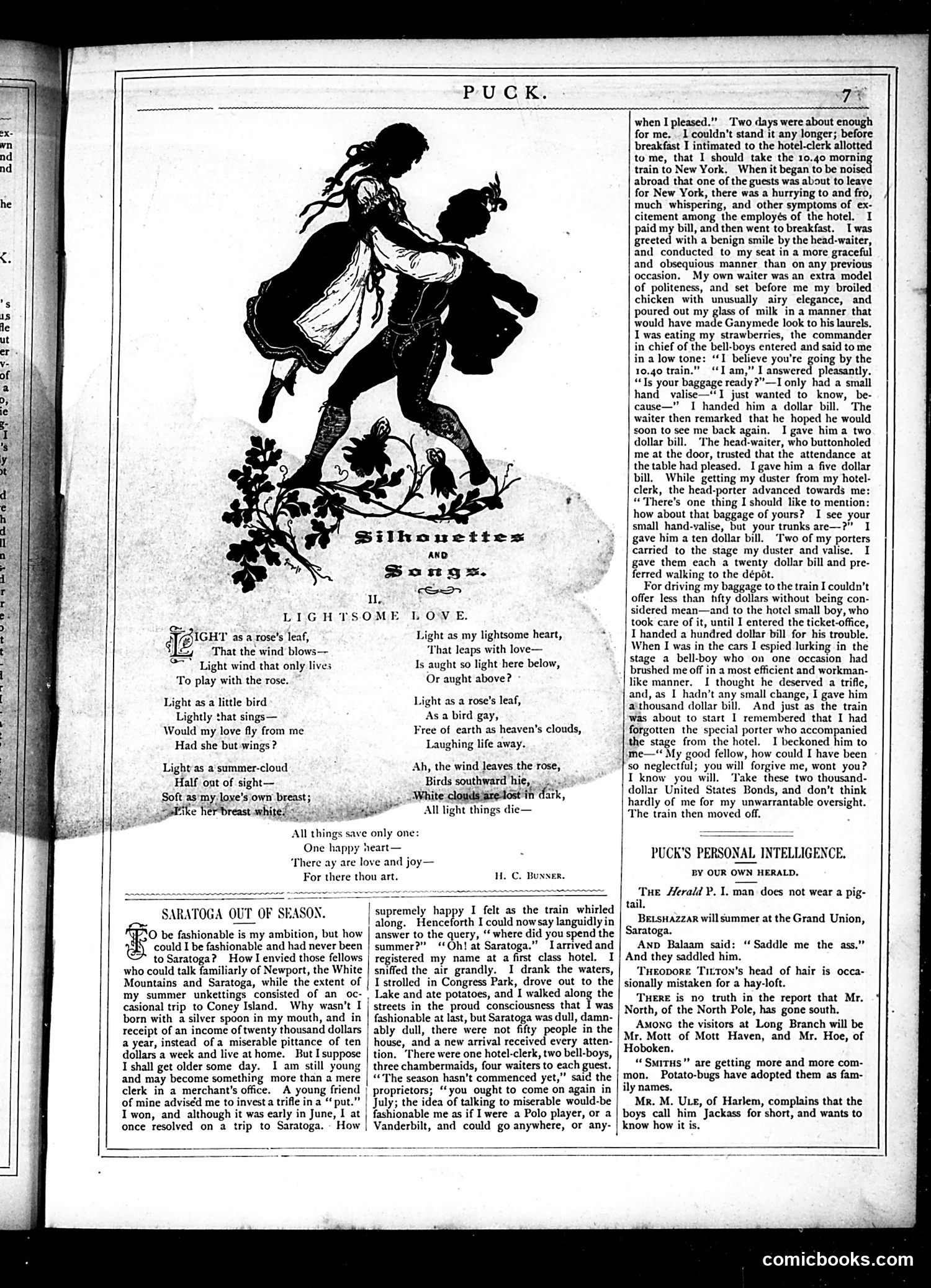
This page contains literary and travel content rather than political satire. The main illustration titled "Silhouettes and Songs" depicts a romantic couple in silhouette—a man carrying a woman—accompanying a poem titled "Lightsome Love" by H.C. Bunner. The poem uses nature metaphors (rose, bird, cloud) to explore romantic themes. Below that, an article titled "Saratoga Out of Season" describes the author's visit to Saratoga Springs, New York, discussing its fashionable reputation and current empty state. The piece includes anecdotes about hotels and social observations. A sidebar section "Puck's Personal Intelligence" provides gossip-style commentary on notable figures in Harlem and other locations, including references to horse racing and society events. The page appears focused on entertainment, literature, and social commentary rather than direct political satire.
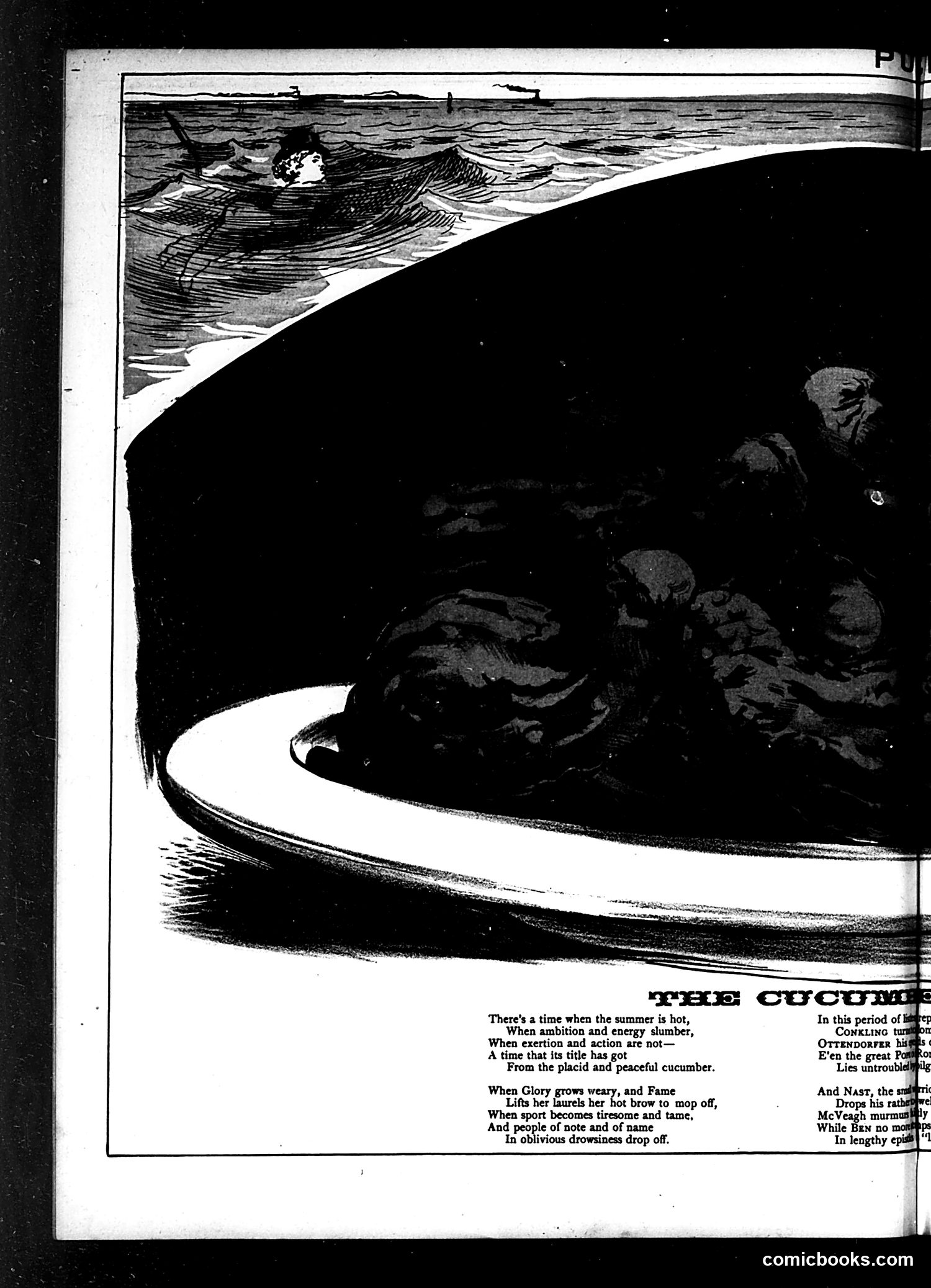
This page presents a poem titled "The Cucumber" with accompanying illustration. The text contrasts the cucumber's peaceful, dormant summer nature with human ambition and exhaustion. The poem satirizes how people of prominence lose status through overexertion—their vigor becomes "tiresome and tame," causing them to fade from public attention. The dramatic illustration depicts what appears to be a cave or dark interior with figures on the right observing something in the shadows, while a swimming figure is visible in water (upper left). The imagery suggests descent or obscurity. The satire likely critiques prominent public figures who overextend themselves and consequently lose influence, using the humble cucumber's restful nature as ironic contrast to human striving. The specific individuals referenced are unclear without additional context.
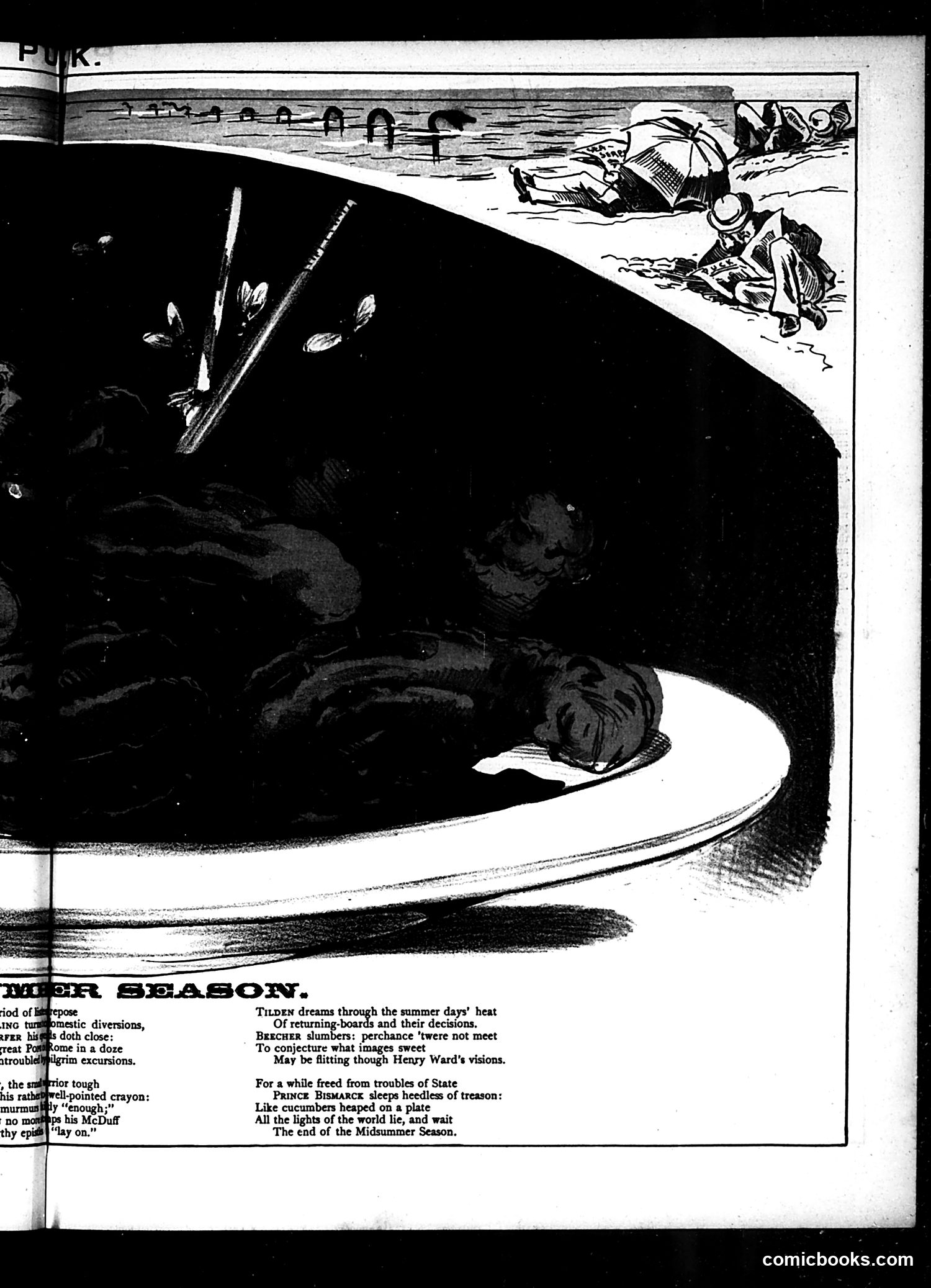
This page depicts a satirical commentary on summer politics during what appears to be a late 19th-century American election season. The large illustration shows underwater creatures (likely representing political figures or parties) in a dark, murky setting—a metaphor for the confusion and treachery of political maneuvering. The accompanying verse references "Tilden dreams," "Bismarck," and "Prince Bismarck sleeps heedless of treason," suggesting European and American political figures and intrigues. The upper panel shows people on a beach, apparently distracted or oblivious to political machinations happening "underwater." The satire suggests that while the public enjoys summer leisure, politicians engage in shadowy dealings and betrayals behind the scenes—a common Puck theme criticizing the gap between public appearance and political reality.
This page consists primarily of **"Silas Gilmore's" theater and entertainment column**, not political cartoons. The content discusses theatrical performances at various New York venues, including critiques of actors and plays. Key references include: - Reviews of Union Square Theatre productions - Commentary on specific performers' talents and mannerisms - Discussion of plays like one featuring "Casauran" and "Colonel Sellers" The "Fashionable Intelligence" section on the right reports **social gossip**: engagements, summer resort activities at places like Halifax and Saratoga, and observations about New York society's seasonal movements. A brief political note appears at bottom: commentary on **Cuba and patriotism**, referencing someone's "mighty arm" raised defending liberty—likely post-Spanish American War commentary. The page reflects Puck's mix of theater criticism, society gossip, and political commentary typical of late 19th-century American magazines.
This page contains two distinct pieces: "The Gallic Idiom" (left column) and "How Hayes's Cabinet Dress" (right column). **"The Gallic Idiom"** satirizes Hon. Index Noyes of Ohio attempting to learn French for a diplomatic examination. The humor centers on the absurdity of his efforts—he struggles to master pronunciation and idioms, with the story emphasizing how inadequately prepared he is for civil service reform positions. The piece mocks both Noyes's incompetence and the broader inefficiency of the civil service system. **"How Hayes's Cabinet Dress"** (right side) discusses President Hayes's cabinet members' clothing choices, particularly focusing on their formal attire and social presentation. It appears to satirize the superficiality of judging officials by appearance rather than competence. Both pieces critique government appointees—one for incompetence, the other for relying on appearances over merit.
This page contains no political cartoon or satire. It is **Chapter XV and XVI of a serialized English short story titled "Two Knaves and a Queen,"** published in Puck magazine. The narrative concerns Miss Hiron, who receives a mysterious letter instructing her to find an Englishman at a train station to help locate a missing person. The story involves romantic complications—Miss Hiron's father disapproves of her interest in a foreign suitor, and there are hints of class tensions and social propriety concerns typical of Victorian-era English fiction. This is **fiction content**, not satirical political commentary. Puck regularly published stories alongside its cartoons and humor pieces to fill pages.
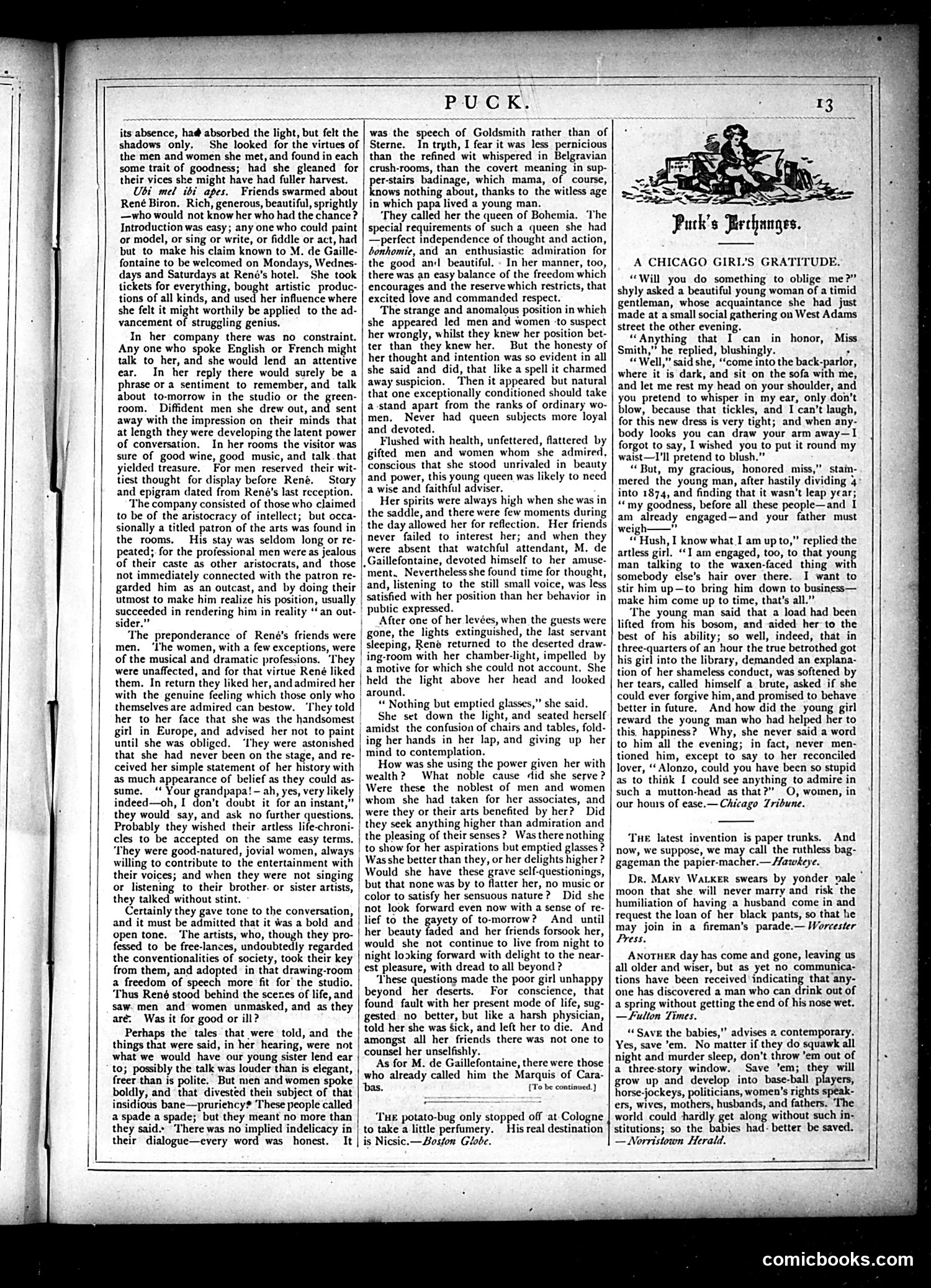
This page contains primarily **text articles** rather than political cartoons. The visible content includes: 1. **"Puck's Arraignments"** - A satirical column with short humor pieces, including "A Chicago Girl's Gratitude" mocking a wealthy woman who condescends to a working-class person at a gathering. 2. Several brief satirical news items and social commentary, including references to **Dr. Mary Walker** (a historical figure known for wearing men's clothing and advocating for women's rights), critiquing both her choices and society's judgment. The humor targets **class pretension, gender conventions, and social hypocrisy** typical of Puck's satirical approach. The magazine uses wit rather than visual caricature on this particular page to mock contemporary social attitudes and behaviors.
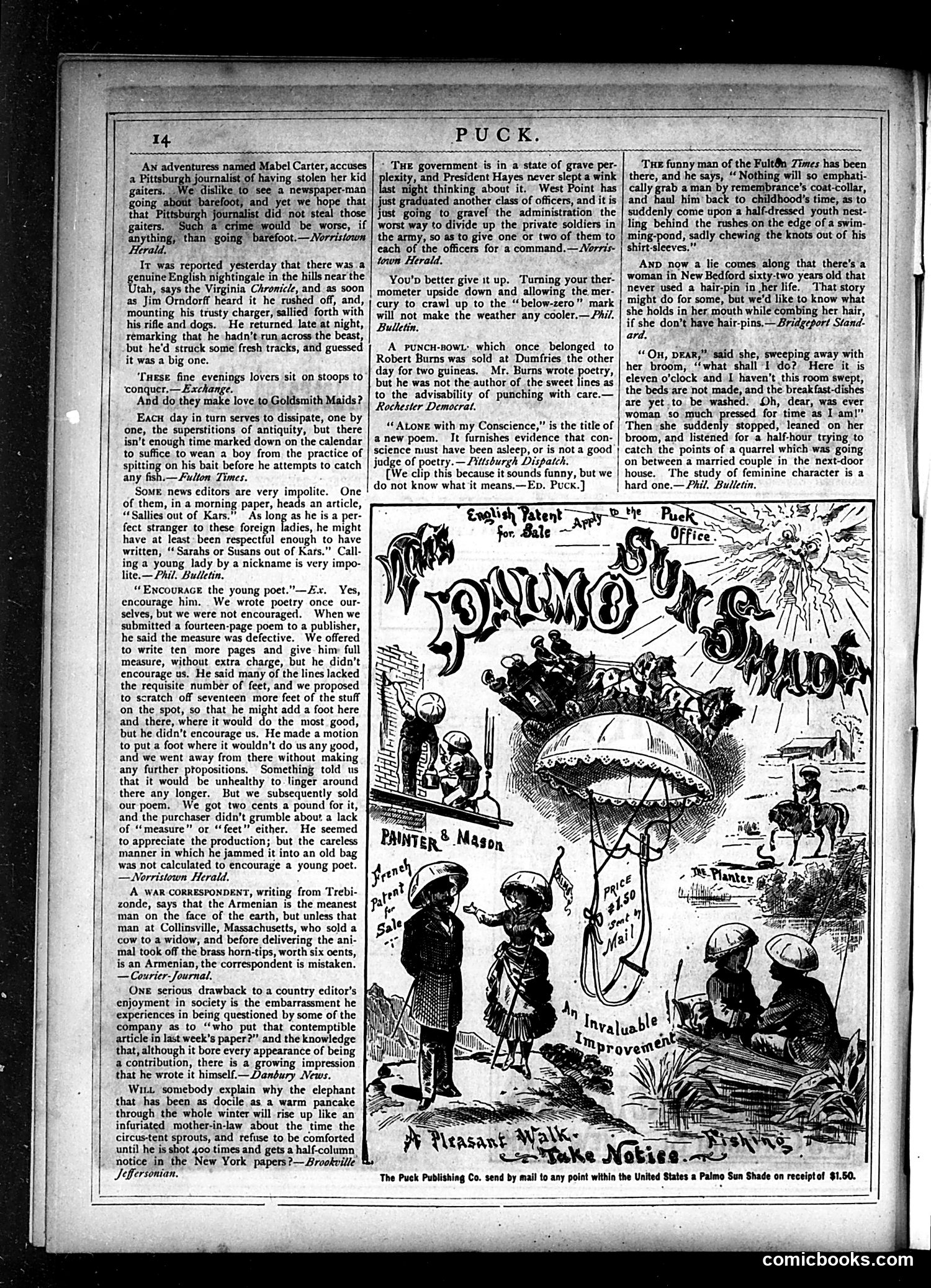
This page mixes editorial commentary with advertisements. The left column contains several short satirical pieces about contemporary social issues: a story about a Pittsburgh journalist accused of kidnapping, commentary on English weather, and discussion of young poets submitting work to publishers. The right side features patent/product advertisements rendered as cartoons, including "Pantomime," "An Invaluable Improvement," and "A Pleasant Walk." These mock inventions use exaggerated illustrations typical of Puck's visual humor—absurd contraptions presented as solutions to everyday problems, a recurring satirical format in the magazine. The overall page reflects Puck's formula: mixing topical humor with visual gags mocking both news events and commercial culture.
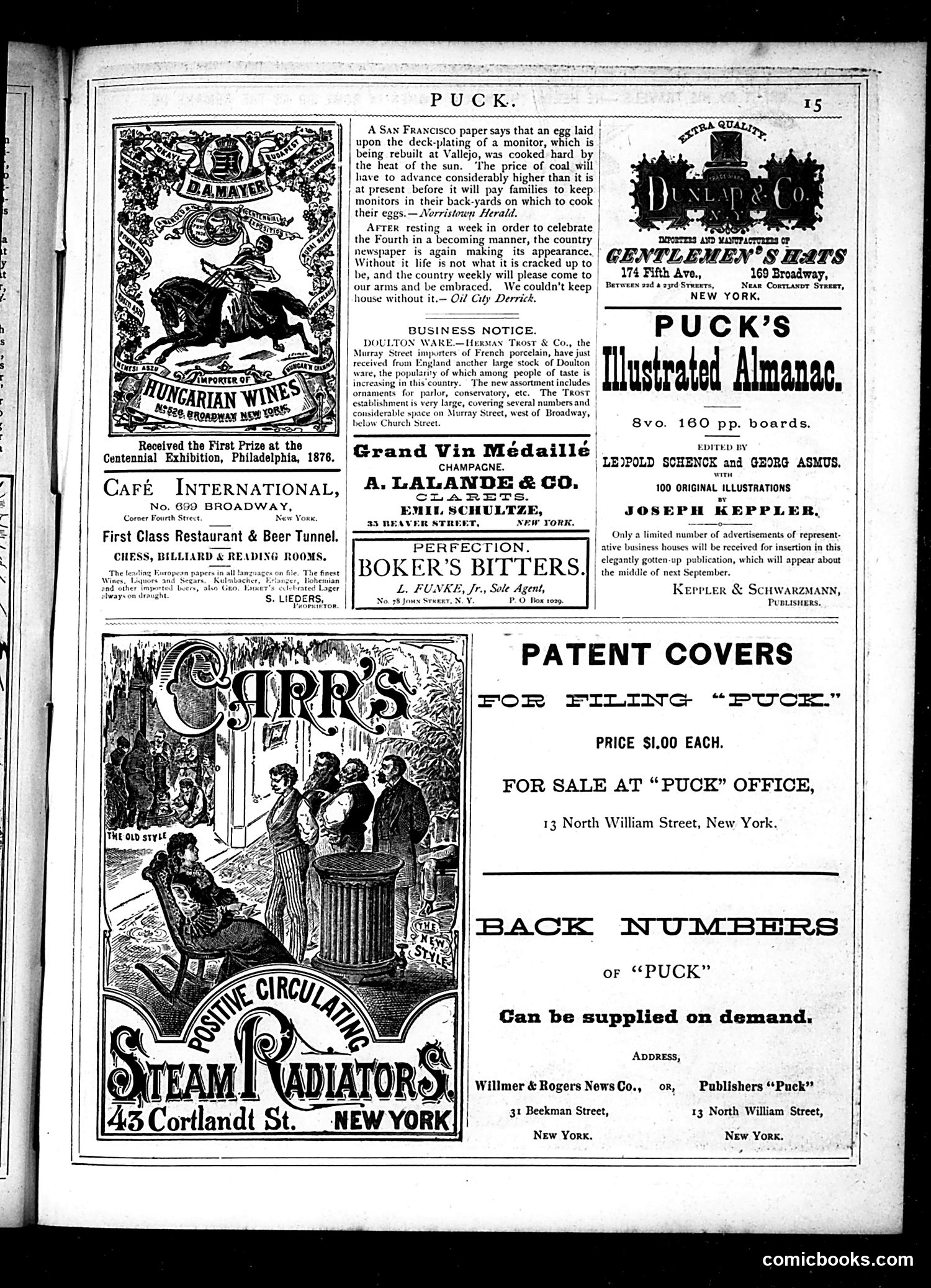
This page is primarily **advertisements and notices** rather than political cartoons. The visible advertisements include: - Hungarian Wines (with decorative imagery) - Café International restaurant/beer tunnel on Broadway - Boker's Bitters - Carr's Steam Radiators - Dunlap & Co. gentlemen's hats - Puck's Illustrated Almanac The only illustration with potential satirical content is the **Carr's Steam Radiators advertisement**, which depicts an indoor scene with multiple figures, but without clear political figures or commentary visible, the exact satirical meaning is unclear. The page primarily functions as a **commercial section** of the magazine, showcasing late 19th-century New York businesses and products. The layout and advertisements reflect the era's commercial culture rather than political satire.
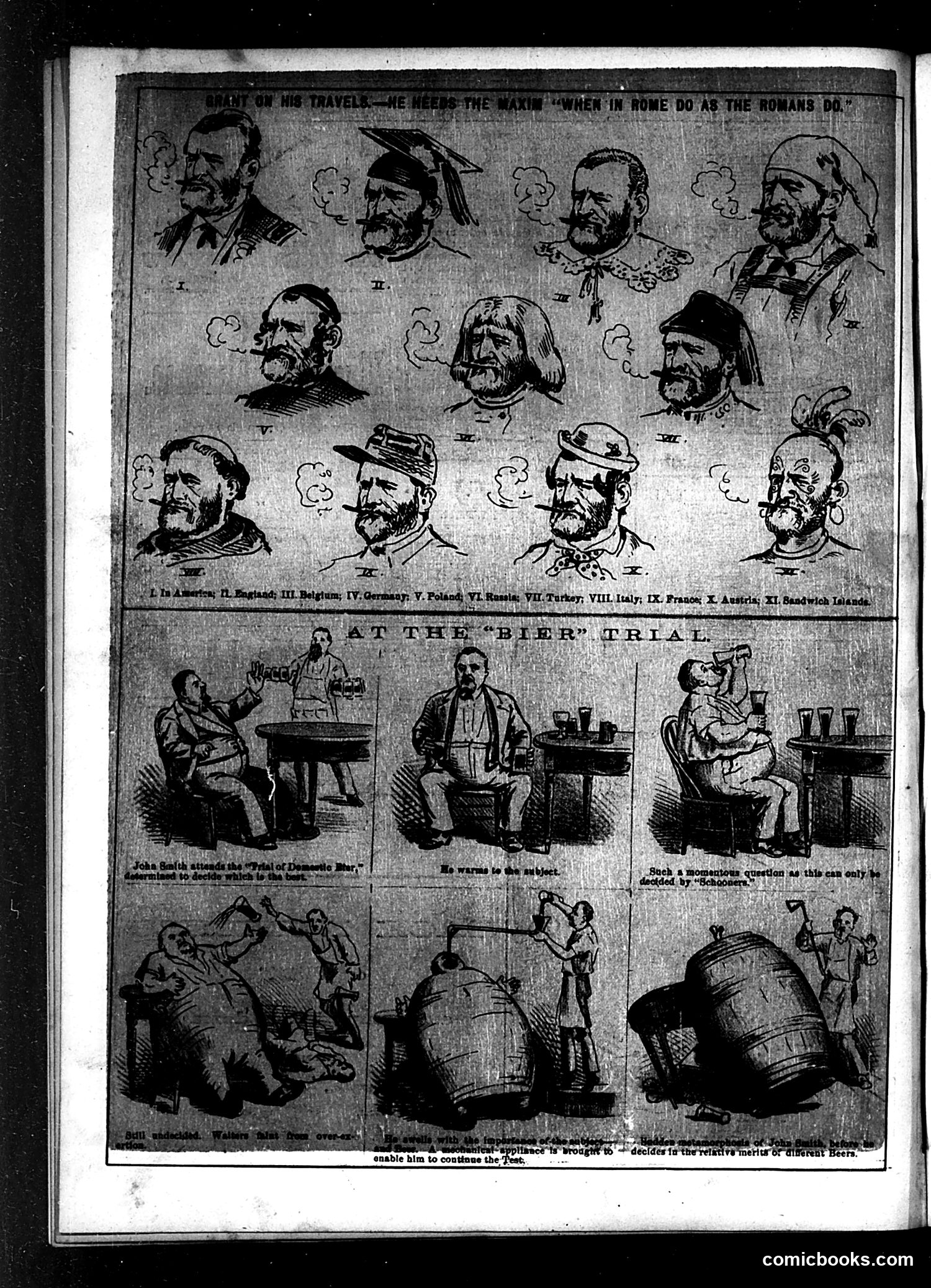
This Puck cartoon satirizes an international "beer trial" — apparently a humorous competition or debate about which nation produces the best beer. The **top section** displays caricatured heads of representatives from different nations (labeled I through XI, including America, England, Belgium, Germany, Poland, Russia, Turkey, Italy, France, Austria, and Sandwich Islands). The **bottom section** depicts the "trial" itself: men tasting and evaluating different beers from large barrels, with exaggerated reactions of approval or disgust. The satire mocks both national pride in beer-making traditions and the pretense of scientifically judging beverages — suggesting that beer preference is inherently subjective and that nations take their brewing heritage absurdly seriously. The cartoon pokes fun at European nationalism and alcohol culture through physical comedy and ethnic caricature.