
Puck, 1877-07-18 · page 13 of 16
Puck — July 18, 1877 — page 13: what you’re looking at
What you’re looking at
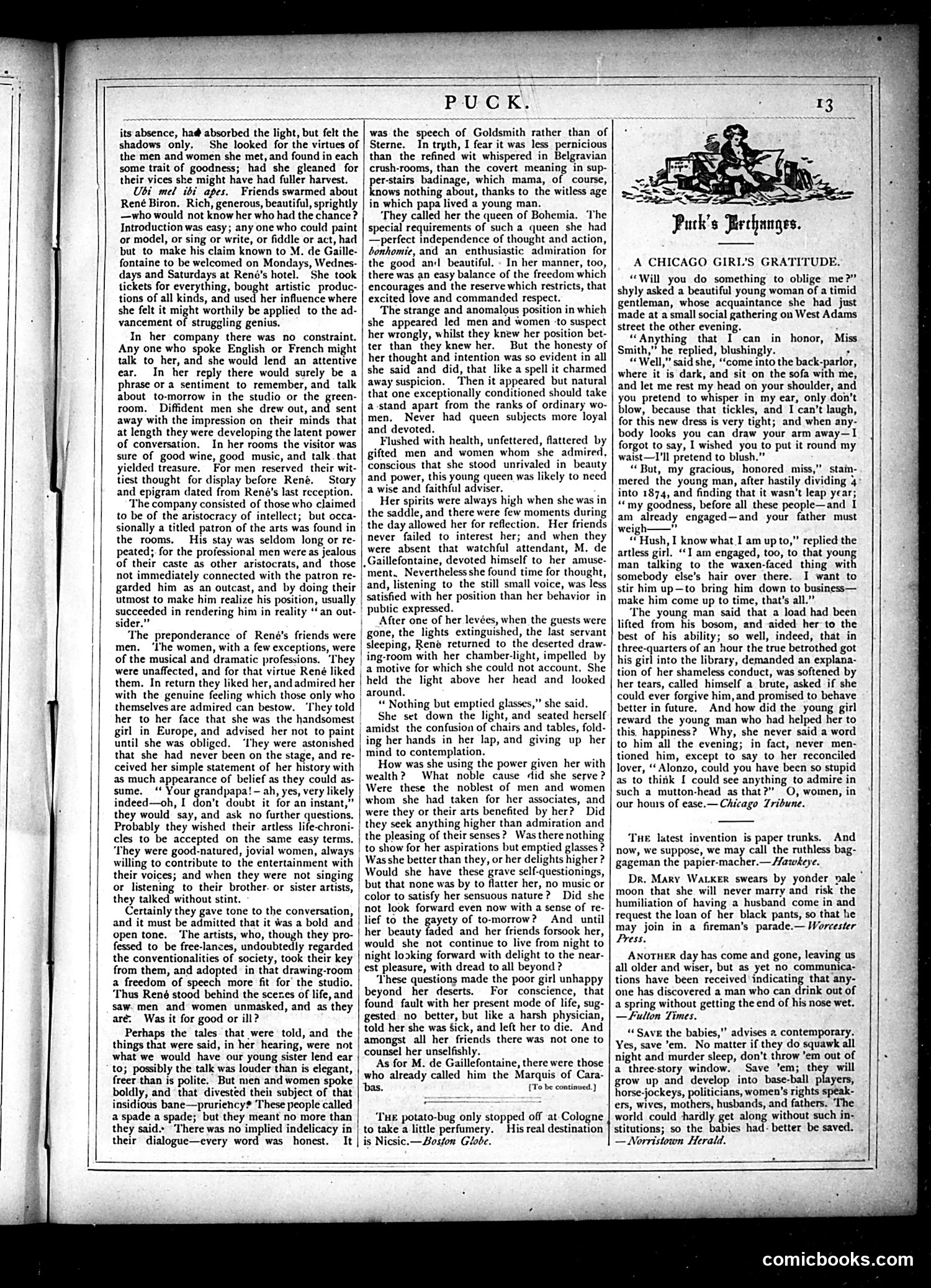
This page contains primarily **text articles** rather than political cartoons. The visible content includes: 1. **"Puck's Arraignments"** - A satirical column with short humor pieces, including "A Chicago Girl's Gratitude" mocking a wealthy woman who condescends to a working-class person at a gathering. 2. Several brief satirical news items and social commentary, including references to **Dr. Mary Walker** (a historical figure known for wearing men's clothing and advocating for women's rights), critiquing both her choices and society's judgment. The humor targets **class pretension, gender conventions, and social hypocrisy** typical of Puck's satirical approach. The magazine uses wit rather than visual caricature on this particular page to mock contemporary social attitudes and behaviors.
📄 Transcribed text from this page (OCR, searchable)
Machine-transcribed from the original scan — historical spelling and the odd misread are preserved.
its absence, ha@ absorbed the light, but felt the shadows only, She looked for the virtues of the men and women she met, and found in each some trait of goodness; had she gleaned for their vices she might have had fuller harvest. Ubi mel ibi apes. Friends swarmed about René Biron. Rich, generous, beautiful, sprightly —who would not know her who had the chance? Introduction was easy; any one who could paint or model, or sing or write, or fiddle or act, had but to make his claim known to M. de Gaille- fontaine to be welcomed on Mondays, Wednes- days and Saturdays at René's hotel. She took tickets for everything, bought artistic produc- tions of all kinds, and used her influence where she felt it might worthily be applied to the ad- vancement of struggling genius. In her company there was no constraint. Any one who spoke English or French might talk to her, and she would lend an attentive ear. In her reply there would surely be a phrase or a sentiment to remember, and talk about to-morrow in the studio or the green- room. Diffident men she drew out, and sent away with the impression on their minds that at length they were developing the latent power of conversation. In her rooms the visitor was sure of good wine, good music, and talk. that yielded treasure. For men reserved their wit- tiest thought for display before René. Story and epigram dated from René’s last reception. ‘The company consisted of those who claimed to be of the aristocracy of intellect; but occa- sionally a titled patron of the arts was found in the rooms. His stay was seldom long or re- peated;. for the professional men were as jealous of their caste as other aristocrats, and those not immediately connected with the patron re- garded him as an outcast, and by doing their utmost to make him realize his position, usually succeeded in rendering him in reality ‘‘an out- sider.” The preponderance of René’s friends were men. ‘I'he women, with a few exceptions, were of the musical and dramatic professions. ‘They were unaffected, and for that virtue René liked them. In return they liked her, and admired her with the genuine feeling which those only who themselves are admired can bestow. her to her face that she was the handsomest girl in Europe, and advised her not to paint until she was obliged. ‘They were astonished that she had never been on the stage, and re- ceived her simple statement of her history with as much appearance of belief as they could as- | sume. “ Your grandpapa! - ah, yes, very likely indeed—oh, I don’t doubt it for an instant,” they would say, and ask no further questions. Probably they wished their artless life-chroni- cles to be accepted on the same easy terms, ‘They were good-natured, jovial women, always | willing to contribute to the entertainment with their voices; and when they were not singing or listening to their brother. or sister artists, they talked without stint. Certainly they gave tone to the conversation, and it must be admitted that it was a bold and open tone. ‘The artists, who, though they pro- fessed to be free-lances, undoubtedly regarded the conventionalities of society, took their key from them, and adopted in that drawing-room a freedom of speech more fit for’ the studio. ‘Thus René stood behind the sceres of life, and saw. men and women unmasked, and as they aré. Was it for good or ill? Perhaps the tales that were told, and the things that were said, in her hearing, were not what we would have our young sister lend ear to; possibly the talk was louder than is elegant, freer than is polite. But men and women spoke boldly, and that divested their subject of that insidious bane—pruriency® These people called a spade a spade; but they meant no more than they said. ‘There was no implied indelicacy in their dialogue—every word was honest. It ‘They told | was the speech of Goldsmith rather than of Sterne. In tryth, I fear it was less pernicious than the refined wit whispered in Belgravian crush-rooms, than the covert meaning in sup- perstair badinage, which mama, of course, snows nothing about, thanks to the witless age in which papa lived a young man. ‘They called her the queen of Bohemia. ‘The special requirements of such a queen she had —perfect independence of thought and action, bonhomie, and an enthusiastic admiration for the good an beautiful. - In her manner, too, there was an easy balance of the freedom which encourages and the reserve which restricts, that excited love and commanded respect. The strange and anomalous position in whieh she appeared led men and women -to suspect her wrongly, whilst they knew her position bet- ter than they knew her. But the honesty of her thought and intention was so evident in all she said and did, that like a spell it charmed away suspicion. Then it appeared but natural that one exceptionally conditioned should take a-stand apart from the ranks of ordinary wo- men, Never had queen subjects more loyal and devoted. Flushed with health, unfettered, flattered by gifted men and women whom she admired, conscious that she stood unrivaled in beauty and power, this young queen was likely to need | a wise and faithful adviser. Her spirits were always high when she was in | the saddle, and there were few moments during | the day allowed her for reflection. Her friends never failed to interest her; and when they were absent that watchful attendant, M. de .Gaillefontaine, devoted himself to her amuse- ment. Nevertheless she found time for thought, and, listening to the still small voice, was less satisfied with her position than her behavior in | public expressed. | After one of her levées, when the guests were gone, the lights extinguished, the last servant | sleeping, René returned to the deserted draw- | ing-room with her chamber-light, impelled by a motive for which she could not account. She | held the light above her head and looked | around. “ Nothing but emptied glasses,” she said. She set down the light, and seated herself amidst the confusion of chairs and tables, fold- ing her hands in her lap, and giving up her mind to contemplation. How was she using the power given her with wealth? What noble cause did she serve ? Were these the noblest of men and women whom she had taken for her associates, and were they or their arts benefited by her? Did they seek anything higher than admiration and the pleasing of their senses? Was there nothing to show for her aspirations but emptied glasses ? Was she better than they, or her delights higher ? Would she have these grave self-questionings, but that none was by to flatter her, no music or color to satisfy her sensuous nature? Did she not look forward even now with a sense of re- lief to the gayety of to-morrow? And _ until her beauty faded and her friends forsook her, would she not continue to live from night to night looking forward with delight to the near- est pleasure, with dread to all beyond ? ‘These questions made the poor girl unhappy beyond her deserts. For conscience, that found fault with her present mode of life, sug- gested no better, but like a harsh physician, told her she was Sick, and left her to die. And | amongst all her friends there was not one to | counsel her unselfishly. As for M. de Gaillefontaine, there were those who already called him the Marquis of Cara- Das. {To be continued.) ‘Tue potato-bug only stopped off at Cologne to take a little perfumery. His real destination is Nicsic.—Boston Globe. A CHICAGO GIRL'S GRATITUDE. “Will you do something to oblige me?” shyly asked a beautiful young woman of a timid gentleman, whose acquaintance she had just made at a small social gathering on West Adams street the other evening. “Anything that I can in honor, Smith,” he replied, blushingly. 5 “Well,” said she, “come into the back-parlor, where it is dark, and sit on the sofa with me, and let me rest my head on your shoulder, and you pretend to whisper in my ear, only don’t blow, because that tickles, and I can’t laugh, for this new dress is very tight; and when any- body looks you can draw your arm away—I forgot to say, I wished you to put it round my waist—I'll pretend to blush.” “But, my gracious, honored miss,” stain- mered the young man, after hastily dividing 4° into 1874, and finding that it wasn’t leap year; “my goodness, before all these people—and I am already engaged—and your father must weigh" “Hush, I know what.I am up to,” replied the artless girl. “(I am engaged, too, to that young man talking to the waxen-faced thing wit somebody else’s hair over there. I want to stir him up—to bring him down to business— make him come up to time, that’s all.” ‘The young man said that a load had been lifted from his bosom, and aided her to the best of his ability; so well, indeed, that in three-quarters of an hour the true betrothed got his girl into the library, demanded an explana- tion of her shameless conduct, was softened by her tears, called himself a brute, asked if she could ever forgive him, and promised to behave better in future. And how did the young girl reward the young man who had helped her to this, happiness? Why, she never said a word to him all the evening; in fact, never men- tioned him, except to say to her reconciled lover, Alonzo, could you have been so stupid as to think [ could see anything to admire in such a mutton-head as that?” O, women, in our hours of ease.— Chicago Tribune. Miss ‘Tue latest invention is paper trunks. And now, we suppose, we may call the ruthless bag- gageman the papier-macher.— Hawkeye. Dr. Mary WaLker swears by yonder vale moon that she will never marry and risk the humiliation of having a husband come in and request the loan of her black pants, so that he may join in a fireman's parade.— Worcester Press. Anorner day has come and gone, leaving us all older and wiser, but as yet no communica- tions have been received indicating that any- one has discovered a man who can drink out of a spring without getting the end of his nose wet, —Fulton Times. “Save the babies,” advises 2 contemporary. Yes, save ‘em. No matter if they do squawk all night and murder sleep, don’t throw ’em out of a three-story window. Save ’em; (ner will grow up and develop into base-ball players, horse-jockeys, politicians, women’s rights speak- ers, wives, mothers, husbands, and fathers. ‘The world could hardly get along without such in- stitutions; so the babies had- better be saved. —Norristown Herald. comicbooks.com