
Puck, 1877-07-18 · page 7 of 16
Puck — July 18, 1877 — page 7: what you’re looking at
What you’re looking at
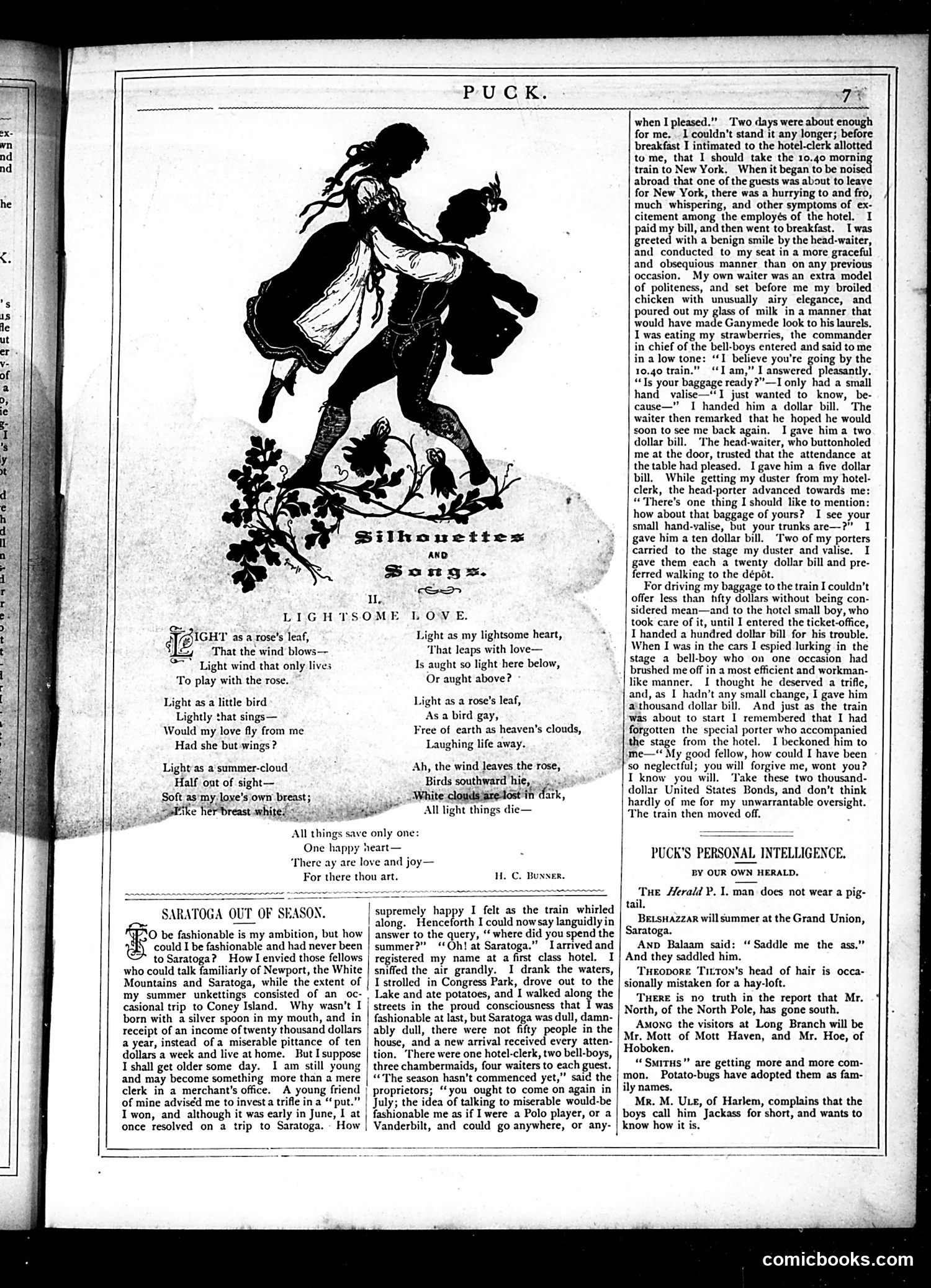
This page contains literary and travel content rather than political satire. The main illustration titled "Silhouettes and Songs" depicts a romantic couple in silhouette—a man carrying a woman—accompanying a poem titled "Lightsome Love" by H.C. Bunner. The poem uses nature metaphors (rose, bird, cloud) to explore romantic themes. Below that, an article titled "Saratoga Out of Season" describes the author's visit to Saratoga Springs, New York, discussing its fashionable reputation and current empty state. The piece includes anecdotes about hotels and social observations. A sidebar section "Puck's Personal Intelligence" provides gossip-style commentary on notable figures in Harlem and other locations, including references to horse racing and society events. The page appears focused on entertainment, literature, and social commentary rather than direct political satire.
📄 Transcribed text from this page (OCR, searchable)
Machine-transcribed from the original scan — historical spelling and the odd misread are preserved.
Sithouerttes ANO Sa wg =. Cm Il. LIGHTSOME LOVE, Light as my lightsome heart, ‘That leaps with love— Is aught so light here below, Or aught above? qeicur as a rose's leaf, Ig ‘That the wind blows— ©" Light wind that only lives To play with the rose. Light as a rose’s leaf, Asa bird gay, Free of earth as heaven's clouds, Laughing life away. Light as a little bird Lightly that sings— Would my love fly from me Had she but wings ? Ah, the wind leaves the rose, Birds southward hie,» ... _ White cloudsjareslost in dark, All light things die— Light-as a’summer-cloud Half ont of sight— Soft as'my, loye’s own breast ; apabike her breast whites. All things save only one: One happy heart— ‘There ay are love and joy— For there thou art. H.C. Buxver. SARATOGA OUT OF SEASON 'O be fashionable is my ambition, but how | | supremely happy I felt as the train whirled along. Venceforth I could now say languidly in answer to the query, ‘“ where did you spend the could I be fashionable and had never been | summer?” ‘Oh! at Saratoga.” arrived and to Saratoga? How I envied those fellows | registered my name at a first class hotel. I who could talk familiarly of Newport, the White | sniffed the air grandly. I drank the waters, Mountains and Saratoga, while the extent of | I strolled in Congress Park, drove out to the my summer unkettings consisted of an oc- | Lake and ate potatoes, and I walked along the casional trip to Coney Island. Why wasn’t I | streets in the proud consciousness that I was | born with a silver spoon in my mouth, and in | fashionable at last, but Saratoga was dull, damn- receipt of an income of twenty thousand dollars | ably dull, there were not fifty people in the a year, instead ofa miserable pittance of ten | house, and a new arrival received every atten- dollars a week and live athome. But I suppose | tion. ‘There were one hotel-clerk, two bell-boys, I shall get older some day. I am still young | three chambermaids, four waiters to each guest. and may become something more than a mere | “The season hasn't commenced yet,” said the clerk in a merchant's office. A young friend | proprietors; ‘you ought to come on again in of mine advised me to invest a trifle in a “put.” | July; the idea of talking to miserable would-be Iwon, and although it was early in June, I at | fashionable me as if I were a Polo player, or a once resolved on a trip to Saratoga. - How | Vanderbilt, and could go anywhere, or any- when I pleased.” Two days were about enough for me. . 1 couldn't stand it any longer; before breakfast I intimated to the hotel-clerk allotted to me, that I should take the 10.40 morning train to New York. When it began to be noise abroad that one of the guests was about to leave for New York, there was a hurrying to and fro, much whispering, and other symptoms of ex- citement among the employés of the hotel. I paid my bill, and then went to breakfast. Lwas greeted with a benign smile by the head-waiter, and conducted to my seat in a more graceful and obsequious manner than on any previous occasion, My own waiter was an extra model of politeness, and set before me my broiled chicken with unusually airy elegance, and poured out my glass of milk in a manner that would have made Ganymede look to his laurels, I was eating my strawberries, the commander in chief of the bell-boys entered and said to me in a low tone: ‘I believe you're going by the 1o.4o train.” “Iam,” 1 answered pleasantly. “Is your baggage ready?”—I only had a small hand valise—‘I just wanted to know, be- cause—" I handed him a dollar bill. The waiter then remarked that he hoped he would soon to see me back again. I gave hima two dollar bill. ‘The head-waiter, who buttonholed me at the door, trusted that the attendance at the table had pleased. I gave him a five dollar bill. While getting my duster from my hotel- clerk, the head-porter advanced towards me: “There's one thing I should like to mention: how about that baggage of yours? I see your small hand-valise, but your trunks are—?” I gave him a ten dollar bill. Two of my porters carried to the stage my duster and valise. I gave them each a twenty dollar bill and pre- ferred walking to the dépot. For driving my baggage to the train I couldn’t offer less than hfty dollars without being con- sidered mean—and to the hotel small boy, who took care of it, until I entered the ticket-office, I handed a hundred dollar bill for his trouble. When I was in the cars I espied lurking in the stage a bell-boy who on one occasion had brushed me off in a most efficient and workman- like manner. I thought he deserved a trifle, and, as I hadn’t any small change, I gave him aithousand dollar bill. And just as the train was about to start I remembered that I had forgotten the special porter who accompanied the stage from the hotel. I beckoned him to me— My good fellow, how could I have been so neglectful; you will forgive me, wont you? I know you will. ‘Take these two thousand- dollar United States Bonds, and don’t think hardly of me for my unwarrantable oversight. The train then moved off. PUCK’S PERSONAL INTELLIGENCE. BY OUR OWN HERALD. Tue Herald P. 1. man does not wear a pig- tail. BeEtsuazzar will summer at the Grand Union, Saratoga. Anp Balaam said: “Saddle me the ass.” And they saddled him. THeopore Titton’s head of hair is occa- sionally mistaken for a hay-loft. Tuere is no truth in the report that Mr. North, of the North Pole, has gone south. Amonc the visitors at Long Branch will be Mr. Mott of Mott Haven, and Mr. Hoe, of Hoboken. “Smits” are getting more and more com- mon. Potato-bugs have adopted them as fam- ily names. Mr. M. Ute, of Harlem, complains that the boys call him Jackass for short, and wants to know how it is. comicbooks.com